
Namaste 🙏
Welcome to Hi Sanatani. It’s a joy to have you here as we explore the deeper layers of human nature. By diving into this Bhagavad Gita Summary 1.06, we create a sacred bridge together, turning ancient verses into helpful tools for your personal growth and peace.
Translation of Bhagavad Gita chapter 1 verse 6 in English:
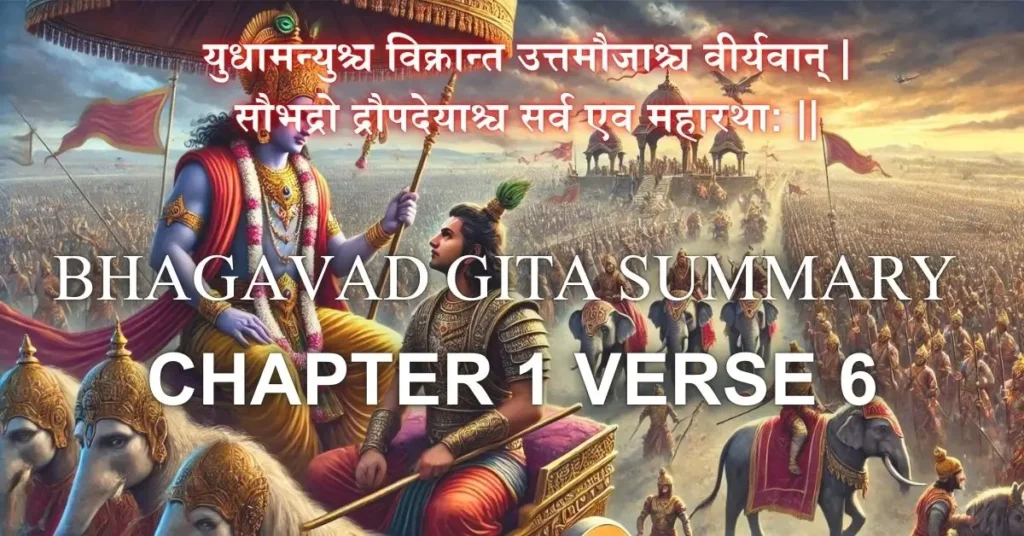
युधामन्युश्च विक्रान्त उत्तमौजाश्च वीर्यवान् |
सौभद्रो द्रौपदेयाश्च सर्व एव महारथा: ||
In English :
yudhāmanyuś ca vikrānta uttamaujāś ca vīryavān
saubhadro draupadeyāś ca sarva eva mahā-rathāḥ
Full Line-by-Line Phonetic Breakdown of Bhagavad Gita Chapter 1 Verse 6:
- Yudhāmanyuś ca vikrānta uttamaujāś ca vīryavān
- Yu-dhaa-ma-nyush cha vi-kraan-ta ut-ta-mau-jaash cha veer-ya-vaan
- Saubhadro Draupadeyāś ca sarva eva mahārathāḥ
- Sau-bha-dro Drau-pa-de-yaash cha sar-va e-va ma-haa-ra-thaah
“Standing tall with unwavering courage, fearless Yudhamanyu and valiant Uttamaujas exude pride, joined by the heroic Abhimanyu—Subhadra’s brave son—and the formidable sons of Draupadi, all distinguished as elite warriors in battle.”
JOIN THE HISANATANI COMMUNITY
Get daily Verse Summaries & High-Res Posters directly on your WhatsApp.
JOIN CHANNELIntroduction : Insights into the Divine Dialogue
In Bhagavad Gita Summary 1.6, we can see it serves as a continuation of the systematic citation of warriors present on the battlefield at Kurukshetra. This section provides an account of those who are aligned with the Kaurava, presenting their strength and capability in preparation for the great war. While it seems like a straightforward enumeration, it carries deeper layers of meaning tied to the themes of duty, morality, and the chaos of conflict.
The Bhagavad Gita, in its entirety, is not merely about war but a metaphor for the internal and external struggles every individual faces. Chapter 1.6 creates the stage for these profound discussions, revealing the scope of the challenges ahead for Arjuna as he struggles with his emotions, values, and duty.
Establishing the Scene: Context and Background
The Bhagavad Gita begins on a battlefield, but its true conflict is internal. It captures a raw, human dialogue between Prince Arjuna and his guide, Lord Krishna, at a moment of total crisis. While the broader scripture explores duty ($dharma$) and the soul ($atman$), Chapter 1—Arjuna Vishada Yoga—specifically focuses on Arjuna’s emotional collapse as he weighs the heavy human cost of war.
This ancient struggle mirrors our own modern dilemmas. We often find ourselves torn between professional responsibilities and personal values. Bhagavad Gita Chapter 1 verse 6 serves as a reflection of this universal tension: the weight of decision-making and the emotional fallout that occurs when our cold duty clashes with our deepest sentiments.
When Duty Meets Emotion: A Deep Dive into Bhagavad Gita Chapter 1 verse 6
Chapter 1 of the Bhagavad Gita sets the stage for the epic confrontation by chronicling Arjuna’s doubts and distress. Often titled The Yoga of Arjuna’s Dejection, this initial chapter frames a personal crisis that is as significant as the physical preparations for battle. On the surface, the chapter narrates a moment when the mighty warrior, revered for his prowess, finds himself paralyzed by empathy and ethical dilemma. His spirit trembles as he faces the realities of kinship and the impending destruction of war because he believes that the loss is irreversible.
Especially within the crucial segment identified as Chapter 1.6, Arjuna articulates his inner disarray—a reckoning of his emotions in the face of overwhelming duty versus familial love and loyalty. This moment is the fulcrum of his transformation, a point where the force of ancient duty (dharma) meets his human apprehensions. Here, the emotional narrative of the Gita crystallizes into a question familiar to every seeker: At what cost does one uphold duty?
Summary of the Bhagavata Gita Chapter 1 Verse 6
After establishing a clear translation and contextual background, we now dig into a detailed exploration of Duryodhana’s mindset on the battlefield of Kurukshetra.
Join us as we navigate through the psychological, philosophical, historical, and spiritual dimensions of this legendary figure’s mindset, and discover how his internal battles offer a window into the universal struggle for self-assurance and moral integrity.

Courage and Duty in a Single Verse: What It Truly Means?
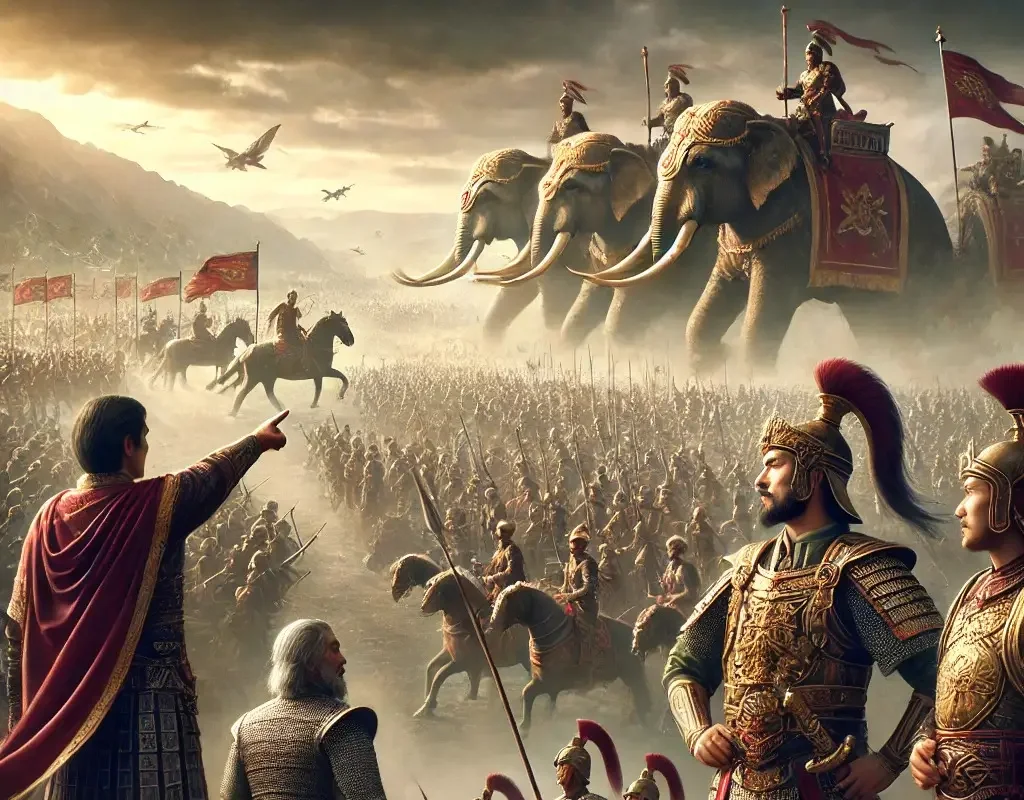
This sloka from Chapter one verse six of Bhagavad Gita describes the valiant warriors fighting on the Pandava side in the Kurukshetra war. Their portrayal serves not just as a list but reflects deeper qualities of courage and moral duty. Here’s a breakdown:
- The Symbolism in the Enumerated Warriors
The warriors mentioned in Chapter 1.6, such as Yudhamanyu, Uttamaujas, Abhimanyu, and the sons of Draupadi, represent more than just physical combatants. Each individual carries symbolic meaning:
- Yudhamanyu and Uttamaujas: Represent unwavering loyalty and fearlessness in the face of challenges.
- Abhimanyu: Symbolizes youthful courage and determination.
- Sons of Draupadi: Stand for justice and the collective effort to uphold righteousness.
This enumeration serves as a reflection of the qualities needed to face life’s adversities. It reminds readers that strength isn’t solely physical—it is also moral and spiritual.
- Symbolic Representation: These names embody readiness to fight for righteousness (dharma) despite overwhelming challenges.
- Context in the Epic: This enumeration sets the stage for the monumental conflict, emphasizing the values of sacrifice, duty, and bravery.

Inside Duryodhana’s Mind: The Struggle Beneath the Surface
This verse reveals Duryodhana’s internal struggle. On the surface, he’s boasting about his army, but his detailed listing of warriors suggests:
Duryodhana’s psychological state is crucial to understanding this chapter. His emotions and mental conflicts provide an essential environment to the battlefield:
- Fear and Insecurity: Despite outward confidence, Duryodhana is inwardly tormented by the strength and loyalty of the Pandava warriors.
- Arrogance as a Defense Mechanism: He masks his internal conflict through pride and an inflated sense of superiority.
- Lesson in Human Nature: Duryodhana’s inability to reconcile with his emotions serves as a reminder of how our unchecked ego and insecurities can lead us to poor decision-making.
- Need for Validation – Instead of trusting his army’s strength, he feels the need to prove it to his teacher and himself.
- Fear of Defeat – He recognizes that despite his army’s size, the Pandavas have Krishna on their side, and that unsettles him.
Psychologically, this verse teaches us that when people feel insecure, they often overcompensate by talking too much about their strengths. Real confidence comes from inner peace, not just from external power.

Philosophical Insights: Reflecting on the True Nature of Strength
This verse is not just about war; it’s a reflection of life itself.
- Just like Duryodhana, we often look outside for strength, listing our achievements, wealth, or connections to feel secure.
- However, true strength doesn’t come from numbers—it comes from self-awareness, wisdom, and righteousness.
- Duryodhana, despite having a massive army, lacks dharma (righteousness), and deep inside, he knows this. His battle is not just against the Pandavas but also against his own conscience.
This verse reminds us that our real power in life comes from our inner values, not just our external successes.
From Scrolls to Battlefields: The History Behind Bhagavad Gita Chapter 1 verse 6
Beyond the immediate theatrics of battle, this narrative offers profound philosophical lessons:
- Strength Beyond Numbers: Much like Duryodhana’s attempt to compensate for his inner doubts by listing warriors, We, sometime also feel pressurized to showcase our achievements, wealth, or social connections and just only for the suppression of our inner fear about own skills and capability. True strength, however, derives not from external numbers but from inner wisdom, self-awareness, and integrity.
- Duty Versus Personal Conscience: Duryodhana is caught in the delicate balance of adhering to the path of dharma (duty) while wrestling with his own ethical dilemmas. His internal conflict mirrors the universal dilemma of choosing between personal values and societal expectations.
- Internal Battles as Catalysts for Growth: The internal struggle experienced by Duryodhana is not simply a sign of weakness. Instead, it offers us an opportunity for introspection and growth—a recurring theme in the Bhagavad Gita where internal harmony is essential to triumph over our external challenges.
Through this lens, the episode encourages us to reexamine our own lives. It suggests that realizing true strength involves trusting our inner voice and nurturing self-awareness, rather than relying solely on external validation.

Spiritual Perspective: The Eternal Message of Inner Wisdom
At its core, the Bhagavad Gita rise above the immediate narratives of war, offering timeless spiritual guidance:
- Life as an Internal Battlefield: Just as Duryodhana’s external display battles his inner insecurities, every individual struggle with internal conflicts. Our thoughts, emotions, and fleeting ego battles often dictate how we perceive our life’s journey.
- The Illusion of External Validation: Duryodhana’s reliance on the sheer number of warriors is analogous to how many seek validation through material achievements or social status. In reality, genuine power stems from cultivating inner peace, dharma, and self-awareness.
- Aligning with Dharma: The deeper lesson here is that without a dependable anchor in righteousness and inner clarity, external success is fleeting. Embracing dharma—the pursuit of a life guided by ethical conduct and profound spiritual insight, just like The Essence of Bhagavad Gita—ensures that our external endeavors are balanced by a solid foundation of internal strength.
This spiritual takeaway resonates deeply even today. It reminds us that regardless of the battles we face, approaching them with inner calm, wisdom, and an unwavering commitment to right action is the true path to victory.
Modern Day Relevance
Though written thousands of years ago, the teachings of Bhagavad Gita Chapter 1.6 remain profoundly relevant in today’s world. Here’s how:
Facing Life’s Challenges: Just as the Pandavas prepared themselves for a difficult battle, modern individuals can draw inspiration to face challenges head-on, relying on their inner strength and support systems.
Ethical Decision-Making: The warriors’ unwavering commitment to righteousness teaches us the importance of ethical integrity, even when the stakes are high.
Leadership and Teamwork: The unity displayed by these warriors is a lesson in collaboration and leadership, emphasizing the need for shared purpose in achieving success in modern organizations or personal endeavors.
Conclusion: Embracing Inner Strength in the Face of External Challenges
Duryodhana’s moments on the battlefield offer a multifaceted lesson. On one level, his presentation of great warriors is an attempt to influence both himself and his mentor of the might of his army. Yet, inevitably, it also exposes the inherent insecurity and fear that no amount of external advantage can fully allay.
This narrative from the Mahabharata challenges us to examine our own lives, questioning whether our strength lies solely in outward accomplishments or in the cultivation of inner virtues. The timeless teachings of the Bhagavad Gita urge us to seek balance—trusting not just in our external competencies but equally in our inner resolve and dharma.
By looking beyond, the surface and embracing the lessons of self-awareness, righteousness, and spiritual fortitude, we can learn that true power in life comes from within. Let Duryodhana’s struggle be a reminder: While external achievements can impress the world, only inner peace and integrity can guarantee lasting strength in the most challenging battles.
Are you inspired by the timeless lessons of Bhagavad Gita Chapter 1.6? Explore deeper insights into the Bhagavad Gita by visiting our Bhagavad Gita blog series & Stories. Share your thoughts and reflections, and let’s keep this divine dialogue alive in our lives!
FAQs:
What is the spiritual essence of Chapter 1.6?
Chapter 1.6 highlights the qualities of courage, loyalty, and wisdom while advocating for detachment from emotional distractions in fulfilling one’s duties.
How can the teachings of Chapter 1.6 impact daily life?
By embodying the principles of dharma and detachment, individuals can approach challenges with clarity, resilience, and a sense of purpose.
What makes Chapter 1.6 unique in the Bhagavad Gita?
While it appears to be a simple enumeration, Chapter 1.6 introduces the symbolic warriors, setting the stage for deeper philosophical discussions throughout the Gita.
