
Namaste 🙏
Welcome to Hi Sanatani. It’s a joy to have you here as we explore the deeper layers of human nature. By diving into this Bhagavad Gita Summary 1.08, we create a sacred bridge together, turning ancient verses into helpful tools for your personal growth and peace.
Translation of Bhagavad Gita Shloka Verse 1.7 in English:
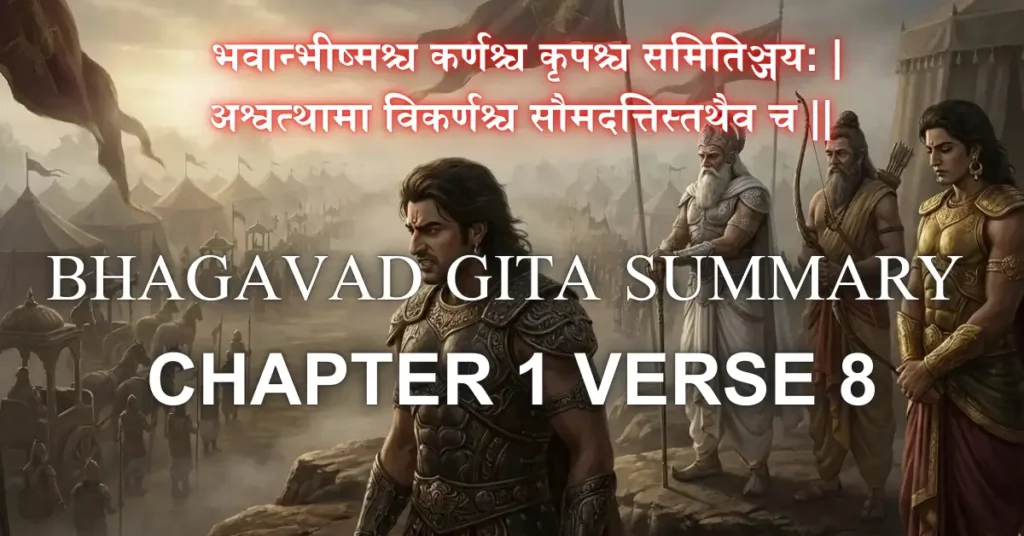
भवान्भीष्मश्च कर्णश्च कृपश्च समितिञ्जय: ।
अश्वत्थामा विकर्णश्च सौमदत्तिस्तथैव च ।।
In English :
bhavān bhīṣmaś ca karṇaś ca kṛpaś ca samitiñjayaḥ
aśvatthāmā vikarṇaś ca saumadattis tathaiva ca
Feel the Vibration: A Guided Chant of Bhagavad Gita Chapter 1 Verse 8:
- bhavān bhīṣmaś ca karṇaś ca kṛpaś ca samitiñjayaḥ
Bha-vaan Bheesh-mash cha Kar-nash cha Kri-pash cha Sa-mi-tin-ja-yah - aśvatthāmā vikarṇaś ca saumadattis tathaiva ca
Ash-vat-thaa-maa Vi-kar-nash cha Sau-ma-dat-tis Ta-thai-va cha
English Translation:
“You (Drona), Bhishma, Karna, Kripa, the victorious Ashwatthama, Vikarna, and the son of Somadatta (Bhurishrava) are all great warriors.”
JOIN THE HISANATANI COMMUNITY
Get daily Verse Summaries & High-Res Posters directly on your WhatsApp.
JOIN CHANNELLaying the Foundation: Understanding the Context
Chapter 1, titled Arjuna Vishada Yoga (The Yoga of Arjuna’s Dejection), sets the stage for the intense dialogue between Lord Krishna and Arjuna. As warriors prepare for battle, emotions run high. Arjuna is overcome with compassion and confusion. Meanwhile, Duryodhana, the Kaurava prince, seeks to fortify his camp’s morale by reminding Dronacharya of the powerhouses on their side.
The battlefield of Kurukshetra is fully prepared. Armies stand face to face. Conches have been blown. The moment of action is near.
Yet before weapons speak, words reveal minds.
Duryodhana has already acknowledged the strength of the Pandavas in previous verses. Now, in Bhagavad Gita 1.8, he turns inward—toward his own camp—almost counting his assets aloud. This is not inspiration. This is reassurance.
Bhagavad Gita summary 1.8: Power, Persuasion, and Insecurity
As Bhagavad Gita summary 1.8 unfolds, something interesting happens beneath the surface. The verse is not adding new information—it is repeating reassurance. And repetition, in psychology, is rarely about strength. It is about uncertainty.
Zoom out from the battlefield, and this verse begins to resemble our world:
Let’s Unveiled the key insights
Unveiling the Verse: A Clear and Simple Breakdown of 1.8
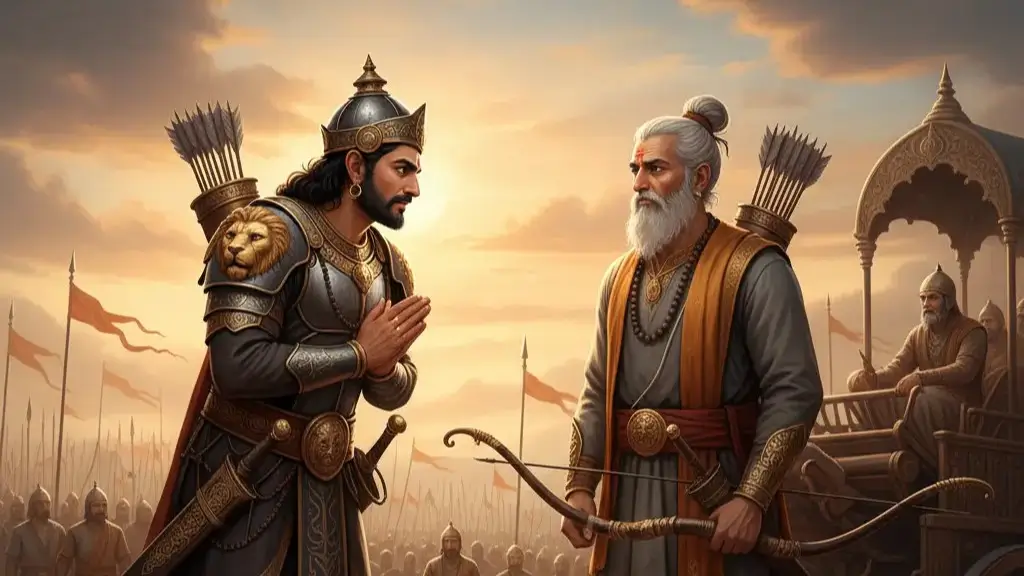
Duryodhana continues his speech by naming warriors he believes will bring victory to the Kaurava side. His intent isn’t just to praise them—it’s a subtle attempt to provoke loyalty and commitment. This verse reveals Duryodhana’s strategic mind and his understanding of the battlefield dynamics.
In this verse, Duryodhana names the greatest warriors fighting for the Kauravas:
- Bhishma – the legendary grandsire. The eldest warrior on the field, a man bound by his vow to serve the Kauravas. Respected by all.
- Karna – Duryodhana’s closest friend and one of the most skilled archers. Known for his loyalty and generosity, yet burdened by his complex identity.
- Kripacharya – wise and undefeated in battle. One of the few warriors who survived the Kurukshetra war. He was considered wise and powerful. He is also one of the Chiranjivi.
- Ashwatthama – fierce son of Dronacharya. Son of Dronacharya, known for his rage and later, for his controversial acts in the war’s aftermath.
- Vikarna – a Kaurava with a moral compass. Duryodhana’s brother, yet one of the few Kauravas who openly questioned the injustice against Draupadi.
- Bhurishravas (Saumadatti) – a formidable fighter. A powerful warrior from the Bahlika kingdom, committed to the Kaurava cause.
On the surface, Duryodhana is showcasing strength.
In truth, he is leaning on names instead of principles.
Philosophical Insight: Power vs Dharma

Bhagavad Gita 1.8 highlights the illusion that power guarantees victory. History—and the Mahabharata—prove otherwise.
The Pandavas is fewer | The Kauravas is many.
Yet the Gita quietly asks: Which side is truly strong?
True strength flows from dharma, not dominance.
The Silent Contrast: Krishna’s Absence Speaks Loudly
One striking detail in Chapter 1 is that Krishna has not spoken yet. While Duryodhana fills the air with words and names, Krishna remains silent. This contrast is intentional.
- Duryodhana represents noise born of insecurity
- Krishna represents silence rooted in certainty
Before wisdom speaks, ego exhausts itself. When we cling to roles, positions, or allies, fear arises. When we rest in awareness, fear dissolves.
Bhagavad Gita 1.8 belongs to that space—where ego is still trying to hold ground before surrender becomes inevitable.
Leadership Psychology Hidden in Bhagavad Gita 1.8
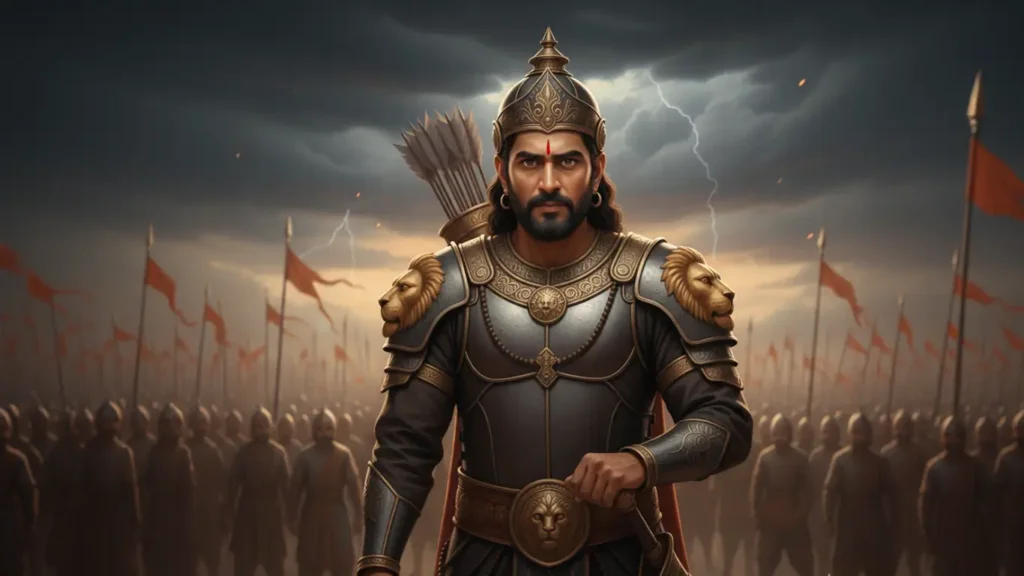
Duryodhana’s list isn’t just admiration—it’s a calculated psychological tactic. He knows that Dronacharya favors the Pandavas. By listing these warriors, he tries to reinforce his own position and stir pride and duty in his commander.
Respect Mixed with Dependency
Duryodhana begins with “Bhavān” (You yourself), addressing Dronacharya with reverence. But the respect is strategic. Duryodhana wants to awaken competitiveness and loyalty in his general.He subtly reminds his teacher of his own son, Ashwatthama, fighting on the Kaurava side.
Respect here is not humility—it is persuasion.
Ego and Overcompensation: The Duryodhana Pattern
Duryodhana’s behaviour reflects classic overcompensation:
- Listing strengths to hide fear
- Using respect to control others
- Trusting power while ignoring ethics
Modern psychology recognizes this pattern well—leaders driven by ego often fear losing control and therefore seek constant reassurance.
Strength Without Inner Conviction
Despite having legendary warriors, Duryodhana feels compelled to say it out loud. This reflects a universal psychological truth:
When confidence is real, it is silent.
When it is fragile, it speaks repeatedly.
Historical Perspective: Warfare in Ancient India
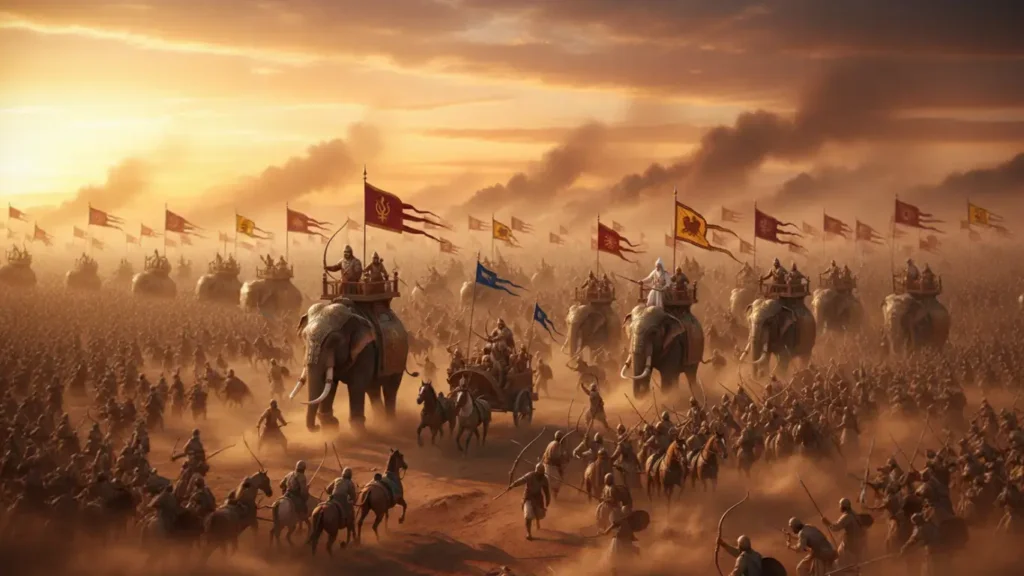
In ancient Indian warfare, leaders often announced their champions before battle. This served both strategic and psychological purposes. However, the Mahabharata shows us something deeper:
even the strongest armies fall when their cause is hollow. Each warrior carried a legacy, a kingdom, and a motivation. Duryodhana’s strength lay in numbers and status—but not necessarily in dharma.Despite Bhishma, Karna, and Drona, the Kauravas lose—because their foundation was adharma.
Spiritual Message of Bhagavad Gita Chapter 1 Verse 8
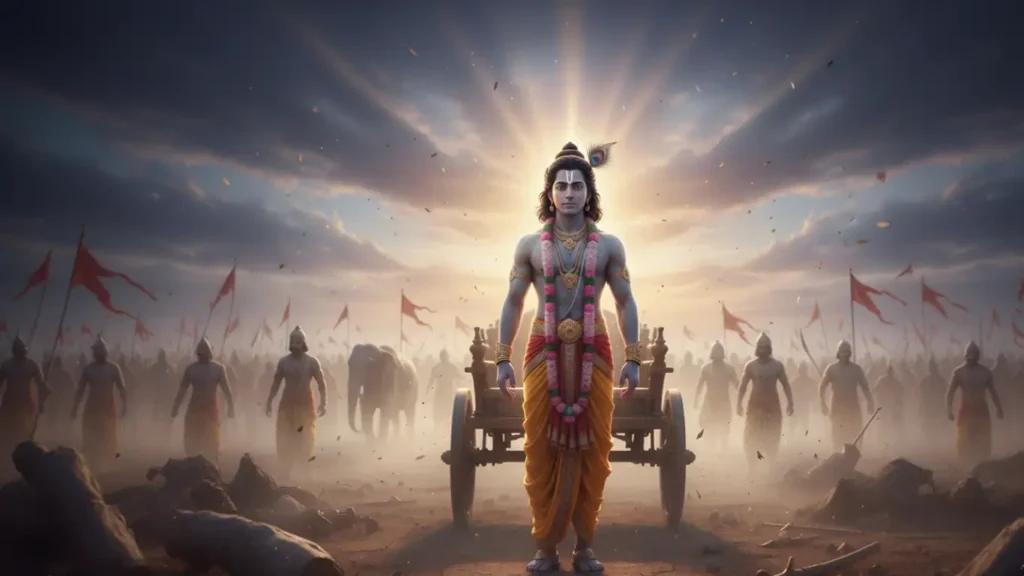
The spiritual core of this verse lies in its unspoken contrast between material power and moral righteousness. These warriors were mighty, but their alignment with adharma (unrighteousness) sealed their fate.
The Bhagavad Gita summary of Chapter 1.8 teaches us quietly but firmly:
- Strength without ethical grounding is ultimately self-destructive.
- External power cannot heal inner fear.
- Numbers cannot replace moral clarity.
- Victory does not belong to ego
Duryodhana stands surrounded by warriors, yet inwardly alone.
Stop asking, “Who is with me?”
Start asking, “What am I aligned with?”
Because people may stand with us today and leave tomorrow.
But dharma, once chosen, never abandons us.
Modern-Day Relevance of Bhagavad Gita Summary 1.8

Like Duryodhana, we often exaggerate achievements to mask our fears. True power lies in humility and inner balance.
We see Duryodhana everywhere today:
- Leaders who name-drop teams but lack vision
- Companies that boast size but lack values
- Individuals who collect validation instead of inner strength
Social media profiles, corporate meetings, even relationships—many mirror this verse. Loud confidence often hides quiet fear.
Deeper Contemplation: Reading Bhagavad Gita 1.8 as an Inner Dialogue
If we pause and sit with Bhagavad Gita summary 1.8, the verse slowly shifts from a historical narration to an inner conversation we all experience.
Duryodhana’s voice is not just his own—it is the voice that arises in us when we feel uncertain yet try to appear strong.
Have you noticed this moment within yourself?
- When you list achievements to feel secure
- When you remind others of your support system
- When you speak loudly to silence inner doubt
This verse gently exposes that pattern—without judgment, without drama. Imagine this scene inwardly:
A vast battlefield inside your mind. Thoughts stand like warriors—strong, loud, demanding attention. One by one, they announce themselves, asking for reassurance.
Yet somewhere, untouched by the noise, stands quiet awareness.
Bhagavad Gita 1.8 reminds us:
The one who needs to declare strength has not yet touched stillness.
When you feel the urge to prove, pause.
When you feel the need to list, breathe.
When you feel fear, return to values.
From Strategy to Surrender: The Journey Ahead
Chapter 1 is only the beginning.
Duryodhana speaks. Arjuna will soon break down.
And then : Krishna speaks.
Bhagavad Gita summary 1.8 plays a crucial role in this arc. It shows us the limits of strategy without wisdom. The Gita does not condemn preparation—but it reminds us that preparation without dharma leads to unrest.
Ask yourself:
- Are you chasing success at the cost of values?
- Do your decisions align with truth?
Let the Bhagavad Gita 1.8 inspire you to lead with integrity, to recognize the real battle is often within, and to choose the path of dharma, even when it’s hard.
Please let me know in the comment .
Embrace the Teachings of the Gita. Dive deeper into the Bhagavad Gita to uncover its timeless wisdom and practical guidance. Let its verses inspire you to cultivate inner clarity, align with higher values, and navigate life’s challenges with courage and grace.
Voice of the Soul
Finding clarity in the questions we all carry…
What is the main meaning of Bhagavad Gita 1.8?
It states that several powerful warriors—including Bhishma, Karna, Kripa, Ashwatthama, Vikarna, and Bhurishrava—stand with the Kauravas, revealing Duryodhana’s attempt to portray confidence while exposing his inner reliance on their strength.
Why does Duryodhana list these warriors in this verse?
He mentions the warriors to impress and reassure both himself and his teacher, Dronacharya, emphasizing the strength of the Kaurava army and trying to secure loyalty and morale.
What psychological insight does Bhagavad Gita 1.8 provide?
The verse shows how leaders may use boasting and external validation to mask inner uncertainty, highlighting ego-driven thinking rather than grounded confidence.
How is Bhagavad Gita 1.8 spiritually significant?
Spiritually, it contrasts material strength with deeper truth—suggesting that reliance on outer power without dharma (righteousness) is unstable, preparing the reader for Krishna’s upcoming teachings on inner wisdom.
What can modern readers learn from this verse?
It mirrors everyday life where people seek validation through status, achievements, or support, reminding us that true strength comes from inner clarity, purpose, and ethical grounding rather than external approval.
Does this verse criticize the warriors named in it?
No. The verse’s focus is not on the individuals’ worth—many are praised heroes—but on Duryodhana’s mindset in naming them, showing his dependency on external might rather than righteous conviction.
