
Namaste 🙏
Welcome to Hi Sanatani. It’s a joy to have you here as we explore the deeper layers of human nature. By diving into this Bhagavad Gita Summary 1.15, we create a sacred bridge together, turning ancient verses into helpful tools for your personal growth and peace.
Translation of Bhagavad Gita Shloka Verse 1.15 in English:
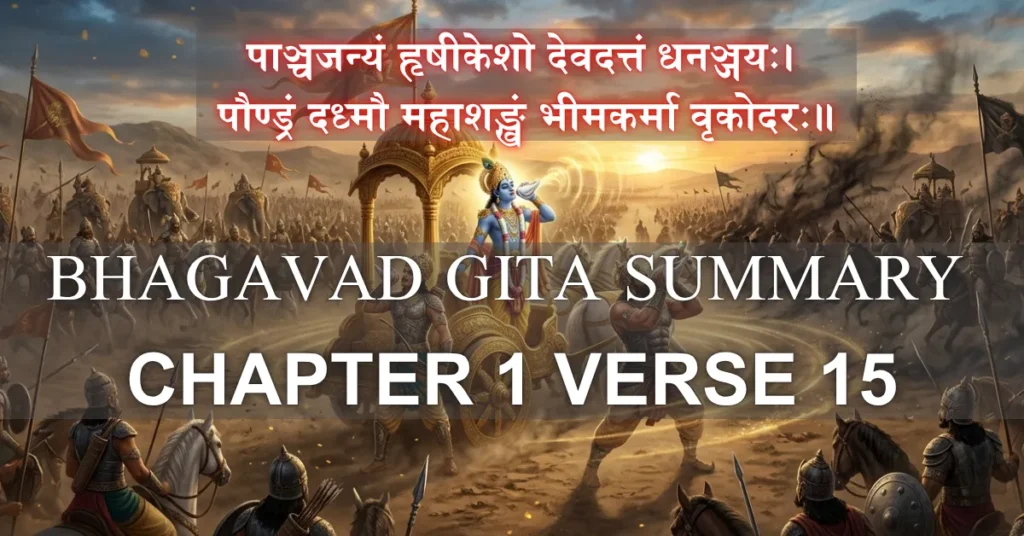
पाञ्चजन्यं हृषीकेशो देवदत्तं धनञ्जयः।
पौण्ड्रं दध्मौ महाशङ्खं भीमकर्मा वृकोदरः॥
In English :
pāñcajanyaṁ hṛṣīkeśo devadattaṁ dhanañjayaḥ
pauṇḍraṁ dadhmau mahāśaṅkhaṁ bhīmakarmā vṛkodaraḥ
Feel the Vibration: A Guided Chant of Bhagavad Gita Chapter 1 Verse 15:
- pāñcajanyaṁ hṛṣīkeśo devadattaṁ dhanañjayaḥ
Paan-cha-jan-yam Hri-shee-ke-sho De-va-dat-tam Dha-nan-ja-yah - pauṇḍraṁ dadhmau mahāśaṅkhaṁ bhīmakarmā vṛkodaraḥ
Paun-dram Dadh-mau Ma-haa-shan-kham Bhee-ma-kar-maa Vri-ko-da-rah
English Translation:
Lord Krishna blew His conch named Panchajanya; Arjuna blew the conch Devadatta; and Bhima, the performer of mighty deeds, blew the great conch Paundra.
JOIN THE HISANATANI COMMUNITY
Get daily Verse Summaries & High-Res Posters directly on your WhatsApp.
JOIN CHANNELA Quiet Whisper for Your Busy Mind
You wake up to notifications. Deadlines stare at you. Expectations surround you. Somewhere in this noise, your clarity gets buried.
This verse is your reminder: Before you react, align. Before you speak, center. Before you act, choose your frequency.
Krishna’s conch represents inner mastery. Arjuna’s represents focused action. Bhima’s represents fearless strength.
When life feels loud, Bhagavad Gita Summary 1.15 teaches you to produce your own sound — one that comes from purpose, not panic.Let’s explore how.
The Verse in Plain Words for a Strong Heart

Imagine two teams before a big cricket match.
One side shouts loudly to scare the other team. The other side calmly ties their shoelaces, looks at each other confidently, and signals, “We’re ready.”
That’s this verse.
Krishna blows His conch called Panchajanya. Arjuna blows Devadatta. Bhima blows Paundra.
Each conch has a name. Why? Because this is not random noise. It is identity. It is readiness.
Think of it like your ringtone. When your phone rings, you know whether it’s family, office, or spam. Sound carries meaning.Here, Panchajanya is Krishna’s sound — divine control.Devadatta is Arjuna’s — gifted purpose.Paundra is Bhima’s — fearless strength.
Think of it like this: Before your exam, presentation, or interview — what is your “conch”? Is it nervous self-talk? Or is it calm confidence?
The lesson from Bhagavad Gita Summary 1.15 is simple: Start your battle with intention.
Even a 10-year-old can understand this: When you feel scared, call your best friend, take a deep breath, and say, “I can do this.”
That is your conch moment.
Don’t let the world’s noise decide your mood. Blow your own signal first.
The Eternal Logic Behind Divine Alignment

In Vedic thought, sound is not decoration — it is creation. The universe begins with vibration.
Krishna as Hrishikesha — master of senses — blowing the first conch in Bhagavad Gita Chapter 1 Verse 15 symbolizes consciousness governing matter.
Philosophically, this is profound.
The senses create chaos when unguided. The ego reacts to fear. But when higher awareness leads, action becomes Dharma.The order matters:
Krishna first.
Then Arjuna.
Then Bhima.
Krishna represents the Supreme Consciousness. Arjuna represents the human will. And Bhima, the Strength.
Consciousness → Intention → Strength.
This is cosmic architecture mirrored in human psychology.
Modern analogy?
In a company, if the CEO (vision) is confused, the managers (intellect) panic, and employees (action) scatter.But when vision is clear, execution flows.
This verse BG1.15 encodes a metaphysical hierarchy:
Align the inner governor before deploying outer action.
Sound follows consciousness.Victory follows alignment.
Healing the Modern Mind: A Lesson in Response

Psychologically, sound triggers emotion.
The Kauravas tried to intimidate. Krishna’s response was not louder — it was steadier.
This is emotional regulation.
When someone criticizes you, do you react impulsively? Or respond with grounded confidence?
Today, stress hijacks our inner battlefield. We scroll social media and unconsciously absorb others’ fears.
Krishna demonstrates calm authority. Arjuna mirrors it. Bhima amplifies it.
This is nervous system mastery.
Instead of anxiety spirals, create anchor rituals:
- Deep breathing before meetings
- A grounding affirmation
- Five seconds of silence before replying
That is your Panchajanya.
Instead of reacting to criticism, breathe.
Instead of doom-scrolling, step outside.
Instead of spiralling, chant.
Sound is therapy.
Even modern neuroscience confirms rhythm calms the vagus nerve.
Bhagavad Gita Chapter 1 Verse 15 reveals an ancient psychological hack:
Create your own stabilizing signal.
Awakening the Atman: The Grace of the Master

Spiritually, Krishna as Hrishikesha — master of senses — signals that the Divine resides within the human system.
When you meditate, chant, or act selflessly, you blow your inner conch.
Arjuna’s Devadatta means “God-given.” Your talents are not accidents. They are entrusted gifts.
Bhima’s mighty conch represents raw energy.
When these three harmonize, something miraculous happens:
You act without inner fragmentation.
Many people today feel split — mind wants one thing, heart another, body another.
This verse invites integration.
When awareness guides intention and intention guides strength, your action becomes Yoga.
It is no longer struggle. It becomes sacred participation.
The battlefield outside becomes a path inward.
This verse is not about war.It is about awakening.
The battlefield is inside.
The Divine charioteer waits for you to listen.
The Echoes of Kurukshetra: The Battlefield That Heard a Higher Truth

Historically, this moment shook Kurukshetra.
The armies recognized Krishna’s presence instantly. His conch carried moral authority.
Ancient warfare used conches for signaling. But in BG1.15, each conch had symbolism.
The Pandavas were fighting for Dharma, not dominance.
Krishna’s sound communicated legitimacy.
Imagine entering a courtroom with truth on your side. Your silence carries power.
That was this moment.
The echo across Kurukshetra was not just acoustic. It was ethical.
And that is why this verse marks the subtle beginning of the Gita’s revelation.
The war had not yet begun — but righteousness had declared itself.
Historically, the names of these conchs—Pāñcajanya, Devadatta, and Pauṇḍra—carried immense weight. They were legendary artifacts. Dhanañjaya (Arjuna) earned his conch through conquest and merit.
This Bhagavad Gita Summary 1.15 reminds us that the “weapons” we carry into our modern battles—our degrees, our skills, our reputation—are not just items; they are earned identities.
Your 24-Hour Gita Challenge: A 5-Minute Ritual to Reclaim Your Inner Battlefield

Here is your life-manual practice.
Tomorrow morning, before you check your phone or email, sit in silence for 60 seconds.
Before starting your day:
- Sit upright.
- Close your eyes.
- Inhale deeply five times.
- Whisper: “I act from clarity, not chaos.”
Visualize blowing a conch from your heart.
That’s it.
Do this before meetings. Before difficult conversations. Before important decisions.
Small ritual. Massive recalibration.
Because if you don’t declare your frequency, the world will impose one.
Blow your Panchajanya daily.
Beyond the Battlefield
The battlefield always arrives — in meetings, in relationships, in decisions.
But Bhagavad Gita Chapter 1 Verse 15 is not about ancient war horns.
Remember: The loudest voice is not the strongest.The aligned voice is.
BG1.15 teaches you to begin every challenge with divine focus, steady breath, and fearless intention.
Sound your clarity.
Stand in alignment.
And then step forward.
Ready to align your daily life with timeless wisdom?
Please let me know in the comment .
Embrace the Teachings of the Gita. Dive deeper into the Bhagavad Gita to uncover its timeless wisdom and practical guidance. Let its verses inspire you to cultivate inner clarity, align with higher values, and navigate life’s challenges with courage and grace.
🌼 Join the HiSanatani WhatsApp Channel for your daily dose of light 🪔.Join Now.
Voice of the Soul
Finding clarity in the questions we all carry…
Why does the Bhagavad Gita give specific names to each conch shell?
In Vedic culture, naming an object signifies its unique energy and purpose. In Gita 1.15, naming the conchs shows that the Pandavas’ tools weren’t just weapons; they were extensions of their identity and divine mission. It teaches us that our own skills and “tools” in life should be used with clear, conscious intention.
What is the spiritual meaning of Lord Krishna’s conch, “Pāñcajanya”?
Pāñcajanya symbolizes the “Victory of the Five.” Spiritually, it represents the Divine Sound (Om) that gives you mastery over your five senses. When Krishna blows this conch, he is signaling that the soul is now in command, silencing the “noise” of worldly distractions and internal fear.
Why is Krishna called “Hṛṣīkeśa” in this specific verse?
Hṛṣīkeśa translates to “Master of the Senses.“ By using this name here, the Gita teaches a psychological lesson: before we can win any external battle—like a career challenge or a difficult relationship—we must first follow the “Inner Director” who helps us control our wandering mind and stay focused.
Can the sound of the conch in Verse 15 help with stress and anxiety?
Yes. Psychologically, the sound represents a “Pattern Interrupt.“ Just as the conch drowned out the chaos of the battlefield, focusing on a single “Divine Sound” or a positive goal helps you practice selective attention. It allows you to filter out stressors and return to a state of calm, centered authority.
Is Bhagavad Gita 1.15 only about a historical war?
Not at all. While it describes a historical scene, it serves as a Practical Life Manual. The “war” is a metaphor for our daily struggles. The verse teaches us the importance of Internal Alignment—ensuring our mind (Krishna), intellect (Arjuna), and energy (Bhima) are all “sounding the same note” before we take action.
How can I apply the lessons of Verse 1.15 to my modern career?
Use it as a ritual for Professional Presence. Before starting any major task, “blow your conch” by clearly defining your intent and your specific role. It’s the difference between being reactive (responding to emails in a panic) and being proactive (starting your day with a clear, commanding declaration of your goals).
