
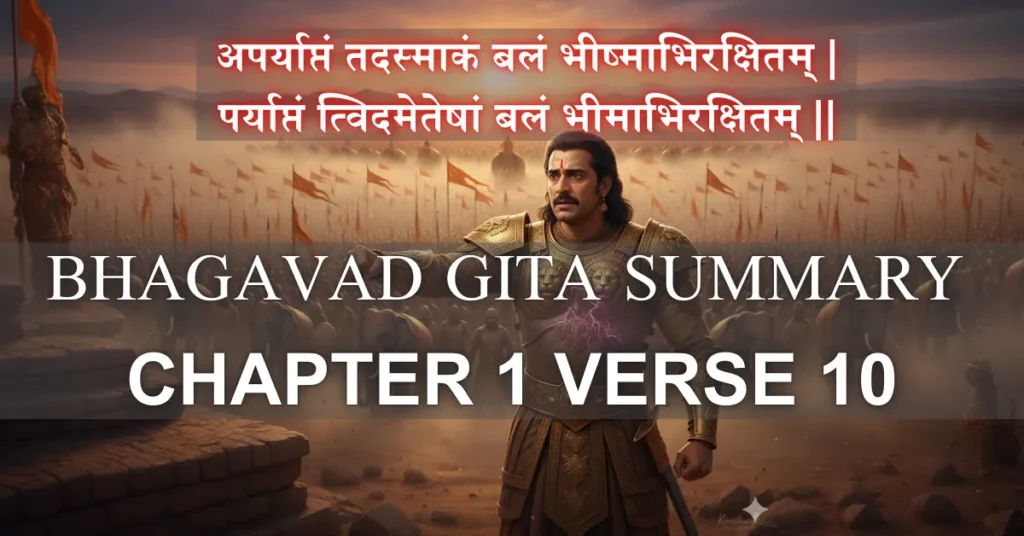
Translation of Bhagavad Gita Shloka Verse 1.10 in English:
अपर्याप्तं तदस्माकं बलं भीष्माभिरक्षितम् ।
पर्याप्तं त्विदमेतेषां बलं भीमाभिरक्षितम् ॥
In English :
aparyāptaṁ tad asmākaṁ balaṁ bhīṣmābhirakṣitam
paryāptaṁ tv idam eteṣāṁ balaṁ bhīmābhirakṣitam
Feel the Vibration: A Guided Chant of Bhagavad Gita Chapter 1 Verse 10:
- aparyāptaṁ tad asmākaṁ balaṁ bhīṣmābhirakṣitam
A-pa-ryaap-tam tad as-maa-kam ba-lam bheesh-maa-bhi-rak-shi-tam - paryāptaṁ tv idam eteṣāṁ balaṁ bhīmābhirakṣitam
Par-yaap-tam tvi-dam e-te-shaam ba-lam bhee-maa-bhi-rak-shi-tam
English Translation:
“Our strength, protected by Bhishma, is limitless;
whereas the strength of the Pandavas, protected by Bhima, is limited.”
JOIN THE HISANATANI COMMUNITY
Get daily Verse Summaries & High-Res Posters directly on your WhatsApp.
JOIN CHANNELA Quiet Whisper for Your Busy Mind
Before we go deeper, pause for a second.
Do you ever feel like you have “everything” on paper—the job, the degrees, the gadgets—yet you still wake up with a heavy chest? You aren’t alone. Duryodhana felt this 5,000 years ago.
Life today feels like Duryodhana’s battlefield — constant competition, comparison, pressure to prove yourself. Everyone looks strong on Instagram. Everyone sounds confident in meetings. Yet inside… anxiety.
This verse is like a soft tap on your shoulder saying:
“Stop counting others. Start knowing yourself.”
The Gita doesn’t shout. It gently reveals. And today, it reminds you — peace isn’t built by gathering more; it’s built by trusting what you already are.In this journey of Bhagavad Gita Summary 1.10, Let’s explore how.
The Big Playground Lesson: Why Being “Biggest” Isn’t Always “Best”

Imagine two school teams preparing for a match. One captain shouts, “We have 50 players! We’ll crush them!”
But then keeps saying, “Protect our best player carefully!”
What does that show?
He’s scared. That’s exactly Duryodhana.
Even a 10-year-old can understand this: If you’re truly strong, you don’t need to shout about it.
Real strength is silent. Like:
- A topper who studies quietly
- A tree that gives fruit without noise
- A parent who protects without boasting
Duryodhana’s mistake is overthinking numbers. The Pandavas simply trust themselves.
What we learnt here?
👉 Stop counting how many advantages others have.
👉 Focus on what you already possess.
Peace begins when comparison ends.
The Logic of Perception: How Our Bias Shapes Our Reality

If we dive into the Philosophical Insight of Bhagavad Gita Chapter 1 Verse 10, we can explores the concept of Maya (Illusion). Duryodhana uses the word Aparyaptam, which can mean both “unlimited” and “insufficient.” His subconscious is betraying him. He is obsessed with the material (the size of the army) and ignores the metaphysical (the presence of Krishna/Divine). When we base our reality purely on what we can measure, we fall into the trap of Dualism, where fear and greed take turns ruling us. The “Truth” is that material abundance cannot substitute for moral alignment.
Truth carries invisible support. In modern terms:
A small startup with purpose beats a huge company without vision.
A sincere relationship beats hundreds of fake connections.
Alignment beats accumulation. Always.
Healing the Modern Mind: A Lesson in Focus by Bhagavad Gita Summary 1.10

Psychologically, this verse screams: comparison is stress.
Duryodhana keeps scanning the enemy side.That’s exactly what we do on social media.
Scrolling = modern battlefield.
- Who earns more?
- Who looks better?
- Who is ahead?
And suddenly your own life feels “insufficient.” That’s Duryodhana’s mind.
Comparison creates artificial scarcity. Your brain forgets your own strengths. Krishna’s subtle advice in Bhagavad Gita Chapter 1 Verse 10:
🪈Attention is energy. Put it on yourself.
When you stop monitoring others:
- anxiety drops
- focus returns
- confidence grows
Mental health improves not by becoming stronger, but by feeling enough.
The Shield of Grace: Why Protection Comes from Within.

Spiritually, the contrast between Bhishma and Bhima is profound. Bhishma represents the “Old Guard” and “Duty without Soul,” while the Pandavas represent “Surrender to the Divine.” Even though Bhishma is invincible, Duryodhana is nervous. Why? Because Divine Grace 🙏cannot be bought with numbers. When you are connected to the Atman (Soul), even a “limited” resource becomes an unstoppable force. This verse teaches us that Balam (Strength) is a spiritual frequency, not just a physical tally.
The armies represent inner forces.
Kauravas = ego, greed, doubt
Pandavas = faith, devotion, truth
Ego always looks big.Soul always looks quiet. Yet divine support flows toward the pure heart.
Bhishma symbolizes tradition and power. Bhima symbolizes strength of Dharma.
God stands with Dharma, not numbers. So spiritually:
🪈 Even if you feel “alone,” you’re never unsupported.
The Strategy of Kurukshetra: The General’s Final Calculation

Through this verse 10 of Bhagavad Gita Chapter 1 , Historically we can relate that this happens right before the wars begin. Duryodhana tries to motivate his soldiers. His speech is political psychology.
He:
- praises his side
- minimizes the enemy
- hides fear
Classic leadership tactic. But the epic subtly shows: Leaders who depend on propaganda, not truth, Collapse.
The Pandavas don’t boast. They prepare silently.
Historically, the Kaurava army was nearly twice the size of the Pandavas (11 Akshauhini vs 7). Yet, this verse proves that History is written by the resolute, not the numerous. Quiet conviction beats loud pride. Kurukshetra becomes a mirror for every age.
Your 24-Hour Gita Challenge: Putting Wisdom into Action

Let’s make this practical. Today, try this:
🪔 Gita Exercise
For 24 hours:
- No comparing yourself to others
- No checking competitor stats
- No negative self-talk
Instead:
- The Exercise: Put your phone in another room for 30 minutes.
- The Goal: Focus entirely on one person or one project.
- Write : 5 strengths you already have. That’s your “army.” Protect those — like Bhishma. Grow those like Bhima.
You’ll feel lighter instantly. Because confidence grows from recognition, not competition.
Beyond the Battlefield
So before the first arrow flies…
before Krishna speaks philosophy…
before destiny unfolds…
This one verse quietly teaches us:
Fear shouts. Faith stays calm.
Choose calm. Choose clarity. Choose Dharma. And walk your life’s battlefield with inner certainty.
Please let me know in the comment .
Embrace the Teachings of the Gita. Dive deeper into the Bhagavad Gita to uncover its timeless wisdom and practical guidance. Let its verses inspire you to cultivate inner clarity, align with higher values, and navigate life’s challenges with courage and grace.
🌼 Join the HiSanatani WhatsApp Channel for your daily dose of light 🪔.Join Now.
Voice of the Soul
Finding clarity in the questions we all carry…
What is the meaning of Bhagavad Gita Chapter 1 Verse 10?
It shows Duryodhana claiming his army is stronger, but his hidden fear reveals that ego-based confidence is unstable.For a simple, child-friendly explanation, read “Why Being “Biggest” Isn’t Always “Best””
What does ‘Aparyaptam’ mean in Gita 1.10?
“Aparyaptam” is a fascinating double-meaning word. It can mean “unlimited” or “insufficient.” Outwardly, Duryodhana boasts of endless strength, but inwardly he feels it isn’t enough. This reveals his mental conflict.
Explore this deeper in “The Logic of Perception” where we unpack its philosophical truth.
Why does Duryodhana compare Bhishma and Bhima?
He compares Bhishma and Bhima to reassure himself. Bhishma symbolizes defense, Bhima raw strength. This comparison shows psychological warfare, not spiritual confidence.
👉 See how this affects the mind in “Healing the Modern Mind: A Lesson in Focus.“
Is this verse about strategy or spirituality?
Both. On the battlefield of Kurukshetra, it shows military strategy. But inwardly, it reveals the war between ego and Dharma. History and spirituality meet in one moment.
👉 Discover the battlefield context in “The Strategy of Kurukshetra.”
How can I apply Bhagavad Gita 1.10 in daily life?
Notice where you exaggerate strength or hide fear. Instead of comparing, act with clarity and purpose. Start with one conscious step today — small, steady, sincere.
👉 Try the exercise in “Your 24-Hour Gita Challenge”
What life lesson does Gita 1.10 teach for modern stress?
he verse exposes the Comparison Trap. Even with bigger numbers, Duryodhana feels restless. Today we do the same — comparing salaries, followers, achievements. True strength comes from inner clarity, not external count.
👉 Learn how to build that inner stability in “The Shield of Grace”
