
Namaste 🙏
Welcome to Hi Sanatani. It’s a joy to have you here as we explore the deeper layers of human nature. By diving into this Bhagavad Gita Summary 1.11, we create a sacred bridge together, turning ancient verses into helpful tools for your personal growth and peace.
Translation of Bhagavad Gita Shloka Verse 1.12 in English:
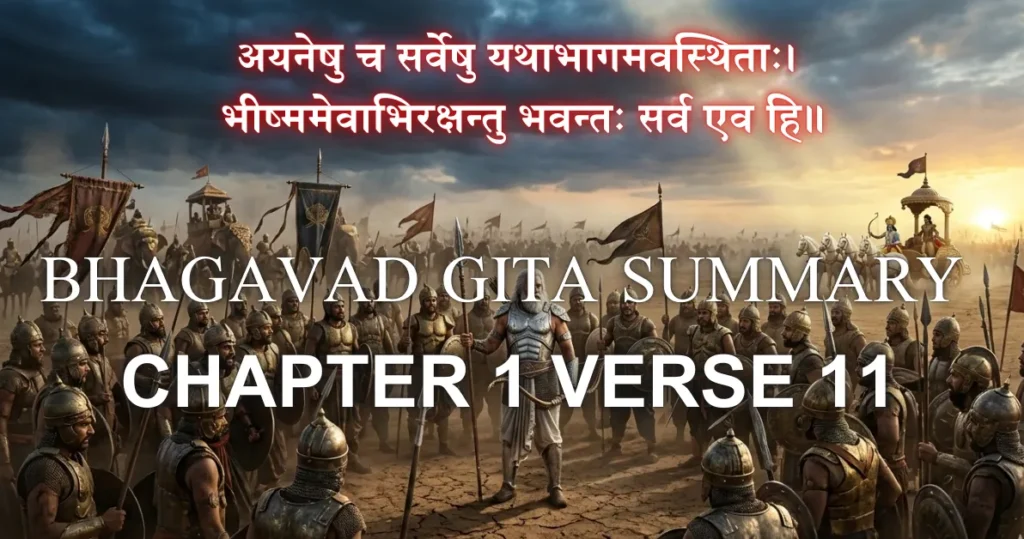
अयनेषु च सर्वेषु यथाभागमवस्थिताः।
भीष्ममेवाभिरक्षन्तु भवन्तः सर्व एव हि॥
In English :
ayaneṣu ca sarveṣu yathā-bhāgam avasthitāḥ
bhīṣmam evābhirakṣantu bhavantaḥ sarva eva hi
Feel the Vibration: A Guided Chant of Bhagavad Gita Chapter 1 Verse 11:
- ayaneṣu ca sarveṣu yathā-bhāgam avasthitāḥ
A-ya-ne-shu cha sar-ve-shu ya-thaa-bhaa-gam a-va-sthi-taah - bhīṣmam evābhirakṣantu bhavantaḥ sarva eva hi
Bheesh-mam e-va a-bhi-rak-shan-tu bha-van-tah sar-va e-va hi
English Translation:
“Therefore, all of you, positioned strategically at your respective posts, must fully protect Bhishma from every side.”
A Quiet Whisper for Your Busy Mind
Some days you feel it, don’t you?
That quiet worry —
“If this job goes… if this person leaves… if this plan fails… what will happen to me?”
Modern life is noisy, but the fear is ancient.
We search for one strong pillar to hold us up.
Money. Relationships. Status. Approval.
Yet the Gita whispers something radical:
Anything you depend on can disappear.
Verse 1.11 is a mirror. It shows what fear looks like when disguised as control. And gently invites you to build something deeper —an inner ground that cannot shake.
Let’s walk into that truth together.
The Verse in Plain Words for a Peaceful Mind
Imagine a school cricket team.
One player is the best batsman. Everyone thinks, “If he stays, we win.” So the whole team only protects him instead of playing well themselves.
What happens? If that one player gets out — panic.
That’s exactly the situation described in Bhagavad Gita Chapter 1 Verse 11..
Duryodhana tells everyone: “Protect Bhishma!”
Instead of trusting the whole army, he depends on one person.
The Bhagavad Gita Summary 1.11 reveals a simple but powerful message: Don’t put all your hope in one thing.
Not one friend.Not one salary.Not one backup plan.
Because real strength comes when everyone stands strong together.
Life works the same way. If your happiness depends only on: one person. one result.one opportunity You live in fear.But if you build inner courage, skills, faith, and discipline — you become stable.Like a table with four legs.
The Eternal Logic Behind Krishna’s Words: Bhagavad Gita Summary 1.11

Philosophically, this verse reveals a universal truth: attachment breeds insecurity.
Why?
Because whatever is external can be lost.
Bhishma is mortal.Armies are temporary.Bodies are fragile.
The deeper metaphysical insight behind the Bhagavad Gita Summary 1.11 reminds us that placing safety in changing things guarantees anxiety.
Only the Self (Atman) is permanent.Everything else changes.This is the eternal logic.
It’s like investing all your money in one volatile stock. You’ll constantly check the market.It’s like holding water in your fist — the tighter you grip, the faster it slips.But if your wealth is diversified, peace follows.
In the same way, Bhagavad Gita Chapter 1 Verse 11 quietly illustrates this timeless principle: Attachment equals volatility | Wisdom is stability
Duryodhana chooses external dependency. Krishna teaches inner sovereignty.
The lesson?
Anchor yourself in the unchanging.That’s the philosophical backbone of this verse.
From Anxiety to Inner Ground — A Lesson for the Modern Mind

Psychologically, this verse is pure gold.
As highlighted in the Bhagavad Gita Summary 1.11, Watch closely: When afraid, humans try to control. Micromanage.Over-plan.Overthink.
Duryodhana does the same in BG1.11.
He shouts instructions because his mind is shaking.
Sound familiar?
Corporate burnout.Relationship insecurity.Constant phone checking.
All are symptoms of one thing: Inner instability.
We cling to something to feel safe. But that creates more stress. It’s a loop.
This verse suggests something revolutionary: Instead of protecting one external pillar, strengthen yourself. Meditate. Learn. Build skills. Build inner confidence.
Because a stable mind doesn’t need constant protection. It becomes its own protector.
Connecting with the Divine Within: Spiritual aspect of Bhagavad Gita 1.11.

Spiritually, Bhishma symbolizes eternal guardians.
But the Gita gently asks:
Why seek protection outside when the Divine lives inside you?
As reflected in the Bhagavad Gita Summary 1.11,Krishna represents inner guidance. the Divine within.
The Atman is your eternal shield.
When you align with the Atman (the Soul), your “limited” resources become infused with infinite potential. This is why a single prayer can sometimes outweigh a thousand plans.In BG 1.11,The verse asks us: Are you protected by the “Grandfather” (your past achievements) or by the “Divine Vitality” (your current connection to God)?
When you remember this: Fear melts.
You realize: “I am protected by Dharma itself.”
Not by people.
Not by situations.
But by grace.
This verse invites us to shift: From outer support to inner surrender
From dependence to devotion
When you trust the Divine presence within, life feels supported even in chaos.
That is Bhakti.That is Yoga. That is freedom.
The Historical Pulse of the Battlefield : The Echoes of Kurukshetra
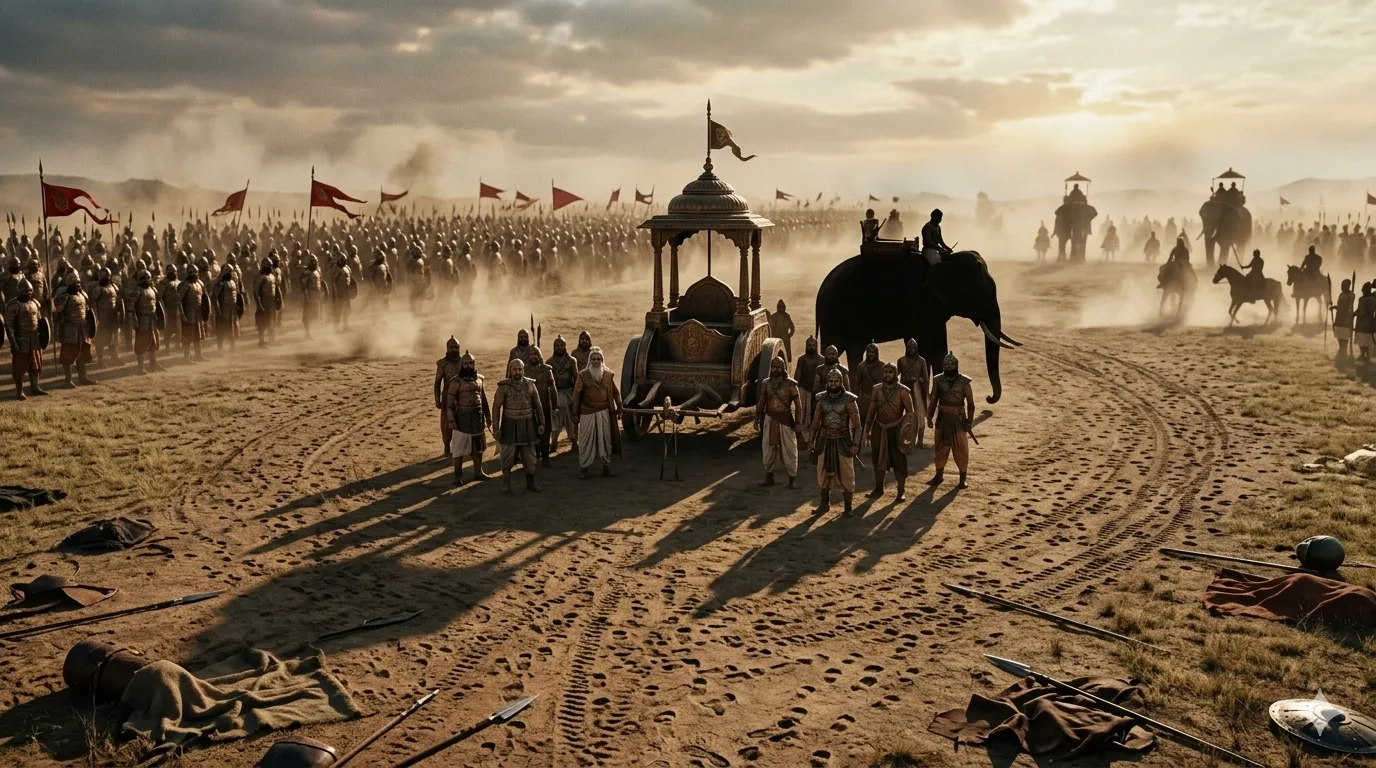
On the battlefield of Kurukshetra, Bhishma was the Kauravas’ strongest warrior.
Duryodhana knew this.
So historically, his command makes military sense. But emotionally?
It reveals insecurity.
This tension becomes clearer when we look at the Bhagavad Gita chapter 1 Verse 1, where the stage of Kurukshetra is set—not just as a battlefield of armies, but as a battlefield of human psychology.
Contrast this with the Pandavas.
They relied on Krishna’s wisdom, not just physical might.
History shows what happened.
Numbers didn’t win. Clarity did.
The Bhagavad Gita Summary 1.11 helps highlight this deeper lesson:
Leadership based on fear collapses.
Leadership based on faith sustains.
Even today, organizations crumble when built around one hero instead of shared purpose.
Every day you fight:
Doubt vs faith| Fear vs courage| Dependence vs trust
Kurukshetra isn’t ancient.
It’s happening in every boardroom and family daily.
Your Manual for Today: The “Quiet Strength” Practice

Let’s make this practical. Today, do one simple thing inspired by the wisdom behind Bhagavad Gita Summary 1.11.
The “Strength Diversification” Exercise
Ask yourself: “If this one thing disappears, will I break?”
Then fix it.
Examples:
• Learn one new skill
• Build a second income source
• Strengthen two friendships
• Spend 10 minutes in meditation
Take a piece of paper. On the left side, write one thing you feel anxious about (for example, “I don’t have enough time”). On the right side write: “With Divine Grace, what I have is sufficient.”
Every time you feel the “Duryodhana Tremor”—the urge to count and compare—repeat the word “Paryāptam” (Sufficient). As seen in BG 1.11, depending on a single pillar creates fear. True strength grows when your stability comes from within.
Shift your focus from the size of your problem to the source of your strength.
Build inner anchors. Not just outer ones.
By tonight, you may feel lighter.
Less scared | More stable.
That’s the living wisdom of Bhagavad Gita chapter 1 Verse 11—not theory, but transformation.
Beyond the Battlefield
Verse 1.11 doesn’t shout.
It whispers.
Don’t look for someone to protect you.
Awaken the strength already within.
Because the one anchored in the Self
Walks through life like a mountain — Steady, silent, unafraid.
The battle isn’t won by the one with the most soldiers;
it’s won by the one with the most soul.
Don’t let the “unlimited”noise of the world drown out the “sufficient”peace of your heart.
You are enough, you have enough, and you are protected.
Please let me know in the comment .
Embrace the Teachings of the Gita. Dive deeper into the Bhagavad Gita to uncover its timeless wisdom and practical guidance. Let its verses inspire you to cultivate inner clarity, align with higher values, and navigate life’s challenges with courage and grace.
🌼 Join the HiSanatani WhatsApp Channel for your daily dose of light 🪔.Join Now.
Voice of the Soul
Finding clarity in the questions we all carry…
Why was Duryodhana so worried about Bhishma in Verse 11?
Despite Bhishma’s strength, Duryodhana knew he was the backbone. If Bhishma fell, the morale of the entire Kaurava army would collapse. It shows that even the strongest need support.
What does ‘Ayaneṣu’ mean in this context?
It refers to the strategic entrances or divisions of the military phalanx (vyooha). Practically, it means being mindful of all areas of our life that affect our main goal.
What is the main message of Bhagavad Gita Summary 1.11?
It teaches that depending solely on external pillars for security leads to fear; true stability comes from inner strength and collective unity.
How can I apply Verse 1.11 to my modern life?
By “diversifying” your sources of happiness and building internal skills rather than relying on a single job, person, or outcome.
What life lesson does Gita 1.11 give us?
It teaches that a leader’s job is to ensure that the core assets (people or values) are supported by the entire ecosystem. Success is a collective responsibility, not just an individual’s burden.We practice this “Quiet Strength” in today’s 24-Hour Gita Exercise.