
Namaste 🙏
Welcome to Hi Sanatani. It’s a joy to have you here as we explore the deeper layers of human nature. By diving into this Bhagavad Gita Summary 1.13, we create a sacred bridge together, turning ancient verses into helpful tools for your personal growth and peace.
Translation of Bhagavad Gita Shloka Verse 1.13 in English:
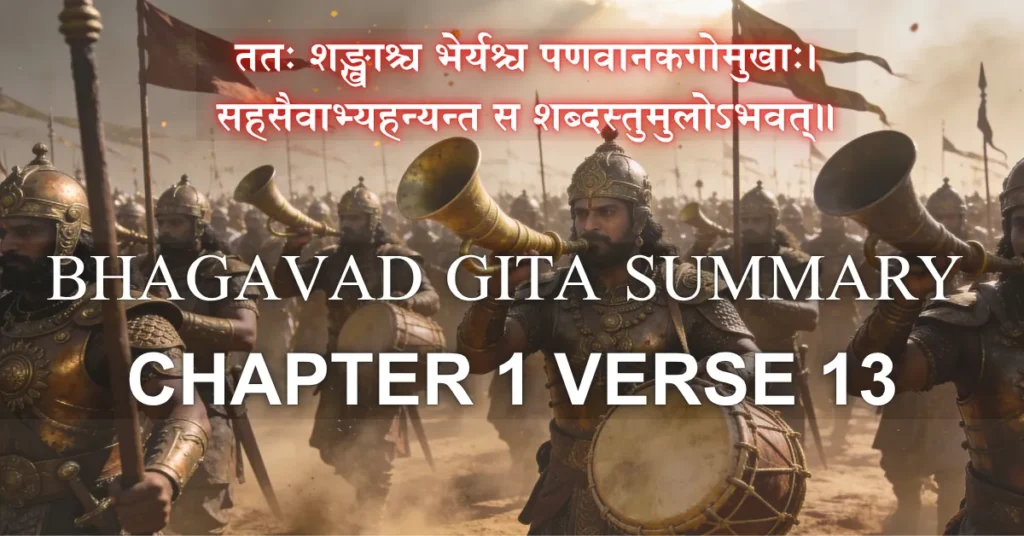
ततः शङ्खाश्च भेर्यश्च पणवानकगोमुखाः।
सहसैवाभ्यहन्यन्त स शब्दस्तुमुलोऽभवत्॥
In English :
tataḥ śaṅkhāś ca bheryaś ca paṇavānaka-gomukhāḥ
sahasaivābhyahanyanta sa śabdas tumulo ’bhavat
Feel the Vibration: A Guided Chant of Bhagavad Gita Chapter 1 Verse 13:
- tataḥ śaṅkhāś ca bheryaś ca paṇavānaka-gomukhāḥ
Ta-tah Shankh-aash cha Bher-yash cha Pa-na-va-na-ka Go-mu-khaah - sahasaivābhyahanyanta sa śabdas tumulo ’bhavat
Sa-ha-sa-e-va Abh-ya-ha-nyan-ta Sa Sha-bdas Tu-mu-lo Bha-vat
English Translation:
“Then conches, kettledrums, tabors, trumpets, and horns were suddenly sounded all at once, and the combined sound was tumultuous.”
A Quiet Whisper for Your Overstimulated Mind
Do you ever feel like the world is just too loud? Between the “pings” of your smartphone and the heavy weight of your own “to-do” list, the noise can feel like a storm.
Let’s be honest.
Your battlefield may not be Kurukshetra—but it feels loud.
Sometimes it feels like life is a thousand instruments blasting at once.
Bhagavad Gita Chapter 1 Verse 13 reminds you of something critical:
Noise is inevitable. Panic is optional.
This verse acts as your life manual because it acknowledges that chaos is often the precursor to clarity. It teaches us that when the “drums” of life start beating, we shouldn’t shrink away in fear. Instead, we must recognize that this noise is simply the energy required to move from standing still to moving forward.
Before Arjuna breaks down, the environment becomes chaotic. The Gita shows us a deep truth—inner clarity is tested only when outer volume rises.
This verse is your manual for modern overwhelm.
Now let’s break it down.
Simple Perspective: When Noise Feels Bigger Than You

Imagine your classroom suddenly erupting in shouting. Everyone talking at once. Drums beating. Whistles blowing.
Would you feel calm? Probably not.
That’s exactly what happens here.
The Kaurava army creates loud sounds to show power and confidence. But loudness does not equal strength.
Sometimes people shout because they are afraid.
Sometimes situations look big only because they are noisy.
Think of social media.A trending topic feels huge.But is it truly powerful—or just loud?
This verse teaches a childlike truth:
Do not judge power by volume.
If someone argues loudly, stay calm.
If a problem feels big, breathe first.
If life gets noisy, don’t join the chaos.
Strength is quiet control.
Even a 10-year-old can practice this:
When friends fight loudly, stay silent and think before reacting.
That is wisdom in action.
Philosophical Perspective: The Science of Collective Energy

Why does collective sound matter?
Because energy amplifies when unified.
If you try to understand Bhagavad Gita Summary 1.13 in metaphysical terms, sound represents vibration. Vibration creates momentum. Momentum shapes reality.
When many minds align—even in fear or aggression—their combined vibration becomes powerful.
But here’s the deeper truth: External vibration cannot disturb the Self unless you identify with it.
The battlefield noise symbolizes Maya—the overwhelming field of sensory experience.
Krishna will soon teach Arjuna about the eternal Self. But first, the illusion must feel real.
Philosophically, this verse exposes how temporary forces attempt to dominate perception.Yet the Atman remains untouched.
Modern parallel?
Market crashes. Office politics. Public criticism.
They feel loud. They feel massive.
But the Self—the observer—remains silent.
The Gita invites you to identify not with the noise… but with the witness.
That shift changes everything.
Psychological Perspective: Mental Mastery in a World of Notifications

This verse is a portrait of overstimulation.
When many instruments blast simultaneously, the body reacts. Heart rate rises. Muscles tense. Attention narrows.
This is fight-or-flight activation.Today, the “instruments” look different:
• Email alerts
• Workplace competition
• Relationship tension
• Financial pressure
• Constant digital scrolling
Your brain does not differentiate between a battlefield drum and a notification ping. Both trigger response.
When everything screams for attention, your focus fractures.
Bhagavad Gita Chapter 1 Verse 13 exposes the tactic:
Overwhelm the opponent’s nervous system.
Arjuna’s breakdown does not happen in isolation. It happens after sensory escalation.
But you are not helpless.
Modern psychology agrees: When overstimulated, pause. Breathe. Regulate.
If you react immediately, you lose control.
If you respond consciously, you lead.
Next time your inbox explodes or someone pressures you in a meeting:Do not match their volume.
Lower your tone.Slow your speech.Calm energy disrupts chaos.
That’s battlefield psychology 101.Mental mastery begins with sensory discipline.
Hearing the Silence Beneath the Storm : Tuning into the Divine Frequency of Bhagavad Gita 1.13

Spiritually, the various instruments (conchs, drums, horns) represent the various Indriyas (Senses) and faculties of man.
When they all sound together “Sahasā” (suddenly), it represents the alignment of the body, mind, and soul toward a single goal. To reach the Divine, your prayer shouldn’t be a weak thought—it should be a “tumultuous” roar of your entire being crying out for Truth.
Many seekers quit here, mistaking turbulence for failure.
But turbulence is purification.
The tumultuous sound is the ego’s resistance to surrender.
If you sit long enough, you notice something profound:
Behind the roar… is silence.Behind the sound… is space.
And within that space… is the Self.The Atman is never shaken by vibration.
It is the eternal listener.The verse prepares the soul for revelation.
The Echoes of Kurukshetra: Tactical Move Before the Collapse

On the battlefield of Kurukshetra, this was strategic signaling.
History tells us the Kaurava army was massive—11 Akshauhinis. When Bhishma signaled, the collective blast of thousands of instruments was a show of Intimidation.
The Kauravas wanted to display unity and dominance.
Mass sound equals morale boost.In ancient warfare, psychological warfare mattered as much as weapons.this moment signals coordinated readiness for war.
By creating tumult, they attempted to:
• Boost their own confidence
• Shake the Pandavas’ morale
• Project invincibility
But here’s the irony:The loudest army does not always win.The most aggressive force does not guarantee righteousness.
Shortly after, Arjuna—not intimidated by noise but by emotion—will falter.This verse marks the height of external strength before internal breakdown begins.
History teaches us:Empires fall not from outer noise—but inner confusion.
That’s why Krishna’s teaching becomes necessary.Looking through the historical lens of Bhagavad Gita Chapter 1 Verse 13, we see that every boardroom battle has its roots in an ancient field of Dharma.
Your 24-Hour Gita Challenge: Master Your Inner Soundscape

When we view our daily stress through the lens of BG1.13, we realize that ancient strategy is actually modern therapy.Today, your life manual invites you into a simple yet powerful experiment: become aware of your “soundscape.”
Start by stepping into a busy environment—a café, a park, or even your workplace. For a few minutes, resist the urge to escape into earphones. Instead, listen. Notice the layers of sound around you—the hum of traffic, distant conversations, footsteps, maybe even your own breath. Like the conch shells and instruments described in Bhagavad Gita 1.13, these are just the background score of your life. They may be loud, chaotic, even overwhelming—but they are not you. In the noisiest environment, the calmest mind always wins.
Then, at some point in your day, take this practice deeper with a sacred pause.
Give yourself one hour of intentional silence. Turn off notifications. No background noise. No scrolling. Just sit with stillness. As the outer noise fades, your inner “instruments” will become clearer—thoughts, anxieties, unfinished conversations, subtle fears. Don’t resist them. Don’t judge them. Simply observe.
You’ll begin to notice something profound: peace doesn’t come from controlling the world’s noise—it comes from mastering your awareness of it.
This is your Gita experiment for today. Master the vibration, and you reclaim your clarity.
Beyond the Battlefield
Bhagavad Gita Chapter 1 Verse 13 is not merely a description of war drums.It is a mirror of your nervous system.
A metaphor for collective pressure.
A prophecy of inner awakening.Life will grow loud before it grows clear.When chaos rises, remember:You are not the noise.
You are the witness.Stand in that truth.The drums of Kurukshetra have faded into the pages of time, but the drums of your own life are beating right now. Will you let the noise overwhelm you, or will you become the conductor of your destiny? The Gita is your baton.And when you are ready to walk this path daily—
Please let me know in the comment .
Embrace the Teachings of the Gita. Dive deeper into the Bhagavad Gita to uncover its timeless wisdom and practical guidance. Let its verses inspire you to cultivate inner clarity, align with higher values, and navigate life’s challenges with courage and grace.
🌼 Join the HiSanatani WhatsApp Channel for your daily dose of light 🪔.Join Now.
Voice of the Soul
Finding clarity in the questions we all carry…
What is the meaning of Bhagavad Gita Chapter 1 Verse 13 in plain words?
It describes the Kaurava army sounding all their instruments—conch shells, drums, and horns—at once. This created a “Symphony of the Start,” symbolizing that when you begin a great task, you must move from standing still to Massive Action with all your energy.
What is the “Philosophical Why” behind the tumultuous noise in this verse?
The noise represents a Vibrational Shift. In Vedic thought, every major creation or destruction begins with a profound vibration (Spanda). This “tumultuous” sound is the metaphysical signal that the old world is ending to make way for the establishment of Dharma.
How does Gita 1.13 help in managing modern Mental Noise?
This verse mirrors the “Sound Wall” of Anxiety we feel during high-stress transitions. By recognizing that the “drums and trumpets” of our stress are simply signs of Arousal and Readiness, we can label our anxiety as “Activation” rather than fear, helping us stay focused.
What is the spiritual lesson of the “tumultuous sound”?
Spiritually, the loud instruments represent the Distractions of the Senses (Indriyas). The lesson is to find the “Silent Witness” or the Atman within. Even when the external world is roaring, your inner soul remains the calm space in which the noise exists.
Why did the Kauravas use so many instruments in this historical context?
Historically, this was a form of Psychological Intimidation. The Kauravas used their 11 Akshauhinis (divisions) to create a “Sonic Wall” to shatter the Pandavas’ morale. It teaches us that loudness is not strength, and a loud beginning does not guarantee a victorious end.
How can I apply the “24-Hour Gita Challenge” from Verse 1.13 to my career?
Apply the “Power Hour” Launch. Just as the instruments sounded “suddenly” (Sahasā), choose one difficult task today and start it with a burst of total intensity. Use the noise of your environment as fuel to drive your Momentum, proving that you are the conductor of your destiny.