Namaste 🙏
Welcome to Hi Sanatani. It’s a joy to have you here as we explore the deeper layers of human nature. By diving into this Bhagavad Gita Summary 1.14, we create a sacred bridge together, turning ancient verses into helpful tools for your personal growth and peace.
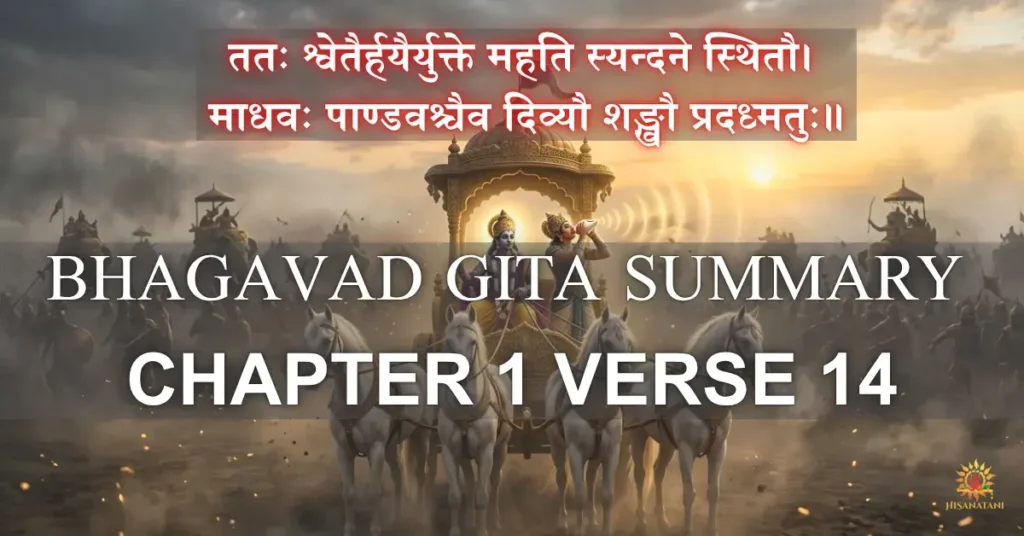
Translation of Bhagavad Gita Shloka Verse 1.14 in English:
ततः श्वेतैर्हयैर्युक्ते महति स्यन्दने स्थितौ।
माधवः पाण्डवश्चैव दिव्यौ शङ्खौ प्रदध्मतुः॥
In English :
tataḥ śvetair hayair yukte mahati syandane sthitau
mādhavaḥ pāṇḍavaś caiva divyau śaṅkhau pradadhmatuḥ
Feel the Vibration: A Guided Chant of Bhagavad Gita Chapter 1 Verse 14:
- tataḥ śvetair hayair yukte mahati syandane sthitau
ta-tah shve-tair ha-yair yuk-te ma-ha-ti syan-da-ne sthi-tau - mādhavaḥ pāṇḍavaś caiva divyau śaṅkhau pradadhmatuḥ
maa-dha-vah paan-da-vash chai-va di-vyau shan-khau pra-dadh-ma-tuh
English Translation:
Then Lord Krishna and Arjuna, stationed on their magnificent chariot drawn by white horses, blew their divine conches.
A Quiet Signal for Your Overloaded Mind
Do you ever feel like the world is shouting at you? Deadlines, notifications, and social expectations create a “Kaurava noise” that makes you feel small. You’re stressed because you’re listening to the wrong sounds.
Verse 14 is your spiritual noise-canceling headphone. It reminds you that when you align yourself with your highest purpose (your inner Krishna), the chaos doesn’t just stop—it gets overpowered by a superior, divine confidence.
The Verse in Plain Words for a Peaceful Mind

Imagine two teams about to start a big match.
One team shouts loudly to scare the other. But the captain of the second team stays calm. He looks at his coach. They nod.
Then they blow a whistle confidently.
That’s this verse BG1.14.
Krishna (the guide) and Arjuna (the warrior) blow their conches. They are not scared. They are ready.
The white horses? They symbolize purity.
The chariot? Your body. Krishna driving it. Your wisdom guiding your actions.
Simple lesson from Bhagavad Gita Summary 1.14:
Before starting anything important, align your mind.
Not loudness. Not ego. Clarity wins.
Even a 10-year-old can understand this: If you feel scared before an exam, take a deep breath. Stand straight. Remind yourself who you are.Then begin.
The Strategy of Divine Alignment Before Action : Panchendriya Chakra
Philosophically, this verse reveals hierarchy.
Arjuna is the warrior. But Krishna is holding the reins.
Matter follows consciousness. Action follows awareness.
The “White Horses” symbolize the five senses (Indriyas) purified by wisdom. The chariot symbolizes embodied life. Usually, our senses pull us in five different directions (distraction, greed, etc.). But here, they are “yoked” to a single chariot driven by the Supreme Consciousness. The battlefield is karma. And the conch? Declaration of dharma.
Krishna is called “Madhava” — the Lord of fortune and knowledge. Arjuna is “Pandava” — son of righteousness.
This is metaphysics of Bhagavad Gita Chapter 1 Verse 14 in motion.
The eternal logic:
When consciousness (Krishna) governs the senses (horses), action becomes divine.
Without inner governance, power becomes destruction. With guidance, it becomes dharma.
In modern language:
Skill without clarity creates burnout.
Skill with purpose creates impact.
Healing the Modern Mind : A Lesson from BG1.14 in Focus
Psychologically, this verse teaches grounding.
Before major stress events — meetings, interviews, hard conversations — anxiety spikes. The mind races.
Krishna does not react impulsively to the Kaurava noise. He responds deliberately.
That is emotional regulation.The divine conch represents intentional response over reactive impulse.
Corporate analogy:
You receive a harsh email. Instead of firing back, you pause. Breathe. Think. Respond strategically.
That pause? That’s Krishna holding the reins.
The white horses? Your senses pulling you toward anger, fear, distraction.
Bhagavad Gita Chapter 1 Verse 14 whispers:
Control your nervous system. Lead your emotions.
Confidence is not loud. It is centered.
When the Divine Takes the Driver’s Seat : A Lesson of Surrender

Spiritually, this verse is profound.
Krishna is not a passive observer. He is actively present in the chariot of life.The soul (Arjuna) must choose to let the Divine guide.
That is surrender — not weakness, but alignment.
The conch sound is sacred vibration. It clears negativity. It announces dharma.
When you pray before action, meditate before speaking, reflect before deciding — you invite Krishna into your chariot.
Bhagavad Gita Chapter 1 Verse 14 teaches Bhakti and Karma merging.
Act. But act guided.The Divine does not remove your battle.
He sits beside you in it.When you stop trying to “force” life and let the Divine take the lead, your very presence begins to radiate a “divine sound” that clears the path before you.
The Echoes of Kurukshetra: Moment of Supreme Fear
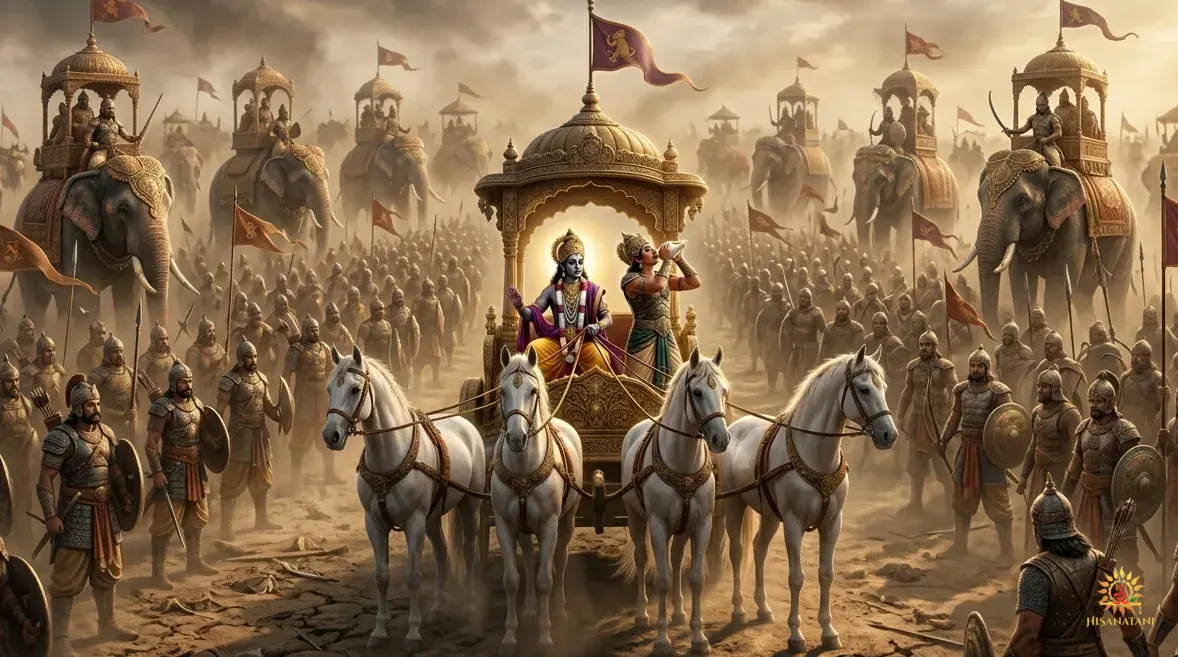
Historically, Kurukshetra was charged with tension.
Families divided.Teachers against students. Brothers against brothers.
This was a moment of supreme fear.
The Pandavas were vastly outnumbered.After the Kauravas’ loud display in Verse 13, this verse balances the field.
Krishna’s presence changes morale instantly.
This is leadership psychology at play.
A battlefield is not won only by weapons. It is won by spirit.
Krishna and Arjuna standing together signal unity between human effort and divine wisdom.
It’s a historical reminder that a small, focused group aligned with Truth will always outweigh a massive crowd fuelled by ego.This was not just a war. It was a civilizational pivot.And the sound of those conches?
It echoed across history.
Your 24-Hour Gita Challenge: Command Your Chariot

Here is your action step.
Before any important task tomorrow:
- Sit straight.
- Take 5 deep breaths.
- Mentally say: “I align with clarity.”
- Visualize holding your life’s reins firmly.
- Then begin.
This is your modern conch-blow.
No rushing. No reacting.
Lead your senses.
Let wisdom drive.
For 24 hours, observe how this changes your performance.
Small ritual. Massive impact.
Beyond the Battlefield
The battlefield is not somewhere else.
It is your office. Your home. Your own mind.
Bhagavad Gita Chapter 1 Verse 14 teaches one unstoppable truth:Do not enter life’s battles alone.
Invite clarity. Invite discipline. Invite the Divine.
Blow your inner conch before you act.
If this wisdom resonated, don’t walk this path alone.
Please let me know in the comment .
Embrace the Teachings of the Gita. Dive deeper into the Bhagavad Gita to uncover its timeless wisdom and practical guidance. Let its verses inspire you to cultivate inner clarity, align with higher values, and navigate life’s challenges with courage and grace.
🌼 Join the HiSanatani WhatsApp Channel for your daily dose of light 🪔.Join Now.
Voice of the Soul
Finding clarity in the questions we all carry…
What is the simple meaning of Bhagavad Gita Chapter 1 Verse 14?
In this verse, Lord Krishna and Arjuna blow their divine conch shells from a magnificent chariot pulled by white horses. It marks the exact moment where the “noise” of the opposition is met with the “voice” of divine truth. It symbolizes that when you are on the path of righteousness (Dharma), you possess a natural authority and confidence that cannot be shaken.
Why are the horses in Krishna’s chariot white?
White is the color of Sattva (purity and goodness). Symbolically, the five horses represent our five senses. In Verse 1.14, the white horses show us that when our senses are “yoked” (controlled) and purified by higher wisdom, we gain the speed and direction needed to win life’s battles without getting distracted by the chaos.
What does the ‘Divine Conch’ symbolize for a modern professional?
Unlike the loud, aggressive sounds made by the Kauravas, the conches of Krishna and Arjuna are called Divyau (Divine). Psychologically, this represents Resonant Focus. It’s the difference between “shouting to be heard” (ego) and “speaking with impact” (purpose). It teaches us to find our inner “signal” amidst the daily “noise” of stress and competition.
Why does the Gita call Krishna ‘Madhava’ in this specific battle scene?
‘Madhava’ translates to the “Lord of Knowledge” and the “Husband of the Goddess of Fortune (Lakshmi).” By using this name, the Gita guarantees that where there is Divine Wisdom (Krishna), there will always be Victory and Prosperity. It’s a spiritual reminder that if your “Why” is rooted in service and truth, the “How” and the “Results” will naturally follow.
What is the historical significance of the Pandavas’ chariot in Verse 14?
Historically, the Pandavas were the underdogs with fewer resources. However, Verse 14 describes their chariot as Mahati (Magnificent). This highlights a major strategic lesson: Quality outweighs Quantity. Even though they had a smaller army, their superior alignment, better “equipment” (symbolized by the divine conches), and divine leadership made their victory inevitable from the start.
How can I apply the lesson of Verse 1.14 to my daily stress?
You can take the “24-Hour Gita Challenge.” Just as Krishna and Arjuna blew their conches before the arrows flew, you must set your “Divine Intent” before your workday begins. Start your day with a moment of silence or a “cleansing breath” to center your senses (the white horses). By aligning your mind first, you react to challenges with strategic calm rather than panicked anxiety.