
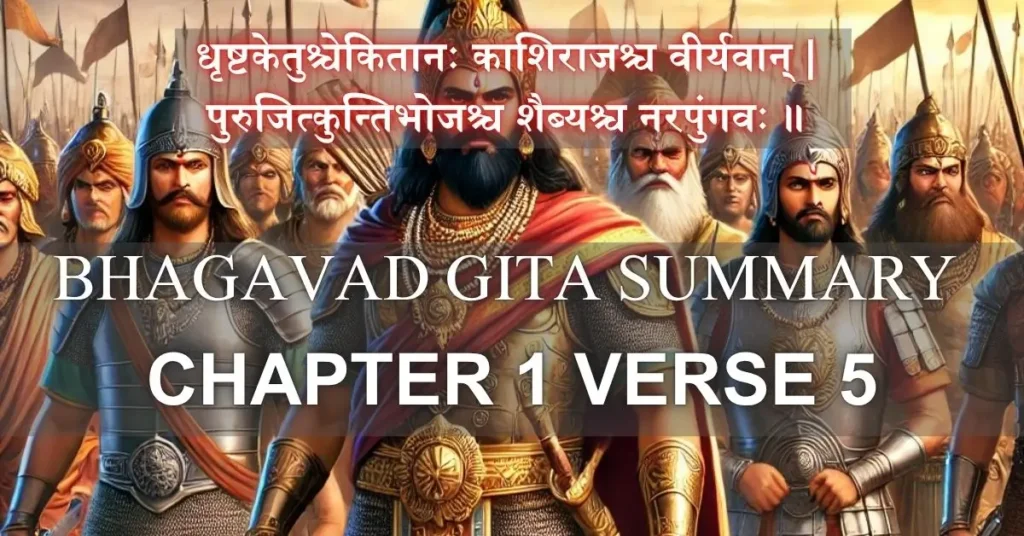
Translation of Bhagavad Gita Shloka Verse 1.5 in English:
धृष्टकेतुश्चेकितानः काशिराजश्च वीर्यवान्।
पुरुजित्कुन्तिभोजश्च शैब्यश्च नरपुंगवः॥
In English :
Dhrishtaketuḥ Chekitānaḥ Kāśirājaśca Vīryavān
Purujit Kuntibhojaśca Śaibyaśca Narapuṅgavaḥ
Full Line-by-Line Phonetic Breakdown of Bhagavad Gita Chapter 1 Verse 5:
- Dhrishtaketuḥ Chekitānaḥ Kāśirājaśca Vīryavān
- Dhrish-ta-ke-tu Che-ki-ta-nah Kaa-shi-raa-jash-cha Vee-rya-vaan
- Purujit Kuntibhojaśca Śaibyaśca Narapuṅgavaḥ
- Pu-ru-jit Kun-ti-bhoj-shcha Shai-bya-shcha Na-ra-pun-ga-vah
“Dhrishtaketu, Chekitana, the valiant king of Kashi, Purujit, Kuntibhoja, and Shaibya—renowned for their courage and nobility—stand united on the battlefield, each distinguished as a leader among men.“
Setting the Stage: Context and Background
Before we go beyond a superficial understanding with Bhagavad Gita summary 1.5, it is important to understand the environment in which these teachings were imparted. The Mahabharata is a saga of families, kingdoms, and eternal conflict. Within this larger epic, the Gita is the moment of quiet reflection in the midst of looming chaos.
- The Prelude to Spiritual Awakening: Chapter 1 helps us see that even Maharathi”s are not immune to doubt. It is a reminder that vulnerability is part of the human condition—a realization that surpasses time and culture.
- Historical Context: The world of the Gita is one where valor, righteousness, and destiny intertwine atop the battlefield of Kurukshetra.
- Role of Key Characters: Here, Arjuna, already a formidable warrior, faces an unparalleled crisis. For the first time, he hesitates as his inner conscience battles the expectations of dharma and the consequences of war.
Summary of the Bhagavata Gita First Chapter Fifth Verse
Bhagavad Gita Chapter 1, Verse 5 is not just a simple enumeration of warriors fighting for the Pandavas—it is a verse filled with deeper meanings and insights into leadership, strategy, dharma (duty), and psychology. As Duryodhana lists the names of key warriors, it reveals several underlying themes, including recognition of strength, strategic thinking, duty, and psychological insight.
In this article, we will explore these aspects in detail, providing a comprehensive understanding of how this verse applies not only to the battlefield of Kurukshetra but also to real-life situations.
Recognition of Strength – The Importance of Acknowledging One’s Opponents

Even though Duryodhana is a confident and aggressive leader, he does not ignore the strength of his enemies. In verse 1.5, he acknowledges the might of the Pandava warriors, listing their names and recognizing their capabilities.
Why is Recognition of Strength Important?
- Avoiding Overconfidence: Many leaders fail because they underestimate their competition. Duryodhana’s acknowledgment shows that, despite his arrogance, he understands that the Pandavas are not weak.
- Preparation and Readiness: Recognizing an opponent’s strength allows one to prepare better, both physically and mentally. Duryodhana was aware that ignoring the Pandavas’ power could be disastrous for his side.
- Respect for the Enemy: While Duryodhana may not have liked the Pandavas, his recognition of their warriors’ strength shows a level of respect, even if unwillingly. This highlights the importance of respecting those we compete with in life.
How This Bhagavad Gita synopsis Applies to Modern Life ?
- In Business: Companies that ignore their competitors often lose market share. Recognizing the strengths of rival businesses helps in strategizing effectively.
- In Personal Growth: Understanding and learning from stronger opponents in any field (sports, career, academics) lead us to self-improvement.
- In Leadership: A good leader does not dismiss the abilities of others but rather acknowledges and prepares accordingly.
Psychological Insight into Duryodhana – The Hidden Fear Behind His Words
Duryodhana, despite his outward confidence, reveals his inner anxiety and fear through this verse. By listing the strengths of the Pandava warriors, he unconsciously expresses his concerns about the war.

What This Verse Reveals About Duryodhana’s Psychology
- False Confidence: Duryodhana often portrayed himself as fearless, but his detailed listing of enemy warriors suggests he was nervous about the battle’s outcome.
- Self-Doubt: By openly acknowledging the Pandava army’s strength, he reveals that he was not as confident as he appeared to be.
- Overcompensation: His aggressive and dominant attitude may have been a way to mask his inner fear and insecurity.
Psychological Lessons from This Verse
- Confidence vs. Insecurity: People who seem overly confident may sometimes be masking deep insecurity.
- Acknowledging Fear is the First Step to Overcoming It: Duryodhana’s recognition of the Pandava warriors shows that even strong leaders feel fear—but the key is how they handle it.
- Words Reveal More Than We Intend: The way we speak about others often reflects our inner fears and doubts.
Real-Life Applications
- In Leadership: Many leaders project confidence, but self-awareness and the ability to handle fear intelligently make them truly great.
- In Personal Growth: Accepting one’s weaknesses and working on them is more effective than pretending they do not exist.
- In Psychological Resilience: Facing fear and uncertainty with a strategic mindset leads to better decision-making.
Strategic Thinking – The Need for Understanding Strengths and Weaknesses
Duryodhana does not randomly list the warriors; he does so with a strategy in mind. His approach reflects strategic thinking, a crucial skill in war, business, and life.
Key Elements of Strategic Thinking in This Verse
- Awareness of Resources: Duryodhana understood that listing out the enemy’s warriors would help him evaluate where his army stood in comparison.
- Understanding Strengths and Weaknesses: By naming specific warriors, he mentally assesses their capabilities, indirectly planning how to counter them.
- Leadership and Command: As a leader, Duryodhana was responsible for motivating his army. By listing these warriors, he indirectly encouraged his own side to be prepared.
Strategic Thinking in Real Life
- In Business and Careers: Successful professionals always analyze market trends, competitors, and industry strengths before making major decisions.
- In Warfare and Security: Military leaders conduct extensive intelligence gathering to understand enemy strengths before planning attacks or defenses.
- In Personal Life: Whether making financial decisions, choosing a career path, or planning major life changes, a strategic approach ensures better results.
The verse reminds us that in any competitive or challenging situation, recognizing the strengths of others and strategizing accordingly can lead to success.
Symbolism of Duty (Dharma) – Commitment to Righteousness
The warriors mentioned in Bhagavad Gita 1.5 are not just ordinary fighters; they symbolize dharma (duty) and righteousness. Their commitment to fighting for the Pandavas was not just about personal loyalty but also about standing for justice.
Understanding Dharma in This Verse
- Courage and Loyalty: The warriors mentioned were committed to the Pandavas because they believed in the righteousness of their cause.
- Standing Against Adharma (Unrighteousness): The war was not just about power—it was a battle between dharma (righteousness) and adharma (injustice).
- Responsibility Over Emotions: Many of these warriors had personal connections with the Kauravas, yet they fought for the Pandavas because it was their duty.
Application of Dharma in Modern Life
- In Work and Ethics: Choosing the right path in business, even when shortcuts seem tempting, is an example of following dharma.
- In Personal Decisions: Standing up for what is right, even when it is difficult, reflects the spirit of dharma.
- In Social Justice: Many leaders and activists work for justice, even when faced with personal loss, much like the warriors who chose to fight on the side of righteousness.
This verse teaches us that dharma should always guide our decisions, even when it requires sacrifice.
Conclusion
The beauty of the Bhagavad Gita summary of Chapter 1.5 lies in its simplicity—a few verses that capture the essence of human uncertainty and the promise of divine clarity. From Arjuna’s trembling resolve to the silent promise of forthcoming wisdom, Chapter 1.5 resonates as an emblem of our own inner battles.
Embrace your doubts as the first step towards greater self-awareness. Trust that every moment of hesitation is also an opportunity for transformation. And remember, just as Arjuna eventually finds consolation in Krishna’s guidance, each of us has the potential to discover our own inner light amid life’s storms.
Thank you for joining me on this reflective journey through one of the Gita’s most introspective moments. If you have thoughts or questions about this passage—or if you’d like to explore more about the interplay of duty, morality, and spiritual awakening—feel free to leave a comment below. Let’s continue the conversation, drawing inspiration from ancient wisdom to illuminate the path forward in our modern lives.
FAQs:
1. What is the main message of Bhagavad Gita Chapter 1.5?
It highlights the strength of the warriors in the battle and sets the stage for Arjuna’s moral conflict, leading to Krishna’s divine guidance.
2. How does Chapter 1.5 relate to Arjuna’s inner conflict?
It introduces the emotional and ethical struggles Arjuna faces, questioning his duty as a warrior.
3. What are the spiritual teachings from this chapter?
It emphasizes Dharma (righteous duty), detachment from personal emotions, and the importance of clear decision-making.
4. How can we apply the lessons of Chapter 1.5 in our daily lives?
By making choices based on wisdom and responsibility rather than personal bias, and by understanding that life’s struggles are growth opportunities.
5. Why is the Bhagavad Gita important in Hindu philosophy?
It serves as a spiritual guide, teaching wisdom, self-realization, and the importance of righteous action.
6. Why is Bhagavad Gita Chapter 1 important?
Chapter 1 sets the stage for the entire Gita, introducing Arjuna’s dilemma and the moral conflicts of war.
7. What does Bhagavad Gita 1.5 signify?
Verse 1.5 lists warriors on the Pandava side, symbolizing strength, loyalty, and dharma.
8. How does Chapter 1 of Bhagavad Gita relate to modern life?
It teaches leadership, overcoming doubt, and making righteous decisions despite emotional conflicts.
9. What is the main message of the Bhagavad Gita?
The Bhagavad Gita emphasizes duty, selfless action, and devotion to higher wisdom.
10. How can one apply the Bhagavad Gita in daily life?
By practicing discipline, righteousness, selfless service, and inner strength in decision-making.
1 thought on “Bhagavad Gita Summary 1.5 | Unlock Divine Inner Power”
Very Good Post