
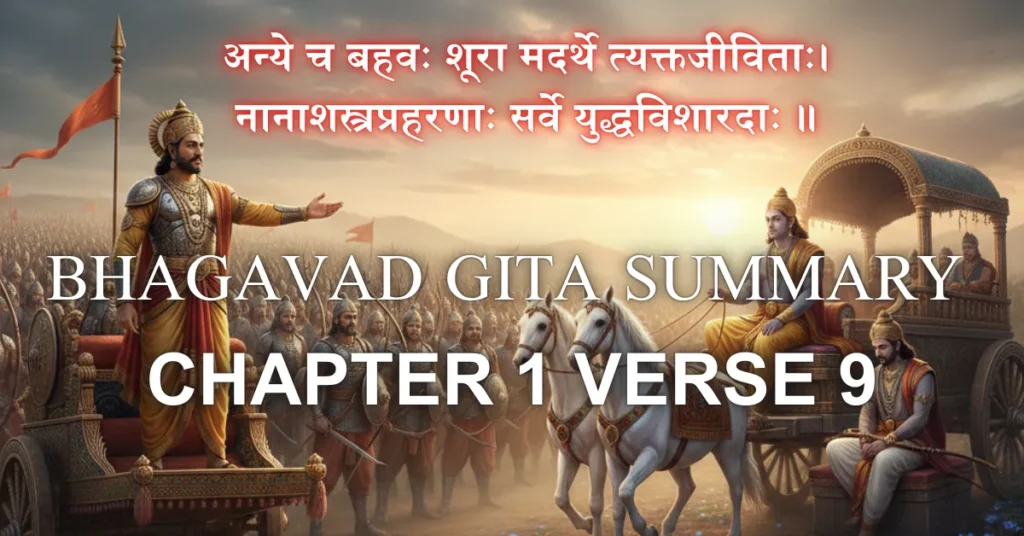
Translation of Bhagavad Gita Shloka Verse 1.9 in English:
अन्ये च बहवः शूरा मदर्थे त्यक्तजीविताः।
नानाशस्त्रप्रहरणाः सर्वे युद्धविशारदाः ॥
In English :
Anye ca bahavaḥ śūrā mad-arthe tyakta-jīvitāḥ
Nānā-śastra-praharaṇāḥ sarve yuddha-viśāradāḥ
Feel the Vibration: A Guided Chant of Bhagavad Gita Chapter 1 Verse 9:
- Anye ca bahavaḥ śūrā mad-arthe tyakta-jīvitāḥ
An-ye cha ba-ha-vah shoo-raa Mad-ar-the tyak-ta jee-vi-taah - Nānā-śastra-praharaṇāḥ sarve yuddha-viśāradāḥ
Naa-naa shas-tra pra-ha-ra-naah Sar-vey yud-dha vi-shaa-ra-daah
English Translation:
“There are many other heroes, ready to give up their lives for me. They are armed with many kinds of weapons and are all skilled in warfare.”
JOIN THE HISANATANI COMMUNITY
Get daily Verse Summaries & High-Res Posters directly on your WhatsApp.
JOIN CHANNELA Quiet Whisper for Your Busy Mind
Some days life feels louder than it should. Your phone keeps buzzing, responsibilities stack up, and your mind keeps preparing for problems that haven’t even happened yet. You create backup plans for your backup plans, thinking that if you just gather enough security — more money, more support, more control — you’ll finally feel safe. Yet, strangely, the heart still feels restless.
If this sounds familiar, take a slow breath.
Because this is exactly where the wisdom of the Bhagavad Gita meets you — not as philosophy, but as quiet guidance. Bhagavad Gita Chapter 1 Verse 9 gently shows us something surprising: piling up outer strength cannot calm an inner storm. Real steadiness begins within. Think of this verse as a small lamp in the dark, a simple life manual reminding you that courage is not collected — it is discovered inside your own soul.
Seeing the Verse Like a Child Would

If you were to explain this scene to a child, it would sound simple. Imagine a boy about to play a big match. Instead of trusting himself, he keeps saying, “Don’t worry, my team is huge… we have so many players… we can’t lose.” He repeats it again and again. The louder he speaks, the more you sense he is scared.
That is exactly what Duryodhana is doing. He is not calm. He is convincing himself.
The lesson from Bhagavad Gita Chapter 1 Verse 9 is gentle but powerful. Strength is not about how many friends stand behind you. It is about how steady you feel inside. Even a small person with courage can stand tall, while a crowd without confidence trembles. The Gita begins teaching this truth in the simplest way possible.
The Deeper Philosophy of False Security

At a deeper level, this verse reveals a timeless human habit. We believe accumulation equals protection. More money feels safer. More contacts feel stronger. More tools feel smarter. Yet history keeps proving that nothing external truly protects us forever.
Duryodhana’s army is massive, yet destiny does not favor him. Why? Because truth and clarity matter more than numbers.
The philosophy here is subtle. Anything outside you can disappear. Wealth can burn. Armies can fall. Relationships can change. But the awareness within you — the witnessing consciousness — remains untouched. The Bhagavad Gita Summary 1.9 slowly redirects us from dependence on the outer world to trust in the inner Self. That is the real foundation of strength.
Psychological Perspective: Why Your “Safety Nets” Aren’t Working

This verse feels surprisingly familiar in our modern world. Today, we gather backups for everything: backup careers, backup savings, and backup validation through social media. Yet, stress levels keep rising. It’s like carrying ten umbrellas and still worrying about rain.
This happens because fear doesn’t disappear through quantity; it dissolves through clarity.
Duryodhana is essentially “doom-scrolling” his own army list to calm a racing heart. It’s the ancient version of the “LinkedIn Profile Syndrome”—listing skills and high-end tools to convince ourselves we are okay. But the Gita reminds us that anxiety doesn’t care about your resume. If you are fighting a war against your conscience (Dharma), no amount of “various weapons” or coping mechanisms will provide true mental stillness.
Turning Inward Toward the Divine Source: Spiritual aspect of Bhagavad Gita 1.9.

Spiritually, every warrior mentioned in this verse represents our own worldly abilities—our talents, our sharp senses, and our specialized skills. But without a connection to something higher, they are like weapons without direction.
There is a profound contrast hidden here. On one side, we hear the language of the Ego: “My warriors. My army. My strength.” On the other side, we see the posture of the Seeker: “Guide me. 🙏” One depends on force; the other depends on Grace. One clings to the temporary; the other surrenders to the Eternal. When we rely solely on our “army” of possessions and control, life feels heavy and fragile. But when we realize that the Divine stands within us, fear dissolves. True spiritual strength isn’t about how many people stand with you—it is about how closely you are aligned with the Self.
The Historical Pulse of the Battlefield : The Calm Before the Storm
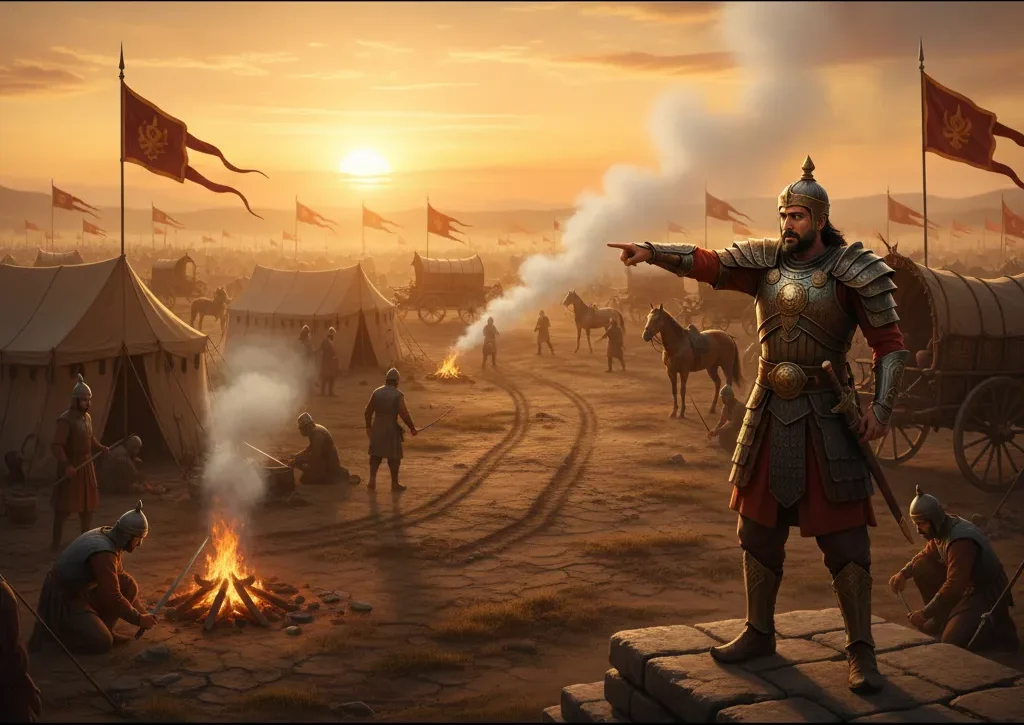
On the battlefield of Kurukshetra, conches had already sounded. War was only seconds away. Duryodhana stood between two vast armies and approached his Guru, Drona, listing his “Arsenal of Kurukshetra.”
He wasn’t exaggerating. The Kaurava army was objectively superior in numbers and technology. They possessed Nānā-śastra-praharaṇāḥ—a sophisticated array of weaponry ranging from long-distance projectile ‘Astras’ to hand-to-hand ‘Shastras.’
But history reveals a striking irony here. He had the world’s greatest archers and the most disciplined professionals, yet he was trembling. This verse captures the exact psychological tremor before destiny unfolds. It sets the stage for a tragic truth: a leader can have the greatest technology and the largest team, but if they are bound to a throne of injustice, their power eventually collapses under its own weight.
Your Manual for Today: The “Quiet Strength” Practice

How can we bring the wisdom of this verse into our busy lives today? It starts with a simple shift in where we look for security.
A Small Reflection: Take a moment to look at the two “armies” we all carry:
- The Outer Army: Our job titles, the numbers in our bank accounts, our social media followers, and our “back-up plans.”
- The Inner Army: Our quiet clarity, our integrity, our breath, and our inner peace.
Ask yourself gently: Which of these truly protects me at 3 AM when I feel anxious?
The 24-Hour Practice: Today, try to spend just fifteen minutes away from the noise of your “Outer Army.” Sit quietly with your breath. Notice that you are whole and complete even without your achievements or possessions.
Feel that stillness. It is your real strength. Once you begin to trust that quiet power inside you, the battles on the outside won’t feel so frightening anymore.
Beyond the Battlefield
The warriors of the Gita stood ready to give everything for their cause. Today, the world doesn’t ask for your life, but it does ask for your attention, your integrity, and your courage.
Will you show up to your life with the expertise of a master and the heart of a hero?
Step into the light of the Gita every single day. Let’s navigate this battlefield together.
Please let me know in the comment .
Embrace the Teachings of the Gita. Dive deeper into the Bhagavad Gita to uncover its timeless wisdom and practical guidance. Let its verses inspire you to cultivate inner clarity, align with higher values, and navigate life’s challenges with courage and grace.
🌼 Join the HiSanatani WhatsApp Channel for your daily dose of light 🪔.Join Now.
Voice of the Soul
Finding clarity in the questions we all carry…
What is the meaning of Bhagavad Gita Chapter 1 Verse 9?
It captures human insecurity. Duryodhana boasts of his army to quiet an internal fear. As we explored in Seeing the Verse Like a Child Would, it is the sound of a heart trying to convince itself of its own power.
What does ‘mad-arthe’ mean in Verse 9?
It means “for my sake.” It shows Duryodhana’s ego-driven view that others exist only for his ambition. In Spiritual Alignment, we learn to shift this into an “offering,” turning ego-stress into a flow of grace.
What does ‘Tyakta-jīvitāḥ’ mean in a modern context?
It refers to Total Cognitive Immersion. When you are so dedicated to a purpose that “what-ifs” disappear, your anxiety drops. Removing the “Exit Strategy” is the secret to peak performance.
What is the spiritual takeaway?
True security comes from the Divine Source, not material control. Without this inner direction, as seen in our Spiritual Perspective, even the best talents are just “weapons without a map.“
What life lesson does Gita 1.9 give us?
It teaches that noise is often fear wearing armor. Real security comes from Inner Stability, not numbers. We practice this “Quiet Strength” in today’s 24-Hour Gita Exercise.
How is this verse relevant today?
Modern stress comes from “doom-scrolling” our assets—likes, money, or followers—to feel safe. The Psychological Lens reminds us that external validation can never heal internal fear.
