
Namaste 🙏
Welcome to Hi Sanatani. It’s a joy to have you here as we explore the deeper layers of human nature. By diving into this Bhagavad Gita Summary 1.12, we create a sacred bridge together, turning ancient verses into helpful tools for your personal growth and peace.
Translation of Bhagavad Gita Shloka Verse 1.12 in English:
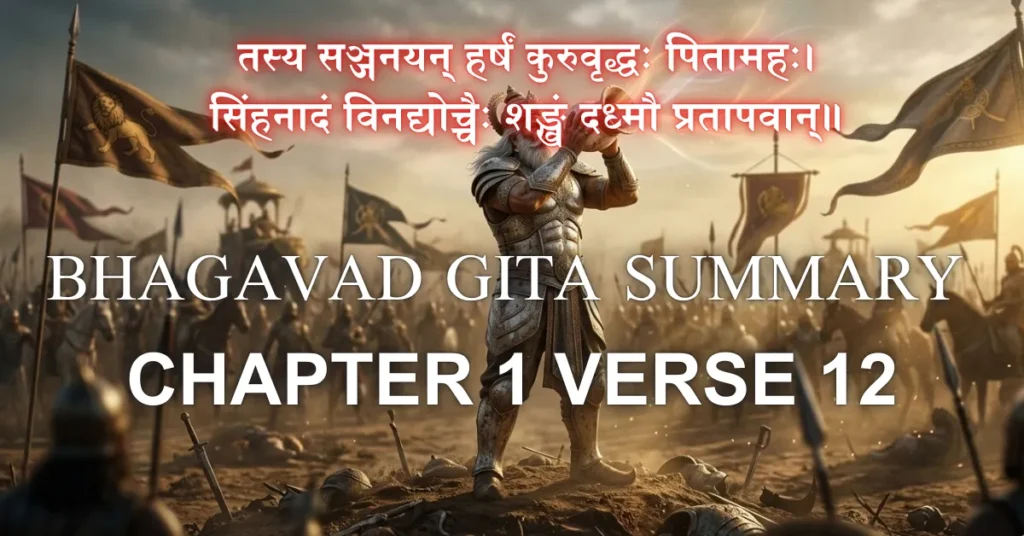
तस्य सञ्जनयन्हर्षं कुरुवृद्धः पितामहः ।
सिंहनादं विनद्योच्चैः शङ्खं दध्मौ प्रतापवान् ॥
In English :
tasya sañjanayan harṣaṁ kuru-vṛddhaḥ pitāmahaḥ
siṁha-nādaṁ vinadyocchaiḥ śaṅkhaṁ dadhmau pratāpavān
Feel the Vibration: A Guided Chant of Bhagavad Gita Chapter 1 Verse 12:
- tasya sañjanayan harṣaṁ kuru-vṛddhaḥ pitāmahaḥ
Ta-sya | San-ja-na-yan | Har-sham | Ku-ru-vridd-hah | Pi-taa-ma-hah - siṁha-nādaṁ vinadyocchaiḥ śaṅkhaṁ dadhmau pratāpavān
Sim-ha | Naa-dam | Vi-nad-yo-ch-chaih | Shan-kham | Da-dhmau | Pra-taa-pa-vaan
English Translation:
“Then the mighty grandsire Bhīṣma, roaring like a lion and bringing joy to Duryodhana, loudly blew his conch shell.”
JOIN THE HISANATANI COMMUNITY
Get daily Verse Summaries & High-Res Posters directly on your WhatsApp.
JOIN CHANNELA Quiet Whisper for Your Busy Mind
We live in a world of “mental noise”—notifications, deadlines, and the constant “what-ifs” of the future. Just like Duryodhana, we often get lost in the math of our problems. We count our resources and still feel poor; we count our friends and still feel lonely.
Bhagavad Gita Chapter 1 Verse 12 is your soul’s “alarm clock.” It tells you that when the world gets too loud with doubt, you need to find your inner “Lion’s Roar.” This verse isn’t just about a battle; it’s about the moment you decide to stop worrying and start doing. It’s the manual for transforming anxiety into decisive action.
The Verse in Plain Words for a Peaceful Mind

Imagine a school sports day. Everyone is nervous. No one wants to start. Then the whistle blows.
and Suddenly — Action.
That’s this verse Bg1.12.
Bhīṣma simply blows a conch shell to encourage his team. It’s like saying, “Don’t be afraid. I’m with you. Let’s go!”
For a child:
👉 It means “Be brave when life begins something difficult.”
For us:
👉 Start your day with confidence.
Sometimes we wait too long for perfect conditions. But courage often begins with just one step, It’s not big. It’s subtle.
We wait for giant motivation. Life gives us tiny signals.
A bell. A breath. A prayer. A friend’s voice. These are inner anchors.
Deep diving in Bhagavad Gita Summary 1.12 we will learn :
Action creates confidence. Not the other way around. And Action is the best cure for fear.
The Eternal Logic Behind Krishna’s Words

Why mention a conch at all?
Because the Gita 1.12 teaches that energy precedes action.
Sound (Nāda) is the first vibration of creation. Even the universe began with sacred resonance — Om.
Bhishma’s roar represents Vibrational Leadership. While Duryodhana felt a shallow “Harsham” (joy), the universe heard the bell of destiny. In the professional world, we often wait for “perfect data” before moving. The logic here is that Dharma (Duty) creates its own momentum. You act, not because you’re sure of the win; you act because you know the “time of the lion” has arrived. The “Why” is simple: the soul must eventually express its purpose, and the “Roar” is the sound of that expression breaking through the resistance of the ego.
In this journey of Bhagavad Gita summary 1.12 , we can see ,Without inner alignment, even strength fails.
With inner conviction, even weakness triumphs.
This verse quietly tells us:
Victory begins in consciousness, not in circumstance.
Psychological Perspective: How One Sacred Tone Calms the Anxious Brain

Modern life is an endless battlefield of notifications.
Ping. Scroll. Compare. Worry.
Your nervous system never rests.
Psychology calls this “hyper-arousal.”
In this Bhagavad Gita summary 1.12, Bhīṣma offers the ultimate antidote—a single-pointed cue.
One sound. One focus. One moment.
That is the essence of grounding. When attention narrows, anxiety drops. When breath slows, cortisol lowers.
Ancient warriors knew this instinctively;
Today, we call it mindfulness.
In the context of Bhagavad Gita Chapter 1 Verse 12, the conch is basically a prehistoric meditation bell.
It tells the brain: “Come back. Be here.”
Modern psychology talks about “Pattern Interrupts”—a technique to stop a downward spiral of negative thoughts.
Duryodhana was spiraling into anxiety, paralyzed by his own mental noise. Bhīṣma used the conch sound as a sensory intervention to force a mental reset. Imagine starting your day not with your phone… but with silence. Or one chant. Or three deep breaths. You’ll feel the difference immediately. Because, as taught in Bhagavad Gita Chapter 1 Verse 12, the mind doesn’t need more information. It needs Alignment.
Awaken the Inner Atman : The Sacred Resonance of Bhagavad Gita 1.12.

Spiritually, the conch is sacred across temples and rituals in India. It is said to purify space and invite grace. But as we see in this Bhagavad Gita summary 1.12, its deeper meaning is inward.
The conch reminds us of the inner sound—the subtle vibration sages call Om. It’s always there.
Behind thoughts. Behind fear.
When you sit quietly, you may feel it—a hum of existence. That is your true nature.
The sounding of the shell in Bhagavad Gita Chapter 1 Verse 12 mirrors that inner truth.
Bhīṣma is not creating strength from the outside; he’s reminding everyone of the strength that already exists within the soul.
Sometimes, God doesn’t give us a hug; He gives us a trumpet blast to wake us up from our spiritual slumber.
Spiritual growth is not about adding something new to your life. It’s about remembering what was never lost.
And sometimes… all it takes is a sacred sound to remember.
This Bhagavad Gita Chapter 1 Verse 12 summary invites us to see our daily challenges as a “Sacred Call.”
When you hear the “conch” of a new responsibility or a difficult task, don’t shrink away.
Realize that the strength to blow that conch comes from the Atman within. You aren’t just a professional doing a job; you are a divine spark answering the call of duty.
The Echoes of Kurukshetra: Commanding the Field

History remembers Bhīṣma as the unconquerable commander.
At this moment, he was the oldest man on the field, yet he possessed the loudest voice.
This was a strategic psychological move captured perfectly in this Bhagavad Gita summary 1.12.
By blowing the conch, Bhīṣma officially opened the doors of war. It was a moment of ancient chivalry. He was telling the Pāṇḍavas, “The lion is awake; prepare yourselves.”
In the scene described in Bhagavad Gita Chapter 1 Verse 12,
when he blows the conch, morale surges.
Leadership isn’t words. It’s energy transmission.
The entire army borrows his confidence.
This is timeless—in offices, in families, and in modern teams.
The calmest heart becomes the anchor.
One steady person stabilizes everyone.
This lesson from Bhagavad Gita Chapter 1 Verse 12 teaches us: Be the vibration others can lean on.
Whether you are leading a corporate department or a household, your “roar” of confidence is what sets the tone for those around you.
Your 24-Hour Gita Challenge: Putting Wisdom into Action

Let’s make this intimate.
This Bhagavad Gita summary 1.12 is not just a history lesson; it is a manual for your morning.
Tomorrow morning, try this:
Sit quietly. Close your eyes.
Take 5 slow breaths.
Chant “Om” once. Feel the chest vibrate.
That is your conch. Don’t rush.
Let the day begin from that space.
This small ritual, inspired by the spirit of Bhagavad Gita Chapter 1 Verse 12, resets your emotional frequency.
You’ll notice: Clearer thoughts. Less fear . Softer reactions . Stronger decisions .
It takes 60 seconds. But it changes the entire day.
Because you’re no longer reacting to life—you’re responding from your center.
And that’s exactly what Bhagavad Gita Chapter 1 Verse 12 trains us to do: to find our roar before the battle begins..
Beyond the Battlefield
The roar of Bhishma’s conch still echoes today through the wisdom of Bhagavad Gita Chapter 1 Verse 12. It asks each of us a fundamental question: Are you going to stay lost in the whispers of your fear, or are you ready to find the courage of the lion? Life is a battlefield, and as this Bhagavad Gita summary 1.12 illustrates, our internal state dictates our external victory. You don’t have to walk this path alone. When you align your actions with your duty (Dharma), the universe itself provides the strength and resonance you need to succeed.
Please let me know in the comment .
Embrace the Teachings of the Gita. Dive deeper into the Bhagavad Gita to uncover its timeless wisdom and practical guidance. Let its verses inspire you to cultivate inner clarity, align with higher values, and navigate life’s challenges with courage and grace.
🌼 Join the HiSanatani WhatsApp Channel for your daily dose of light 🪔.Join Now.
Voice of the Soul
Finding clarity in the questions we all carry…
What is the spiritual meaning of the conch in Bhagavad Gita 1.12?
In Bhagavad Gita Chapter 1 Verse 12, the conch represents more than a war signal. It is a symbol of sacred resonance—the inner “hum” of the universe. It reminds us that we don’t need to look outside for strength; we just need to wake up the divine power that is already sleeping inside our hearts.
Why did Bhishma blow his conch to make Duryodhana happy?
Bhishma saw that Duryodhana was paralyzed by hidden fear. As a wise elder, he blew his conch to provide a tactical signal—a “lion’s roar” to break the silence of worry. This is a verse in plain words about how one bold action from a leader can give an entire team the courage to start.
How can the “Lion’s Roar” help me stop overthinking?
Modern psychology calls this a psychological reset. When your mind is stuck in a loop of “what-ifs,” you need a “Pattern Interrupt.” By taking one deep breath or making one firm decision, you snap out of the fog. It’s about shifting from a “worrying mind” to a “vibrating heart.”
What does a “Lion’s Roar” look like in modern leadership?
In the echoes of Kurukshetra, the roar wasn’t about being loud; it was about being certain. For leaders today, it represents energy transmission. It means being the calmest person in the room so that others can lean on your confidence when things get chaotic.
Why did Bhishma fight for the “wrong” side?
Bhishma’s life is a lesson in eternal logic and duty. Even though he didn’t agree with Duryodhana, he stayed true to his word. He shows us how to do our duty with 100% intensity without getting attached to the result—a practice known as Karma Yoga.
How can I use Verse 1.12 to improve my workday?
Try a 60-second resonance ritual before you check your emails. Take the 24-hour Gita challenge: pick the one task you are most afraid of and attack it with “lion-like focus” first thing in the morning. Action is the best cure for workplace anxiety.
