Namaste 🙏
Welcome to Hi Sanatani. It’s a joy to have you here as we explore the deeper layers of human nature. By diving into this Bhagavad Gita 1.18 Summary, we create a sacred bridge together, turning ancient verses into helpful tools for your personal growth and peace.
Translation of Bhagavad Gita Shloka Verse 1.18 in English:
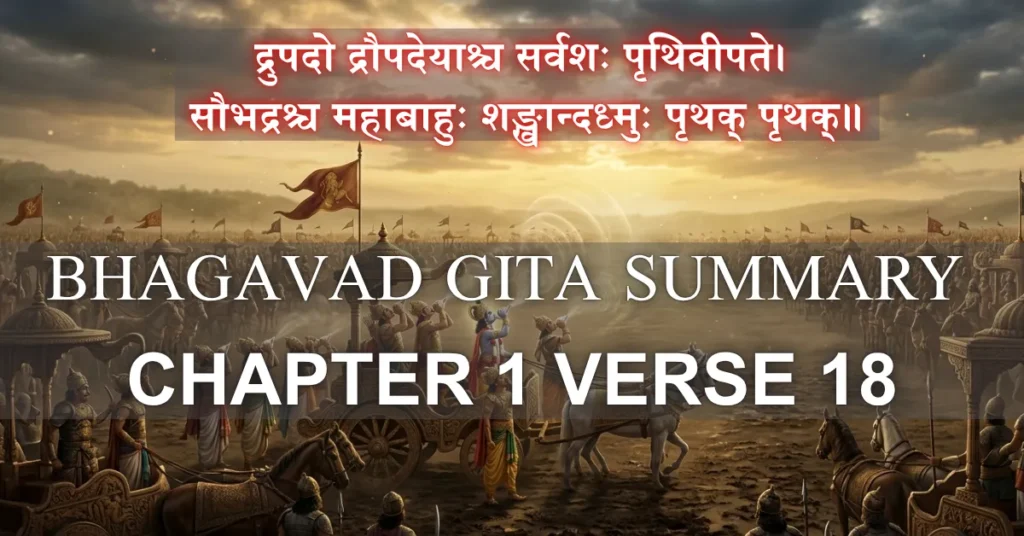
द्रुपदो द्रौपदेयाश्च सर्वशः पृथिवीपते।
सौभद्रश्च महाबाहुः शङ्खान्दध्मुः पृथक् पृथक्॥
In English :
drupado draupadeyāśca sarvaśaḥ pṛthivīpate |
saubhadraśca mahābāhuḥ śaṅkhāndadhmuḥ pṛthak pṛthak ||
Feel the Vibration: A Guided Chant of Bhagavad Gita Chapter 1 Verse 18:
- drupado draupadeyāśca sarvaśaḥ pṛthivīpate |
Dru-pa-do Drau-pa-de-ya-shcha Sar-va-shah Pri-thi-vi-pa-te - saubhadraśca mahābāhuḥ śaṅkhāndadhmuḥ pṛthak pṛthak ||
Sau-bha-drash-cha Ma-ha-ba-huh Shan-khan-dadh-muh Pri-thak-pri-thak
English Translation:
“O Lord of the Earth, King Drupada, the sons of Draupadi, and the mighty-armed son of Subhadra, all blew their respective conch shells.”
JOIN THE HISANATANI COMMUNITY
Get daily Verse Summaries & High-Res Posters directly on your WhatsApp.
JOIN CHANNELA Quiet Whisper for Your Busy Mind
In the relentless hustle of 2026, the noise of social media, corporate targets, and personal expectations can feel like a battlefield within our mind. You often feel like a lone soldier. This Summary of Bhagavad Gita 1.18 is your soul’s reminder that you are not alone. Just as the Pandavas stood with their allies, your inner strengths—your discipline, your kindness, and your resilience—are blowing their conch shells or say standing alongside you. This verse acts as a “Life Manual” to help you gather your internal “allies” and find your voice when the world tries to drown you out.
Finding Your Voice in the Crowd

In this Bhagavad Gita Chapter 1 Verse 18, many different kings blow their shells together. Think of it like a school assembly or a big football game.
Even though there are many people, every single person’s voice matters to make a big “Roar.”
If we explain this to a child or a peaceful mind, this means that when you work with good friends for a good cause,
your combined “sound” becomes powerful enough to scare away any “bully” or “bad thought.”
👉 You don’t need to be alone in your struggles.
👉 Your “team” could be your habits, your values,
The Eternal Logic Behind Collective Power in BG1.18

Why does Krishna describe each warrior separately?
Because existence itself is built on individual expression within universal unity. Philosophically, this verse delves into the concept of unity in diversity.
Each warrior blows his conch “separately,” yet together they create a harmonized force. This mirrors life—individual identities merging into a larger purpose.
Krishna subtly shows that:
👉 Truth (Dharma) is never weak when aligned collectively.
👉 Strength is not in uniformity, but in aligned individuality.
In modern terms we can say A successful company isn’t made of identical thinkers—it thrives when diverse minds work toward a shared vision.
The Summary of Bhagavad Gita 1.18 teaches us that when our intellect, emotion, and action vibrate unitedly, the resulting resonance is enough to shatter the illusions of the ego.
Psychological Perspective: Healing the Modern Mind Through Inner Alignment

Your mind is rarely silent. It’s a battlefield of voices:
- One part of it wants growth
- Another fears failure
- One seeks peaceAnother chases validation
This inner conflict creates anxiety.
Psychologically, this verse has very powerful message.
Your mind is like that battlefield—where your inner voices are disconnected.
But when your thoughts, beliefs, and actions align—
👉 You gain confidence
👉 You reduce mental noise
👉 You act decisively
This “conch-blowing” is symbolic of mental synchronization.
Modern burnout often comes from internal conflict. This verse teaches us that:
Align your inner voices, and your outer world will stabilize.
Awaken the Inner Atman : The Sacred Resonance of Bhagavad Gita 1.18
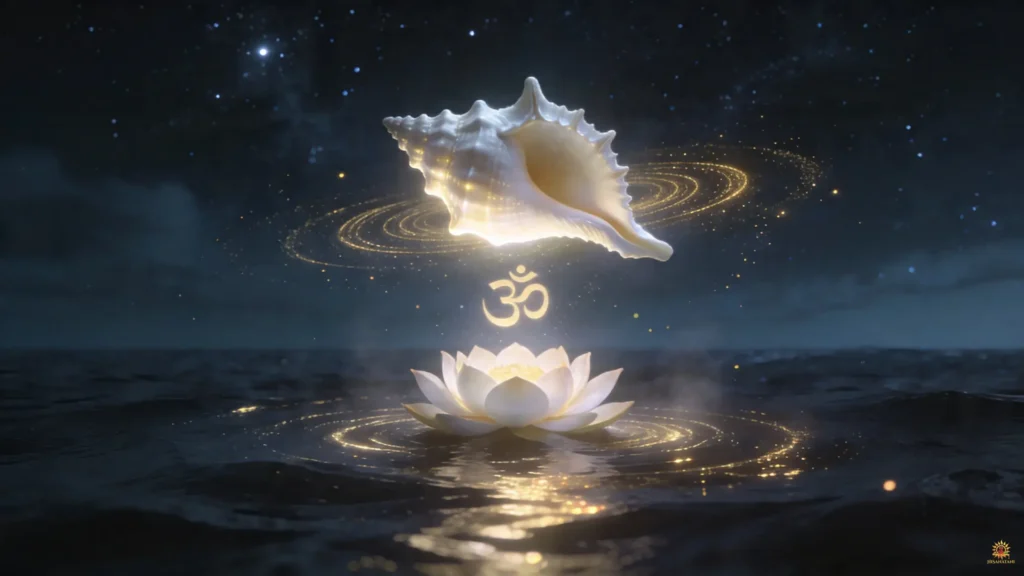
Spiritually, the different conch shells represent the different Vrittis (fluctuations) of the mind being tuned to the Divine.
It is not just an instrument—it is a symbol of cosmic vibration.
Each warrior represents a divine quality within you.When Abhimanyu (the soul’s courage) and Drupada (the soul’s wisdom) announce their presence, the “Atman” is ready for battle.
This is about vibrating at a higher frequency.
When you live with integrity, your life becomes a “Shankha” (conch) that echoes the Divine Will.
So when Bhagavad Gita Chapter 1 Verse 18 describes multiple conchs, it is actually pointing toward a deeper truth:
Your soul is awakening through many layers, not just one.Spiritual growth is not linear.
It is a multi-dimensional unfolding.
The Echoes of Kurukshetra: A Battlefield of Energy, Not Just Weapons
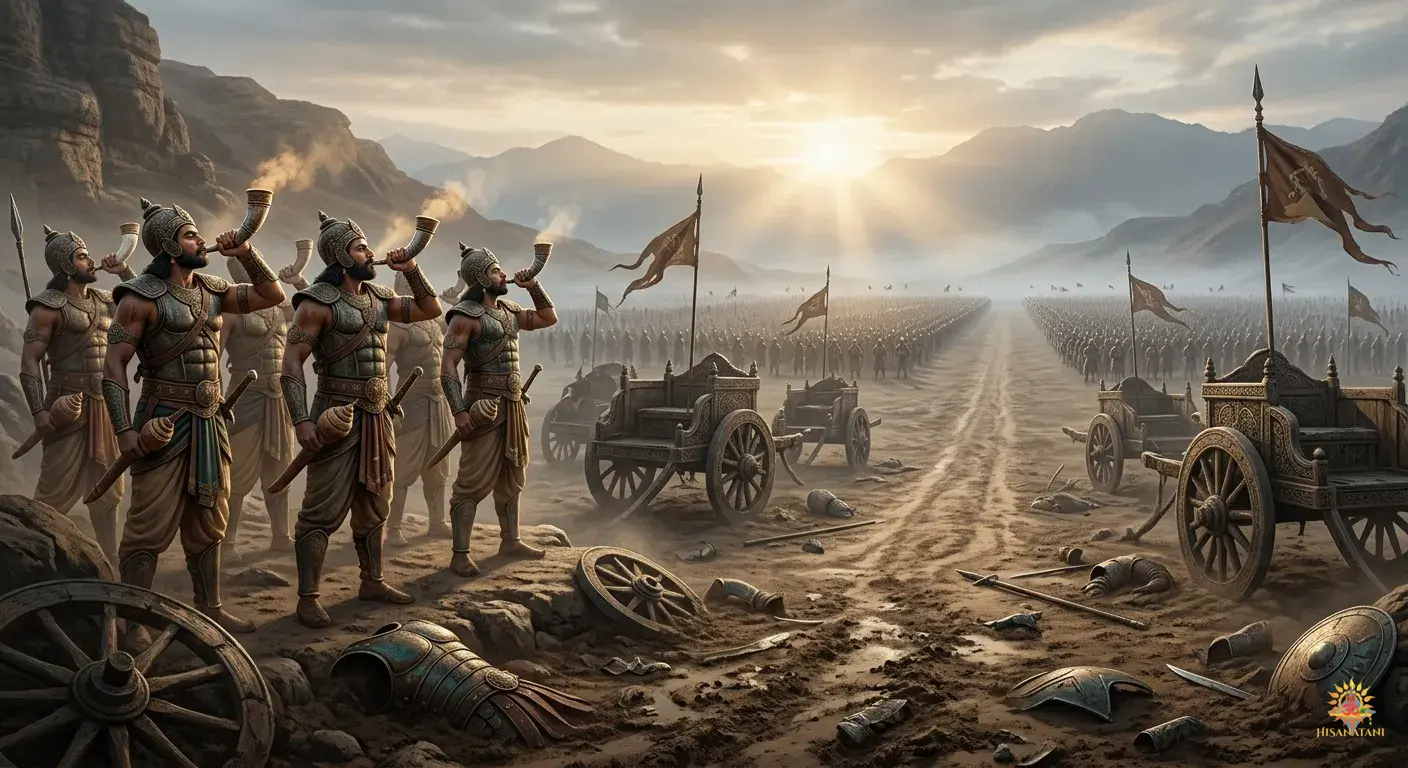
Historically, this verse BG1.18 emphasizes the tragedy and the nobility of the war. Drupada was the father-in-law, the sons of Draupadi were the future heirs, and Abhimanyu was the beloved nephew.
By listing them, the Gita highlights that the entire lineage was at stake.
It provides a sobering look at how Dharma sometimes requires the ultimate sacrifice from every generation.
This context reminds us that the struggle for truth is a relay race, passed down from the experienced to the young.
Your 24-Hour Gita Challenge: “Confidence Call” Audit

Today, take a “Life Manual” moment to audit your environment.
What are you letting into your ears and mind?
Is it “Noise” (gossip, negativity, mindless scrolling) or
“Resonance” (uplifting music, sacred chanting, meaningful conversation)?
Your Challenge: For the next 24 hours, intentionally “blow your conch” by speaking only words that are true, kind, and necessary. Identify one difficult conversation you’ve been avoiding.
Before you speak, take three deep breaths (mimicking the effort of blowing a conch) and speak your truth with the authority of someone who has “mighty allies” backing them.
Do not mumble; let your “Dharma” be heard clearly in your workspace or home.
Notice how this single action changes the “vibration” of your home or office, as practiced in The Power of Your Inner Team.
Beyond the Battlefield
Life will always present its battlefield moments.
The question is—will you stay silent, or will you rise with your inner army?
Bhagavad Gita Summary 1.18 teaches you this:
You are strongest when your inner world stands united.
is not about conchs.
It is about your inner symphony.
So the next time you feel scattered, don’t panic.
Pause. Listen. Align.
So today, don’t whisper your fears—
Declare your courage. Let your inner sound rise.
Please let me know in the comment .
Embrace the Teachings of the Gita. Dive deeper into the Bhagavad Gita to uncover its timeless wisdom and practical guidance. Let its verses inspire you to cultivate inner clarity, align with higher values, and navigate life’s challenges with courage and grace.
🌼 Join the HiSanatani WhatsApp Channel for your daily dose of light 🪔.Join Now.
Voice of the Soul
Finding clarity in the questions we all carry…
What does Bhagavad Gita Chapter 1 Verse 18 mean?
It describes Pandava warriors blowing conchs individually, symbolizing unity through diversity and readiness.
👉 Revisit “Finding Your Voice in the Crowd for a simple explanation.
What is the deeper meaning of “prithak prithak”?
What is the deeper meaning of “prithak prithak”?
It means “separately,” highlighting individuality within unity—a key philosophical insight of the Gita.
👉 Explore “The Eternal Logic Behind Collective Power”
How does BG 1.18 help with anxiety?
It teaches aligning inner thoughts instead of suppressing them, creating emotional balance and clarity.
👉 Read “Healing the Modern Mind Through Inner Alignment”
Is Bhagavad Gita Chapter 1 Verse 18 spiritually significant?
Yes, it represents awakening of inner divine qualities and alignment with cosmic vibration.
👉 Dive into “Awaken the Inner Atman”
What practical lesson can I apply today from this verse?
Focus on aligning your inner conflicts and take one action toward clarity.
Is Bhagavad Gita Chapter 1 only about war?
Is Bhagavad Gita Chapter 1 only about war?
No, it symbolically represents inner conflict and the journey toward clarity and Dharma.
👉 Reflect on “The Eternal Logic Behind Collective Power.”
