
Namaste 🙏
Welcome to HiSanatani. It’s a joy to have you here as we explore the deeper layers of human nature. By diving into this Bhagavad Gita 1.19 Summary, we create a sacred bridge together, turning ancient verses into helpful tools for your personal growth and peace.
Translation of Bhagavad Gita Shloka Verse 1.19 in English:
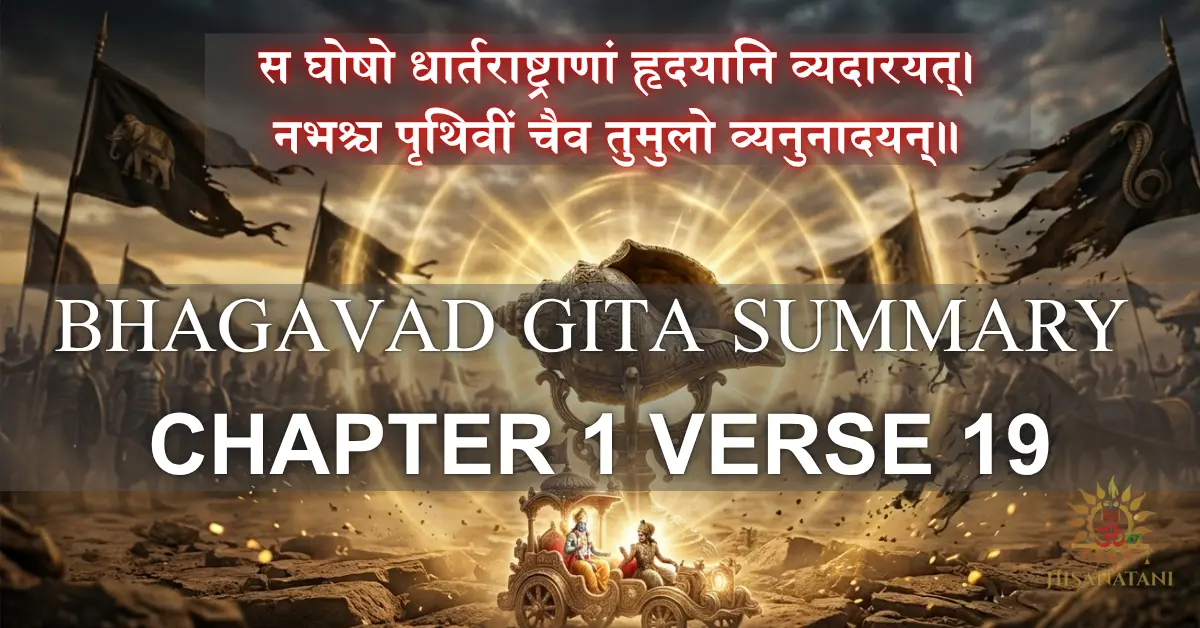
स घोषो धार्तराष्ट्राणां हृदयानि व्यदारयत् ।
नभश्च पृथिवीं चैव तुमुलो व्यनुनादयन्॥
In English :
sa ghoṣo dhārtarāṣṭrāṇāṃ hṛdayāni vyadārayat |
nabhaśca pṛthivīṃ caiva tumulo vyanunādayan ||
Feel the Vibration: A Guided Chant of Bhagavad Gita Chapter 1 Verse 19:
- sa ghoṣo dhārtarāṣṭrāṇāṃ hṛdayāni vyadārayat |
sa | gho-sho | dhaar-ta-raash-traa-naam | hri-da-yaa-ni | vya-daa-ra-yat | - nabhaśca pṛthivīṃ caiva tumulo vyanunādayan ||
na-bhash-cha | pri-thi-veem | chai-va | tu-mu-lo | vya-nu-naa-da-yan ||
English Translation:
“That resounding vibration tore through the hearts of Dhritarashtra’s sons and echoed powerfully across the sky and the earth.”
JOIN THE HISANATANI COMMUNITY
Get daily Verse Summaries & High-Res Posters directly on your WhatsApp.
JOIN CHANNELA Gentle Reminder for Your Restless Heart
There are days when everything feels loud — but noisy, nothing feels clear.
You scroll. You think. You worry. And somewhere deep inside, a quiet unease just sits there.
This verse doesn’t add more noise. It offers something rarer — resonance.
Truth isn’t something you shout. It’s something you become.
And when you do, even your smallest expression carries a vibration, strong enough to dissolve fear — within you and around you.
Your peace isn’t found in a quiet room. wherever you are, just close your eyes and feel.
It lives in a soul that vibrates with such clarity that the world’s chaos simply cannot touch it.
Let this be your pause. Your return.
When Truth Feels Strong Without Effort

Let’s keep it simple.
Imagine a classroom. One student studied — sits calmly, no fidgeting. The other hasn’t prepared — eyes darting, leg bouncing.
Teacher says: “Let’s begin.”
Who feels shaken?
That’s exactly what this verse is about.
The Pandavas’ sound in Bhagavad Gita Chapter 1 Verse 19 is loud, not because they want to scare everyone. It’s powerful because they’re aligned. The Kauravas feel fear not because of the Intensity — but because of what that sound reflects back to them.
Their own guilt.
When you’re completely honest — with yourself, with others — you don’t need to prove anything.
Your calm becomes your loudest statement.
Integrity is your loudest instrument.
The Invisible Law: Why Truth Disturbs the Untrue

Bhagavad Gita 1.19 summary reveals something quietly profound: Truth does not attack — it exposes.
The Kauravas aren’t defeated by sound. They’re confronted by their own inner dissonance.
Think of it this way.
A specific frequency can shatter glass — not by force, but by resonance. When the right vibration meets a fragile structure, the structure collapses under its own weakness.
Same principle here.
The Pandavas’ divine sound meets the Kauravas’ inner fragmentation — and something cracks.
This is why:
A lie feels threatened in the presence of honesty.
Ego feels uncomfortable in the presence of humility.
Control feels shaken in the presence of surrender.
Truth is not aggressive. It’s coherent. And coherence has a natural power — it reorganizes everything around it.
Standing in truth often feels lonely. But here’s the thing — it also feels, eventually, deeply powerful.
Psychological Perspective: Where Anxiety Actually Begins

Here’s something worth sitting with.Anxiety is not always caused by the situation. Most of the time, it comes from misalignment within.Look at the Kauravas. Massive army. Brilliant strategist. Resources. Numbers. Yet they felt fear the moment the Pandavas’ sound hit the air.Why?Because somewhere, they knew.They knew their cause wasn’t rooted in truth. That knowing created a silent crack in their psyche.Modern life looks exactly the same:
Overthinking — despite success.
Stress — despite control.
Fear — despite preparation.
This verse gently asks: Where in your life are you out of alignment?
Peace doesn’t come from controlling outcomes. It comes from aligning with truth. One powerful conviction — held steady — can silence a thousand nagging doubts.
The Sacred Vibration: When Sound Becomes Consciousness

In spiritual terms, the sound in this verse isn’t auditory. It’s vibrational consciousness.
The conches the Pandavas blow are not just instruments — they’re symbols of awakened awareness. The sound carries intention, purity, and surrender.
This is why it echoes through both sky and earth. It isn’t limited by space.
When your actions arise from truth rather than ego:
Your words carry weight and the world pauses to listen.
Your silence carries depth inviting others to dive deeper.
Your presence carries peace and everyone longs to be near you.
This is the journey from noise to Nada — sacred sound. You don’t create this power. You allow it by becoming aligned.
And when you allow it — when you let something higher than your ego lead?Even the strongest opposition has no choice but to feel it.
Before the First Arrow: The War Within Was Already Won

No arrows. No swords. No blood. Not yet.
But something irreversible has already happened.
The Kauravas had spent years building their advantage — allies, resources, strategy. Bhishma as commander. Numbers that dwarfed the Pandava side.
And yet — the moment Krishna’s Panchajanya and Arjuna’s Devadatta rang out, the psychological field shifted.
The Kauravas felt it — not as strategy, but as disturbance. This is the exact second when a bully realizes the person they’ve been pressuring is no longer afraid.
Because war is never just physical.
It is:
Mental — who believes they will win.
Emotional — who is carrying guilt.
Energetic — whose cause aligns with truth.
In BG 1.19, the Pandavas had already won in all three layers before a single weapon moved. History confirms: Victory begins in the unseen.
Your 24-Hour Gita Challenge: Become the Resonance

Today, don’t try to be louder. Try to be truer.
Three steps. Under 10 minutes total.
Step 1 — Name your noise.
What’s creating the most inner friction right now? A decision you’re avoiding? A truth you’re suppressing? A role you’re forcing? Name it. Don’t skip this.
Step 2 — The 5-Minute Resonance Practice.
Find 5 minutes of stillness. Chant “Om” — or if that’s not your style, breathe deeply and repeat one simple truth to yourself. Feel the vibration in your chest. Visualize it quietly dissolving the friction you named in Step 1. Not forcing. Just allowing.
Step 3 — Align one action.
Pick one small step today that moves you toward truth — not toward what looks good, but toward what’s actually right. Say no to something draining. Send an honest message. Make the decision you’ve been postponing.
Notice what shifts.
When you align, your life begins to resonate — and that resonance changes everything around you.
Beyond the Battlefield
The loudest sounds in life are not always the most powerful.
Most of the time — the truest ones barely make a sound.
Bhagavad Gita 1.19 summary reminds us that real strength lives in resonance, not volume. When you align with what is true — in your work, your relationships, your own inner life — your very being becomes a force that dissolves fear quietly, completely, and without effort.
You were not born to match the noise of the world. You were born to be its quiet truth.
Please let me know in the comment .
Embrace the Teachings of the Gita. Dive deeper into the Bhagavad Gita to uncover its timeless wisdom and practical guidance. Let its verses inspire you to cultivate inner clarity, align with higher values, and navigate life’s challenges with courage and grace.
🌼 Join the HiSanatani WhatsApp Channel for your daily dose of light 🪔.Join Now.
Voice of the Soul
Finding clarity in the questions we all carry…
What is the meaning of Bhagavad Gita 1.19?
The Pandavas’ divine sound pierced the Kauravas’ hearts — symbolizing how truth-aligned action naturally destabilizes fear and falsehood. Confidence isn’t built; it’s revealed when you act in alignment with dharma.
👉 Explore: “The Invisible Law: Why Truth Disturbs the Untrue”
Why did the Kauravas feel fear in Bhagavad Gita Chapter 1 Verse 19?
Their cause was rooted in adharma. Deep inside, they knew they were wrong — and that inner guilt made them psychologically vulnerable. External power couldn’t protect them from what they already knew.
👉 Read: “Where Anxiety Actually Begins”
How does BG 1.19 relate to anxiety and mental health today?
Anxiety often comes from inner misalignment, not outer circumstances. The Kauravas felt fear despite their strength because they lacked inner truth. Aligning your actions with honesty dissolves anxiety at its root.
👉 See: “Where Anxiety Actually Begins”
What is the historical significance of BG 1.19 in the Mahabharata?
It marks the first psychological turning point at Kurukshetra. Before a single arrow was released, the Pandavas had already shifted the entire battlefield’s morale through unified, dharmic presence. The outcome began right here.
👉 Dive into: “Before the First Arrow: The War Within Was Already Won”
How can I apply Bhagavad Gita 1.19 summary in daily life?
Use the 3-step Resonance Challenge: name your inner friction, spend 5 minutes in stillness with intentional breath or chanting, then take one small truth-aligned action. Inner clarity follows naturally.
👉 Try: “Your 24-Hour Gita Challenge: Become the Resonance”
