
Namaste 🙏
Welcome to Hi Sanatani. It’s a joy to have you here as we explore the deeper layers of human nature. By diving into this Bhagavad Gita Summary 1.17, we create a sacred bridge together, turning ancient verses into helpful tools for your personal growth and peace.
Translation of Bhagavad Gita Shloka Verse 1.17 in English:
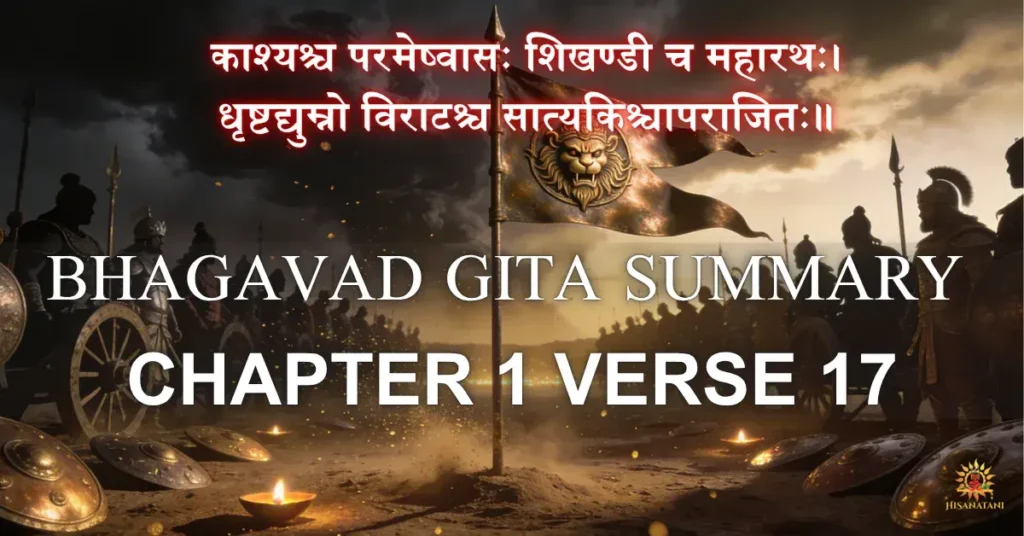
काश्यश्च परमेष्वासः शिखण्डी च महारथः।
धृष्टद्युम्नो विराटश्च सात्यकिश्चापराजितः॥
In English :
kāśyaś ca parameṣvāsaḥ śikhaṇḍī ca mahārathaḥ
dhṛṣṭadyumno virāṭaś casātyakiś cāparājitaḥ
Feel the Vibration: A Guided Chant of Bhagavad Gita Chapter 1 Verse 17:
- kāśyaś ca parameṣvāsaḥ śikhaṇḍī ca mahārathaḥ
Kā-shyaś cha pa-ra-mesh-vā-sah Shi-khan-dee cha ma-haa-ra-thah - dhṛṣṭadyumno virāṭaś casātyakiś cāparājitaḥ
Dhri-shṭa-dyum-no vi-raa-tash cha Saa-tya-kish chaa-pa-raa-ji-tah
English Translation:
“The King of Kashi, an excellent archer; Shikhandi, the mighty warrior; Dhrishtadyumna and Virata; and Satyaki, the unconquerable…”
JOIN THE HISANATANI COMMUNITY
Get daily Verse Summaries & High-Res Posters directly on your WhatsApp.
JOIN CHANNELA Soft Glow for Your Anxious Heart
Let’s be honest—modern life feels like a battlefield.
Too many thoughts. Too many expectations. Too many versions of “you” pulling in different directions.
And somewhere in that noise… you feel tired.
This verse, within Bhagavad Gita Summary 1.17, doesn’t shout. It gently reveals:
👉 You are not broken. You are just scattered.
And when your inner forces align—even slightly—peace doesn’t come from outside.
It rises from within.
Let this be your pause.Your return.
Hear It Like a Child: The Power of Being Ready Inside

At first glance, this verse just lists warriors. Simple, almost ordinary.
But look closer.
It’s like naming your friends before a big school match. Each name brings comfort. Strength. Familiarity.
For a child, this is easy to understand:
👉 When your whole team stands together, you feel brave—even if you’re scared inside.
This is the innocence of BG 1.17.
It reminds you that life is not about facing everything alone. Even your inner world is made of “many parts”:
- Your courage
- Your fear
- Your hope
And when they stop fighting each other… something magical happens.
Peace begins in simplicity.
The Eternal Logic Behind Krishna’s Words

Philosophically, this verse whispers a truth that is easy to overlook:
Everything in existence longs for alignment.
Planets orbit in harmony. Seasons flow in rhythm. Even your breath follows a pattern.
So why does the human mind feel chaotic?
Because it forgets its natural state—unity.
Each warrior here is not separate. They are expressions of a single intention.
In Summary of Bhagavad Gita 1.17, Krishna’s silent teaching is profound:
👉 Separation is illusion. Unity is reality.
When you feel disconnected—from people, from purpose, from yourself—it is not reality.
It is misalignment.
And the moment alignment returns… clarity follows effortlessly.
Psychological Perspective: Calming the Storm of “Not Enough”
Stress today comes from one dangerous belief:
👉 “Everything depends on me.”
This creates anxiety, burnout, and constant mental fatigue.
The Bhagavad Gita Chapter 1 Verse 17 breaks that illusion.
Each warrior is powerful—but none fights alone.
That reduces pressure. It creates shared responsibility.
Psychologically, this is powerful.
Shift your mindset:
- From: “I must carry everything”
- To: “I contribute my part”
This reduces anxiety instantly.
In today’s hustle culture, this verse is your reminder to delegate, trust, and breathe.
Awaken the Inner Atman : Connecting with the Divine Frequency Within
Spiritually, this verse is not about war—it is about awakening.
Each warrior is a vibration within your consciousness.
When scattered, they create noise.
When aligned, they create music.
And in that music, the Atman (your true self) becomes audible.
This is where Krishna’s presence becomes meaningful—not outside, but within.
👉 He is the silent conductor of your inner symphony.
When you meditate, reflect, or act with awareness, you are not “doing” spirituality.
You are remembering alignment.
This BG1.17 is a doorway:
From ego’s noise towards to soul’s silence.
Inner conflict toward inner harmony.
The Echoes of Kurukshetra: Where Outer War Mirrors Inner Conflict
Historically, this verse captures a critical military snapshot.
The Pandava army is not just loud—it is organized and formidable.
Each warrior mentioned was legendary:
- Masters of archery
- Strategic leaders
- Battle-hardened fighters
This wasn’t random listing—it was psychological warfare.
By naming these warriors, the message is clear:
👉 “We are strong. We are ready. We are united.”
Even before arrows are fired, confidence becomes a weapon.
Confidence doesn’t come from noise.
It comes from knowing you stand aligned.
Even today, before any big moment—an interview, a decision, a confrontation—you feel this.
That quiet gathering of your inner strength.
That is your Kurukshetra moment.
Your 24-Hour Gita Challenge: Putting Wisdom into Action
Let’s not keep this as philosophy.
Let’s live it.
Today, try this:
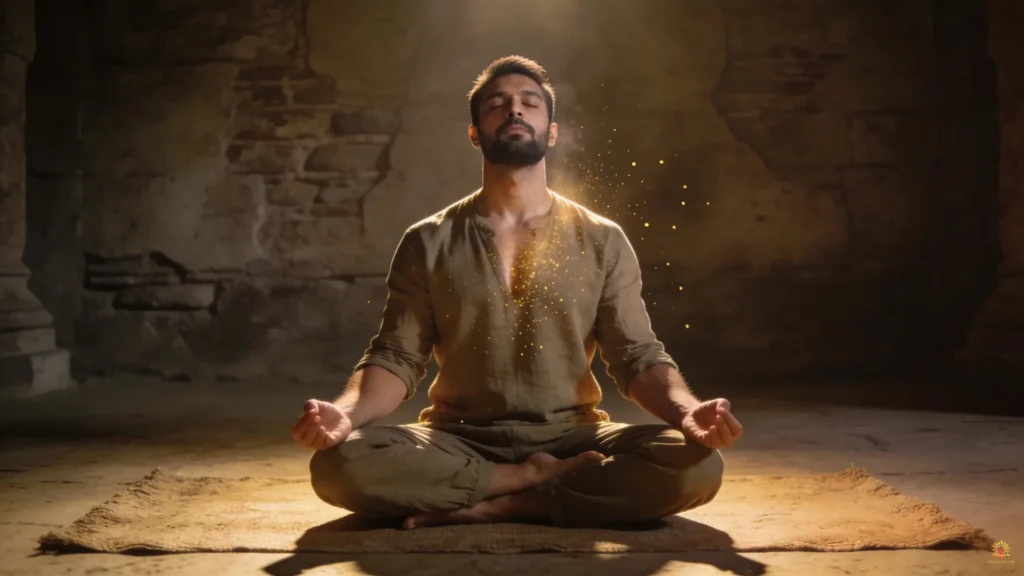
- 🌿 Sit quietly for 5 minutes
- 🌿 Observe your thoughts without judgment
- 🌿 Ask yourself: “What truly matters today?”
Then:
👉 Choose ONE intention. Not ten.
And align your actions with it.
That’s it.You just practiced Bhagavad Gita Summary 1.17.At night, reflect gently:
- Was I aligned today?
- Or was I scattered?
No guilt. Just awareness.
Because awareness is where alignment begins.
Beyond the Battlefield
Life will always have its battles. But remember—victory doesn’t come from fighting alone.
It comes from alignment, unity, and inner clarity.
Bhagavad Gita Summary 1.17 is not just a verse—it’s a strategy.
A reminder that when your thoughts, actions, and support system align…
👉 You become unstoppable.
Please let me know in the comment .
Embrace the Teachings of the Gita. Dive deeper into the Bhagavad Gita to uncover its timeless wisdom and practical guidance. Let its verses inspire you to cultivate inner clarity, align with higher values, and navigate life’s challenges with courage and grace.
🌼 Join the HiSanatani WhatsApp Channel for your daily dose of light 🪔.Join Now.
Voice of the Soul
Finding clarity in the questions we all carry…
Who are the warriors mentioned in Bhagavad Gita 1.17?
The verse lists powerful figures like the King of Kashi, Shikhandi, and the invincible Satyaki. Each represents a specific powerhouse of skill and moral virtue standing for Truth. You can learn more about how these names represent your own hidden talents in “Hear It Like a Child: The Power of Being Ready Inside“
What does Bhagavad Gita Summary 1.17 teach about teamwork?
It teaches that true power comes from “Collective Presence.” A winning team isn’t just a group of people; it is a diverse assembly of recognized individual strengths working in harmony. You can explore how this synergy creates success in our section: The Eternal Logic Behind Krishna’s Words
Why is Satyaki called “unconquerable” in BG 1.17?
Satyaki represents the soul’s innate resilience (Aparajitah) that remains untouched by external failures or career setbacks. This term reminds us of our indestructible nature. Dive deeper into how to tap into this inner strength in Connecting with the Divine Frequency Within
How does Bhagavad Gita Chapter 1 Verse 17 help with modern stress?
It helps by shifting your focus away from the “size of the problem” and toward the “strength of your resources.” Listing your allies and skills creates a psychological barrier against panic. See how to implement this shift today in Calming the Storm of “Not Enough”.
What is the significance of the King of Kashi in this verse?
The King of Kashi symbolizes traditional wisdom and supreme authority. His presence shows that the path of Dharma is supported by the highest level of intellect and experience. Discover how to reclaim your own personal authority in Where Outer War Mirrors Inner Conflict
How can I apply Bhagavad Gita 1.17 to my career today?
Apply it by performing a “Strengths Audit.” Identify the specific professional skills and core values—your inner warriors—that make you unique. This grounding technique is essential for high-pressure environments. Start your practice now with Your Daily Ritual: The Breath of the Hero.
How do I teach my child self-confidence using Bhagavad Gita 1.17?
In an era of social media comparison, Bhagavad Gita Summary 1.17 teaches children the “Hero’s Roll Call.” Instead of trying to be like everyone else, kids learn to identify their specific “Superpower”—just as each warrior in this verse was honored for their unique skill. This shifts a child’s focus from “Am I better than them?” to “I am proud of my own strength.”
Learn how to explain the bravery of a “School Match” to your child in our section:”Hear It Like a Child: The Power of Being Ready Inside“
What does the Bhagavad Gita say about helping kids handle school pressure?
The Summary of Bhagavad Gita 1.17 provides a spiritual “Security Blanket.” It shows that even the greatest heroes relied on a support system of allies before facing a challenge. By teaching your child that they have an “Inner Circle” of strengths and supporters, you reduce their anxiety about facing “battles” like exams or social pressure alone.
Turn this verse into a 5-minute calmness ritual for your child by following our guide in: “Your 24-Hour Gita Challenge: Putting Wisdom into Action“
