Namaste 🙏
Welcome to Hi Sanatani. It’s a joy to have you here as we explore the deeper layers of human nature. By diving into this Bhagavad Gita 1.20 Summary we create a sacred bridge together, turning ancient verses into helpful tools for your personal growth and peace.
Translation of Bhagavad Gita Shloka Verse 1.20 in English:
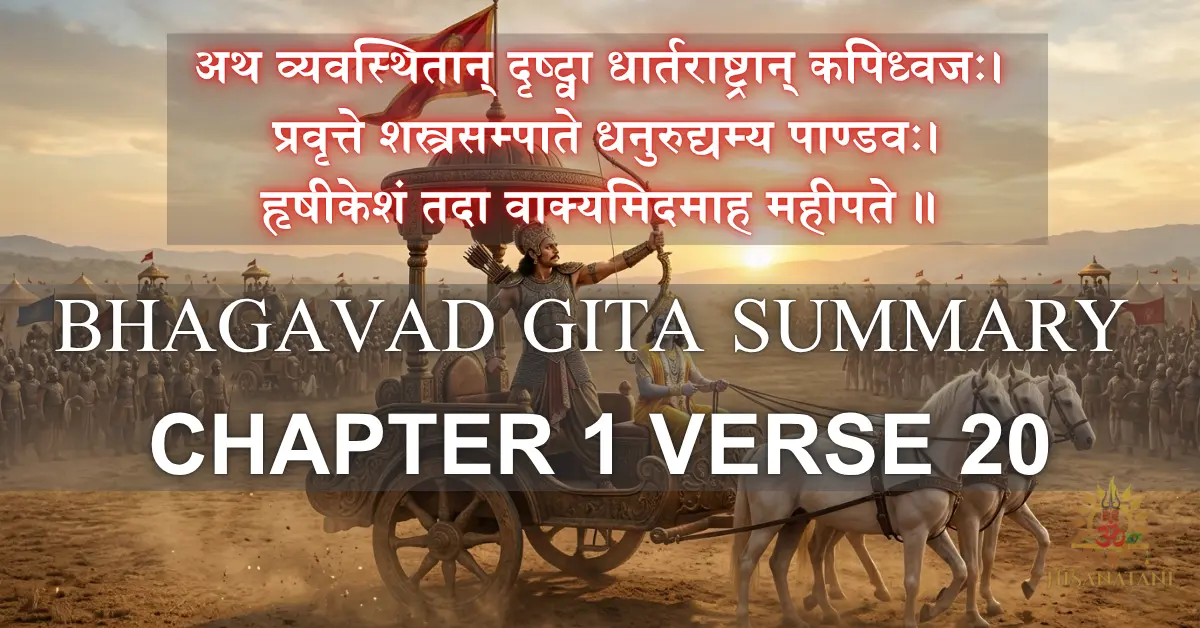
अथ व्यवस्थितान्दृष्ट्वा धार्तराष्ट्रान् कपिध्वजः ।
 प्रवृत्ते शस्त्रसम्पाते धनुरुद्यम्य पाण्डवः ।
हृषीकेशं तदा वाक्यमिदमाह महीपते ॥
In English :
atha vyavasthitān dṛṣṭvā dhārtarāṣṭrān kapi-dhvajaḥ |
pravṛtte śastra-sampāte dhanur udyamya pāṇḍavaḥ ||
hṛṣīkeśaṁ tadā vākyam idam āha mahī-pate|||
Feel the Vibration: A Guided Chant of Bhagavad Gita Chapter 1 Verse 20:
- atha vyavasthitān dṛṣṭvā dhārtarāṣṭrān kapi-dhvajaḥ |
A-tha | Vya-va-sthi-tān | Dṛṣh-ṭvā | Dhār-ta-rāṣh-ṭrān | Ka-pi-Dhva-jaḥ - pravṛtte śastra-sampāte dhanur udyamya pāṇḍavaḥ ||
Pra-vṛt-te | Śhas-tra-Sam-pā-te | Dha-nur | Ud-yam-ya | Pān-ḍa-vaḥ - hṛṣīkeśaṁ tadā vākyam idam āha mahī-pate|||
Hṛ-ṣī-ke-śhaṁ | Ta-dā | Vāk-yam | I-dam | Ā-ha | Ma-hī-pa-te
English Translation:
“O King “— seeing the sons of Dhritarashtra arrayed for battle, as weapons were about to clash, Arjuna — whose chariot flag bore the emblem of Hanuman — raised his bow and then spoke these words to Hrishikesha (Krishna).
JOIN THE HISANATANI COMMUNITY
Get daily Verse Summaries & High-Res Posters directly on your WhatsApp.
JOIN CHANNELWhy Your Mind Goes Blank Before the Most Important Moments of Your Life
You know the feelings.
The night before a big job interview.
The moment before you send that message you’ve been drafting for three weeks.
The second you walk into a room where a difficult conversation is waiting.
Everything you prepared, its seems suddenly vanishes.
The mind goes quiet — but not the peaceful kind of quiet.
That is exactly where Arjuna stands in this verse.And for your case, nobody tells you: that freeze is not failure.
It is your nervous system registering that this moment matters. Modern culture trains us to either suppress that feeling with distraction or shame it as weakness.
The Gita does neither.
It shows a world-class warrior experiencing it fully — and still raising his bow.
The Summary of Bhagavad Gita 1.20 is this: awareness before action is not hesitation.
It is wisdom. And the warrior who sees clearly has already started the most important battle — the one inside.
You Don’t Need to Be Fearless. You Just Need to Pick It Up.
Picture a kid at the starting line on sports day. A minute ago, everything was fine. Friends were laughing, teachers were smiling, the air smelled like sunscreen and chalk. But now the race is about to start. And suddenly, the kid notices the fastest runners in school are right next to them.
The heartbeat changes. Hands go cold.
That familiar sinking feeling.
That kid is Arjuna.
Bhagavad Gita Chapter 1 Verse 20 is not a war strategy. It is that exact moment — where something that seemed manageable from a distance suddenly becomes very real, very close, and very heavy.
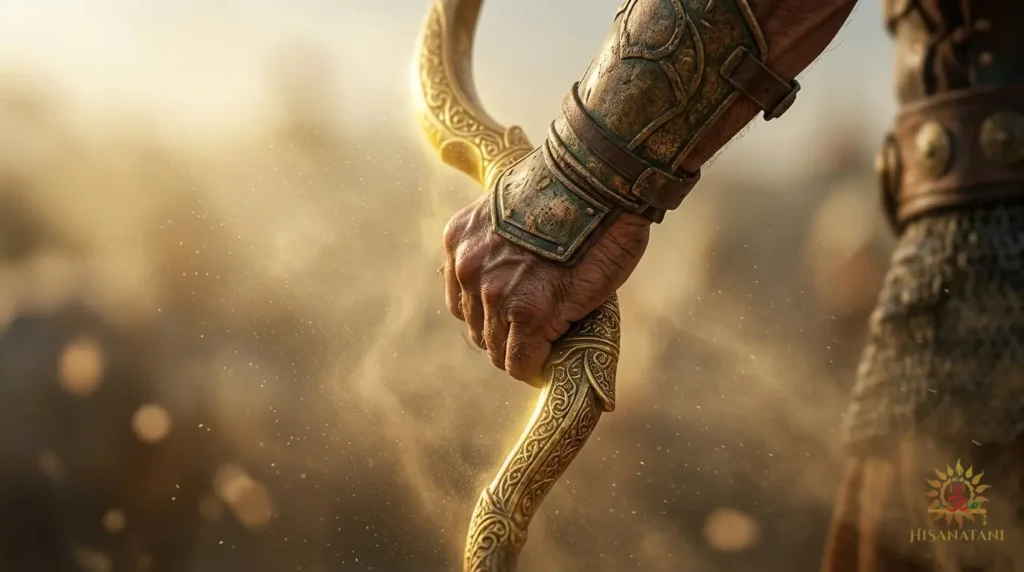
But here’s what the verse quietly shows: Arjuna doesn’t run. He doesn’t pretend he’s not nervous. He just picks up his bow.That’s it. That’s the whole lesson.He doesn’t win the battle in this verse. He doesn’t even fire an arrow. He just prepares. He shows up. He holds the tool.
Think about a kid picking up a pencil before an exam they’re terrified of.
Or gripping the handlebars of a bicycle before going down a steep hill for the first time.
That physical act — just holding the thing — tells your brain: we are doing this.
Action creates courage. Not the other way around.
The child who understands this understands something that most adults forget: bravery isn’t acting without fear. Bravery is picking up the bow while your hands are still shaking.
The Strategic Pause That Changes Everything
Philosophically, there’s a principle that most people never notice because it’s hiding in plain sight: Observation always precedes transformation.
Not action. Not decision. Observation.
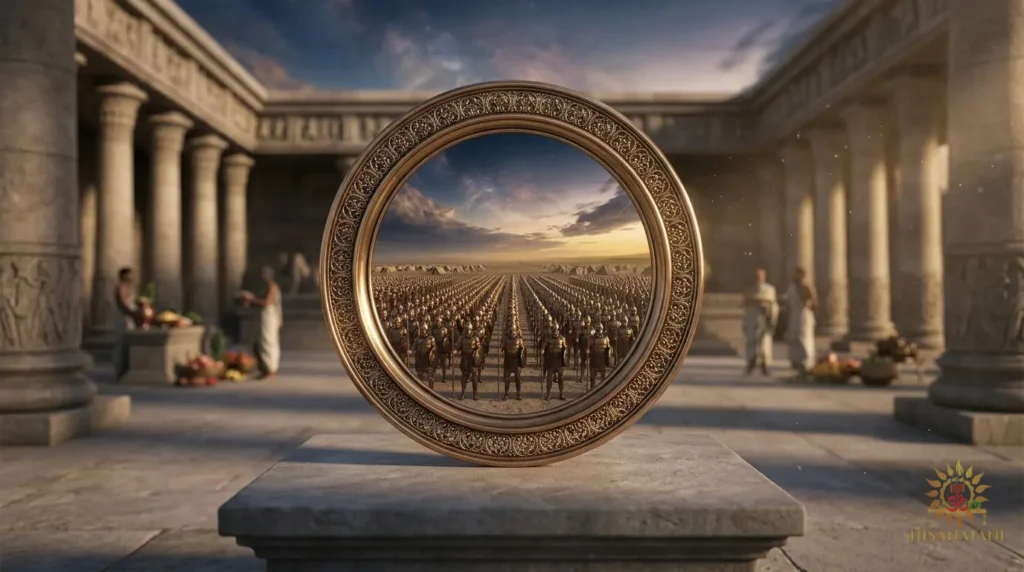
Arjuna’s first move in this verse is not to shoot. It is to see. He surveys the battlefield. He absorbs reality without flinching from it. This is not passivity — this is one of the rarest skills a human being can develop.
Think about how most people actually operate. Reaction to reaction. Notification to notification. Every emotional impulse triggering the next behavior automatically, like falling dominoes. There is no space between stimulus and response. That space is where wisdom lives — and most of us have collapsed it completely.
The verse BG1.20 shows something philosophers across traditions have argued: consciousness must precede choice. You cannot make a real decision from inside automatic behavior. You can only make a reaction.
Look closer at the symbolism. Arjuna is called Kapi-Dhvaja — the one whose flag carries Hanuman. Hanuman is not decoration. He represents disciplined intelligence in service of something higher than ego. Philosophically, this tells us: even before Arjuna understands what is happening internally, a higher wisdom is already present, travelling with him, waiting.
That is a profound idea. The soul carries wisdom even when the mind hasn’t caught up yet.
The eternal truth embedded in BG 1.20: the moment you stop reacting and truly see your situation — that pause, however uncomfortable — is the beginning of every real breakthrough. Without it, life becomes what it is for most people: very busy, very productive, and completely directionless.
Why Your Brain Shuts Down Before Big Moments (And What Arjuna’s Bow Actually Teaches About It)
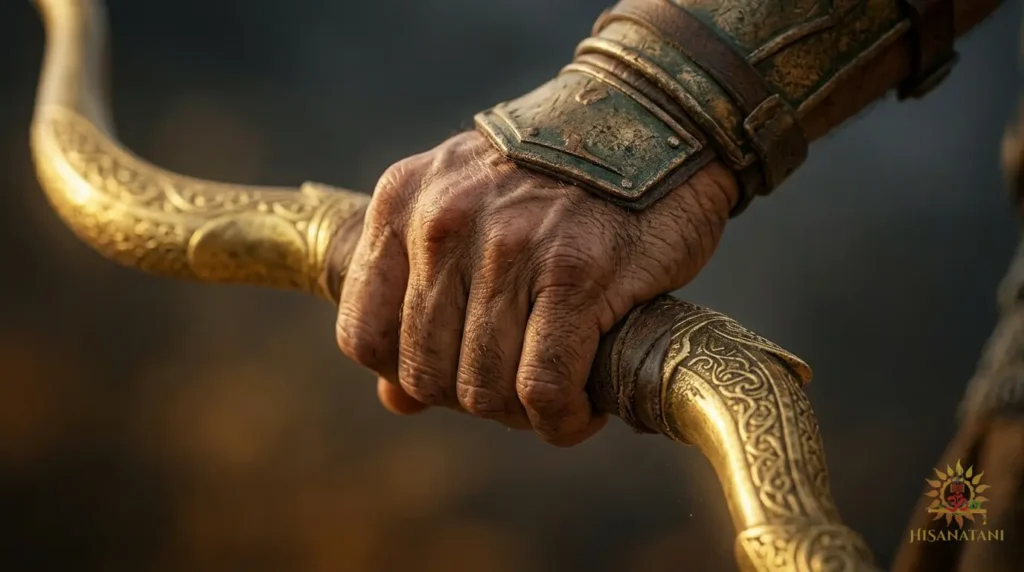
Here’s something your therapist might not have told you yet: Anxiety doesn’t mean something is wrong with you. Often, it means something is right.
When Arjuna stands across from the Kaurava army, he doesn’t freeze out of weakness — his body simply does what bodies do when death feels close. His heart pounds. The world narrows to a tunnel. Every face he’s ever loved on the other side of that battlefield floods back at once, unbidden.
That’s not cowardice. That’s just being human.
Sound familiar? Because this is you before that Zoom presentation. Before confronting your boss. Before sending the resignation email. Before telling someone the truth they don’t want to hear.
The mistake most people make is treating this state as a sign to stop. The Gita treats it as a sign that you’re alive and paying attention.
But here’s the crucial part that Bhagavad Gita 1.20 Summary gets right and most self-help content gets wrong: Arjuna doesn’t try to think his way out of the anxiety. He bypasses it entirely with a physical act. He lifts his bow.
This is what psychologists call a somatic anchor — a deliberate physical action that pulls the nervous system out of the mental spiral and back into the body. Modern research backs this completely. When the prefrontal cortex (your decision-making brain) is compromised by stress, trying to reason your way forward doesn’t work. But moving does. Opening a document. Making the call. Writing the first terrible sentence.
Avoidance, by contrast, trains the brain to associate that situation with threat — and the fear grows, not shrinks. Every time you close the laptop without starting, the hill gets steeper.
Arjuna lifted the bow. That’s all. He didn’t fire it yet. One physical act of engagement was enough to break the freeze. That’s not ancient mythology. That’s neuroscience.
You Are Not Fighting This Alone (You Just Can’t See Who’s on Your Flag)
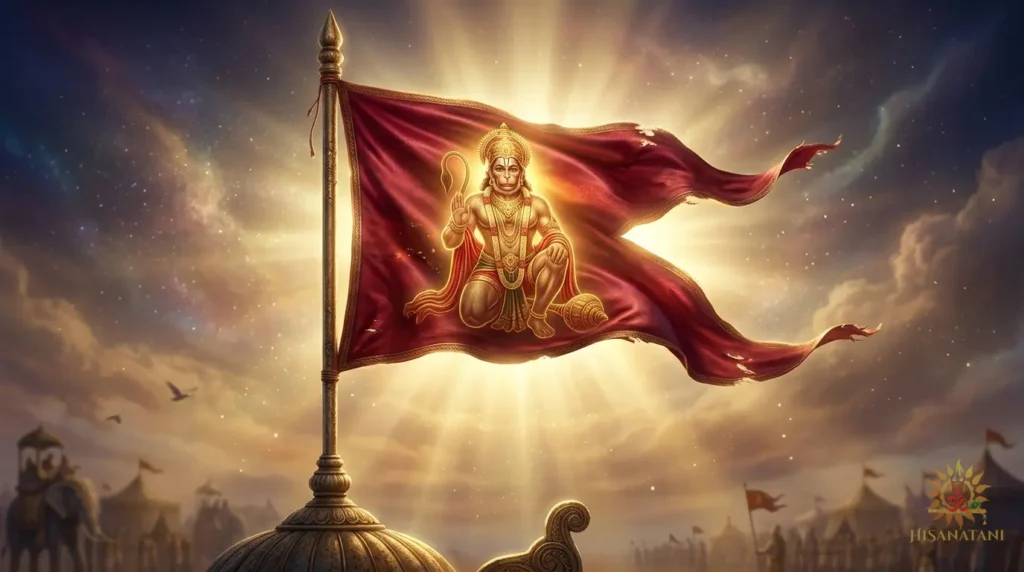
There is a detail in this verse that most people read straight past because it sounds like a decorative title: Kapi-Dhvaja — the one whose chariot flag bore Hanuman.
Stop there for a second.
Hanuman is not a decoration. In the Mahabharata, Hanuman granted Bhima this boon — that he would ride above Arjuna’s chariot as a divine protector, not visible to enemies, but present through every blow. Hanuman represents something very specific: maximum strength in total surrender to a higher purpose. No ego. No personal agenda. Just flawless devotion in service of Dharma.
Now notice the timing. Arjuna doesn’t have clarity yet. He hasn’t heard Krishna’s teachings. He hasn’t transcended his confusion. He’s about to collapse emotionally in the very next verses. And yet — Divine presence is already there. Already travelling with him. Already on the flag.
That changes the entire spiritual reading of this verse.
Most people believe grace arrives after they get their act together. After they become disciplined. After they stop being afraid. After the confusion resolves. The Gita reverses this completely: grace arrives before understanding. Presence precedes clarity.
This is deeply comforting if you sit with BG1.20. Especially right now, in a world where people feel profoundly alone — spiritually exhausted, disconnected beneath the noise of constant stimulation, showing up to their daily battlefields without knowing why.
You don’t have to be ready for Divine support to show up. You just have to be willing to remain present. Willingness attracts grace.
Arjuna lifted the bow. That was enough. The flag was already flying above him.
What Was Actually Happening on That Field the Morning of Kurukshetra
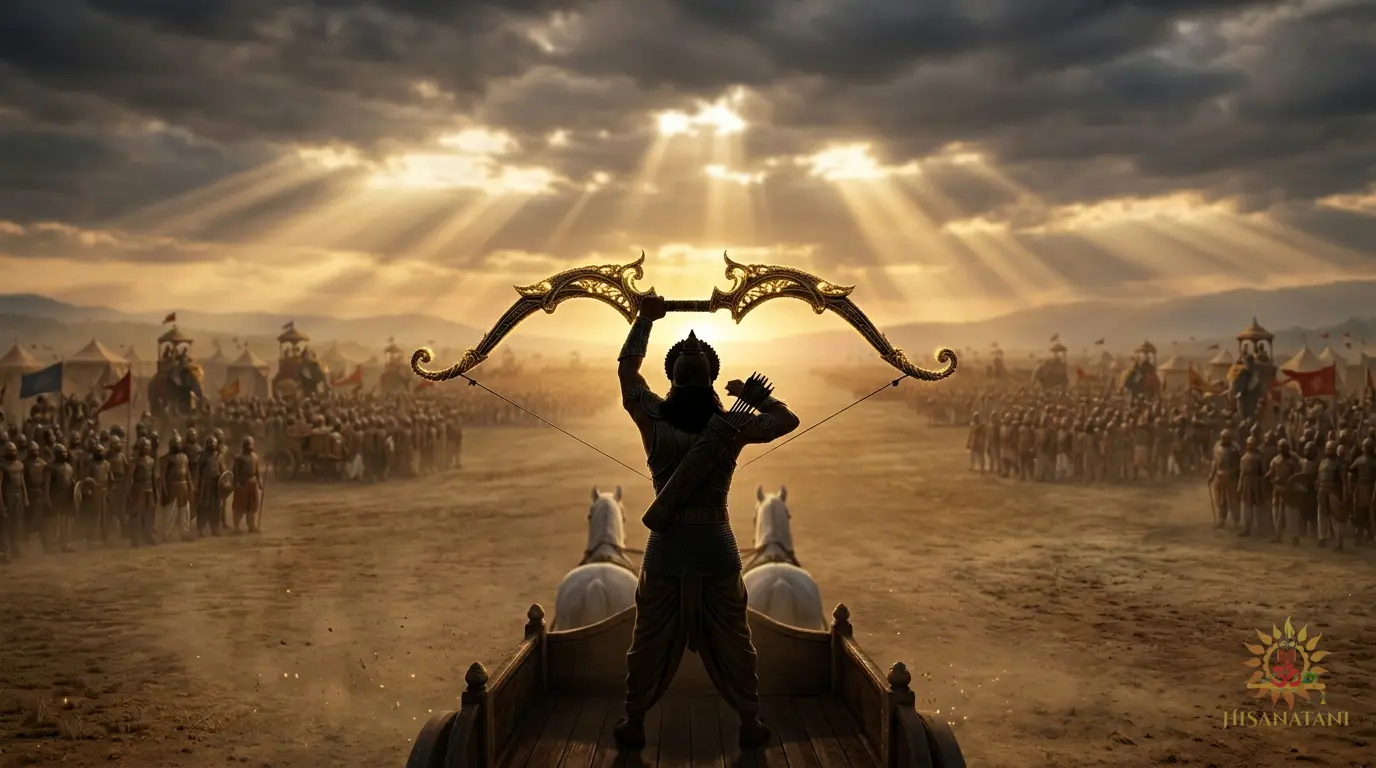
Let’s forget the spirituality for a moment. Just look at the historical facts of Bhagavad Gita Chapter 1 Verse 20.
Eighteen days of war are about to begin. The Pandavas field 7 Akshauhini (military divisions). The Kauravas field 11. Statistically, Arjuna is staring down a superior force. The men across from him include Bhishma — arguably the greatest warrior alive — and Drona, the teacher who trained Arjuna himself. The odds-on paper are terrible.
But more than strategy, there is something else happening here that ancient warfare rarely allows for: emotional complexity on a battlefield.
These armies have not been assembled of strangers. Arjuna knows faces in that crowd. Loves some of them. Owes others a debt of respect. The Pandavas spent thirteen years in exile — twelve years in forests, one year hiding their identities in the Virata kingdom — swallowing humiliation after humiliation. All of that compressed history arrives at this exact moment.
When Arjuna lifts the Gandiva — his divine bow, gifted by Varuna, legendary for its weight and power — he is not performing a gesture. He is carrying thirteen years of exile, the future of Dharma, the weight of his family’s honor, and the memory of every teacher standing across from him, all in one physical act.
Bg1.20 marks something historically rare in any ancient text: it records the psychological realism of a great warrior the instant before battle. Not a war machine. A human being. One who carries grief and duty simultaneously.
That is why the Gita begins here. Not with answers. With a man standing in full awareness of everything he stands to lose — and choosing to raise his weapon anyway.
The 24-Hour Gita Challenge: Stop Planning. Lift the Bow.
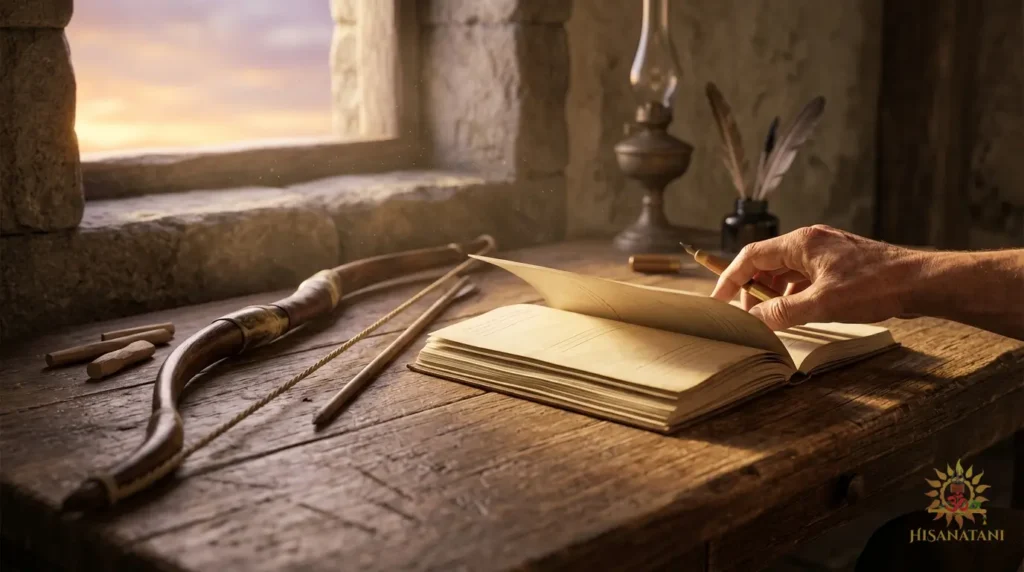
No theory. Real execution. Three steps only.
Step 1: Name Your Battlefield (5 minutes) Get a notebook. Write down one situation you have been emotionally avoiding. Not a vague worry — something specific. An overdue conversation. A career decision you’ve been deferring. A financial reality you haven’t looked at directly. Most anxiety grows because problems stay undefined inside the head. Naming it on paper reduces its psychological grip immediately. The mind fears the fog, not the fact.
Step 2: Touch the Tools (3 minutes only) Don’t try to finish the task. Just lift the bow. Open the email draft. Sit in the chair where you do the hard thing. Pull up the document. Dial the number but don’t press call yet. Three minutes of physical contact with the task breaks the freeze loop your nervous system has been running. You’ll find that once the tool is in your hand, starting happens almost automatically.
Step 3: One Single Action. Cross Everything Else Off. Arjuna didn’t fight the whole war in Bhagavad Gita 1.20 Summary . He picked up his bow and asked one important question. Look at your task list. Find the one thing that — if done today — would shift the most weight. Draw a line through everything else. Execute that one thing. Action dissolves fear faster than any amount of thinking.
Beyond the Battlefield
The Bow Was Already in His Hands. What About Yours?
Bhagavad Gita 1.20 Summary does not give you an answer. It shows you a moment. A warrior, fully conscious of what stands before him, making one simple choice: to remain present and prepare.
It’s not telling you to be fearless. Not to have all the answers. Not to wait for perfect conditions.
Just to show up. To pick up the bow. To turn toward what is real.
That is all this verse asks of you. And it’s also the hardest thing.
Because right now, in May 2026, most people are running — from difficult conversations, from burnout they won’t name, from decisions that require them to face themselves honestly. The noise of notifications, content, and constant stimulation makes the running easier than ever.
But somewhere beneath all of that, there’s a Kurukshetra with your name on it. A situation which you can’t avoid. A reality that is quietly waiting for you to stop scrolling and look it in the eye.The Gita doesn’t promise the battle will be easy.
It promises you are not fighting it alone. Raise the bow. Ask the question. Let what happens next, happen. Are you ready?
Please let me know in the comment .
Embrace the Teachings of the Gita. Dive deeper into the Bhagavad Gita to uncover its timeless wisdom and practical guidance. Let its verses inspire you to cultivate inner clarity, align with higher values, and navigate life’s challenges with courage and grace.
🌼 Join the HiSanatani WhatsApp Channel for your daily dose of light 🪔.Join Now.
Voice of the Soul
Finding clarity in the questions we all carry…
What is the main message of Bhagavad Gita 1.20?
The verse captures the exact second Arjuna consciously faces his battlefield rather than avoiding it — raising his bow before asking a single question. The lesson is that readiness precedes clarity, not the other way around. Most people wait to feel ready before they act. Arjuna acts, and readiness follows. This is explored step-by-step in “The 24-Hour Gita Challenge: Stop Planning. Lift the Bow.”
Why is Hanuman on Arjuna’s flag in BG 1.20?
Hanuman rides Arjuna’s chariot flag as a divine boon — representing supreme strength in complete surrender to a higher purpose. His presence signals that Arjuna carries spiritual backing even before he realizes it. Divine support doesn’t wait for you to be ready — it’s already on your banner. The full spiritual depth of this is in “You Are Not Fighting This Alone.”
Why does Arjuna lift his bow but not shoot yet?
Because this verse isn’t about combat — it’s about the moment before commitment. Lifting the bow is a somatic act: it breaks the psychological freeze, grounds the nervous system, and converts paralysis into readiness. He doesn’t need to fire to move forward. He needs to hold the weapon. The neuroscience behind this is unpacked in “Why Your Brain Shuts Down Before Big Moments.”
How does Bhagavad Gita Chapter 1 Verse 20 relate to modern anxiety?
Arjuna’s nervous system response is identical to what modern humans experience before difficult meetings, hard decisions, or uncomfortable truths — threat-detection, emotional overload, the urge to freeze or flee. The verse normalizes this response and shows how one physical act of engagement can break the loop. See the full breakdown in “Why Your Brain Shuts Down Before Big Moments.”
What can students and young professionals learn from BG 1.20 Summary?
That the most important move isn’t a perfect plan — it’s showing up and touching your tools. Arjuna doesn’t have a guaranteed win. He doesn’t wait for better odds. He assesses reality, picks up his weapon, and then asks for guidance. That sequence — action first, clarity follows — is the core teaching. Apply it directly using “The 24-Hour Gita Challenge.”
