Namaste 🙏
Welcome to Hi Sanatani. It’s a joy to have you here as we explore the deeper layers of human nature. By diving into this Bhagavad Gita Summary 1.21-22 we create a sacred bridge together, turning ancient verses into helpful tools for your personal growth and peace.
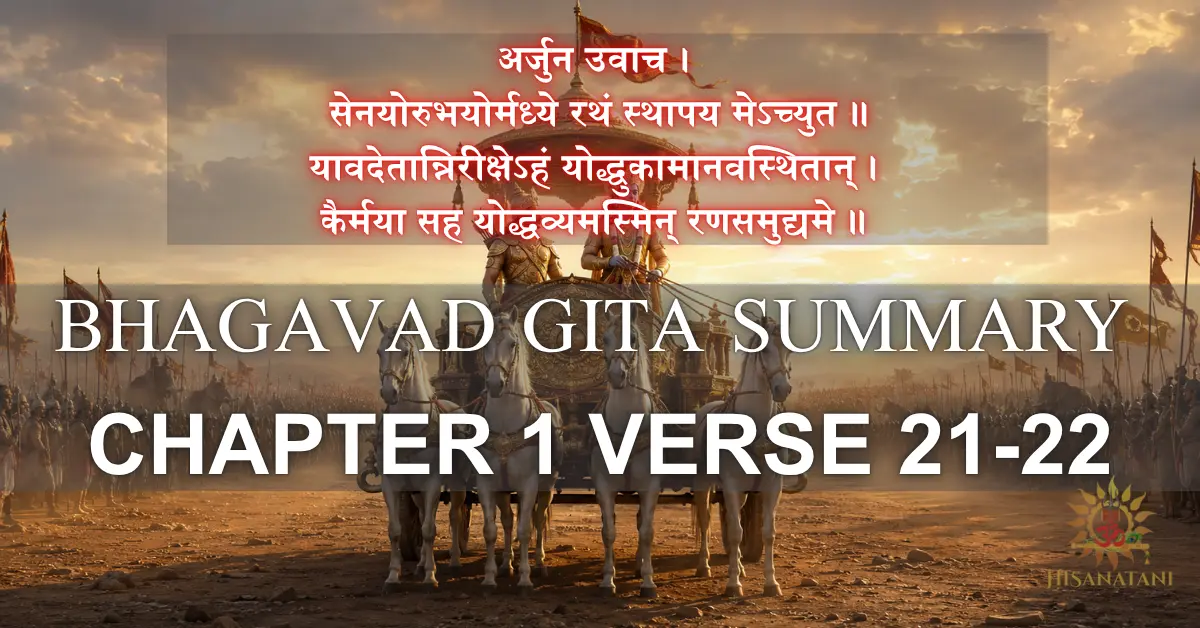
Translation of Bhagavad Gita Shloka Verse 1.21-22 in English:
अर्जुन उवाच
सेनयोरुभयोर्मध्ये रथं स्थापय मेऽच्युत ।
यावदेतान्निरीक्षेऽहं योद्धुकामानवस्थितान् ॥१.२१॥
कैर्मया सह योद्धव्यमस्मिन् रणसमुद्यमे ॥१.२२॥
In English :
arjuna uvāca
senayor ubhayor madhye rathaṁ sthāpaya me ‘cyuta |
yāvad etān nirīkṣe ‘haṁ yoddhu-kāmān avasthitān ||
kair mayā saha yoddhavyam asmin raṇa-samudyame ||
Feel the Vibration: A Guided Chant of Bhagavad Gita Chapter 1 Verse 21-22:
- arjuna uvāca
Ar-ju-na u-va-cha - senayor ubhayor madhye rathaṁ sthāpaya me ‘cyuta |
Se-na-yor u-bha-yor madh-ye ra-tham stha-pa-ya me a-chyu-ta - yāvad etān nirīkṣe ‘haṁ yoddhu-kāmān avasthitān ||
kair mayā saha yoddhavyam asmin raṇa-samudyame ||
Yaa-vad e-taan ni-reek-she a-ham yod-dhu-kaa-maan a-va-sthi-taan
Kair ma-yaa sa-ha yod-dha-vyam as-min ra-na sa-mud-ya-me
English Translation:
“Arjuna said: O Krishna, place my chariot between the two armies so I may observe those assembled here, eager for battle, and understand with whom I must fight.”
JOIN THE HISANATANI COMMUNITY
Get daily Verse Summaries & High-Res Posters directly on your WhatsApp.
JOIN CHANNELWhy Your Soul Needed to Hear This Today
There’s a quiet exhaustion many carry today — not from doing too little, but from constantly reacting. Endless scrolling. Instant replies. Emotional decisions. You rarely get the chance to just be with what is.
This verse enters your life like a gentle interruption. It doesn’t push you to act — it invites you to witness. To step back from the chaos of your own mind and simply observe.
Bhagavad Gita Chapter 1 Verse 21-22 is not about war — it is about awareness. And awareness… is where healing begins.
Learning to See Before You Feel Overwhelmed
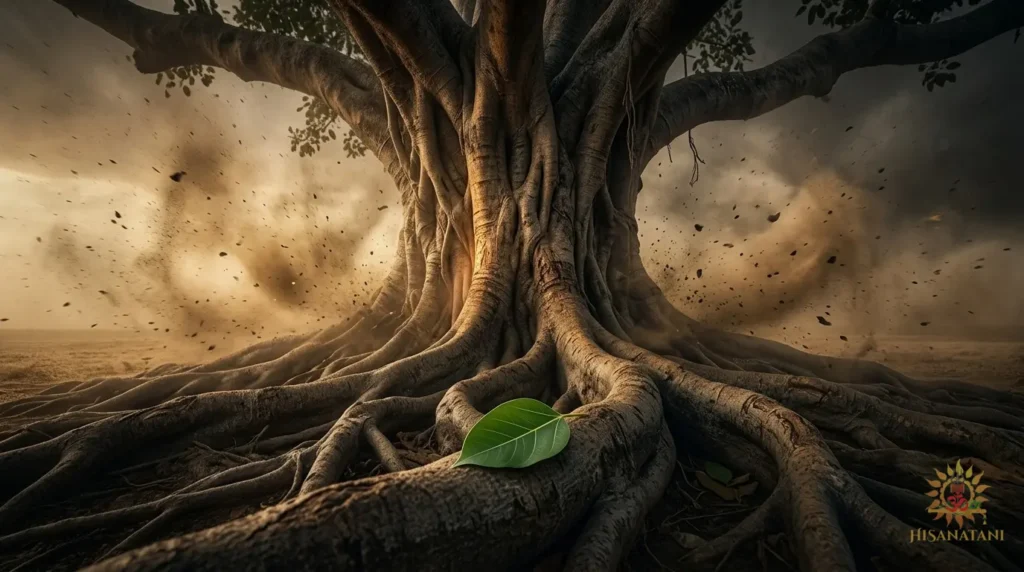
At its simplest, this verse is about looking before acting. Think of a child about to jump into a swimming pool without checking the depth. What would you say? “Wait… look first.”
That’s exactly what Arjuna does. He doesn’t rush into battle. He pauses to see who is there. In the Bhagavad Gita Summary 1.21-22, this becomes a universal life lesson: Don’t let emotions drive your actions blindly.
Whether it’s anger, excitement, or fear — pause and observe. You receive a harsh message on WhatsApp. Your fingers rush to reply. But what if you paused… and read it twice? That pause can save relationships.
Awareness is your first shield against regret.
The Hidden Geometry of Conscious Choice
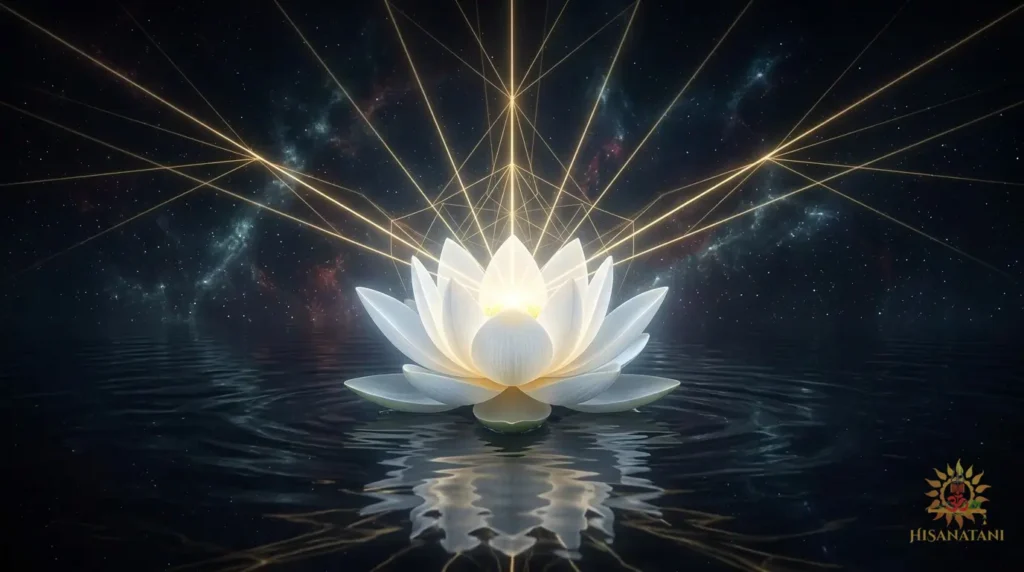
Beneath the surface, this verse reveals a profound metaphysical rhythm. Life is not chaotic — it follows an inner geometry. And that geometry begins with perception.
In the Summary of Bhagavad Gita 1.21-22, Arjuna seeks alignment between his outer duty and inner truth. He refuses to act until both are in harmony. This is the essence of Dharma.
Without right perception, even right action becomes distorted. You may choose a career, a partner, or a path — but if chosen from confusion, it leads to suffering.
Krishna does not interrupt Arjuna’s request. Why? Because the universe honors conscious inquiry. You are not the battle — you are the one observing it.
The quality of your life is shaped not by your actions — but by the awareness behind them.
Breaking the Cycle of Emotional Reactivity
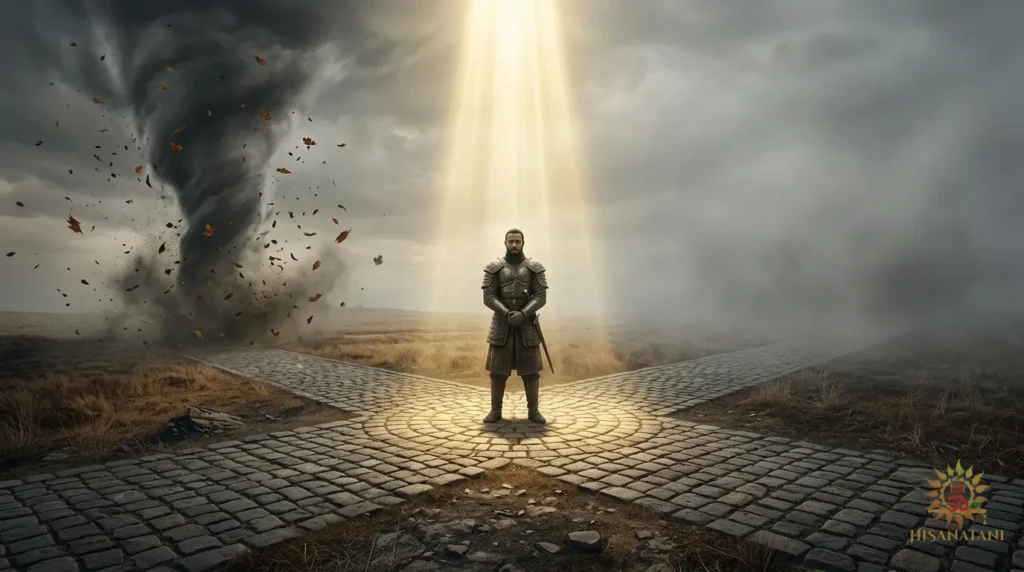
Your mind is trained to react. Notification → Response. Criticism → Defense. Fear → Avoidance. This loop creates anxiety. But Arjuna disrupts this loop.
Instead of reacting to the battlefield, he observes it. Psychologically, this is the birth of mindfulness — the ability to witness without immediate reaction.
In BG 1.21-22, Arjuna creates space between stimulus and response. That space is sacred. Imagine you’re in a tense meeting. Someone questions your work. Your heart races. Instead of reacting, you breathe… observe… and respond calmly. That’s inner mastery.
From “I feel, therefore I act” → to “I observe, therefore I choose.”
Standing at the Threshold of the Soul
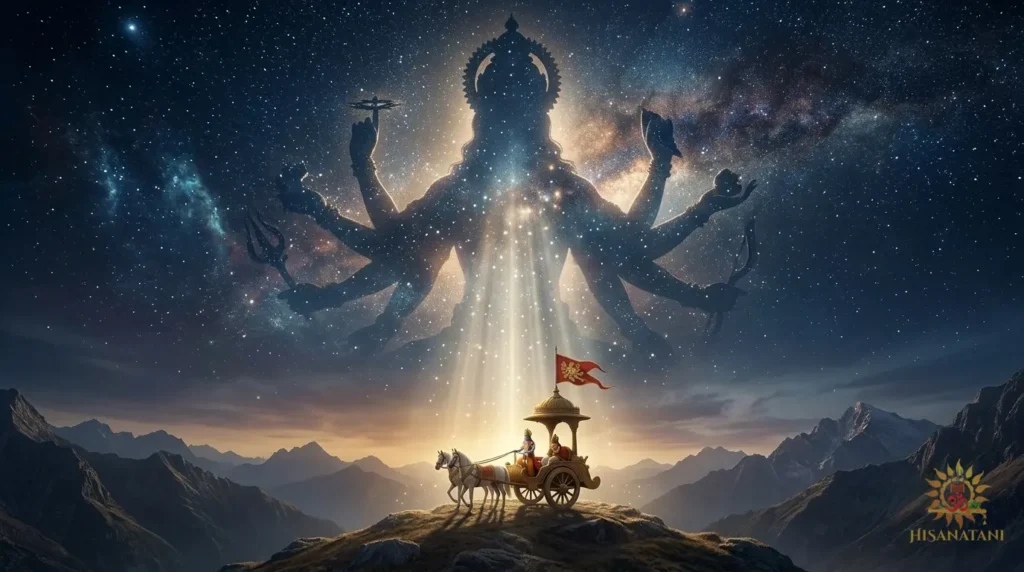
This moment is deeply spiritual. Arjuna is not just standing between two armies — he is standing between two states of consciousness. One driven by ego. One guided by truth. And who holds the reins? Krishna.
In Bhagavad Gita Chapter 1 Verse 21-22, Krishna represents the Higher Self — the still, wise awareness within you. When Arjuna asks Krishna to guide the chariot, he is surrendering control to that higher intelligence.
This is the beginning of inner awakening. You don’t need to control everything. You need to align with what is true.
“Divine Grace” isn’t about escaping problems — it’s about being guided into the heart of them with a protector by your side.
When you let higher consciousness lead, confusion dissolves into clarity.
Beyond Kurukshetra : The Human Moment Behind the Epic War
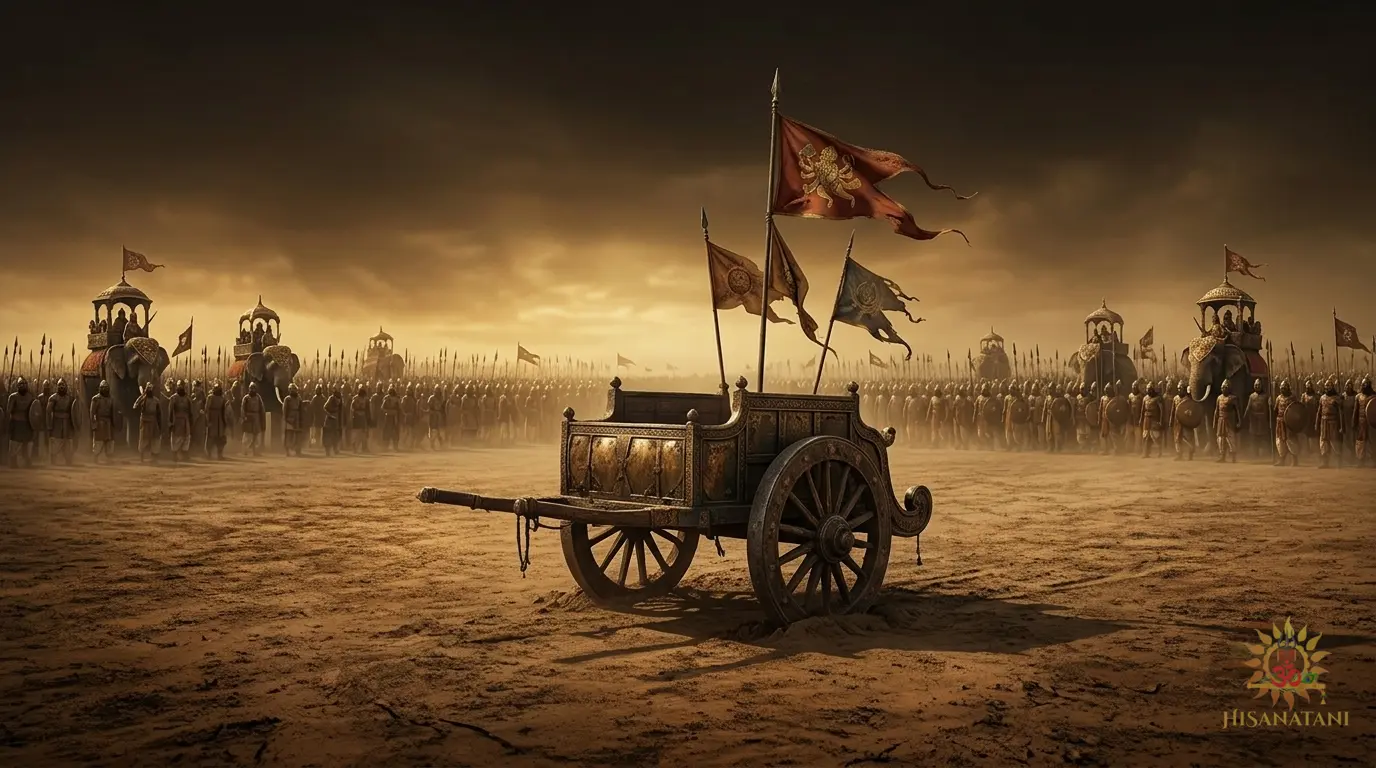
Historically, this is one of the most human moments in the Mahabharata. The war is about to begin. Generations of conflict have led to this point.
Yet, in Bhagavad Gita Summary 1.21-22, we see not a warrior — but a human being. Arjuna wants to see who stands before him. He is looking at his grandfathers, teachers, cousins, and friends — not just soldiers.
This isn’t just a tactical move; it’s a heart-wrenching confrontation with his own history. Every great battle has deep roots in our past, our upbringing, our unresolved loves.
This moment sets the stage for Arjuna’s breakdown — and Krishna’s divine teaching.
Every external conflict carries an internal emotional weight.
The 24-Hour Stillness Challenge: Your Madhye Meditation
Today, practice the Madhye Meditation. When you encounter a moment of high stress — an angry message, a difficult conversation, a crossroads decision — do not respond immediately.
Close your eyes. Imagine yourself standing in a chariot between two armies. Ask your inner wisdom — your Krishna — to hold the chariot in the middle. Spend 60 seconds observing your feelings without judging them.
Ask yourself: What am I really feeling beneath this reaction? What would clarity — not emotion — choose here?
Don’t suppress. Don’t react. Just witness. This is the ultimate life manual exercise: moving from a reactive victim to a conscious observer in the heat of the moment.
You move from chaos to consciousness. From reaction… to realization.
The World Will Always Rush You
The world will always rush you. To decide faster. React quicker. Move immediately. But wisdom moves differently.
It pauses. It observes. It understands. Arjuna’s greatest strength was not his bow — it was his willingness to see clearly.
And that strength lives within you too.
Please let me know in the comments.
Embrace the Teachings of the Gita. Dive deeper into the Bhagavad Gita to uncover its timeless wisdom and practical guidance. Let its verses inspire you to cultivate inner clarity, align with higher values, and navigate life’s challenges with courage and grace.
🌼 Join the HiSanatani WhatsApp Channel for your daily dose of light 🪔. Join Now.
Voice of the Soul
Finding clarity in the questions we all carry…
What is Bhagavad Gita Chapter 1 Verse 21-22 about?
It shows Arjuna asking Krishna to pause and observe the battlefield before fighting — teaching that clarity must come before action. Every major decision in life deserves this sacred pause. Explore this in “Learning to See Before You Feel Overwhelmed.”
What does Achyuta mean in Bhagavad Gita 1.21?
Achyuta means “The Infallible One” — one who never slips from their position. By calling Krishna this name at the start of battle, Arjuna anchors himself to an unchanging truth in the middle of chaos. Reflect on this in “The Hidden Geometry of Conscious Choice.”
How does BG 1.21-22 relate to mental health and anxiety?
It introduces the practice of mindful observation — creating space between a trigger and your response. When you name what you’re facing instead of running from it, anxiety loses its grip. Revisit “Breaking the Cycle of Emotional Reactivity.”
What is the spiritual meaning of Arjuna asking Krishna to position the chariot?
It symbolizes surrendering the ego’s control to higher consciousness. Arjuna doesn’t navigate alone — he lets divine wisdom lead. It is the beginning of spiritual awakening. Dive into “Standing at the Threshold of the Soul.”
How can I apply BG 1.21-22 to decision-making in daily life?
Practice the Madhye Meditation — when facing a stressful choice, pause 60 seconds and observe your feelings without judgment. Clarity follows when you stop reacting and start witnessing. Start with “The 24-Hour Stillness Challenge.”
