
Namaste 🙏
Welcome to Hi Sanatani. It’s a joy to have you here as we explore the deeper layers of human nature. By diving into this Bhagavad Gita 1.39 Summary we create a sacred bridge together, turning ancient verses into helpful tools for your personal growth and peace.
Translation of Bhagavad Gita Shloka Verse 1.39 in English:
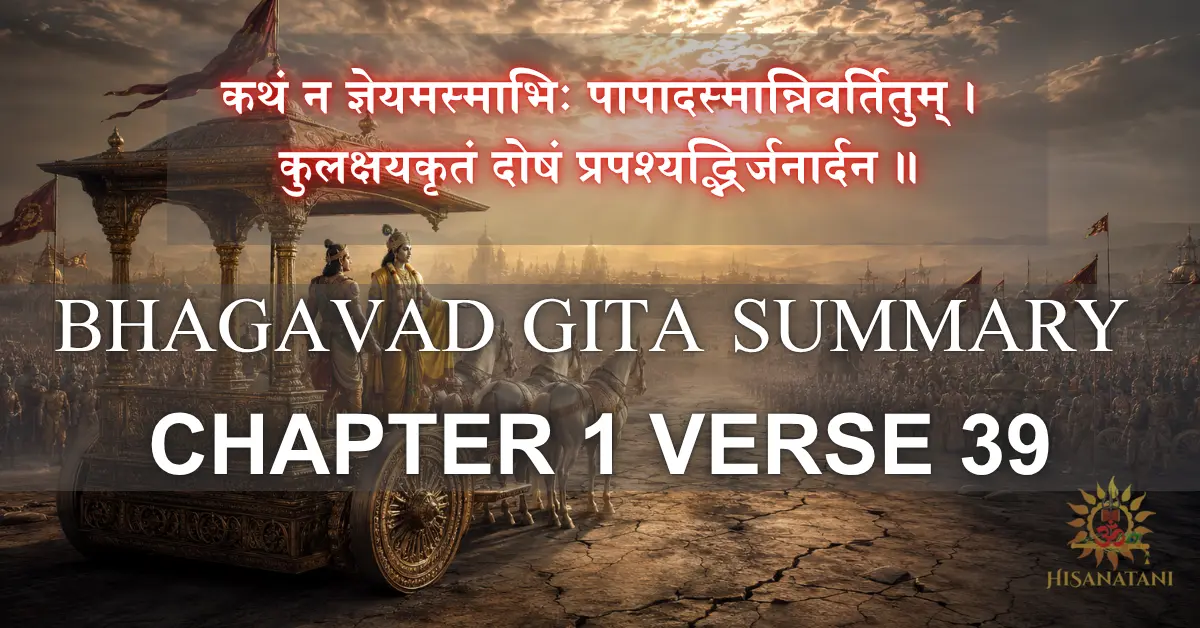
कथं न ज्ञेयमस्माभिः पापादस्मान्निवर्तितुम् ।
कुलक्षयकृतं दोषं प्रपश्यद्भिर्जनार्दन ॥ ३९ ॥
In English :
kathaṁ na jñeyam asmābhiḥ pāpād asmān nivartitum |
kula-kṣaya-kṛtaṁ doṣaṁ prapaśyadbhir janārdana ||
Feel the Vibration: A Guided Chant of Bhagavad Gita Chapter 1 Verse 39 :
- kathaṁ na jñeyam asmābhiḥ pāpād asmān nivartitum |
Ka-thaṁ na jñe-ya-mas-mā-bhiḥ pā-pā-das-mān-ni-var-ti-tum - kula-kṣaya-kṛtaṁ doṣaṁ prapaśyadbhir janārdana ||
Ku-la-kṣa-ya-kṛ-taṁ do-ṣaṁ pra-pa-śyad-bhir-ja-nār-da-na
English Translation:
“O Janardana, we can clearly see the wrong in destroying our own family — so why should we not resolve, right now, to turn away from this sin?”
JOIN THE HISANATANI COMMUNITY
Get daily Verse Summaries & High-Res Posters directly on your WhatsApp.
JOIN CHANNELWhy Your Conscience Is Speaking Louder Than Your KPI Today
Arjuna insists that once the harm of an action is clearly visible, a person of conscience is duty-bound to step back from it.
If you’ve ever walked out of a meeting feeling uncomfortable — even though nothing illegal happened — you’ve already experienced the tension behind Bhagavad Gita Chapter 1 Verse 39.
Maybe a report was “adjusted” to satisfy investors. Maybe customer complaints were hidden to protect quarterly numbers. Maybe someone deserved credit, but politics handed it elsewhere. Or perhaps everyone stayed silent because speaking up felt risky.
Corporate life often teaches us that success belongs to those who “play the game.” But here’s the thing. Every game has rules. The moment those rules are replaced by convenience, trust begins to disappear.
Arjuna isn’t afraid merely because people will die. He is afraid because values can die while people are still alive.
The greatest loss in life is not losing a position. It is losing the person you once promised yourself you would become.
The Playground Rule from BG1.39 Every Child Understands Better Than Many Adults

Imagine a group of children playing cricket in the neighbourhood. Everyone agrees on one rule: “If the ball touches the wall, you’re out.” The game runs smoothly because every child trusts the rule.
Now imagine one child says, “I’ll ignore the rule because I want to win.” Another follows him. Soon everyone creates their own rules. What happens? The match stops being fun.
Arguments begin. Nobody trusts anyone anymore. Eventually, the game ends — not because there weren’t enough players, but because there were no rules everyone respected.
That is exactly what Arjuna is describing in Bhagavad Gita 1.39 Summary. A family, school, office, or society works the same way. Rules are not meant to control people. They protect fairness.
Now replace “family” with “company.” Imagine a workplace where managers hide mistakes, employees steal ideas, leaders favour friends, and promises mean nothing. Would you enjoy working there? Probably not.
Arjuna says this is exactly how decline begins — not with one huge disaster, but with many small choices.
When you protect good habits, good habits protect everyone around you.
When One Broken Principle Rewrites an Entire Culture

Most people think ethics is about individual behaviour. The Bhagavad Gita 1.39 invites us to think much bigger. Arjuna isn’t discussing one person’s morality — he is describing the architecture of civilisation.
Every society rests on invisible agreements. We trust doctors because we believe they act for patients rather than profit. We trust judges because we expect fairness over favour. None of these systems survive through laws alone. They survive through shared character.
Dharma is the unseen operating system beneath every visible institution.
A magnificent skyscraper can collapse if the pillars weaken. Likewise, a wealthy nation can decline while its economy still appears healthy — because moral collapse always begins beneath the surface. Empires rarely disappear because enemies grow stronger overnight; they weaken internally first. Corruption replaces responsibility. Greed replaces service.
The health of any society depends less on its wealth than on the values its people refuse to sell.
The Hidden Mental Cost of Saying “It’s Fine” When It Isn’t
Most people assume stress comes from long working hours. Sometimes it does. But one of the heaviest emotional burdens comes from living against your own values.
Imagine you’re asked to exaggerate sales figures. No one threatens you. Your manager smiles and says, “This is how business works.” You agree. The spreadsheet changes.
The meeting ends. Life moves on. Or does it? Something inside you keeps replaying the decision.
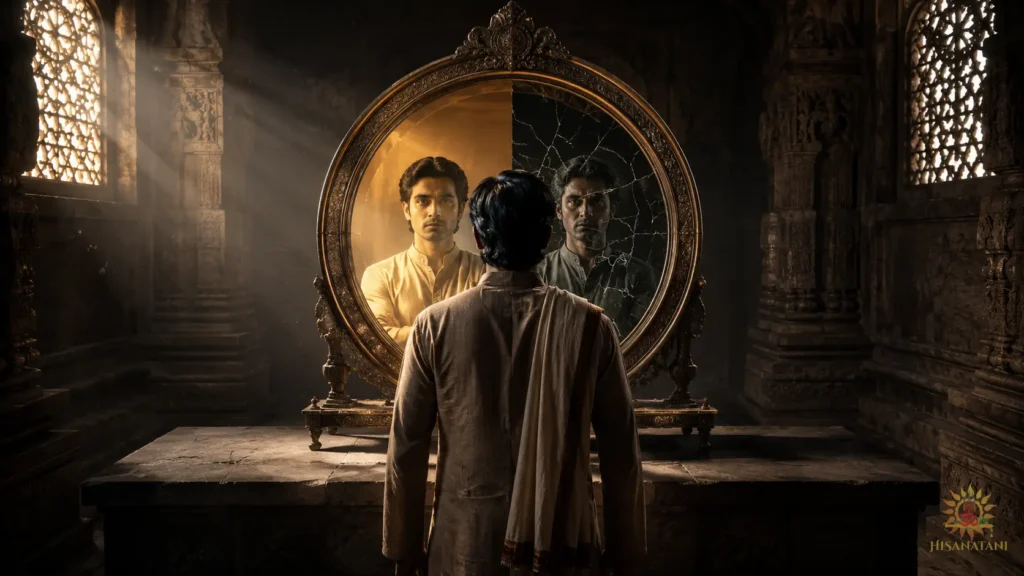
That quiet discomfort is the mind trying to reconcile two conflicting realities: “I believe honesty matters” and “I acted dishonestly.” The greater the gap between those two statements, the greater the inner tension. People often imagine conscience as a loud voice. In reality, it usually whispers — as restless sleep, irritability, or a strange feeling that something is “off” despite outward success.
The easiest person to deceive may be everyone else. The hardest person to deceive is the one you meet every morning in the mirror.
Guarding the Mirror of the Mind (Chitta-Shuddhi)

Spiritually, every action leaves a microscopic impression (samskara) upon your subtle mental body (chitta). Clean, righteous actions smooth the mind’s surface, allowing it to reflect your true inner nature (atman). Selfish, compromise-driven actions scratch that surface, creating distortion and mental noise.
In Bhagavad Gita 1.39, Arjuna’s concern reflects a deep awareness of spiritual causality. He questions why anyone gifted with awareness would intentionally cloud their own consciousness. When you make ethical concessions at work for a title or a bonus, you accumulate that inner residue and trade long-term clarity for short-term comfort.
Standing firm against ethical degradation isn’t just corporate policy — it’s an essential practice of chitta-shuddhi, keeping your consciousness clear and receptive to higher truth.
The Moment Arjuna Looked Beyond the Battlefield

To understand this verse properly, we must return to Kurukshetra. The armies have assembled. Conches have sounded. War is moments away. Yet Arjuna is no longer looking at weapons — he is looking at consequences.
Standing before him are teachers who shaped his childhood, grandfathers who preserved family honour, uncles, cousins, and respected elders. In ancient India, the family was not simply a household — it was the primary institution for education, ethics, and social responsibility. There were no modern universities teaching moral leadership. The family itself was the classroom.
The Summary of Bhagavad Gita 1.39 explains Arjuna’s fear. If thousands of experienced elders died in one war, who would teach the next generation? History repeatedly shows that wars rarely end when fighting stops — their deepest effects appear years later, as communities lose trust and institutions struggle to rebuild shared values. Arjuna sees this chain reaction before the first arrow is released.
Today’s battlefield may not involve chariots, but organisations face similar challenges. When ethical leaders leave, shortcuts often replace standards, and younger employees inherit confusion instead of wisdom.
The 24-Hour Gita Challenge

Ready to translate this wisdom from Bhagavad Gita 1.39 into modern professional reality? Here is your three-step framework for today:
1. Conduct an Ethical Line-Item Audit: Spend ten minutes reviewing your current projects. Identify any active process where quality, transparency, or honesty is being quietly compromised for speed or politics.
2. Draft Your Non-Negotiable Boundary Document: Write down three absolute professional principles you refuse to break — for example, “I will never fabricate performance metrics” or “I will not obscure risks to clients.” Keep this note pinned near your desk.
3. Execute the ‘Voice of Clarity’ Protocol: The next time a meeting leans toward an ethical shortcut, don’t stay silent. Simply ask: “Does this decision align with our long-term standards, or are we taking on unmanaged risk?” Reframe ethics as long-term risk management, not confrontation.
Your Character Is Building Your Future — Whether You Notice It or Not
Arjuna’s words in this verse carry a timeless warning: a society does not collapse the day people stop following rules. It begins collapsing the day good people decide those rules no longer matter.
In today’s corporate world, ethical compromise rarely arrives wearing the label “wrong.” It often appears disguised as speed, profit, loyalty, or survival. It whispers, “Everyone does it,” or “It’s only one report,” or “This is how the industry works.” But every compromise has a hidden cost — some appear in broken trust, some in restless nights, some only years later, when leaders wonder why their teams no longer believe them.
Policies cannot replace integrity. Compliance training cannot replace character. An organisation becomes ethical because its people repeatedly choose honesty — even when nobody is watching.
Before your next difficult decision, ask yourself: “Am I solving today’s problem while quietly creating tomorrow’s crisis?”
Promotions come and go. Titles disappear. But the reputation built by your choices follows you everywhere. Protect your skills. Protect your career. Above all, protect your character — it is the one asset that appreciates every time you refuse to sell it.
Please let me know in the comments.
Embrace the Teachings of the Gita. Dive deeper into the Bhagavad Gita to uncover its timeless wisdom and practical guidance. Let its verses inspire you to cultivate inner clarity, align with higher values, and navigate life’s challenges with courage and grace.
🌼 Join the HiSanatani WhatsApp Channel for your daily dose of light 🪔. Join Now.
Voice of the Soul
Finding clarity in the questions we all carry…
What is the main message of Bhagavad Gita 1.39?
The central teaching is that when righteous values disappear, families, organisations, and societies gradually lose their moral foundation. Ethical decline always begins long before visible collapse. Explore this further in When One Broken Principle Rewrites an Entire Culture.
How is Bhagavad Gita Chapter 1 Verse 39 relevant to today’s workplace?
This verse reminds professionals that ignoring small ethical compromises eventually shapes workplace culture, since one dishonest decision often encourages many more. See the concrete steps in The 24-Hour Gita Challenge.
Why does Arjuna worry about family traditions in this verse?
Arjuna believes families pass down ethics, responsibility, and wisdom across generations, and that losing these traditions leaves future generations without guidance to distinguish right from wrong. This is explained in The Moment Arjuna Looked Beyond the Battlefield.
Can integrity really influence mental well-being?
Yes. Living against your own values often creates inner conflict, emotional exhaustion, and reduced peace of mind. This relationship is explored in The Hidden Mental Cost of Saying “It’s Fine” When It Isn’t.
What is the simplest way to understand this verse?
Think of shared rules that hold any group together — a game, a family, a company. Once those rules are quietly broken by even a few, trust for everyone collapses. See The Playground Rule Every Child Understands Better Than Many Adults for the full picture.
