
Namaste 🙏
Welcome to Hi Sanatani. It’s a joy to have you here as we explore the deeper layers of human nature. By diving into this Bhagavad Gita 2.7 Summary we create a sacred bridge together, turning ancient verses into helpful tools for your personal growth and peace.
Translation of Bhagavad Gita Shloka Verse 2.7 in English:
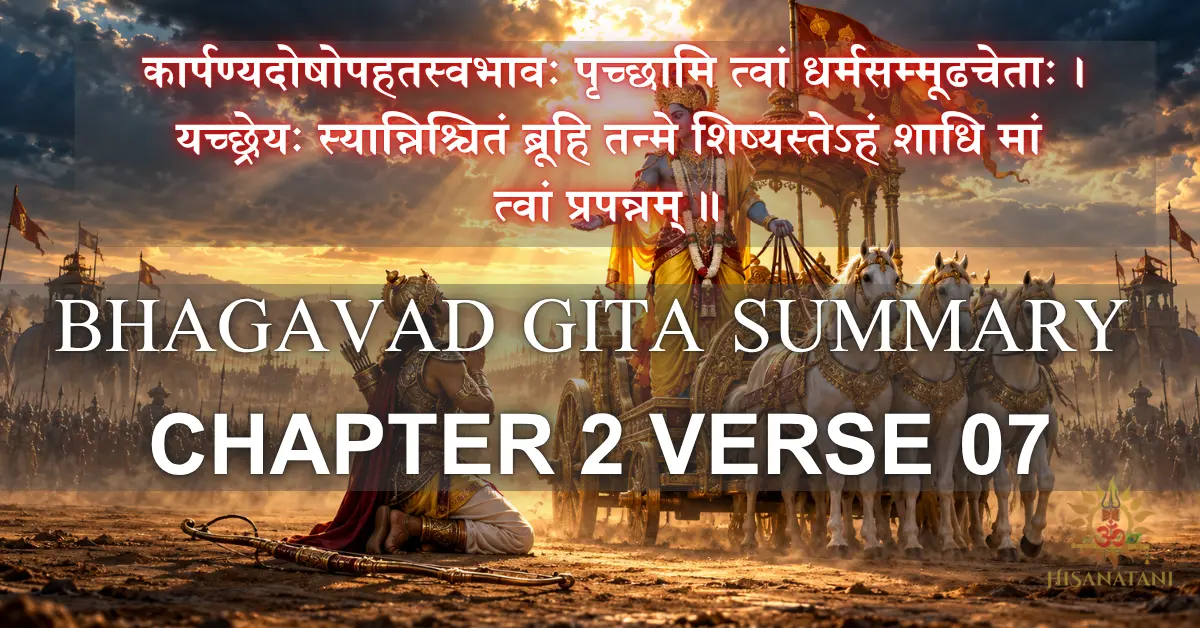
कार्पण्यदोषोपहतस्वभावः पृच्छामि त्वां धर्मसंमूढचेताः।
यच्छ्रेयः स्यान्निश्चितं ब्रूहि तन्मे शिष्यस्तेऽहं शाधि मां त्वां प्रपन्नम्।। २.७।।
In English :
kārpaṇya-doṣopahata-svabhāvaḥ pṛcchāmi tvāṁ dharma-sammūḍha-cetāḥ |
yac chreyaḥ syān niścitaṁ brūhi tan me śiṣyas te ‘haṁ śādhi māṁ tvāṁ prapannam || 2.7 ||
Feel the Vibration: A Guided Chant of Bhagavad Gita Chapter 2 Verse 7:
- kārpaṇya-doṣopahata-svabhāvaḥ
Kār-paṇ-ya-do-ṣo-pa-ha-ta-sva-bhā-vaḥ - pṛcchāmi tvāṁ dharma-sammūḍha-cetāḥ |
Pṛc-chā-mi tvāṁ dhar-ma-sam-mū-ḍha-ce-tāḥ - yac chreyaḥ syān niścitaṁ brūhi tan me
Yac-chre-yaḥ syān niś-ci-taṁ brū-hi tan-me - śiṣyas te ‘haṁ śādhi māṁ tvāṁ prapannam || 2.7 ||
Śiṣ-yas-te-‘haṁ śā-dhi māṁ tvāṁ pra-pan-nam
English Translation:
“My heart is overpowered by the taint of pity; my mind is confused as to my duty. I ask Thee: tell me decisively what is good for me. I am Thy disciple. Instruct me, who has taken refuge in Thee.” — Swami Sivananda translation, as presented by the Gita Supersite (IIT Kanpur).
JOIN THE HISANATANI COMMUNITY
Get daily Verse Summaries & High-Res Posters directly on your WhatsApp.
JOIN CHANNELWhy Your Mind Needed to Hear This Today
Let’s be honest. You’re not short on opinions. Between the boardroom, the group chats, the parents weighing in, and three tabs of career advice open right now, you have more input than any generation before you. And yet the actual decision — the one that’s keeping you up — hasn’t moved an inch.
That’s not a discipline problem. It’s a signal problem. Somewhere between all that noise, your own sense of what’s right got buried.
Arjuna had the same experience, just louder. Surrounded by armies, expectations, and history, he finally said the thing most of us won’t: I don’t know. This verse isn’t about weakness. It’s a masterclass in what to do the moment more thinking stops helping.
The Playground Test: How a Kid Figures Out What’s Actually Fair

Picture a ten-year-old in the kitchen, staring at two bowls of food. One looks delicious. One looks plain. “Which one should I eat?” A good parent doesn’t say “the tastier one” — they say, “the one that’ll actually do you good.” That’s a different question, and it changes everything.
Now picture the same kid on a playground. Two friends want the same ball. One says, “I asked first.” The other says, “I had it first.” The kid is stuck — because neither answer settles what’s actually fair. A wiser adult doesn’t ask who shouted loudest. They ask: what actually happened, and what’s fair here?
That’s the exact shift happening in Bhagavad Gita 2.7. Arjuna isn’t choosing between two attractive options — a bigger bonus versus a better title, a safer job versus an exciting one. He’s asking Krishna what’s genuinely śreyaḥ — what’s truly good, once you strip away which option merely looks better.
Try it with your own stuck decision. If Option A grows things fast but burns everyone out, and Option B grows slower but keeps the team intact — a kid says “bigger number wins.” An adult asks: better for what, exactly? Better for revenue? For the people involved? For who you’ll be five years from now? That one question — better for what — is Arjuna’s move in miniature.
The Mind Wasn’t Built to Solve This Alone

Here’s an uncomfortable truth about the mind: it assumes it’s the final authority on everything, including things far bigger than it can actually process. Arjuna names this directly — kārpaṇya-doṣa, a kind of small, self-defeating weakness that shows up exactly when the stakes get too big for ego alone to handle.
Philosophically, this is the moment the intellect (buddhi) runs into its own edge. Most of us treat that edge as a personal failure — proof we’re not smart enough, not prepared enough. But the Gita treats it as expected. No individual mind, however sharp, is built to calculate every consequence of a genuinely hard choice alone.
That’s not a flaw to fix. It’s a limit to recognize. Arjuna doesn’t get quieter because he suddenly has more facts. He gets quieter because he stops insisting that his isolated point of view has to contain the entire answer.
There’s real relief in that. You don’t have to be the sole source of certainty in your own life. Some truths only show up once you stop trying to manufacture them by yourself and let a larger perspective — a mentor, a teacher, something wiser than your own looping thoughts — actually reach you.
When Thinking Becomes Another Way of Avoiding

There’s productive thinking, and there’s thinking that mostly exists to delay a decision. They can look identical from the inside.
You make a pros-and-cons list. Then another. You check reviews, ask three friends, run the numbers twice. You calculate what happens if you go, what happens if you stay, what happens if you regret either one. At some point you’re no longer analyzing — you’re circling.
This is exactly the state the Bhagavad Gita 2.7 describes: dharma-sammūḍha-cetāḥ, a mind confused about duty. Not lacking intelligence — overloaded by unresolved emotion. Modern psychology has a name for this too: anxiety narrows attention, raises threat-sensitivity, and makes rumination feel like progress when it’s actually just noise on repeat.
The relief isn’t more analysis. It’s naming the loop. Try this the next time a decision won’t settle: write down what you actually know (facts only), what you’re assuming, what you’re afraid will happen, and what you’re hoping will happen. Then ask one more question — what guidance am I missing?
That last question is the bridge to Arjuna. Saying “I don’t know” out loud doesn’t make you less capable. It just stops your brain from defending a conclusion it never actually reached.
Surrender Isn’t Giving Up, It’s Handing Over the Wrong Job

Surrender sounds like a scary word. It sounds like giving up, going passive, saying “whatever happens, happens.” That’s not what’s happening here.
Arjuna doesn’t surrender his responsibility. He surrenders the demand that his own confused mind has to manufacture the answer by itself. That’s a very different thing.
Think of someone lost in a city, refusing to ask for directions because asking feels like admitting weakness. They walk faster. Get more frustrated. Eventually someone says, “you’re going the wrong way,” and they finally stop and ask, “can you show me?” Did they lose anything by asking? No — they gained direction.
That’s the shift in śiṣyas te ‘ham — “I am your disciple.” The ego says, “I must know, and I must control the outcome.” Surrender says, “I’ll control my sincerity, my effort, my willingness to act rightly — the outcome was never fully mine to hold anyway.”
Your career, your relationship, your five-year plan might not unfold on the timeline you drew up. The spiritual question was never “how do I force reality to match my plan?” It’s “how do I stay aligned with what’s true while reality keeps moving?”
Kurukshetra Wasn’t a Boardroom, and That’s Exactly Why It Still Applies
It’s tempting to flatten BG2.7 into a productivity quote. That misses what actually happened.
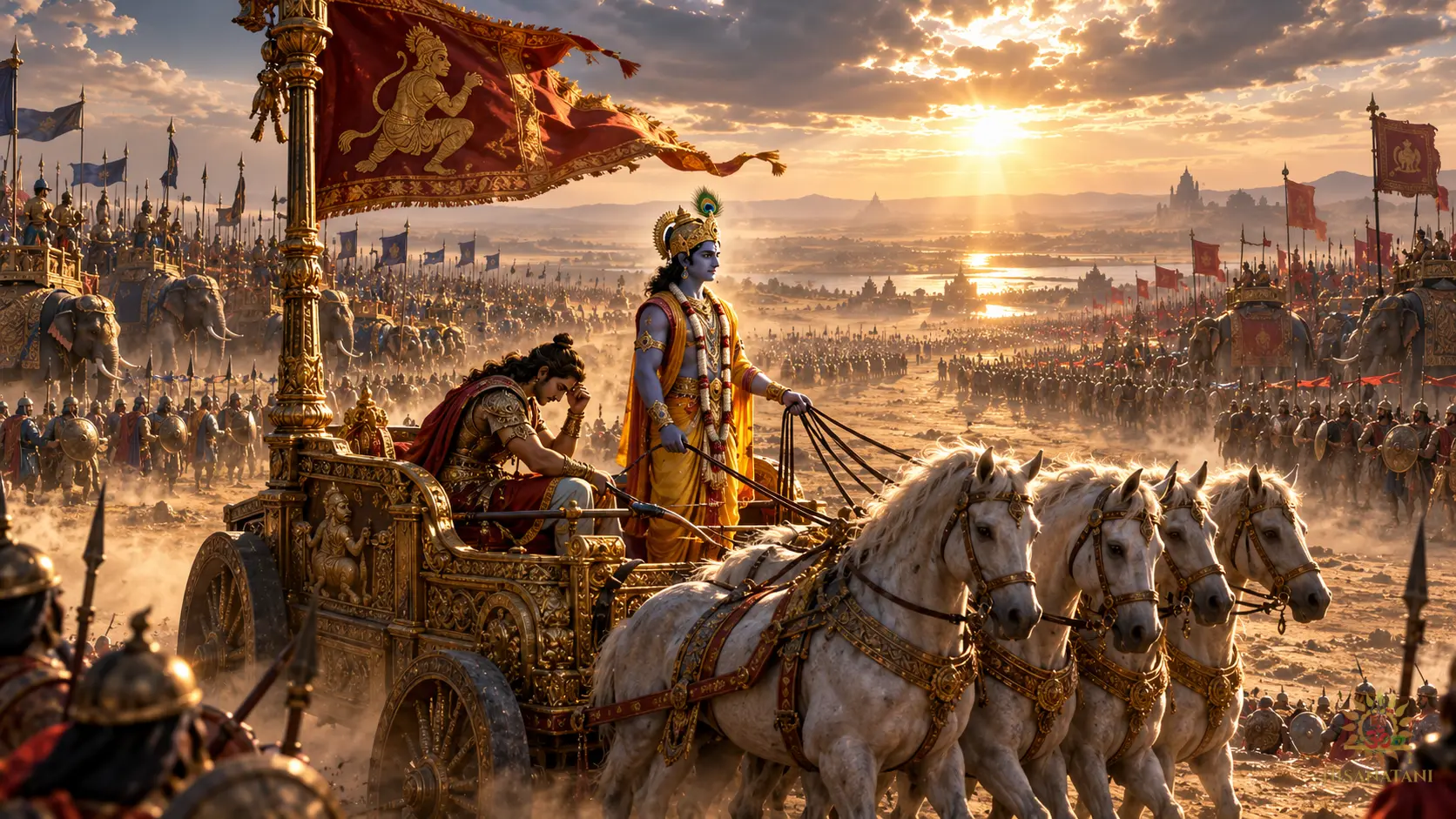
Arjuna is standing on the real battlefield of Kurukshetra. Both armies are assembled. The people on the other side aren’t strangers — they’re his teachers, his relatives, his elders. Chapter 2 opens right after his collapse in Chapter 1, and by BG2.7, he’s moved from arguing with Krishna to actually asking to be taught.
That context matters, because Arjuna isn’t facing a decision with a clean, painless option. Every path costs him something. Keep an underperforming leader on the team, and it hurts the group. Remove them, and it hurts a person who once helped you. Take the promotion, and your family time shrinks. Leave the stable path for something uncertain, and you risk everything you’ve built.
That’s the uncomfortable truth Kurukshetra teaches: a mature decision is rarely a painless one. The question was never “how do I make everyone happy?” It’s “what is actually my responsibility here?” — and that’s a much harder, much more useful question to sit with.
The 24-Hour Gita Challenge: Turn the Noise Into One Decision

You don’t need ten books or another three-hour meeting to apply this. Try this over the next 24 hours.
Step 1 — Write the decision in one line, no story attached. Not five paragraphs — one sentence: “I need to decide whether to accept the new role,” or “I need to decide whether to leave this relationship.” Then list three plain facts underneath. No predictions, no interpretations — just what’s actually true.
Step 2 — Before comparing options, define śreyaḥ for this decision. Ask what’s genuinely good under four headings: the practical impact, the people involved, your integrity, and the person you’ll respect in five years. Don’t score anything yet — just name it.
Step 3 — Find one person whose judgment you trust, and don’t ask “what should I do?” Ask instead: “What am I not seeing?” and “What assumption would you challenge first?” Then go quiet for fifteen minutes — phone away, no scrolling — and let their answer settle before you react to it.
That’s the actual shape of Arjuna’s move in this Summary of Bhagavad Gita 2.7. He doesn’t get more data. He gets a clearer question, an honest teacher, and enough stillness to hear the answer once it arrives.
Ending & CTA
Bhagavad Gita 2.7 isn’t really a verse about weakness. Bhagavad Gita Chapter 2 Verse 7 is about honest recognition — the moment a capable person admits, out loud, that the situation has outgrown their current framework.
That’s not failure. A surgeon can doubt a procedure. A founder can question the company’s direction. A parent can be unsure about a call involving their child. None of that erases what they’re capable of. It just means the moment calls for more than solo effort.
Arjuna’s battlefield didn’t disappear after this BG2.7. His responsibility didn’t disappear. What changed was his relationship to the decision itself — from someone performing certainty to someone actually ready to receive guidance.
If you’re sitting with a decision that won’t settle, try dropping the question you’ve been asking. Instead of “how do I become certain?” ask “what’s genuinely worth choosing here?” Then find someone worth trusting with the real version of the question — not the polished one.
Sometimes the strongest thing a person can say isn’t “I know what to do.” It’s “I’m ready to be taught.”
Please let me know in the comments.
Embrace the Teachings of the Gita. Dive deeper into the Bhagavad Gita to uncover its timeless wisdom and practical guidance. Let its verses inspire you to cultivate inner clarity, align with higher values, and navigate life’s challenges with courage and grace.
🌼 Join the HiSanatani WhatsApp Channel for your daily dose of light 🪔. Join Now.
Voice of the Soul
Finding clarity in the questions we all carry…
What is the main message of Bhagavad Gita 2.7?
Arjuna openly admits he’s confused about his duty and asks Krishna to tell him, decisively, what’s truly good for him — then accepts him as his teacher. See Surrender Isn’t Giving Up, It’s Handing Over the Wrong Job.
What does śreyaḥ mean in Bhagavad Gita 2.7?
Śreyaḥ means what’s genuinely beneficial or good in the long run — not what’s simply pleasant, impressive, or comfortable right now. See The Playground Test: How a Kid Figures Out What’s Actually Fair.
Why does Arjuna call himself Krishna’s disciple in BG2.7?
He shifts from arguing as an equal to asking to be taught — a deliberate move from self-reliance to receptivity. See The Mind Wasn’t Built to Solve This Alone.
How can Bhagavad Gita 2.7 help with decision fatigue or overthinking?
By naming confusion honestly instead of hiding it, clarifying what’s actually beneficial, and seeking guidance rather than endlessly generating more options. See When Thinking Becomes Another Way of Avoiding.
What does Bhagavad Gita Chapter 2 Verse 7 teach about facing a hard decision?
That a mature decision is rarely painless, and clarity often comes from context and responsibility — not from finding an option with zero cost. See Kurukshetra Wasn’t a Boardroom, and That’s Exactly Why It Still Applies.
