
Namaste 🙏
Welcome to Hi Sanatani. It’s a joy to have you here as we explore the deeper layers of human nature. By diving into this Bhagavad Gita 2.3 Summary we create a sacred bridge together, turning ancient verses into helpful tools for your personal growth and peace.
Translation of Bhagavad Gita Shloka Verse 2.3 in English:
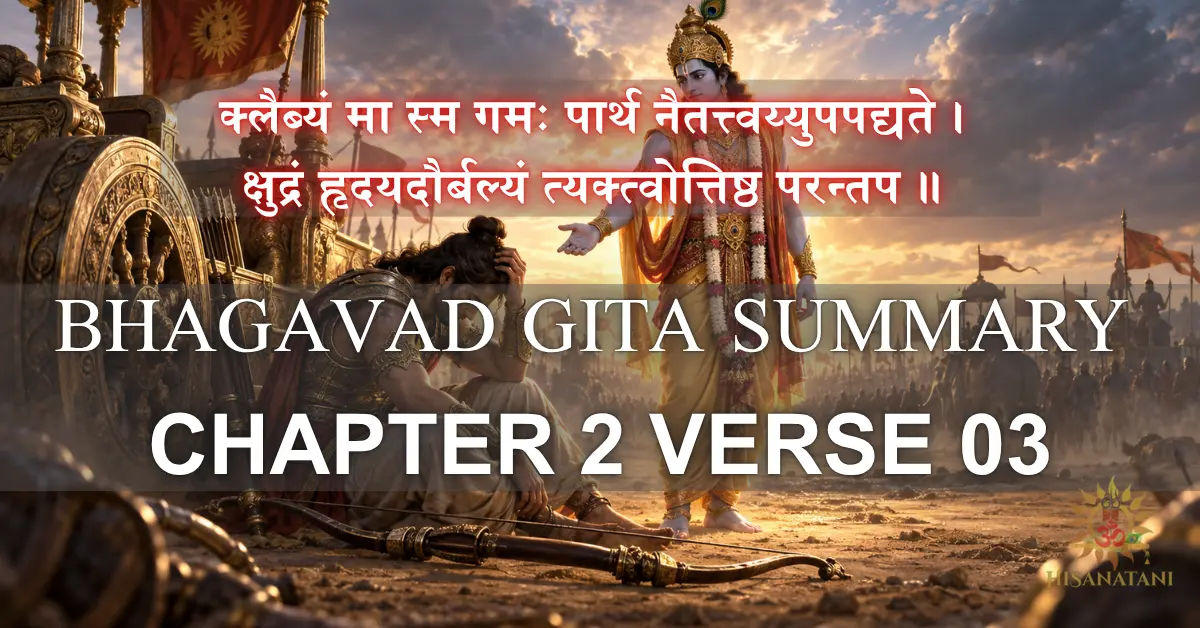
क्लैब्यं मा स्म गमः पार्थ नैतत्त्वय्युपपद्यते ।
क्षुद्रं हृदयदौर्बल्यं त्यक्त्वोत्तिष्ठ परन्तप ॥ २.३ ॥
In English :
klaibyaṁ mā sma gamaḥ pārtha naitat tvayy upapadyate |
kṣudraṁ hṛdaya-daurbalyaṁ tyaktvottiṣṭha parantapa ||
Feel the Vibration: A Guided Chant of Bhagavad Gita Chapter 2 Verse 3:
- klaibyaṁ mā sma gamaḥ pārtha naitat tvayy upapadyate |
Klai-byam maa sma ga-mah paar-tha nai-tat tvay-yu-pa-pad-ya-te - kṣudraṁ hṛdaya-daurbalyaṁ tyaktvottiṣṭha parantapa ||
Kshu-dram hri-da-ya daur-bal-yam tyak-tvot-tish-tha pa-ran-ta-pa
English Translation:
“Don’t slide into this unmanly weakness, Partha. It doesn’t suit you. Shake off this petty faintness of heart and stand up, scorcher of foes.”
JOIN THE HISANATANI COMMUNITY
Get daily Verse Summaries & High-Res Posters directly on your WhatsApp.
JOIN CHANNELYou’re Not Lazy. You’re Tired of Auditioning for Your Own Life.
Let’s be honest. Burnout doesn’t always look like lying in bed. Sometimes it looks like a full calendar, a green dot on Slack, and an “I’m good, just busy” you’ve said so many times it stopped meaning anything.
Underneath, there’s a quieter thought. What if they figure out I’m not as good as they think?
That thought does real damage. It turns a tired mind into a suspicious one, and suddenly every opportunity looks like a trap. Avoiding it starts to feel like being careful.
Krishna’s answer in Bhagavad Gita 2.3 isn’t “try harder.” It’s stranger and kinder than that. What you’re feeling is a state you’re in. It isn’t a fact about you. Big difference, and it changes what you do next.
Buffering Isn’t the Same as Broken

Picture a seven-year-old watching a cartoon on her dad’s phone. Right at the funny part, the screen freezes and a little circle starts spinning.
Does she cry, “The cartoon is gone forever”? No. She says, “It’s loading.” She waits, or she whacks the phone, or she yells for the Wi-Fi. But she never decides the cartoon stopped existing.
Now look at Arjuna. Frozen. Hands shaking, mouth dry, bow on the ground. Everything about him says the warrior has left the building. Krishna reads it differently. In the Summary of Bhagavad Gita 2.3, the freeze is just buffering. The real Arjuna is still in there. The connection is bad.
That’s why Krishna says “give up this weakness” and not “you are weak.” One describes a condition. The other passes a sentence.
And you do the sentence thing constantly. One rejected application becomes “I’m not hireable.” One shaky presentation becomes “I’m bad at speaking.” One rough month becomes “I’ve lost it.”
Ask any teacher: kids bounce back fast because they haven’t learned to staple a label onto a bad moment yet. We adults picked that habit up somewhere along the way.
The kid has it right. The problem is the spinning circle, not the cartoon. Fix the connection, take a breath, press play again. And if you need real rest first? Fine. Recharging isn’t quitting.
You’re the Person, Not the Tab That’s Screaming

Open your laptop. Count the tabs. Somewhere in there one of them is playing audio and you can’t find which. It’s loud, it’s embarrassing, and for a second it feels like the whole machine is broken.
But you’re not the tab. You’re the one sitting in front of the screen who can find it and close it.
That’s the Bhagavad Gita Chapter 2 Verse 3’s move, and it’s a lot older than any browser. Your moods come and go: confident on Monday, hopeless by Thursday, fine again on Sunday. If you were those moods, who’d be around to notice they changed? Something in you watches all of it and stays put. Krishna spends the next several verses building exactly that idea, starting at 2.11.
Now notice the word he picks for the fear. Kṣudra. Petty. Small. Not “terrifying,” not “understandable.” Small. From the inside it feels enormous, sure. But loud and important are different things. A tiny pop-up can still cover your whole screen.
So here’s a rule you can carry around: never write a permanent sentence about yourself using a temporary feeling. “I’m anxious” is weather. “I’m an anxious person” is a life sentence. Keep the first. Refuse the second.
Try it tonight. When the doubt starts up, say quietly, “A thought of failure is showing up.” Sounds silly. Works anyway, because now the sentence has a speaker and a listener, and you just moved into the listener’s chair.
Does that mean fear is always wrong? Of course not. Sometimes it’s a real signal worth hearing. But a signal is information. It isn’t an order.
Don’t Tap the Autocomplete

Your phone has predictive text. Type “Who am I to” and it finishes the sentence for you. Your brain runs one too, trained mostly on your worst moments: the failed exam, the harsh feedback, the friend who got ahead.
So an email lands saying “We’d like you to lead the client presentation,” and before you’ve blinked, the suggestions pop up. Why me? They’ll find out. Tell them you’re not ready.
Here’s the thing. They’re only suggestions. You don’t have to tap them.
That’s uttiṣṭha, “stand up,” in real life. Krishna doesn’t say win the argument with your fear first. He says get up while the fear is still talking. Therapists use a similar idea called behavioral activation: action can pull your mood along, instead of you waiting for the mood to go first. You start, and the confidence catches up. Not every time, but often enough to try.
There’s a two-second version, too. Just say it out loud: “There goes the autocomplete.” Naming it doesn’t stop it, but it slows it down enough for you to choose.
Waiting to feel ready is a sneaky kind of avoidance. Another course. Another résumé rewrite. Six months later you’re still “almost ready.”
One honest caution, though. If you’re truly burned out, not sleeping, dreading everything, feeling numb, then the right next step might be rest, a lighter workload, or a conversation with a doctor or therapist. Krishna’s push isn’t a weapon to use against yourself. Tired needs rest. Frozen needs one small move. Some days it’s both.
Your Job Title Is a Phone Case, Not the Phone

You’ve probably changed your phone case a few times. Different colors, a cracked corner, a cheap one, a fancy one. The phone inside never changed.
Now think about your roles. Employee. Team lead. Founder. “Senior Associate.” The salary slip. The LinkedIn headline. They’re useful, sure. They’re also cases. The trouble starts when we forget there’s a phone inside.
Look at what happened to Arjuna. His whole sense of self got knotted into his relationships and the outcome of this war. When he pictured the cost, the entire person came apart. Ever felt that during appraisal week?
Notice how fast one “Reply All” mistake starts to feel like a ruling on your entire personality. Case cracked. Phone fine.
The Gita’s answer is the Atman, the deeper Self that isn’t dented by a rejection email or inflated by a promotion. That doesn’t make your work unimportant. It makes your work lighter. You can give it everything without needing it to certify your worth.
Later in this chapter, in 2.47, Krishna tells Arjuna he has the right to act but not to the fruits of the action. Here in BG2.3, he’s laying the ground for that: don’t let the result of one battle write the definition of your soul. Prepare hard. Show up. Then loosen your grip on what the outcome “says” about you. That’s what surrender looks like here. Not giving up. Unclenching.
Krishna Wasn’t Hyping Arjuna. He Was Showing Receipts in Bhagavad Gita 2.3.

Let’s not shrink Kurukshetra into a conference room. Two enormous armies stand ready. The conches have sounded. Arjuna asked Krishna to park the chariot between both sides so he could see who he’d be fighting, and what he saw were teachers, uncles, cousins, and Bhishma, the grandfather figure he grew up looking up to. That’s when the bow slipped from his hands.
So when Krishna says “petty weakness,” he isn’t mocking a small worry. He’s calling a full moral crisis petty in one specific way: it’s shrinking the man who’s living through it. Hard thing to say to someone you love. Which is exactly why he chooses his words so carefully.
Think about the timing, too. Krishna waits until the doubt is at its loudest, right in the middle of the battlefield, before saying any of this. Bad timing? Maybe. Or maybe it’s the only moment the words could actually land.
Look at the names. Partha, son of Pritha (another name for his mother Kunti), points back to where he comes from. Parantapa, scorcher of foes, points to what he’s done. This is the man who, in disguise, took on the Kuru army almost single-handed during the Virata episode. Krishna isn’t handing out empty pep talk. He’s pointing at receipts.
That matters if impostor feelings sit on your chest. The fix isn’t “believe in yourself” with nothing behind it. It’s looking back at what you’ve actually done.
One more thing about the word klaibya. Literally it means “unmanliness,” a loaded, old-fashioned term. Read it as shock language, the kind a close friend uses when he’s scared for you. Krishna’s point is a loss of nerve. It isn’t a lecture on gender.
Your office isn’t Kurukshetra. Fair. But the pattern travels: you know your responsibility, and something inside won’t let you walk toward it.
The 24-Hour Gita Challenge: Three Steps Before Tomorrow Night

Don’t file Bhagavad Gita 2.3 away like another quote you’ll never use. Try the 24-Hour Gita Challenge. Three steps. No app needed.
Step 1: Name the thing you’re dodging. Grab a paper. Write, “The decision I’m avoiding is ___, because I’m afraid it’ll prove ___.” Be painfully specific.
“My career is confusing” doesn’t count. “I haven’t applied for the senior role because I’m afraid it’ll prove I’m not ready” does. You can’t fight a cloud. You can fight a sentence.
Step 2: Split feeling from fact. Draw two columns. Left: “I feel like I’m not qualified.” Right: “I meet six of the eight requirements.” Do it for three feelings.
Don’t argue with the left side, just label it. A feeling can be real and still be wrong about the facts. Do this with your phone in another room. Ten minutes. Yes, an actual other room.
Step 3: One move before 8 p.m. tomorrow. One, not ten. Send the application. Ask your manager for the stretch project. Book the interview slot.
Spend thirty focused minutes on your portfolio. Keep it small enough that you can’t hide behind “I’ll think about it.” And if your honest answer in Step 2 was “I’m running on empty,” then your one move is protecting a real block of rest, or booking time with a doctor or therapist. That counts. It’s still standing up.
Why 8 p.m.? Because a deadline makes it real, and because anything you can finish before dinner is something you can’t turn into a saga.
Name it. Split it. Move.
Your Doubt Gets a Vote. It Doesn’t Get the Veto.
Here’s the part of BG2.3 I find hardest to sit with. Krishna doesn’t flatter Arjuna. No “it’ll all work out.” He names the weakness and tells him to leave it behind.
Actually, that’s a gift. Self-doubt gets comfortable. If you never apply, you never get rejected. If you never speak up, nobody can criticize you. But a year later you’re in the same chair, with the same doubts and the same unfinished idea, wondering what would’ve happened if you’d tried.
You’re allowed to feel weak. You’re allowed to be tired, to rest, to ask for help. You’re just not required to obey the weakness.
The noise around you is real. Deadlines, layoff rumors, AI headlines, a cousin’s promotion post, an aunt asking “so, what’s next?” You can’t mute all of it. But how you answer it from the inside is the one part of the day you actually steer.
Courage was never the absence of fear. It’s declining to hand fear the final say. And you don’t need certainty first. Take one step, see a little more, take the next.
So tonight, ask yourself one thing: what’s the smallest brave thing I can do tomorrow? Then go do it.
Please let me know in the comments.
Embrace the Teachings of the Gita. Dive deeper into the Bhagavad Gita to uncover its timeless wisdom and practical guidance. Let its verses inspire you to cultivate inner clarity, align with higher values, and navigate life’s challenges with courage and grace.
🌼 Join the HiSanatani WhatsApp Channel for your daily dose of light 🪔. Join Now.
Voice of the Soul
Finding clarity in the questions we all carry…
What is the main message of Bhagavad Gita 2.3?
Krishna tells Arjuna not to give in to weakness of heart and to get up. The point isn’t “feel nothing.” It’s that a temporary collapse of nerve shouldn’t decide who you are. See how it plays out in Buffering Isn’t the Same as Broken.
What does hṛdaya-daurbalya mean in Bhagavad Gita 2.3?
Hṛdaya-daurbalya means “weakness of heart,” a loss of nerve rather than a lack of ability. Krishna calls it kṣudra, petty or small, because it shrinks whoever carries it. More on that in You’re the Person, Not the Tab That’s Screaming.
How can Bhagavad Gita 2.3 help with imposter syndrome?
Treat the feeling as a passing suggestion, not a verdict. Name it, check the facts, then act anyway. Krishna also points to Arjuna’s actual record instead of offering hype. Start with Krishna Wasn’t Hyping Arjuna. He Was Showing Receipts.
Does Bhagavad Gita 2.3 mean I should ignore burnout?
No. The verse targets frozen fear, not genuine exhaustion. Rest, lighter workloads, and professional help are all legitimate. Tired needs recovery; frozen needs one small move. Learn to tell them apart in Don’t Tap the Autocomplete.
What should I do today after reading Bhagavad Gita 2.3?
Name one decision you’ve been dodging, split your feelings from the facts, and take one small action before tomorrow night. The full steps are in The 24-Hour Gita Challenge: Three Steps Before Tomorrow Night.
