
Namaste 🙏
Welcome to Hi Sanatani. It’s a joy to have you here as we explore the deeper layers of human nature. By diving into this Bhagavad Gita 1.40 Summary we create a sacred bridge together, turning ancient verses into helpful tools for your personal growth and peace.
Translation of Bhagavad Gita Shloka Verse 1.40 in English:
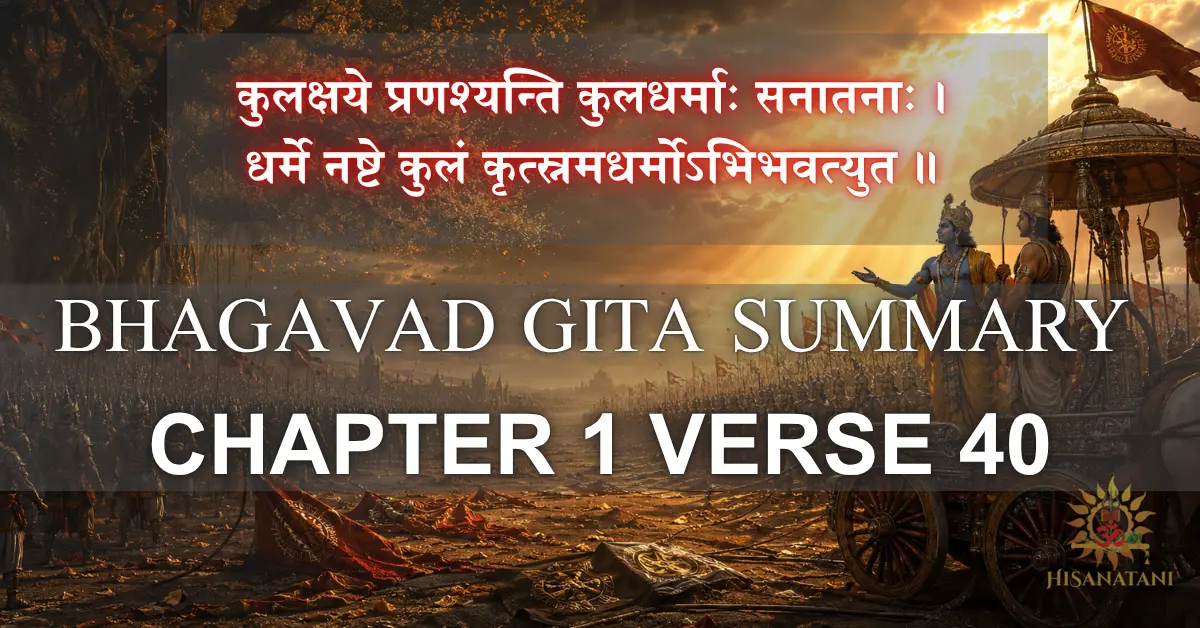
कुलक्षये प्रणश्यन्ति कुलधर्माः सनातनाः ।
धर्मे नष्टे कुलं कृत्स्नमधर्मोऽभिभवत्युत ॥ १.४० ॥
In English :
kula-kṣaye praṇaśyanti kula-dharmāḥ sanātanāḥ |
dharme naṣṭe kulaṁ kṛtsnam adharmo ‘bhibhavaty uta ||
Feel the Vibration: A Guided Chant of Bhagavad Gita Chapter 1 Verse 40:
- kula-kṣaye praṇaśyanti kula-dharmāḥ sanātanāḥ |
ku-la-kṣa-ye pra-ṇa-śyan-ti ku-la-dhar-māḥ sa-nā-ta-nāḥ - dharme naṣṭe kulaṁ kṛtsnam adharmo ‘bhibhavaty uta ||
dhar-me naṣ-ṭe ku-laṁ kṛt-snam a-dhar-mo-bhi-bha-va-ty u-ta
English Translation:
“When a family line breaks down, its time-tested traditions break down with it. And once those traditions are gone, whatever remains of the family slips into disorder.”
JOIN THE HISANATANI COMMUNITY
Get daily Verse Summaries & High-Res Posters directly on your WhatsApp.
JOIN CHANNELWhy Your Conscience Needed This Verse Today
Toxic workplaces rarely ask you to become dishonest overnight. They ask for something smaller. “Ignore this once.” “Everyone does it.” “It’s above your pay grade.” Each request sounds harmless. Each compromise feels temporary.
But here’s the thing in Bhagavad Gita 1.40— character isn’t destroyed by one dramatic decision. It’s reshaped by hundreds of ordinary ones. A lot of young professionals aren’t tired because of the workload. They’re tired because they spend all day negotiating with their own conscience. This verse is a reminder: the real danger isn’t working inside a broken culture. It’s letting that culture quietly rewrite who you are.
The Domino Effect: Why One Wrong Habit Changes the Whole Playground

Imagine a classroom where everyone lines up politely before lunch. The children know the rules, wait their turn, and help one another. Now imagine one child starts pushing others to get food first. At first, the teacher ignores it. Soon another child copies the behaviour. Within days, almost everyone is pushing. The problem was never the first push — it was that nobody stopped it.
This is exactly what Arjuna wants us to understand. In Bhagavad Gita Chapter 1 Verse 40, he explains that when dharma — doing what’s right — becomes weak, people slowly forget how they’re supposed to behave. The same thing happens at work: one employee lies about a report, another takes credit for someone else’s effort, a manager ignores unfair treatment. The office still has computers, meetings, and targets — but something important has disappeared. Trust.
Arjuna teaches that bad behaviour spreads just as fast as good behaviour. People copy what gets rewarded. If dishonesty earns promotions, dishonesty spreads. That’s why protecting good habits matters even when nobody seems to notice.
Culture Is Invisible Until It Breaks

Most people think civilisation is built with roads, buildings, and wealth. Arjuna in BG1.40 disagrees — he believes it rests on something far less visible: shared values. Dharma isn’t merely religion. It’s the invisible operating system that lets people cooperate without constant fear.
Think about a red light. Most days you stop even when no one’s watching, because society functions when people voluntarily respect order. The same principle governs workplaces. A handbook cannot create ethics. Policies cannot manufacture integrity. These tools only support values people have already accepted internally. Once internal discipline disappears, organisations respond with more approvals, more monitoring, more audits — yet trust keeps declining, because procedures can manage behaviour, but they cannot restore character.
Arjuna never suggests collapse happens suddenly. He describes gradual erosion — standards soften, exceptions multiply, until yesterday’s unacceptable action becomes today’s normal practice. That’s why dharma is preventative, not reactive. It asks us to maintain ethical discipline before visible damage appears.
Quiet Quitting Often Begins in the Conscience

Burnout is usually described as having too much work. But modern psychology also recognises a quieter kind of exhaustion — sometimes called moral injury — the distress caused by repeatedly acting against what you know is right. Imagine watching a colleague get credit for work they didn’t do, or staying silent because speaking up could cost you your career. One part of you wants security. Another demands integrity. Living between those two voices burns enormous emotional energy.
This is where BG1.40 becomes surprisingly practical. Arjuna warns that when unethical behaviour becomes normal, honesty starts attracting criticism instead of respect, and integrity starts delaying promotions instead of earning them. People begin questioning themselves — “Am I too idealistic? Maybe I’m the problem.” Many eventually disengage. Some resign quietly. Others stay physically present while checking out emotionally. That’s one root of today’s quiet quitting.
Protecting your values isn’t only a spiritual practice — it’s psychological self-preservation. Every time your actions stay aligned with your conscience, your mind spends less energy managing internal conflict. You think clearer, sleep deeper, and speak with more confidence.
Protecting Your Inner Dharma Before the Office Rewrites Your Soul

Most people think spirituality begins in a temple. The Gita quietly says otherwise — it begins in your choices. Arjuna’s concern in this verse isn’t merely social; beneath it lies a spiritual truth: when dharma declines outside us, it becomes harder to preserve dharma within us.
A toxic environment works like background apps draining a phone battery. You may arrive determined to stay honest, yet all day your mind processes gossip, politics, and subtle pressure to compromise. Your inner energy drains — not because you lack ability, but because your consciousness is constantly defending itself. Your real identity is not your designation, your salary, or your performance rating. Those are roles. The Atman, your true self, remains untouched by any of it.
Arjuna’s warning in Bhagavad Gita Chapter 1 Verse 40 reminds us that every compromise distances us from our own conscience before it affects anyone else. The spiritual loss always comes first. Practising dharma is an act of returning — to clarity, to truth, to the quiet confidence no paycheck can purchase and no office politics can destroy.
Kurukshetra Was Never Just About a War

Arjuna stands between two armies made of teachers, grandfathers, brothers, and friends. He isn’t only calculating military losses — he’s imagining the long-term consequences of civil war. In ancient Vedic society, the kula, the extended family, was the foundation of education, ethics, and social continuity. Elders resolved disputes; knowledge passed down through living example, not written manuals.
Arjuna fears that if the protectors of these households die, future generations may inherit wealth but lose wisdom. His concern is historical before it’s personal: without ethical leadership, traditions weaken; without traditions, discipline weakens; without discipline, confusion spreads.
Seen through today’s lens, the battlefield could just as easily be a workplace. The elders become managers; the younger generation becomes fresh graduates. If experienced leaders reward integrity, healthy workplace traditions continue. If they normalise manipulation, the next generation of employees inherits that culture instead — and civilisations, like companies, rarely collapse because they run out of resources. They collapse because they lose the principles which we can learn from summary of Bhagavad Gita 1.40, that taught people how to use those resources wisely.
The 24-Hour Gita Challenge: Stop Values Erosion Before It Starts

Reading wisdom creates awareness. Practising it creates transformation. Here’s a challenge you can complete in the next twenty-four hours.
Challenge 1 — Name One “Normal” Behaviour That Isn’t Healthy: Look around your workplace. Is gossip treated as teamwork? Is overwork celebrated as commitment? Write down one behaviour everyone accepts but your conscience quietly questions.
Challenge 2 — Perform One Small Act of Integrity Nobody Asked For: Give full credit to a teammate publicly. Correct a mistake before someone else discovers it. Keep one promise exactly as you made it — not for recognition, but because your character is always watching.
Challenge 3 — Audit Your Paycheck Against Your Peace of Mind: Spend ten quiet minutes asking: Is my work changing my skills or changing my values? A career can always be rebuilt. A damaged conscience often takes far longer.
Protect Your Conscience Before Circumstances Force You To
Arjuna’s concern in Bhagavad Gita 1.40 Summary reaches far beyond an ancient battlefield. Cultures don’t collapse because one bad person appears — they collapse when good people slowly begin accepting bad behaviour as normal. Whether it’s a family, a company, or an entire nation, every community survives on invisible foundations: trust, responsibility, honesty, and courage.
Today’s workplace may pressure you to compromise. It may reward shortcuts. But the Gita reminds us that the greatest success isn’t merely reaching the top — it’s arriving there without losing yourself. Protect your competence, but protect your conscience even more. Skills build careers. Character builds lives.
Please let me know in the comments.
Embrace the Teachings of the Gita. Dive deeper into the Bhagavad Gita to uncover its timeless wisdom and practical guidance. Let its verses inspire you to cultivate inner clarity, align with higher values, and navigate life’s challenges with courage and grace.
🌼 Join the HiSanatani WhatsApp Channel for your daily dose of light 🪔. Join Now.
Voice of the Soul
Finding clarity in the questions we all carry…
What is the main message of Bhagavad Gita 1.40?
The central teaching is that when righteousness declines, families and societies gradually lose the values that keep them united — cultural decay begins internally before it becomes externally visible. This idea is explored further in Culture Is Invisible Until It Breaks.
How does Bhagavad Gita 1.40 apply to modern workplaces?
It warns that unethical workplace habits can slowly become accepted as normal. Once manipulation, dishonesty, or silence get rewarded, healthy organisational culture starts deteriorating. See The 24-Hour Gita Challenge for practical ways to resist this drift.
Does Bhagavad Gita 1.40 blame women for social decline?
No. Arjuna is describing the consequences of the collapse of family dharma within the historical context of the Mahabharata. His concern is the breakdown of the entire moral structure of society, not blame directed at women. This historical context is explained in Kurukshetra Was Never Just About a War.
Why is dharma so important in Bhagavad Gita Chapter 1 Verse 40?
Dharma acts as the invisible framework that keeps individuals, families, and institutions stable. When people stop living by ethical principles, confusion and distrust naturally increase. This is explored in Protecting Your Inner Dharma Before the Office Rewrites Your Soul.
What practical lesson can young professionals learn from BG1.40?
Success should never require sacrificing integrity. Small daily acts of honesty shape both personal character and workplace culture. Begin with one ethical action today, as described in The 24-Hour Gita Challenge: Stop Values Erosion Before It Starts.
