
Namaste 🙏
Welcome to Hi Sanatani. It’s a joy to have you here as we explore the deeper layers of human nature. By diving into this Bhagavad Gita 1.38 Summary we create a sacred bridge together, turning ancient verses into helpful tools for your personal growth and peace.
Translation of Bhagavad Gita Shloka Verse 1.38 in English:
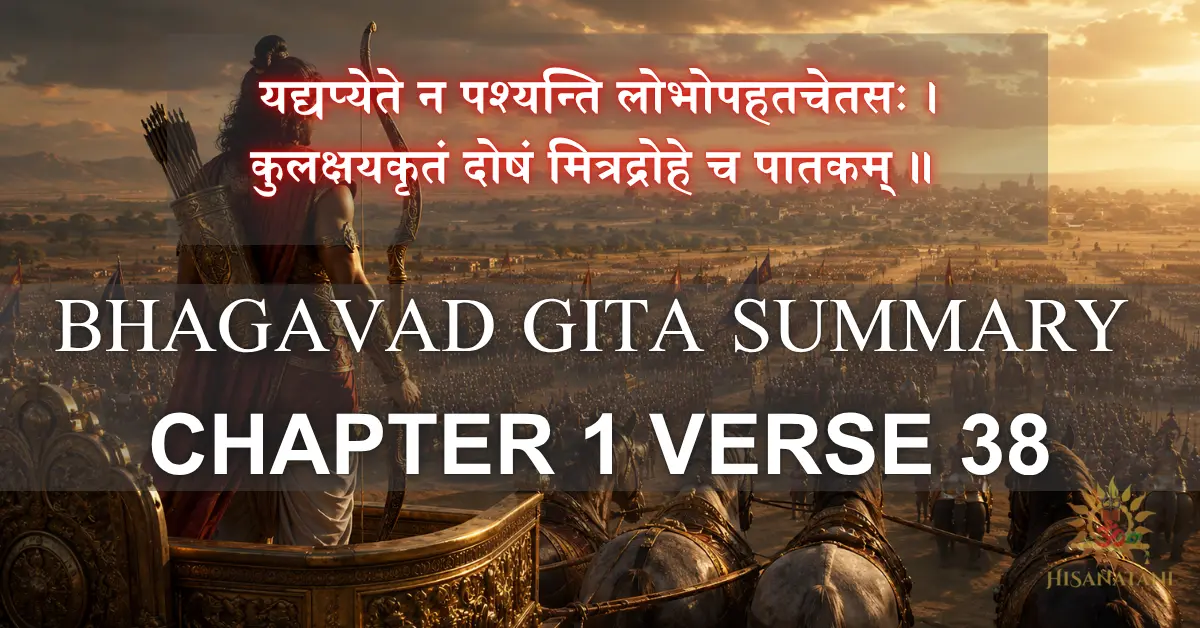
यद्यप्येते न पश्यन्ति लोभोपहतचेतसः ।
कुलक्षयकृतं दोषं मित्रद्रोहे च पातकम् ॥ १.३८ ॥
In English :
yady apy ete na paśyanti lobhopahata-cetasaḥ |
kula-kṣaya-kṛtaṁ doṣaṁ mitra-drohe ca pātakam ||
Feel the Vibration: A Guided Chant of Bhagavad Gita Chapter 1 Verse 38:
- yady apy ete na paśyanti lobhopahata-cetasaḥ |
Yad-yap-ye-te na pash-yan-ti, Lo-bho-pa-ha-ta-che-ta-saḥ - kula-kṣaya-kṛtaṁ doṣaṁ mitra-drohe ca pātakam ||
Ku-la-ksha-ya-kri-tam do-sham, Mit-ra-dro-he cha pa-ta-kam
English Translation:
“Even though these men, their minds overpowered by greed, see no wrong in destroying their own family, and no sin in betraying their friends—”
JOIN THE HISANATANI COMMUNITY
Get daily Verse Summaries & High-Res Posters directly on your WhatsApp.
JOIN CHANNELWhy This Verse Finds You Right Where You Are
Maybe nobody’s asking you to go to war. But you’re probably fighting something — the pressure to earn more, prove more, outperform everyone in the room. None of that is wrong on its own. The trouble starts when ambition quietly stops being a tool and becomes your whole identity. That’s when people start turning into resources. Conversations start turning into networking. And somewhere in there, you stop asking whether you actually want this and start only asking whether you can get it.
Bhagavad Gita 1.38 Summary isn’t warning you away from wanting things. It’s asking a harder question: what are you becoming while you chase it? Because sometimes the biggest loss doesn’t show up after you fail. It shows up after you win.
The Playground Lesson Every Kid Already Knows

Picture a kid on a playground, playing a game with friends. Everyone’s having fun — until one kid gets obsessed with winning. He starts cheating. Pushes people out of the way. Won’t share. And he wins. He gets the toy, the trophy, whatever it was.
But now nobody wants to play with him. Was that actually a win?
That’s exactly what Arjuna is pointing at. The Kauravas want the kingdom so badly they can’t see the damage they’re causing to get it. Winning has quietly become more important than the people it was supposed to be for.
Kids get this instinctively. Adults forget it constantly.
It shows up in smaller versions everywhere: friendships damaged by competition at school, teammates turned into rivals at work, inheritance disputes that break families that survived everything else. The lesson in Bhagavad Gita Chapter 1 Verse 38 is almost embarrassingly simple — winning that costs you trust is usually a loss wearing a disguise.
Relationships take years to build and minutes to wreck. Rebuilding one is almost always harder than earning back the money, title, or approval you traded it for.
When Wanting Something Turns Off Your Eyes

Look closely at what Arjuna actually says. He doesn’t call the Kauravas stupid. He says their minds are overpowered by greed. That’s a different claim, and it matters.
A person can be smart, educated, even self-aware in every other part of life — and still make a decision that wrecks something important. Not because they lack information. Because desire has quietly started editing what they’re willing to see.
Think of it as a ledger with missing entries. When you want something badly enough, your mind records the benefits in full detail and leaves the costs out entirely. You see the promotion. You don’t see the dinner you missed to get it. You see the deal closing. You don’t see the friend who stopped calling.
This is why smart people stay in situations that are clearly costing them something — a job, a habit, a relationship dynamic. They’re not confused. They’re just not letting themselves finish the calculation.
Bhagavad Gita Chapter 1 Verse 38 makes a point that’s easy to miss: ignorance isn’t always about not knowing something. Sometimes it’s a refusal to look at what your desire is asking you to give up. Greed doesn’t just distort your choices — it edits your evidence.
How You Go Broke on Relationships Without Noticing

Psychologists talk about cognitive bias — how the brain quietly protects a decision it’s already attached to. The Gita was describing something similar thousands of years before the term existed.
Here’s how it usually plays out. A promotion opens up. You start working longer hours. Then weekends start disappearing. Then family dinners. Then the calls get shorter, then less frequent. Months later, you get the promotion — and your relationships feel thinner than they used to.
Nothing dramatic happened. No single decision broke anything. It was a hundred small trades, each one reasonable on its own.
That’s relationship bankruptcy. It doesn’t happen suddenly. It happens gradually — the same way Arjuna describes it happening to the Kauravas, whose greed keeps them from ever calculating the real cost of what they’re doing, right up until the cost comes due.
The modern version looks like this: skipping your parents’ calls because work feels urgent, letting friendships go quiet because networking feels more useful, measuring your week by metrics instead of by who you actually showed up for. The psychological lesson in Bhagavad Gita 1.38 Summary is blunt — a mind fixated on gaining something almost always underestimates what it’s spending to get it.
The Math Greed Can’t Do

Spiritually, greed isn’t really about wanting more. It’s about forgetting that you already have enough.
Left alone, most people feel a quiet sense of connection — to others, to their own life, to something steady underneath the noise. Greed interrupts that. It convinces you the good feeling is somewhere else, one step ahead. One more raise. One more title. One more milestone. The finish line keeps moving, and the peace you were chasing keeps moving right along with it.
Arjuna sees that the Kauravas have drifted away from dharma — not because they made one bad decision, but because desire has taken over their whole field of awareness. When that happens, the question quietly changes. It stops being “is this right?” and becomes only “can I get it?”
That shift changes everything, even when nothing on the outside looks different yet.
The spiritual lesson in Bhagavad Gita 1.38 isn’t that greed makes you a bad person. It’s that greed changes what you’re capable of noticing. Once your awareness narrows that far, even the obvious things — a tired spouse, a distant friend, a quiet warning sign — become genuinely hard to see.
What Was Actually Happening at Kurukshetra

Strip away the poetry for a second and look at the situation Arjuna is standing in.
Two armies. Years of failed negotiation behind them. The Kauravas had already rejected multiple chances at peace — they wanted the kingdom, not a compromise. With talks exhausted, war is the only thing left on the table.
Arjuna sees something the other side doesn’t seem to. Not just the coming casualties, but what happens after: families broken apart, a social structure that took generations to build gone in an afternoon, trust between clans that will never fully return.
The Kauravas are measuring the moment by what they stand to gain. Arjuna is measuring it by what it will cost everyone, for years afterward.
That’s the real split in this verse. It’s not “ambitious people” against “peaceful people.” It’s short-term thinking against long-term responsibility. The Kauravas define success as possession — get the throne, keep the throne. Arjuna is starting to define success as something closer to dharma — doing right by the people the decision will actually affect.
That’s what makes Bhagavad Gita Chapter 1 Verse 38 more than a war scene. It’s one of the oldest recorded versions of a fight everyone eventually has with themselves.
The 24-Hour Gita Challenge: Audit Your Ambition

Most people don’t need less ambition. They need cleaner ambition — the kind that isn’t quietly draining people you actually care about.
Try this today. Three steps, nothing abstract.
Step 1 — Name three neglected people. Write down three people who matter to you but have gotten less of your attention lately because of work or some other goal. Pick one. Send them a message today — not tomorrow.
Step 2 — Find the hidden trade-off. Ask yourself plainly: what am I giving up to chase this particular goal? Sleep? Health? Time with family? Peace of mind? Write the honest answer down, even if it’s uncomfortable.
Step 3 — Score success beyond the win. Rate five categories out of ten: career, health, family, friendships, inner peace. If one number is climbing while the rest are falling, your definition of success needs adjusting — not your ambition, your definition.
That’s the practical core of Summary of Bhagavad Gita 1.38. Not “stop wanting things.” Just: stop letting one number rise at the expense of everyone else’s.
The Real Question Isn’t What You’ll Gain
Arjuna’s observation holds up remarkably well thousands of years later. People whose minds get taken over by greed usually don’t see the damage until much later — sometimes not until it’s already done.
The tragedy was never that the Kauravas wanted something. Wanting things is normal. The tragedy is that they stopped noticing what wanting it was costing them.
The Bhagavad Gita 1.38 isn’t anti-ambition. It never asks you to want less. It asks you to pair whatever you’re building with enough awareness to notice who’s standing next to you while you build it.
Build. Create. Achieve. Lead. Just don’t get so locked onto the destination that you damage the people who made the path worth walking in the first place.
A lonely win is usually a loss with better lighting.
Please let me know in the comments.
Embrace the Teachings of the Gita. Dive deeper into the Bhagavad Gita to uncover its timeless wisdom and practical guidance. Let its verses inspire you to cultivate inner clarity, align with higher values, and navigate life’s challenges with courage and grace.
🌼 Join the HiSanatani WhatsApp Channel for your daily dose of light 🪔. Join Now.
Voice of the Soul
Finding clarity in the questions we all carry…
What is the main message of Bhagavad Gita 1.38?
It warns that greed can cloud judgment so completely that a person stops seeing the damage their pursuit of a goal is causing. Explore this further in When Wanting Something Turns Off Your Eyes.
Why does Arjuna mention greed specifically in this verse?
Because he believes the Kauravas can’t recognize the harm of destroying family relationships — their minds are too overpowered by desire to calculate the cost. See How You Go Broke on Relationships Without Noticing.
How is Bhagavad Gita 1.38 relevant to modern life?
Many people trade relationships, health, and peace for success without noticing the trade is happening. Check the bill before you’re stuck paying it, as explained in The 24-Hour Gita Challenge: Audit Your Ambition.
Does the Gita say ambition itself is wrong?
No. It criticizes attachment and greed, not healthy aspiration — ambition paired with awareness is a different thing entirely, as explored in The Math Greed Can’t Do.
What’s the one practical takeaway from BG1.38 for professionals?
Regularly check whether your goals are strengthening your most important relationships or quietly draining them — the core lesson in The Playground Lesson Every Kid Already Knows.
