
Namaste 🙏
Welcome to Hi Sanatani. It’s a joy to have you here as we explore the deeper layers of human nature. By diving into this Bhagavad Gita 1.46 Summary we create a sacred bridge together, turning ancient verses into helpful tools for your personal growth and peace.
Translation of Bhagavad Gita Shloka Verse 1.46 in English:
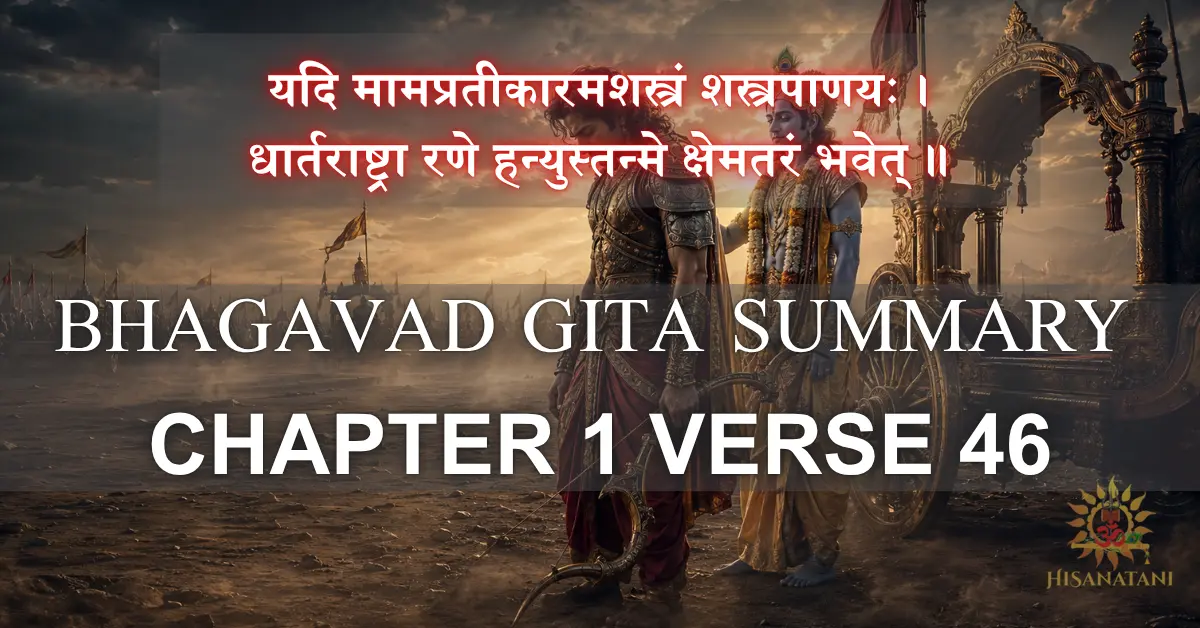
यदि मामप्रतीकारमशस्त्रं शस्त्रपाणयः ।
धार्तराष्ट्रा रणे हन्युस्तन्मे क्षेमतरं भवेत् ॥ ४६ ॥
In English :
yadi mām apratīkāram aśastraṁ śastra-pāṇayaḥ |
dhārtarāṣṭrā raṇe hanyus tan me kṣemataraṁ bhavet ||
Feel the Vibration: A Guided Chant of Bhagavad Gita Chapter 1 Verse 46:
- yadi mām apratīkāram aśastraṁ śastra-pāṇayaḥ |
Ya-di māma-pra-tī-kā-ram a-shas-tram shas-tra-pā-ṇa-yaḥ - dhārtarāṣṭrā raṇe hanyus tan me kṣemataraṁ bhavet ||
Dhār-ta-rāsh-trā ra-ṇe han-yus tan me kshe-ma-ta-ram bha-vet
English Translation:
“If the sons of Dhritarashtra, weapons in hand, were to kill me on the battlefield while I stand unarmed and offer no resistance, that would be far better for me.”
JOIN THE HISANATANI COMMUNITY
Get daily Verse Summaries & High-Res Posters directly on your WhatsApp.
JOIN CHANNELYou’re Not Weak. You’re Just Out of String.
Here’s the thing nobody tells you about burnout: it doesn’t always look like crying at your desk. Sometimes it looks like a fully capable person deciding that losing quietly is easier than trying again.
Arjuna isn’t a coward. He’s one of the best warriors alive. But right here, in this one line, he’d rather be defeated doing nothing than keep carrying the weight of choosing.
If you’ve ever wanted to just let the bad outcome happen so the deciding would stop — you already know this BG1.46.
The Phone at 1% Doesn’t Hate You

Picture your phone battery at one percent. You open an app. It lags. You try another. It freezes. You wouldn’t call the phone lazy. It’s depleted, not broken.
Arjuna’s mind is running the same way. He’s taken in too much — faces, history, guilt, fear — and there’s no processing power left. So he does the equivalent of a phone shutting off mid-task: he drops the bow.
Now think about your own week. Your manager wants speed. Your team wants support. Your inbox wants an answer yesterday. Your phone buzzes through all of it. And somewhere in the middle of that, a voice says, I can’t do this anymore.
That voice isn’t lying to you. It’s reporting battery level, not character.
A kid carrying ten books drops all ten when someone hands them an eleventh. Nobody says the kid hates school. The load just crossed a line. Same thing happens to adults — except our books are invisible. One hard boss. One unresolved fight. One deadline stacked on three others. One feeling that everyone else has it figured out.
Stack enough invisible books and of course you want to put them down.
The lesson here isn’t complicated: when you’re at 1%, the first job isn’t to keep performing. It’s to recognize you’re at 1%. That’s not defeat. That’s just an accurate reading of the gauge — and accurate readings are what let you actually recharge instead of running yourself to zero and calling it discipline.
Giving Up Is Still a Choice

There’s a trap hiding inside Bhagavad Gita Chapter 1 Verse 46, and it’s worth naming directly. Arjuna frames his surrender as noble — better to die unresisting than to cause harm. It sounds like peace. It isn’t.
Refusing to act is still an act. You don’t get to opt out of consequences by opting out of choosing. If Arjuna stands there and lets himself be killed, the war doesn’t stop. His side loses. His family’s claim collapses. Passivity here doesn’t protect anyone — it just hands the outcome to whoever’s still willing to swing a sword.
Translate that to your Monday. “I’ll just let the promotion go to someone else.” “I’ll stop pushing back on the deadline and let it fail.” “I’ll stay quiet in the meeting and let the bad plan go through.” Each of those feels like relief. None of them are neutral. Somebody else is now steering, and you’ve quietly signed off on wherever they take it.
Philosophy has a blunt way of putting this: there’s no such thing as a non-decision. There’s only a decision you made by refusing to notice you were making one.
That doesn’t mean force yourself into a choice at your lowest point — that’s a separate problem, and Krishna spends the rest of the Gita on it. It means: don’t mistake exhaustion for wisdom. Arjuna’s line here isn’t the Gita’s answer. It’s the moment the real question finally shows up.
This Is What a Freeze Response Sounds Like
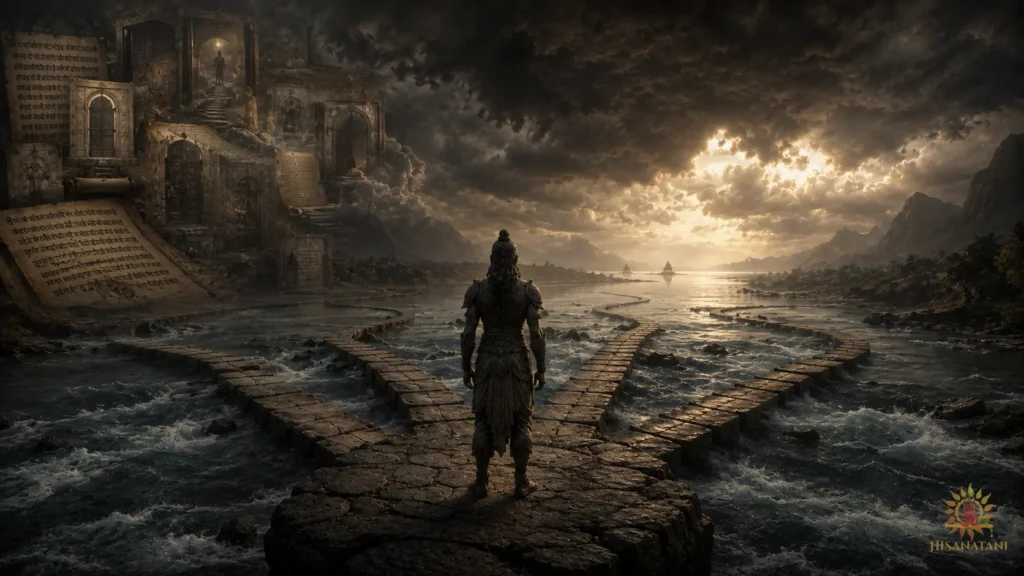
Every nervous system has three basic settings under threat: fight, flight, freeze. Arjuna picks the third one, and it’s worth knowing what that actually is, clinically speaking — not a character flaw, a documented stress response.
When conflicting pressure gets high enough and no clear path forward appears, the system doesn’t crash randomly. It shuts down output while keeping the alarm running. You’re not calm. You’re stuck, wide awake, fully aware something’s wrong, and unable to move.
At work this looks ordinary from the outside. Staring at the same email for forty minutes. Rereading a Slack message five times without replying. Opening the resignation-letter draft you’ve saved but never sent. None of it looks dramatic. All of it is the same mechanism Arjuna’s in — too much input, no clean exit, system stalls.
The dangerous part isn’t the freeze itself. It’s what you do with it. Left alone, a freeze convinces you the exhaustion is permanent, that quitting the job or the decision or the relationship is the only way out. But a freeze has a shelf life. It’s a state, not a verdict.
A pause needs an endpoint, or it becomes a hiding place. Arjuna sitting down isn’t Chapter 18. It’s the end of Chapter 1. Krishna hasn’t said a word yet. Treat your own freeze the same way — real, worth respecting, but not the final word on what you’re capable of once your system resets.
Control Was Always an Illusion, Not a Skill You Lost
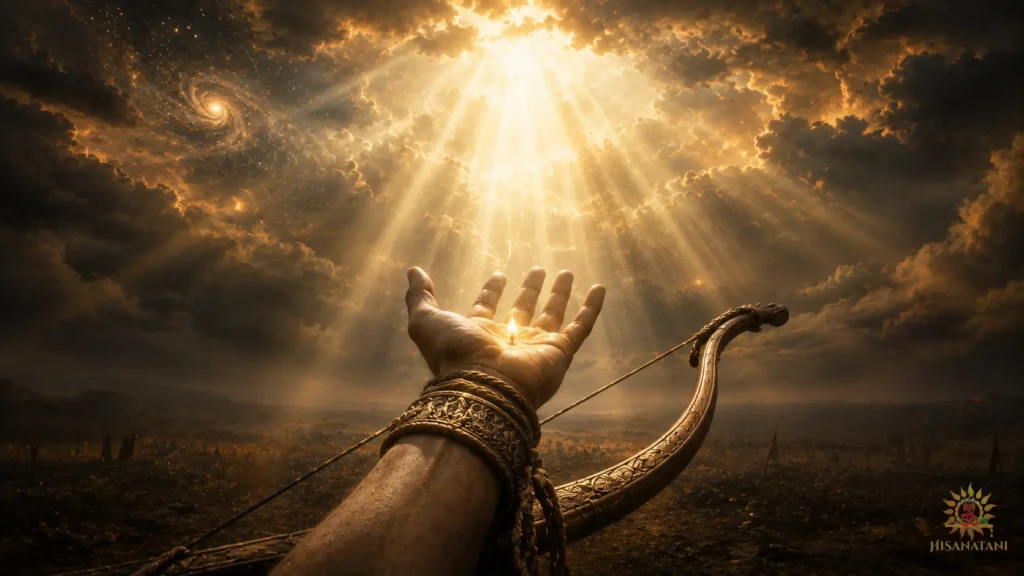
Underneath the exhaustion, something else is cracking in Arjuna: his belief that he was ever fully in control. Right up until this Bhagavad Gita 1.46, his identity ran on being the guy who handles it — the best archer, the reliable one, the person others count on. That identity just hit a wall it can’t argue past.
This is where the ego usually panics, because the ego’s whole deal is a quiet contract: if I perform well enough, I’ll be safe. Life never actually signed that contract. You can prep the deck perfectly and still watch the board react badly. You can lead your team with total sincerity and still lose someone to burnout you didn’t see coming.
Spiritual maturity doesn’t mean you stop caring about outcomes. It means you stop confusing your effort with your control over the result. Arjuna’s collapse is the ego running out of runway — and that’s uncomfortable, but it’s also the only place real surrender can start, because you can’t surrender something you’re still gripping.
The Bhagavad Gita Chapter 1 Verse 46 isn’t telling you to go numb and let life happen to you. It’s showing you the exact moment before a person is ready to trade white-knuckle control for something steadier — a sense of duty that doesn’t collapse every time the outcome looks uncertain. That trade is the whole rest of the Gita.
This Isn’t a Metaphor — It’s an Actual War
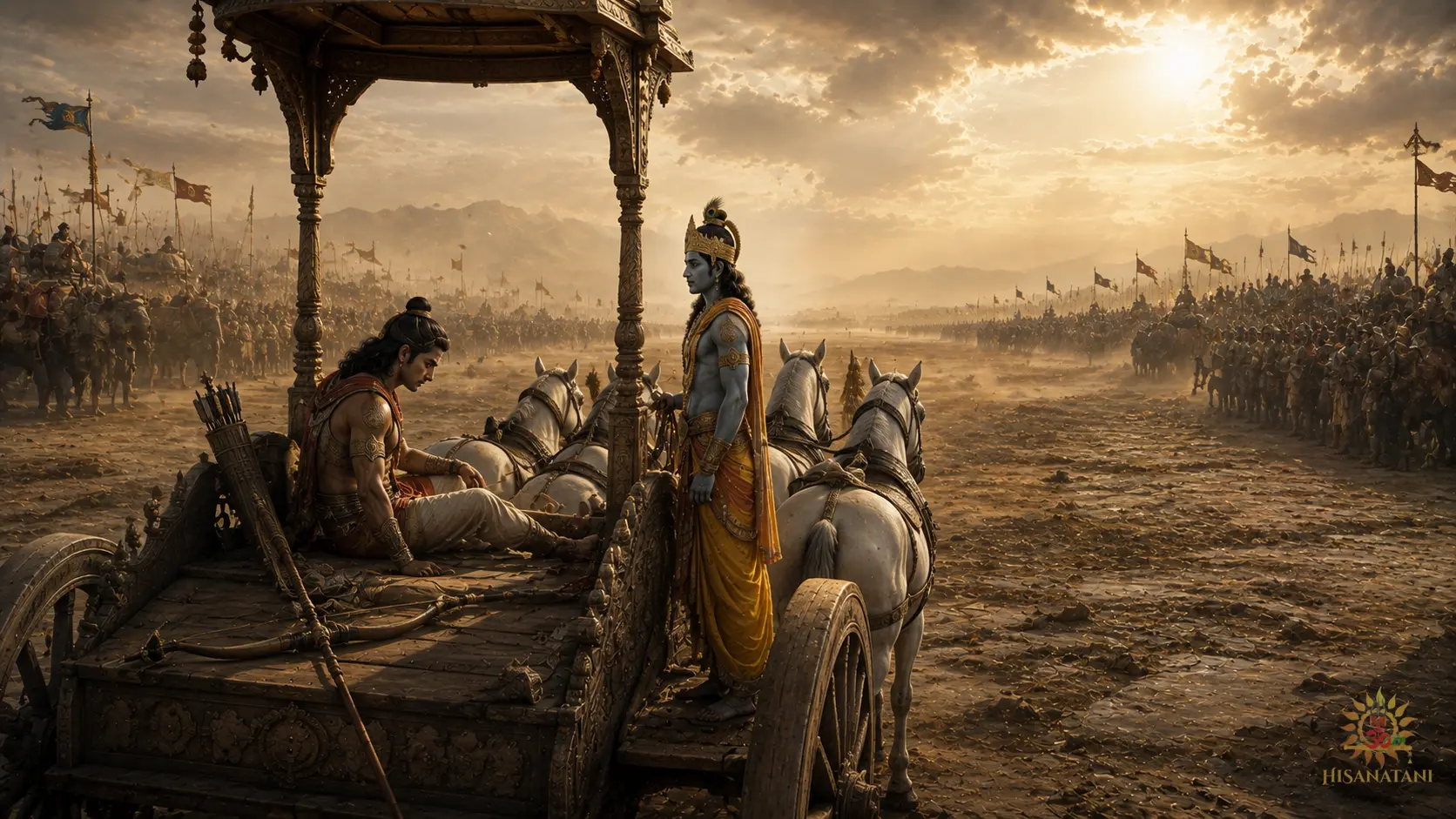
It’s tempting to read this Bhagavad Gita Chapter 1 Verse 46 as a poetic stand-in for a hard day at the office. Worth resisting that urge for a second, because the scale here is not symbolic.
Two full armies are standing on the plain of Kurukshetra. Conch shells have already sounded. Arjuna has personally asked to be driven between the ranks so he can see exactly who he’s about to fight — and he sees Bhishma, who raised him. Drona, who trained him. Cousins he played with as a child.
His line in Bhagavad Gita 1.46 — that he’d rather die unarmed than fight — is not a mood. It’s a proposal with real consequences: his side loses the war, his family’s kingdom is gone, and everyone counting on him is undefended. This is a warrior at the peak of his skill, standing in front of the exact test he trained his whole life for, choosing to fail it on purpose because the emotional cost feels unbearable.
That’s the detail that should stop you. It’s not that Arjuna is weak or untrained. It’s that even total competence can’t out-argue grief once grief gets loud enough. The battlefield doesn’t disappear because he wants to sit down. The duty doesn’t vanish. What’s changed is only his relationship to it — and that gap, between what’s still required of him and what he currently feels capable of, is exactly where Krishna is about to step in.
The 24-Hour Gita Challenge

Don’t let this Summary of Bhagavad Gita 1.46 become another idea you nod at and forget by lunch. Use it today, in three moves.
Step 1 — Name the exact freeze (10 minutes). Write down, in one sentence, the decision or task you’re currently avoiding. Not the whole career. One thing. “I’m avoiding replying to the client email.” “I’m avoiding telling my manager I’m overloaded.” Naming it moves it out of the fog and onto paper, where it’s smaller than it feels.
Step 2 — Separate the fact from the fear (10 minutes). Two columns. Left side: what you actually know. Right side: what you’re imagining might happen. Example — Fact: my workload increased last month. Fear: if I say something, they’ll think I can’t handle the job. Most decision paralysis lives almost entirely on the right side of that page.
Step 3 — Pick up one small piece of the bow (before the day ends). Not the whole decision. One honest next action. Send the email. Book the fifteen-minute conversation. Say no to one meeting that doesn’t need you. That’s it. You’re not required to have the whole battlefield figured out today — just enough clarity for the next real step.
When the Freeze Ends, the Teaching Begins
Bhagavad Gita 1.46 Summary isn’t really about whether Arjuna wins or loses. It’s about the moment a genuinely capable person becomes unable to act because the weight got too heavy to carry alone.
That’s why it still lands, thousands of years later. A manager can have the title, the experience, the data, and still freeze over one email. A twenty-something with every option on the table can still lie awake wanting to disappear from the whole thing. Different battlefield. Same human wiring.
His bow hitting the ground isn’t the end of the story — it’s the end of one way of trying to handle it alone. Krishna hasn’t spoken yet. What comes next will ask Arjuna to separate emotion from wisdom, fear from duty, and outcome from action — a distinction that’s worth just as much to a burned-out professional today as it was on that field.
You don’t need certainty before you act. You don’t need everyone’s approval. You need enough clarity to take the next honest step — and the willingness to admit, out loud if you have to, “I’m overwhelmed.” Just don’t stop there. Ask what you need to understand before you pick the bow back up. That’s where the real conversation starts.
Please let me know in the comments.
Embrace the Teachings of the Gita. Dive deeper into the Bhagavad Gita to uncover its timeless wisdom and practical guidance. Let its verses inspire you to cultivate inner clarity, align with higher values, and navigate life’s challenges with courage and grace.
🌼 Join the HiSanatani WhatsApp Channel for your daily dose of light 🪔. Join Now.
Voice of the Soul
Finding clarity in the questions we all carry…
What is the main message of Bhagavad Gita 1.46?
Arjuna reaches a point of total exhaustion and says he’d rather be killed unarmed than keep fighting — a portrait of someone completely out of gas rather than a spiritual statement. See You’re Not Weak. You’re Just Out of String.
Why does Arjuna say he’d rather die unarmed in BG1.46?
Because continuing to fight requires a decision he can’t bear to make, while standing there and losing feels like relief from having to choose at all — the exact freeze response covered in This Is What a Freeze Response Sounds Like.
Is Arjuna being spiritual or just giving up in Bhagavad Gita 1.46?
He’s giving up — this isn’t enlightened surrender, it’s collapse, and Krishna’s teaching hasn’t started yet. The distinction is explored in Control Was Always an Illusion, Not a Skill You Lost.
How does Bhagavad Gita 1.46 apply to burnout or wanting to quit your job?
It shows that the urge to quit everything often isn’t about the job itself — it’s the freeze response talking. Separating real facts from imagined outcomes is covered in The 24-Hour Gita Challenge.
What can professionals learn from Arjuna’s collapse in Bhagavad Gita Chapter 1 Verse 46?
That even highly capable people freeze under enough combined pressure, and a pause is only useful if it has an endpoint. The child-friendly version of this idea is in The Phone at 1% Doesn’t Hate You.
