
Namaste 🙏
Welcome to Hi Sanatani. It’s a joy to have you here as we explore the deeper layers of human nature. By diving into this Bhagavad Gita 1.26 Summary we create a sacred bridge together, turning ancient verses into helpful tools for your personal growth and peace.
Translation of Bhagavad Gita Shloka Verse 1.26 in English:
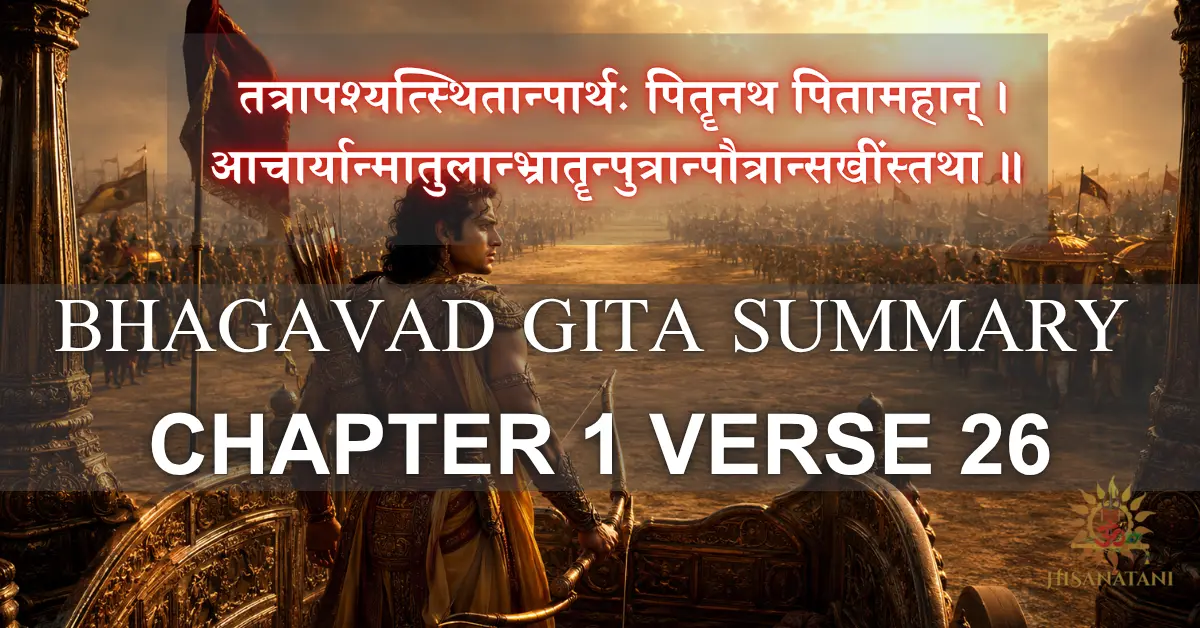
तत्रापश्यत्स्थितान्पार्थः पितॄनथ पितामहान् ।
आचार्यान्मातुलान्भ्रातॄन्पुत्रान्पौत्रान्सखींस्तथा ॥ १.२६ ॥
In English :
tatrāpaśyat sthitān pārthaḥ pitṝn atha pitāmahān |
ācāryān mātulān bhrātṝn putrān pautrān sakhīṃs tathā ||
Feel the Vibration: A Guided Chant of Bhagavad Gita Chapter 1 Verse 26:
- tatrāpaśyat sthitān pārthaḥ pitṝn atha pitāmahān |
ta-trā-pa-śyat sthi-tān pār-thaḥ
pi-tṝn a-tha pi-tā-ma-hān - ācāryān mātulān bhrātṝn putrān pautrān sakhīṃs tathā ||
ā-cār-yān mā-tu-lān bhrā-tṝn
pu-trān pau-trān sa-khīṃs ta-thā
English Translation:
“There Arjuna, son of Pritha, saw arrayed before him fathers, grandfathers, teachers, maternal uncles, brothers, sons, grandsons, and friends — standing on both sides.”
JOIN THE HISANATANI COMMUNITY
Get daily Verse Summaries & High-Res Posters directly on your WhatsApp.
JOIN CHANNELWhy Your Focus Keeps Breaking (And It’s Not Your Fault)
Ever notice how a normal workload turns unbearable the second someone you actually like is involved? A hard project is just a hard project — until your mentor’s name is on it, or your closest colleague is the one asking for the favor.
That’s not weakness. That’s wiring.
Today’s always-on culture makes it worse. Messages don’t stop at 6 PM. Family group chats interrupt deep work. Your manager texts on Sunday like it’s Tuesday.
Before Arjuna feels fear or doubt, he feels this first: attachment entering his line of sight. That’s the actual crack. Bhagavad Gita 1.26 Summary names it before it spirals — and naming it is where you get your grip back.
The Dodgeball Rule Hiding Inside Bhagavad Gita 1.26 Summary

Picture a ten-year-old at recess. Dodgeball. Team captain. Ball in hand, ready to win. Then she looks across the line.
Her best friend is on the other team. So is the kid who shares his lunch with her every day. So is her favorite cousin, visiting for the week.
She doesn’t throw. She hesitates. The game she was winning a second ago suddenly feels impossible.
Nothing on the court changed. The rules are the same. The goal is the same. But her mind stopped treating this like a game and started treating it like a relationship problem.
That’s Arjuna in Bhagavad Gita Chapter 1 Verse 26. One second he’s a warrior surveying a battlefield. The next, he’s a grandson looking at his grandfather.
Kids get this instinctively — it’s harder to compete against someone you love than someone you’ve never met. Adults just dress the same problem up in bigger words: conflict of interest, mixed loyalties, hard conversations.
A manager avoiding honest feedback with a friend on the team. A student who won’t call out a groupmate who isn’t pulling weight. A founder who can’t fire the first employee who believed in the vision.
The task was never the hard part. The task is usually simple. What’s hard is doing the task while your heart is pulling somewhere else.
That’s Arjuna’s first lesson on the battlefield. BG1.26 hands it to us before anything else happens.
Why Nobody Actually Sees Things As They Are

Here’s an uncomfortable truth: you’ve probably never seen a single situation exactly as it is. Not once.
Gravity doesn’t check who it’s pulling down. The sun doesn’t dim itself for people having a bad week. Physical law doesn’t play favorites.
Human perception does, constantly.
The battlefield in Bhagavad Gita Chapter 1 Verse 26 is full of soldiers, commanders, and rival units — that’s the fact of it. But Arjuna doesn’t see any of that. He sees a grandfather. A teacher. Uncles. Friends.
Same field. Completely different reality, because he’s viewing it through memory and relationship, not through fact.
Think about it — an email lands differently depending on who sent it. The exact same sentence feels neutral from a stranger and feels like a personal attack from someone with history attached to it. The words don’t change. Your filter does.
Summary of Bhagavad Gita 1.26 is showing you this filter in real time, before Arjuna even decides what to do about it.
This isn’t a flaw unique to Arjuna. It’s how every human mind works. We don’t experience raw facts — we experience facts wrapped in relationship, memory, and expectation.
Krishna’s entire teaching, unfolding over the chapters ahead, depends on Arjuna — and us — first admitting this. You can’t correct a filter you refuse to notice. That admission starts right here, one glance across a battlefield.
The Real Reason Your Brain Shuts Down Under Pressure

Let’s talk about what’s actually happening in your head when work and personal loyalty collide.
When Arjuna spots his family among the ranks, something in him short-circuits. Modern neuroscience has a name for it — the amygdala, the brain’s alarm system, floods the decision-making prefrontal cortex with stress signals. The system built for quick survival calls starts overriding the system built for calm judgment.
That’s not weakness. That’s hardware.
You’ve felt a smaller version of this. Deep in focused work, then a message from a senior colleague you respect, asking for “just five minutes.” Then your family group chat, unrelated, unavoidable. Your calendar reminds you of a call you didn’t ask for. Three loyalties, one nervous system, zero bandwidth.
This is why productivity advice alone rarely works. You don’t have a time-management problem in these moments. You have an unacknowledged loyalty conflict running underneath the task list.
Bhagavad Gita 1.26 Summary gets ahead of the spiral most self-help skips entirely: notice the attachment before it decides for you. Arjuna’s clarity doesn’t return by ignoring what he feels. It starts precisely because he stops pretending he doesn’t feel it.
Naming the pull is step one. Everything Krishna teaches after this verse builds on that first honest look.
The Soul Behind Every Familiar Face

Here’s where this verse gets quiet and serious.
Every relationship Arjuna sees on that field is real. Grandfather, teacher, brother, friend — none of it is fake, and the Gita never asks you to pretend it is.
But it does ask you something harder: are you only these roles? Son. Employee. Friend. Sibling. Provider.
Roles matter. Nobody’s saying otherwise. But when your whole sense of self gets built entirely out of roles, you inherit every fear that comes with them — fear of disappointing, fear of losing the relationship, fear of being replaced.
Arjuna is standing at the exact edge of that discovery, though he doesn’t know it yet. The teacher he loves, the grandfather who raised him — these aren’t the whole truth of who he is, or who they are either. There’s something underneath the role, and the Gita spends the chapters ahead pointing at it.
This isn’t a call to walk away from people you love. It’s an invitation to stop needing them to hold your identity together. When your sense of self isn’t hostage to every relationship, you can actually show up for people without falling apart when things get complicated.
Bhagavad Gita 1.26 Summary plants that seed early — long before Krishna says a single word.
What Arjuna Was Actually Staring At
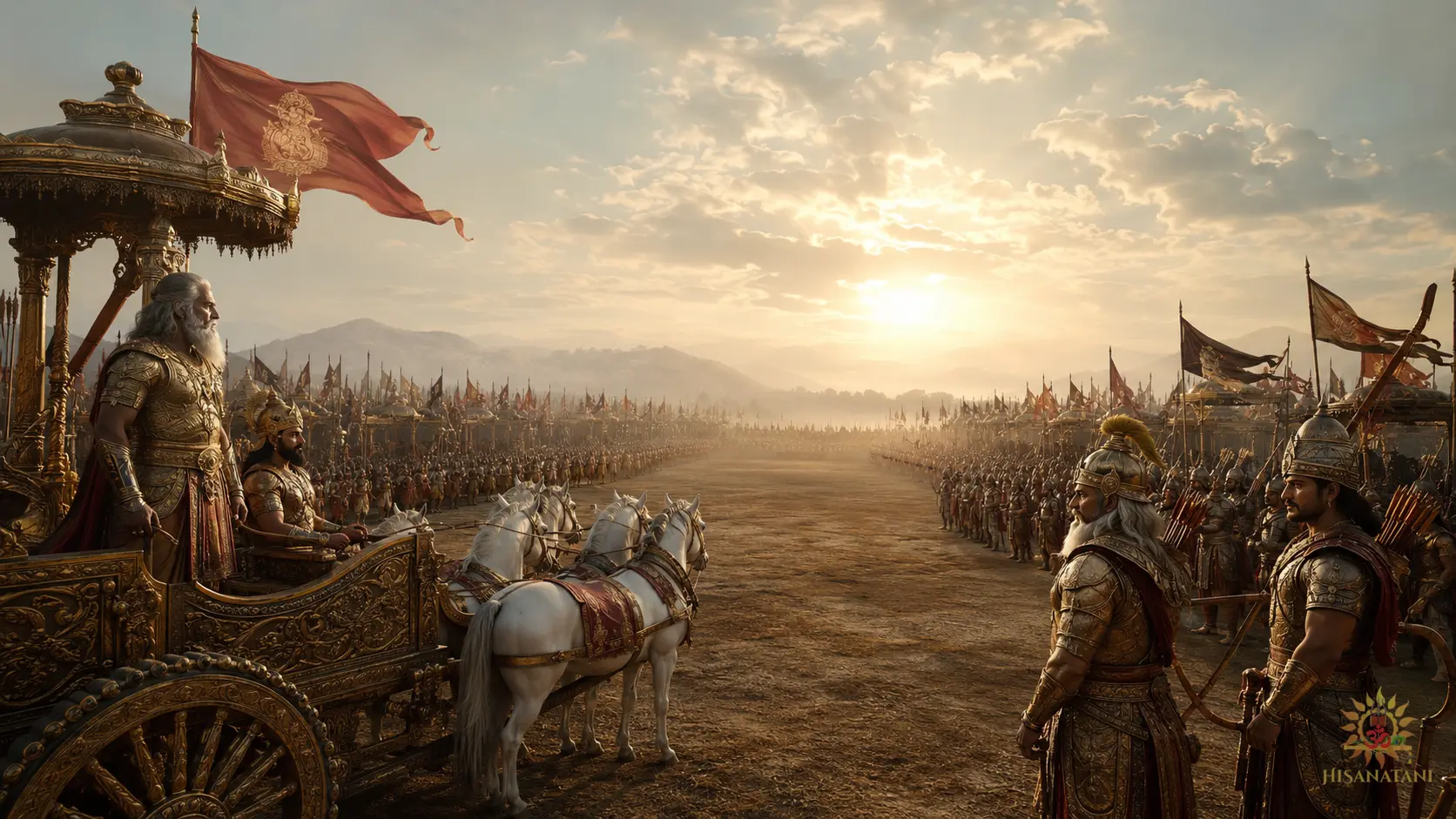
Strip away the philosophy for a second and look at the plain facts of the scene.
Two armies. Fully assembled. Conches already sounded, weapons already drawn. This isn’t a rehearsal — Kurukshetra is a real war about to start, and Arjuna is standing in a chariot parked deliberately between both front lines.
Across from him: Bhishma, the grandfather figure who held him as a child. Drona, the teacher who put a bow in his hands and trained him into the finest archer of his generation. Cousins. In-laws. Childhood friends who grew up in the same courtyards.
This wasn’t a war against strangers. It was a civil war — the kind where every name on the enemy roster is also a name from your own family gatherings.
Ancient Indian society placed enormous weight on respect for elders and loyalty to teachers. Arjuna wasn’t overreacting by the standards of his time. He was responding exactly the way his culture had raised him to respond.
Bhagavad Gita 1.26 Summary captures the precise second those cultural values slam into his duty as a warrior. That collision isn’t a side detail — it’s the entire reason the rest of the Gita needed to be spoken. Without this moment, Krishna has nothing to respond to.
Your 24-Hour Gita Challenge: Draw the Line Without Guilt

Insight is worthless if it stays in your head. Here’s how to run Bhagavad Gita 1.26 Summary through your actual day — three moves, twenty-four hours.
Step 1 — Run the “Who’s Really Asking” Check. Every time someone asks something of you today, write it down. Next to it, answer honestly: is this the task, or is this the relationship talking? You’re not looking to cut people off. You’re looking to see clearly — which is exactly what Arjuna couldn’t do until he named what he saw.
Step 2 — Set a Hard Stop. Pick a real time tonight — 7 PM, 8 PM, whatever fits your life — and actually close the laptop when it hits. Not “do not disturb.” Closed. If a message lands after that, it waits. Arjuna eventually learns there’s a right time to act and a right time to hold steady. Practice holding steady once today.
Step 3 — Use One Honest Sentence. When someone tries to pull you off track, don’t over-explain and don’t apologize five times. Try: “I want to do this well, so I need to finish what’s in front of me first.” Said calmly, that sentence protects your time without damaging the relationship.
Small moves. Real friction, if you actually do them. But this is how a 5,000-year-old verse turns into something you can use before tomorrow morning.
The Moment Before Everything Changed
Bhagavad Gita 1.26 Summary is a small moment on paper. Arjuna looks. He recognizes. He feels. That’s genuinely all that happens in this verse.
But it’s the hinge the entire Gita swings on. The confident warrior who rode onto that field starts confronting feelings he hadn’t processed yet — and that confrontation is what makes the chapters ahead necessary.
If you’re reading this exhausted, half-answering messages from people you respect, half-guarding time for yourself — you already know this feeling. Boundaries get blurry exactly where love and loyalty live, not where strangers are involved.
Clarity doesn’t mean cutting people off. It means seeing what’s actually going on before deciding what to do about it.
That’s where Arjuna is right now. Krishna hasn’t said a word yet. The next verse is where the weight of this moment finally breaks through.
Please let me know in the comments.
Embrace the Teachings of the Gita. Dive deeper into the Bhagavad Gita to uncover its timeless wisdom and practical guidance. Let its verses inspire you to cultivate inner clarity, align with higher values, and navigate life’s challenges with courage and grace.
🌼 Join the HiSanatani WhatsApp Channel for your daily dose of light 🪔. Join Now.
Voice of the Soul
Finding clarity in the questions we all carry…
What does Bhagavad Gita 1.26 actually describe?
Arjuna looks across the battlefield and recognizes fathers, grandfathers, teachers, uncles, brothers, and friends standing on both sides — not strangers preparing for war. See What Arjuna Was Actually Staring At for the full historical picture.
Why does this verse matter so much in Chapter 1?
It marks the exact second Arjuna’s confidence cracks, setting up everything Krishna teaches afterward. Read Why Nobody Actually Sees Things As They Are to understand the deeper pattern.
How does Bhagavad Gita 1.26 connect to modern work stress?
It shows how mixing personal loyalty with professional duty overwhelms the brain’s decision-making. See The Real Reason Your Brain Shuts Down Under Pressure.
Is this verse telling us to detach from family and friends?
No — it’s asking you to stop building your entire identity out of roles alone. See The Soul Behind Every Familiar Face.
What’s one practical takeaway from Bhagavad Gita 1.26 Summary?
Separate the task from who’s asking before you react. Try the steps in Your 24-Hour Gita Challenge: Draw the Line Without Guilt.

1 thought on “Bhagavad Gita 1.26 Summary | Face Conflict With Loved Ones”