
Namaste 🙏
Welcome to Hi Sanatani. It’s a joy to have you here as we explore the deeper layers of human nature. By diving into this Bhagavad Gita 1.31 Summary we create a sacred bridge together, turning ancient verses into helpful tools for your personal growth and peace.
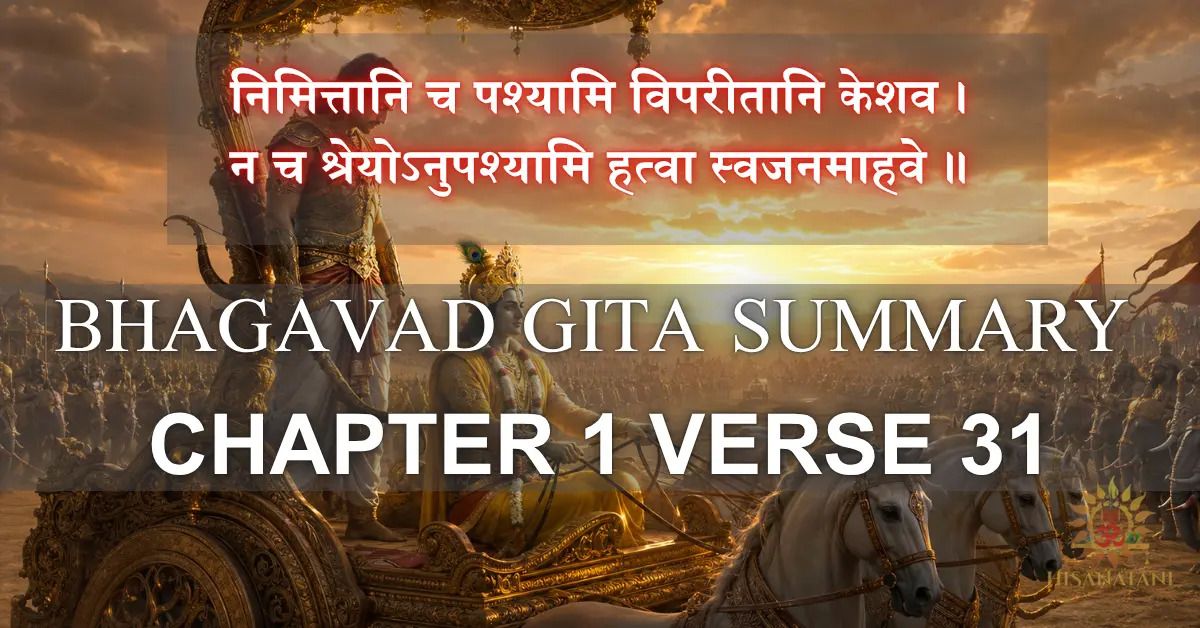
Translation of Bhagavad Gita Shloka Verse 1.31 in English:
न च श्रेयोऽनुपश्यामि हत्वा स्वजनमाहवे ।
न काङ्क्षे विजयं कृष्ण न च राज्यं सुखानि च ॥ १.३१ ॥
In English :
na ca śreyo’nupaśyāmi hatvā svajanam āhave |
na kāṅkṣe vijayaṃ kṛṣṇa na ca rājyaṃ sukhāni ca || 1.31 ||
Feel the Vibration: A Guided Chant of Bhagavad Gita Chapter 1 Verse 31:
- na ca śreyo’nupaśyāmi hatvā svajanam āhave |
Na cha shre-yo-‘nu-pash-yaa-mi hat-vaa sva-ja-nam aa-ha-ve - na kāṅkṣe vijayaṃ kṛṣṇa na ca rājyaṃ sukhāni ca || 1.31 ||
Na kaang-kshe vi-ja-yam krish-na na cha raaj-yam su-khaa-ni cha
English Translation:
“I see no good that can come from killing my own people in this battle, Krishna. I don’t long for victory, nor for a kingdom, nor for the pleasures that come with it.”
JOIN THE HISANATANI COMMUNITY
Get daily Verse Summaries & High-Res Posters directly on your WhatsApp.
JOIN CHANNELWhy Your Soul Needed to Hear This Today
Maybe you’ve never said it out loud, but you’ve thought it. Somewhere between the deadline and the next one, you’ve wondered if the promotion is worth what it’s taking from you. Your evenings. Your patience with the people who matter. Your sense of who you are outside of work.
Arjuna says the quiet part out loud in Bhagavad Gita 1.31. He looks at what winning would cost him and decides the prize isn’t worth the price. That’s not failure talking. That’s a person finally asking the question everyone around him forgot to ask: what’s the point of a win that leaves you emptier than the fight did?
The Game Nobody Wants to Win Anymore

Picture a birthday party game — the last-chair game, where whoever grabs the final seat wins the big prize. You want that prize badly. So you play hard. You nudge past your best friend. You beat your favorite cousin to the chair.
Then you’re sitting there, prize in hand, and you look up. Your friend is crying. Your cousin won’t look at you. The room that was loud a minute ago has gone quiet.
Suddenly the prize doesn’t feel like a prize anymore. It feels heavy. You start wondering if there was a version of this game where everyone stayed happy — even if you didn’t get the chair.
That’s the exact moment Bhagavad Gita 1.31 captures. Arjuna is standing in front of the biggest prize of his life — a kingdom, a victory that songs would be written about for centuries. And he looks across the field and sees the people he’d have to hurt to get it.
His teachers. His cousins. People who taught him how to hold a bow in the first place.
Kids get this instinctively, long before they learn to explain it. A win that costs you your people doesn’t feel like winning. It feels like the party ended and nobody’s celebrating.
Bhagavad Gita 1.31 Summary teaches something every child already senses and every adult eventually has to relearn: some prizes aren’t worth what they take. The goal was never to win at any cost. It was to win in a way you can still feel good about afterward.
Preyas vs Shreyas: The Question Every Ambitious Person Eventually Faces

The Gita has a word for what Arjuna is wrestling with here: shreyas. It roughly means ‘the good that actually lasts,’ as opposed to preyas — ‘the good that feels good right now.’
Victory, in this moment, is pure preyas. It’s immediate. It’s visible. Everyone would understand if Arjuna took it. But he pauses long enough to ask a harder question: does this actually serve what’s good, or does it just feel like winning?
That question doesn’t go away after Kurukshetra. It shows up every time you’re offered a shortcut that works but costs you something you can’t easily name — your integrity, a friendship, a version of yourself you actually like. The offer always looks like preyas: fast, certain, rewarding. Rarely does it announce itself as a trade.
Philosophically, BG1.31 makes an uncomfortable claim: not every available victory deserves to be chased. Two people can look at the same opportunity — the same promotion, the same shortcut, the same ‘yes’ that would make life easier tomorrow — and one sees a win while the other sees a cost dressed up as a win.
Arjuna’s crisis isn’t that he’s too weak to fight. It’s that he’s finally asking whether this particular fight is one worth winning. That distinction — between what’s available and what’s actually good — is the seed of every real decision the rest of the Gita is going to help him make.
When Your Mind Starts Asking ‘Is This Even Worth It?’
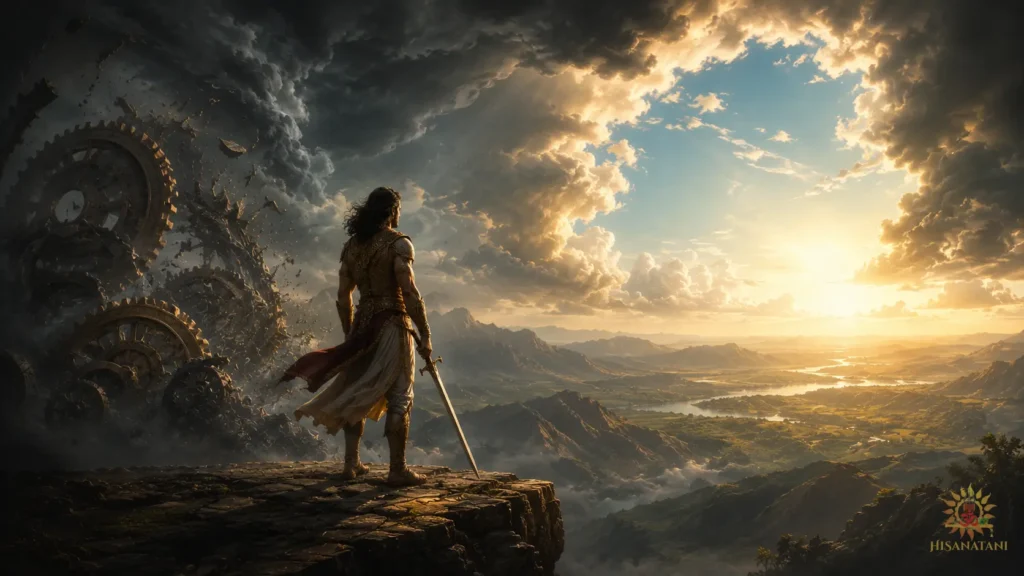
There’s a specific kind of exhaustion that shows up right before a big win — not before you start the race, but right as you’re about to cross the line. Psychologists sometimes call it goal devaluation: the closer you get to something you’ve chased for years, the more you start questioning whether you actually want it.
It sounds backwards. Shouldn’t the finish line feel exciting? But the mind does something strange under pressure — it finally has room to ask the questions it was too busy to ask during the chase.
What am I giving up for this? Who am I becoming to get it? Is the version of me that wins this actually someone I want to be?
Arjuna’s hesitation in Bhagavad Gita Chapter 1 Verse 31 fits this pattern exactly. He’s not confused about how to fight. He’s confused about why he’s still fighting for something that no longer feels like a win. That’s not a breakdown. That’s a mind doing exactly what it’s supposed to do when the cost of a goal finally becomes visible.
If you’ve ever felt strangely flat right before hitting a target you worked years for — the offer letter, the milestone, the title — you’ve felt a version of this. It doesn’t mean something is wrong with you. It usually means part of you has been keeping score on a different scoreboard the whole time, one that measures cost, not just achievement. Listening to that part, instead of pushing past it, is often where clarity actually starts.
The Self That Doesn’t Need the Trophy

Notice what Arjuna calls the people across the battlefield: sva-janam — ‘my own.’ Not enemies. Not obstacles. His own people. That word choice matters.
He’s not detached from the outcome because he doesn’t care. He’s overwhelmed because he cares too much about the wrong measure of victory.
The Summary of Bhagavad Gita 1.31 deeper teaching — one that unfolds slowly across the chapters ahead — is that the self, the Atman, was never actually sitting on that battlefield waiting for a kingdom. Kingdoms rise and fall. Titles get passed around. The applause fades the week after it arrives. None of that touches what you actually are underneath it.
Most of us spend years building an identity out of things that can be taken away — a job title, a bank balance, a seat at a table. And it works, for a while. Until a moment like Arjuna’s arrives: the win is right there, and it suddenly feels like it can’t fill the space it’s supposed to fill.
That’s not a sign to give up. It’s a sign to check what you’ve been building your peace on. Arjuna’s refusal of victory, kingdom, and pleasure in this verse isn’t the Gita’s final answer — Krishna spends the rest of the book gently correcting him. But it’s an honest starting point: a man finally admitting that the prizes he’d spent his life chasing were never going to be the thing that made him whole.
The Warrior Who Said No to His Own Coronation
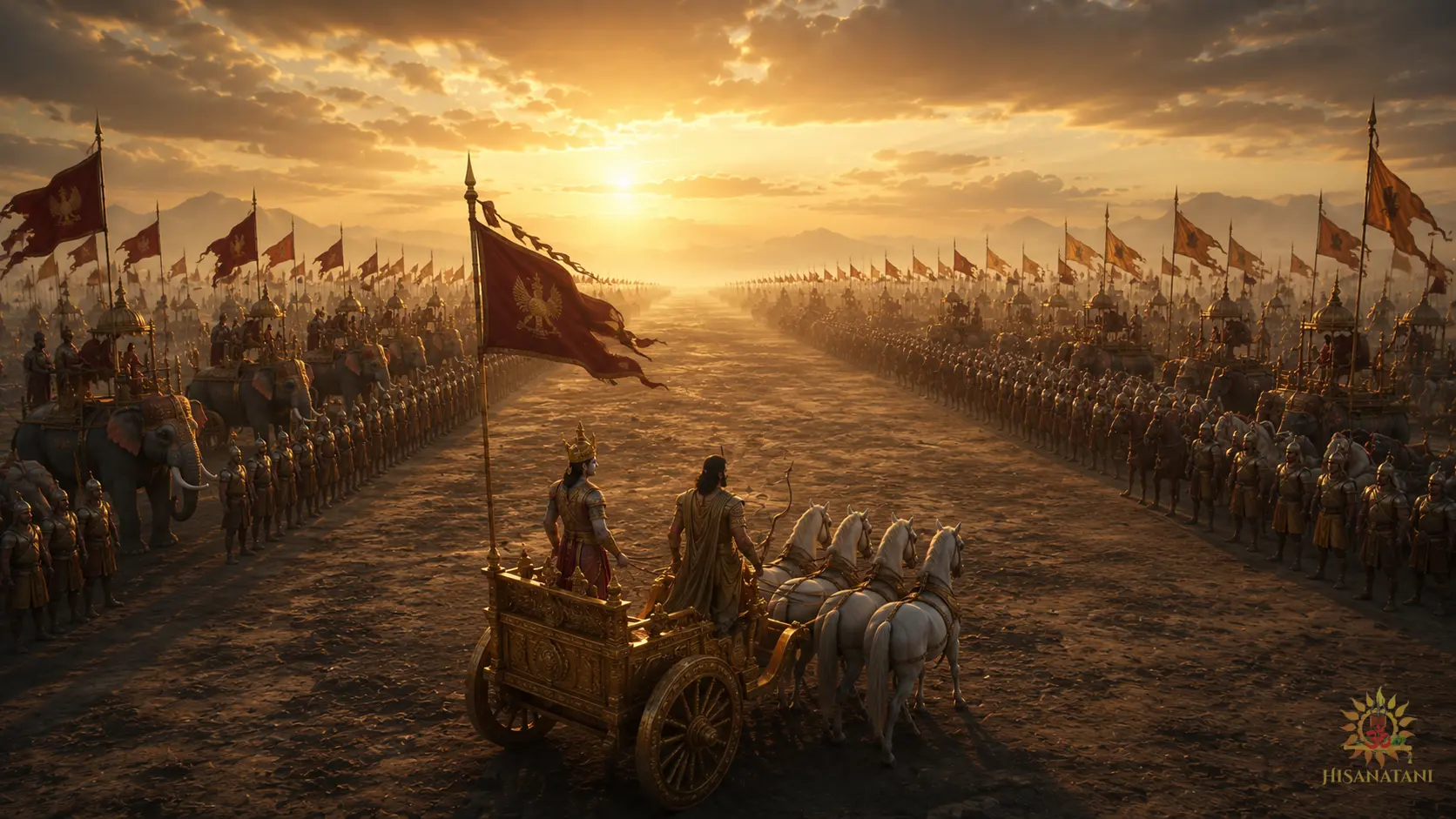
Step back into the actual scene. This isn’t a metaphorical battlefield — it’s Kurukshetra, and the war about to begin will decide who rules the entire Kuru kingdom. Arjuna isn’t a reluctant bystander here. He’s one of the most skilled warriors alive, a Kshatriya trained from childhood for exactly this moment, standing at the head of an army that’s ready to fight for him.
And in Bhagavad Gita Chapter 1 Verse 31, at the exact moment the conches have already sounded and the armies are seconds from clashing, Arjuna does something almost no warrior in his position does. He says he doesn’t want the win.
Historically, this is a strange and radical thing for a Kshatriya to say. Warriors of his class were raised to believe that victory, territory, and the rewards of rule were not just acceptable goals — they were duty. Arjuna isn’t lazy or cowardly. He’s arguably too aware of exactly what this particular victory will cost, because the people on the other side raised him, taught him, and fought beside him for years.
This is the moment the Mahabharata’s central war very nearly doesn’t happen — not because of an enemy’s strength, but because the chosen warrior looks at what winning requires and, for a moment, refuses it. Without this exact hesitation, Krishna’s teaching in the chapters ahead would never have needed to exist. Arjuna’s refusal here isn’t a footnote. It’s the reason the rest of the Gita gets spoken at all.
The 24-Hour Gita Challenge: Check What Your Win Is Actually Costing You
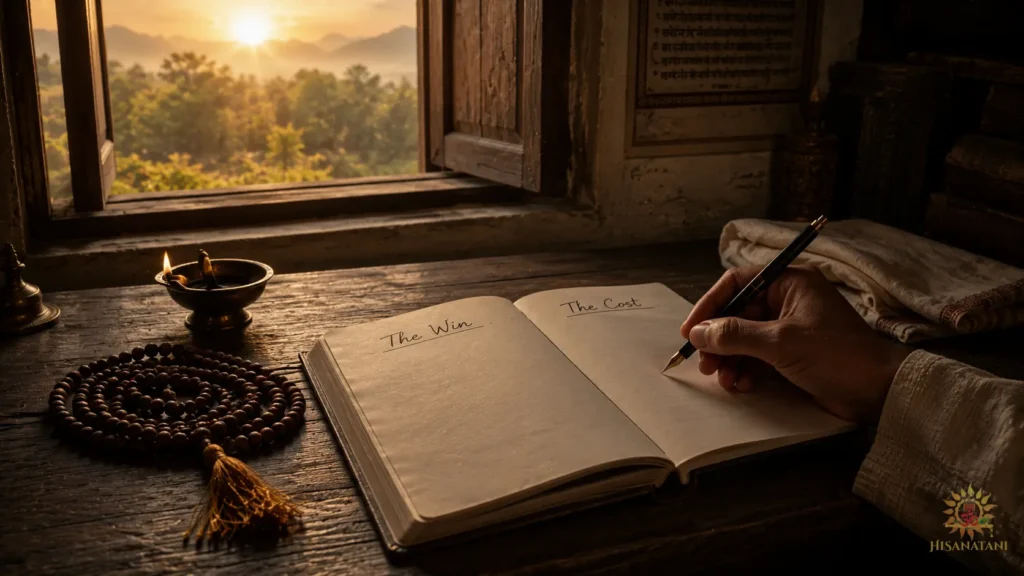
Bhagavad Gita 1.31 Summary isn’t asking you to walk away from every goal you have. It’s asking you to check what a specific win is costing before you cash it in. Here’s how to do that in the next 24 hours.
Step 1: Name the win and the real cost. Pick one goal you’re currently chasing — hard. Write down what you’re trading for it: sleep, a relationship, your patience, your integrity. Be specific. Vague costs are easy to ignore; named ones aren’t.
Step 2: Ask Arjuna’s question. Sit with this for two minutes: if I get this exactly as planned, will it still feel like a win a year from now — for me and for the people it affects? Not ‘will it look good.’ Will it feel good.
Step 3: Choose one adjustment, not an exit. You don’t have to quit the race. Pick one part of the cost you’re willing to renegotiate — a boundary you’ll hold, a relationship you’ll protect, a line you won’t cross even if it slows you down.
This isn’t about becoming someone who never wants to win. It’s about becoming someone who checks the price tag before he pays it. Arjuna’s pause on the battlefield wasn’t the end of his story — it was the beginning of the only version of victory that was ever going to be worth having.
The Real Victory Was Never the One He Was Chasing
Arjuna’s refusal in this verse isn’t the Gita giving up on him. It’s the Gita finally getting his full attention. Before this moment, he was fighting because it was expected. After this moment, he has to actually decide why he’s fighting — and that decision is going to take an entire conversation with Krishna to work out.
If you’ve ever stood this close to a win and felt the ground shift under you, you’re not failing at your goals. You’re finally asking the question that makes the rest of the answer possible: what am I actually trying to win, and at what cost am I willing to win it?
Please let me know in the comments.
Embrace the Teachings of the Gita. Dive deeper into the Bhagavad Gita to uncover its timeless wisdom and practical guidance. Let its verses inspire you to cultivate inner clarity, align with higher values, and navigate life’s challenges with courage and grace.
🌼 Join the HiSanatani WhatsApp Channel for your daily dose of light 🪔. Join Now.
Voice of the Soul
Finding clarity in the questions we all carry…
What is the main message of Bhagavad Gita 1.31?
Arjuna declares he sees no good in killing his own people, and that he doesn’t want victory, a kingdom, or the pleasures that come with them. Read more in Preyas vs Shreyas: The Question Every Ambitious Person Eventually Faces.
Why does Arjuna refuse victory in BG 1.31?
He’s not being cowardly — he’s a trained warrior standing seconds from battle. He refuses because the people he’d have to defeat are his own teachers and family. See The Warrior Who Said No to His Own Coronation.
How does Bhagavad Gita 1.31 apply to modern careers and ambition?
Many people chase a promotion or milestone for years, only to feel strangely empty once it’s within reach — the same gap Arjuna faces. Explore this in When Your Mind Starts Asking ‘Is This Even Worth It?’.
What does shreyas mean in Bhagavad Gita 1.31?
Shreyas refers to lasting good, as opposed to preyas, which is short-term pleasure. Arjuna uses the word to say even victory won’t count as shreyas if it costs him his people. Read The Self That Doesn’t Need the Trophy.
Is Arjuna’s refusal to fight a sign of weakness?
No — it’s an honest reckoning, not cowardice. Refusing a win you can’t feel good about differs from refusing to try. Try The 24-Hour Gita Challenge to check this in your own life.
