
Namaste 🙏
Welcome to Hi Sanatani. It’s a joy to have you here as we explore the deeper layers of human nature. By diving into this Bhagavad Gita 1.28-29 Summary we create a sacred bridge together, turning ancient verses into helpful tools for your personal growth and peace.
Translation of Bhagavad Gita Shloka Verse 1.28-29 in English:
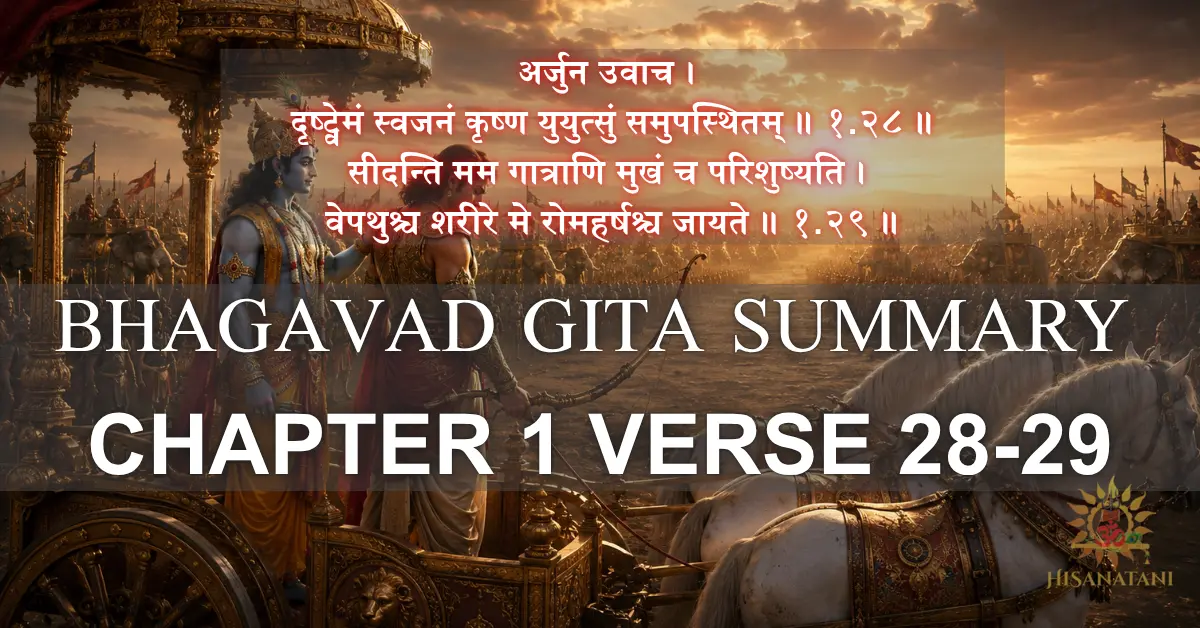
अर्जुन उवाच ।
दृष्ट्वेमं स्वजनं कृष्ण युयुत्सुं समुपस्थितम् ॥ १.२८ ॥
सीदन्ति मम गात्राणि मुखं च परिशुष्यति ।
वेपथुश्च शरीरे मे रोमहर्षश्च जायते ॥ १.२९ ॥
In English :
Arjuna uvāca:
dṛṣṭvemaṁ sva-janaṁ kṛṣṇa yuyutsuṁ samupasthitam ॥ 1.28 ॥
sīdanti mama gātrāṇi mukhaṁ ca pariśuṣyati |
vepathuś ca śarīre me romaharṣaś ca jāyate ॥ 1.29 ॥
Feel the Vibration: A Guided Chant of Bhagavad Gita Chapter 1 Verse 28-29:
- Arjuna uvāca:
dṛṣṭvemaṁ sva-janaṁ kṛṣṇa yuyutsuṁ samupasthitam ॥ 1.28 ॥
Ar-ju-na u-vā-cha
Drish-tve-mam sva-ja-nam krish-na yu-yut-sum sa-mu-pas-thi-tam - sīdanti mama gātrāṇi mukhaṁ ca pariśuṣyati |
vepathuś ca śarīre me romaharṣaś ca jāyate ॥ 1.29 ॥
See-dan-ti ma-ma gaa-tra-ni mu-kham cha pa-ri-shush-ya-ti
Ve-pa-thush cha sha-ree-re me ro-ma-har-shash cha jaa-ya-te
English Translation:
“Arjuna said: ‘O Krishna, seeing my own people gathered here, ready to fight — my limbs are giving way, my mouth is drying up, my body is trembling, and my hair is standing on end.'”
JOIN THE HISANATANI COMMUNITY
Get daily Verse Summaries & High-Res Posters directly on your WhatsApp.
JOIN CHANNELWhy Your Body Needed This Verse Today
Let’s skip the philosophy for a second — you know this exact feeling. A calendar notification pops up: “Meeting starts in 5 minutes.”
Heart rate up. Mouth dry. Hands cold. You’re already rehearsing the worst version of what’s about to happen — and it hasn’t happened yet. This exactly Bhagavad Gita Chapter 1 Verse 28-29 comes in to action.
Here’s what nobody tells you about Arjuna: he wasn’t some nervous rookie. He was the finest archer alive, and he still went through this — not despite his skill, but regardless of it. The Gita doesn’t open with a warrior who has it together; it opens with one who’s honest that he doesn’t, for a moment. That honesty is the whole doorway.
The Playground Lesson Every Child Can Understand

Picture a kid who’s practiced for a school dodgeball match all week — confident, ready. Then the whistle’s about to blow, and they look across the line, and it’s their best friends and cousins on the other team.
Stomach drops. Palms sweat. The ball suddenly feels too slippery to hold. Nothing bad has happened yet — no one’s been hit — but the body’s already reacting like disaster is already here.
That’s Arjuna. Exactly this happened with Arjuna in Bhagavad Gita Chapter 1 Verse 29. He sees people he loves standing where “the enemy” is supposed to stand, and his body responds before his mind can sort out the conflict.
For a ten-year-old, the lesson from BG1.28-29 is short: big feelings can move your body before you even decide how to feel. Shaky hands, a tight stomach — that’s not weakness, it’s your body reacting to something that matters to you. The job isn’t to make the feeling disappear; it’s to notice it, name it, and keep standing anyway.
Courage was never about the absence of fear. It’s what you do in the ten seconds right after it shows up.
The Trap of “I Am My Role”

Look at what’s actually happening under the surface. Arjuna’s panic isn’t really about war — it’s about identity. Up to this point, he knows exactly who he is: the greatest warrior, the reliable one, the guy with the plan.
Then he looks up and every label he’s built his life on stops applying cleanly. Warrior, grandson, student, family member, duty-bound, loyal — suddenly those roles are pointing in opposite directions at the same time.
This is where a Sanskrit idea from Bhagavad Gita Chapter 1 Verse 28-29 called dehatma-buddhi becomes useful — not as jargon, but as a plain fact: we quietly mistake our roles for our real selves. Your job title, your project, your reputation in the group chat — none of that is actually you, it’s just the current outfit you’re wearing.
The instant any of those outfits get threatened, the body reacts like the self itself is under attack. That’s not a flaw in you — that’s just what happens when identity gets fused to something temporary. The Gita’s quiet suggestion here, three verses before Krishna even opens his mouth, is this: the panic isn’t proof you’re falling apart. It’s proof you’ve been standing on something that was never meant to hold your whole weight.
Your Brain Doesn’t Know the Difference Between a Boardroom and a Tiger

This is one of the most accurate psychological passages in ancient writing and Bhagavad Gita Chapter 1 Verse 28 put it just in front of you, but still easy to miss because it’s dressed in old language. Notice what Arjuna doesn’t say — he doesn’t say “I have concerns about the strategic implications of this conflict.” He says his limbs are failing, his mouth is dry, his body is shaking. That’s not philosophy. That’s a nervous system in full alarm.
Modern neuroscience calls this an amygdala hijack — the primitive part of your brain deciding, in half a second, that this is a survival event, and hijacking your rational mind before it gets a vote. Cortisol floods in, blood moves to your limbs, and your thinking narrows to a pinhole exactly when you need it wide open.
Sound familiar? Before a client call, before asking for a raise, before opening a performance review email — your brain is running the exact same program Arjuna’s ran on that battlefield. It just swapped swords for Slack notifications.
The move isn’t to fight the reaction. It’s to recognize it fast: this is your nervous system doing its job a little too well, not a verdict on your ability. Naming the loop is the fastest way out of it.Still don’t get it ? Read again the English meaning of BG1.28-29
The Spiritual Message Hiding Inside the Trembling

Here’s the part of BG1.28-29 most people skip past too fast. Arjuna’s confidence, before this moment, was built entirely on his own certainty. He knew his skills, he knew the plan, he knew who he was.
Then reality didn’t match the plan — and that certainty cracked open. That crack isn’t a malfunction, it’s the opening. As long as ego feels fully in control, nobody goes looking for deeper wisdom; it’s usually the moment our own strength runs out that we finally get quiet enough to hear something bigger than us.
The trembling in Bhagavad Gita Chapter 1 Verse 29 isn’t the end of Arjuna’s story — it’s the first page of it. Before Krishna can teach anything, Arjuna has to first admit, out loud, in front of his charioteer, that he doesn’t have this handled. That single moment of honesty is what makes the rest of the Gita possible.
Sometimes confusion isn’t the opposite of clarity. It’s the entry fee for it.
What Was Actually Happening on That Field
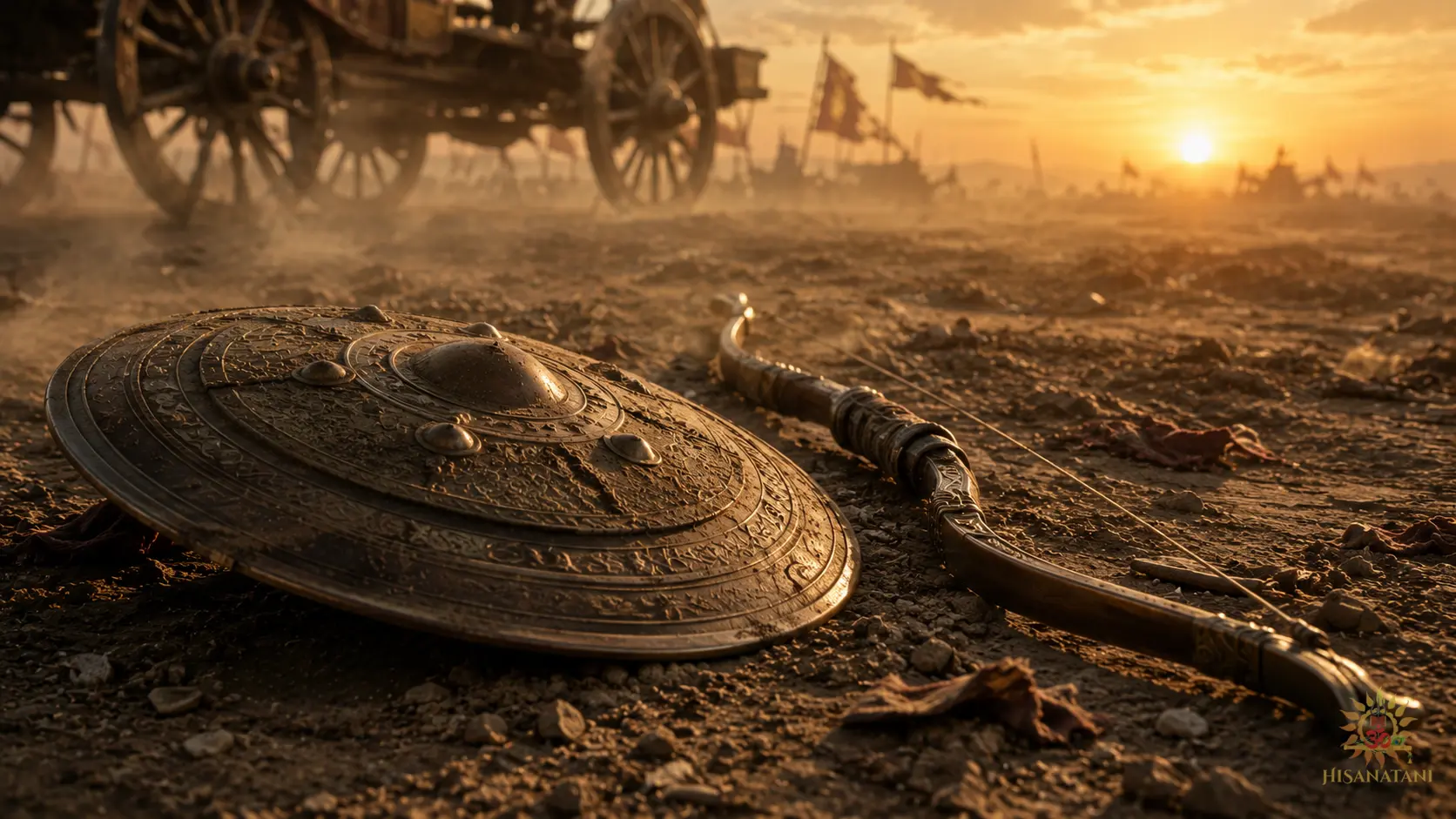
To feel the full weight of these two verses, Bhagavad Gita Chapter 1 Verse 28 and Bhagavad Gita Chapter 1 Verse 29, you have to sit with the real scene for a second. This wasn’t a drill — Arjuna had spent thirteen years in exile preparing specifically for this day. Conches had already sounded, two armies stood ready, and unlike a modern conflict fought through screens and memos, this was face to face — he could see every single person he was about to fight.
Teachers who trained him since childhood. Elders who helped raise him. Cousins he grew up with.
That’s why the reaction is physical, not just strategic. This wasn’t a business decision for Arjuna — it was personal in the most literal sense possible, and history shows us, again and again, that whenever loyalty, duty, and love collide inside one person, the body feels it before the mind can explain it.
Your 24-Hour Gita Challenge

Next time that pre-meeting panic shows up, try this — three moves, twenty-four hours.
Name the signal, out loud if you can. “My shoulders are tight.” “My hands are cold.” Not the story about what might go wrong — just the raw physical fact. Naming it takes it out of the vague fog and into something you can actually work with.
Split the page in two: Facts and Predictions. Write down what’s actually true right now on one side, and write your fears on the other. Almost all the anxiety lives in the second column — almost none of it lives in the first and If you write them , 50% of your problem is solved automatically.
Do the count-and-hold reset. When the wave hits, breathe in slowly for four counts, hold for four, breathe out for six. Do it three times before you speak or send the message — it won’t erase the moment, it just gives your nervous system enough space to stop running the show.
Run this for a full day. Take learnings from BG1.28-29 .Watch what changes.
The Moment Every Warrior Faces
Bhagavad Gita 1.28-29 Summary isn’t really about a battlefield from thousands of years ago. It’s about the half-second before you have to show up for something that matters.
Arjuna’s hands shook. His body trembled. His confidence cracked, right there in front of everyone.
That wasn’t the end of his story. It was the beginning of it.
The battlefield today might just be a laptop screen, a conference room, or a message you’ve been avoiding. But the question hasn’t changed: can you stay present when the fear shows up, instead of being run by it? That’s where it actually starts.
Please let me know in the comments.
Embrace the Teachings of the Gita. Dive deeper into the Bhagavad Gita to uncover its timeless wisdom and practical guidance. Let its verses inspire you to cultivate inner clarity, align with higher values, and navigate life’s challenges with courage and grace.
🌼 Join the HiSanatani WhatsApp Channel for your daily dose of light 🪔. Join Now.
Voice of the Soul
Finding clarity in the questions we all carry…
What is the main message of BG 1.28-29?
Arjuna sees his own relatives standing across the battlefield and his body reacts with full physical panic before his mind can process it. The verses show that awareness of a reaction is the first real step toward wisdom. See Your Brain Doesn’t Know the Difference Between a Boardroom and a Tiger.
Why does Arjuna describe physical symptoms instead of thoughts?
Because that’s how anxiety actually works — it shows up in the body first, as a survival response, before the mind catches up and starts explaining it. Revisit Your Brain Doesn’t Know the Difference Between a Boardroom and a Tiger.
Is Arjuna being weak in these verses?
No — he’s being honest, and that honesty is exactly what opens the door for Krishna’s teaching later in the chapter. See The Spiritual Message Hiding Inside the Trembling.
How is Bhagavad Gita 1.28-29 relevant to a normal work day?
Anyone who’s felt their stomach drop before a review, a hard conversation, or a big presentation is standing exactly where Arjuna stood — the pressure is different, but the body’s response is identical. Explore Your 24-Hour Gita Challenge.
What’s one thing I can actually do today from BG 1.28-29?
Name the physical signal the moment it shows up, separate the facts from the fears, and use a slow breath to buy your nervous system some room. Try Your 24-Hour Gita Challenge.
