
Namaste 🙏
Welcome to Hi Sanatani. It’s a joy to have you here as we explore the deeper layers of human nature. By diving into this Bhagavad Gita 2.1 Summary we create a sacred bridge together, turning ancient verses into helpful tools for your personal growth and peace.
Translation of Bhagavad Gita Shloka Verse 2.1 in English:
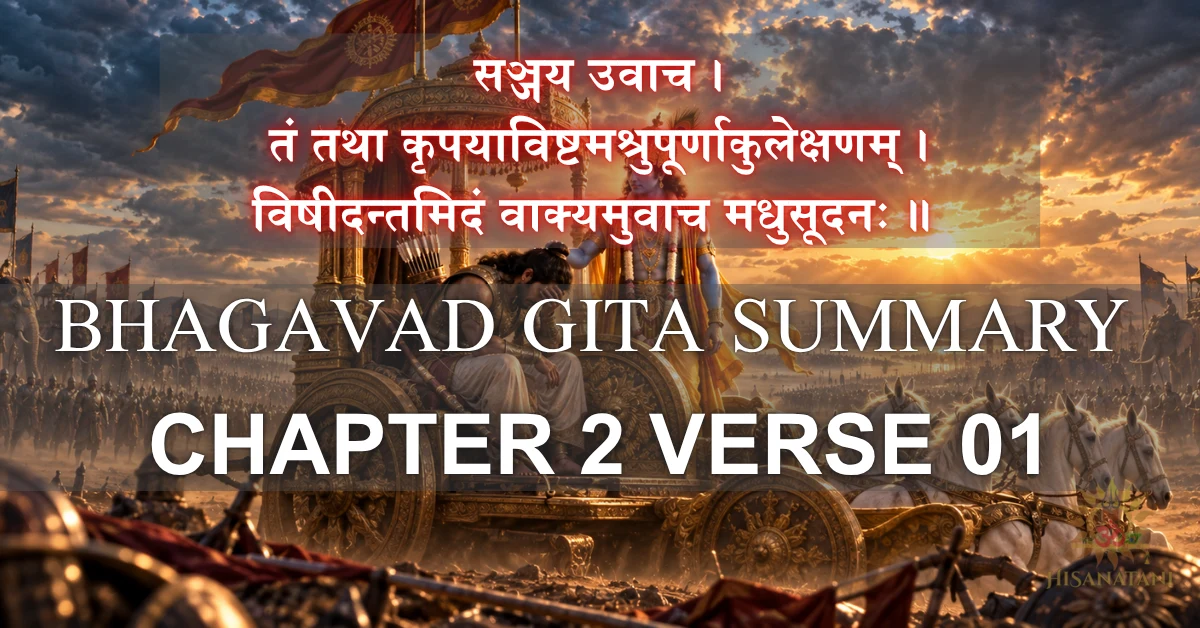
सञ्जय उवाच ।
तं तथा कृपयाविष्टमश्रुपूर्णाकुलेक्षणम् ।
विषीदन्तमिदं वाक्यमुवाच मधुसूदनः ॥ २.१ ॥
In English :
sañjaya uvāca |
taṁ tathā kṛpayāviṣṭam aśru-pūrṇākulekṣaṇam ||
viṣīdantam idaṁ vākyam uvāca madhusūdanaḥ |||
Feel the Vibration: A Guided Chant of Bhagavad Gita Chapter 2 Verse 1:
- sañjaya uvāca |
Sañ-ja-ya U-vā-cha - taṁ tathā kṛpayāviṣṭam aśru-pūrṇākulekṣaṇam ||
Tam Ta-thā Kṛi-pa-yā-viṣ-ṭam A-shru-pūr-ṇā-ku-lek-ṣa-ṇam - viṣīdantam idaṁ vākyam uvāca madhusūdanaḥ |||
Vi-ṣī-dan-tam I-dam Vāk-yam U-vā-cha Ma-dhu-sū-da-naḥ
English Translation:
“Sanjaya said: Seeing Arjuna overwhelmed with compassion, his eyes filled with tears and his mind distressed, Madhusudana, Lord Krishna, spoke these words to him as he was overcome with sorrow.”
JOIN THE HISANATANI COMMUNITY
Get daily Verse Summaries & High-Res Posters directly on your WhatsApp.
JOIN CHANNELWhy Your Soul Needed to Hear This Before You Make Another Decision
Maybe you’ve been calling yourself indecisive. Maybe you’ve downloaded another productivity app, another AI course, another career roadmap — and the inner noise hasn’t moved an inch.
Here’s the thing: information doesn’t always heal uncertainty. Sometimes it multiplies it. You research one path and find twelve competing opinions. The mind keeps reaching outward. But the ache is inward.
That’s what makes this BG2.1 feel so intimate. Krishna first meets Arjuna not as a perfect seeker, but as a distressed human being. No shame in the description. No demand that he instantly become fearless. Just the simple recognition: something inside this person is overwhelmed.
That recognition is its own kind of grace.
Your Brain Is Like a Child Holding Ten Emergency Buttons

Imagine a child at home while a storm rolls in. One loud sound. Then another. Suddenly the child thinks the house is falling down. The parents know the situation is serious — but they also know panic is making the child imagine the worst.
That’s close to what’s happening with Arjuna. He isn’t stupid. He isn’t weak. He knows exactly what’s happening. But his emotions have gotten louder than his judgment.
Think about a young professional whose company announces AI will automate several roles. They open five tabs. One says “AI will replace your industry.” Another says “Learn Python.” Another says “Become an AI engineer.”
Then YouTube starts recommending recession videos. Now they have twenty possible futures in their head — and they do nothing.
Too many possible actions can produce zero action. Bhagavad Gita 2.1 Summary teaches the first basic rule of decision-making: notice the emotional condition before trusting the conclusion. You don’t have to suppress fear or pretend everything’s fine. You simply stop letting the frightened part of your mind become the CEO.
The Future Hurts Most When We Try to Possess It Before It Arrives

There’s a subtle problem inside Arjuna’s sorrow. He isn’t suffering only because of what’s happening now — he’s suffering because his mind keeps moving through imagined consequences. “If I fight, this will happen. If they die, that will happen.” The mind builds scenes that haven’t happened yet, then reacts to them as if they’re already real.
You know this feeling. Your manager messages: “Can we talk tomorrow?” Six words. By midnight your mind has produced an entire movie — maybe you’re being let go, maybe AI is replacing your role, maybe you should resign first. Your body is now responding to a conversation that hasn’t happened.
This is also where your job title stops being the whole story. Product manager, developer, designer, founder — these are roles you carry, not the entirety of who you are. That distinction creates breathing room. And if you can notice fear, there’s already something in you that isn’t completely swallowed by the fear. The observer is present, even while the storm is present.
Bhagavad Gita 2.1 stands at the threshold of that realization. The soul hasn’t disappeared because the mind is confused. Something deeper is still there — quietly aware, waiting to be heard.
Don’t Let a Fear Spike Become a Life Strategy
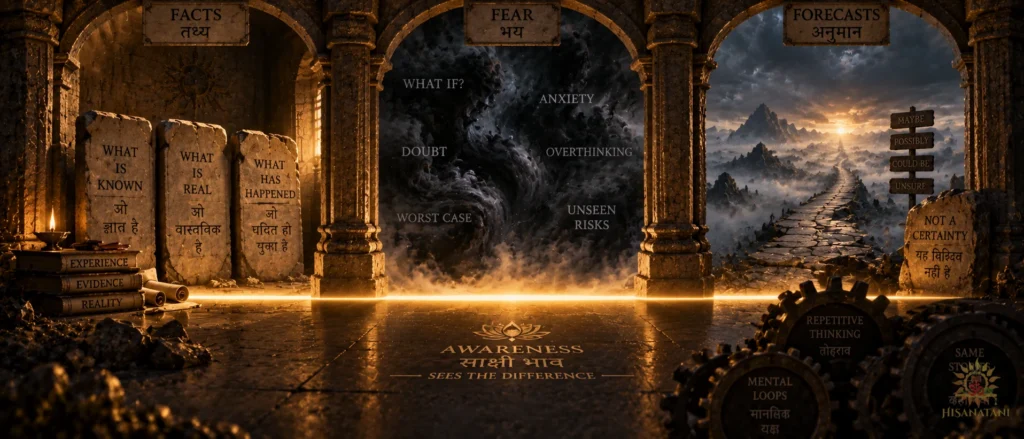
Anxiety rarely arrives alone. You think: “AI is getting better.” The mind adds: “My skills may become less valuable.” Then: “If my skills fall, my income falls.”
Then: “If my income falls, I’ll disappoint my family.” Look how fast a software update turns into an identity crisis.
Modern psychology recognizes what Arjuna demonstrates dramatically: intense emotional states distort judgment. When anxiety rises, attention narrows. You read one article about layoffs and ignore ten neutral pieces of information.
Then comes avoidance — you postpone the course, avoid the manager, stop applying. Research feels productive. Sometimes it’s just anxiety wearing professional clothing.
Try a simple distinction: Facts. Fear. Forecast. Facts: “Our company is automating some tasks.” Fear: “I’ll become irrelevant.” Forecast: “My career will be over within two years.”
These three statements aren’t equal — but anxiety blends them together until the future feels certain. It isn’t.
Don’t attack yourself for being afraid. Identify the state: “I’m overwhelmed right now.” That sentence is surprisingly powerful — it creates a small gap between you and the emotion.
And if anxiety is persistent, severe, or interfering with daily functioning, spiritual reflection can sit alongside proper professional mental-health support. The goal isn’t forced positivity. The goal is clearer seeing.
The Soul Does Not Become Smaller Because the Mind Is Afraid

There’s something tender about Arjuna’s condition. He’s a warrior. Yet he’s crying. And Krishna doesn’t stop engaging with him because of that. That matters spiritually.
We often imagine being spiritual means being permanently calm — never shaken, never uncertain. But the Gita opens one of its greatest teachings with a human being who is none of those things. Arjuna is shaken. And he’s still worthy of guidance. That alone can soften something inside us.
Maybe you meditate and still worry about money. You pray and still feel uncertain about your career. But spiritual depth isn’t measured by the complete absence of disturbance — sometimes it’s measured by your relationship with disturbance.
Can you sit beside your fear without becoming its prisoner? Can you say, “Fear is moving through me, but it isn’t the whole of me”?
The Atman isn’t presented in the Gita as a fragile identity dependent on career success. Your designation can change. Your salary can change. Your industry can change.
Yet the deeper Self isn’t reduced to these temporary movements. Surrender doesn’t mean giving up responsibility — it means releasing the impossible demand that you control every outcome.
On Kurukshetra, Arjuna Was Not Escaping a Spreadsheet Problem

To feel the weight of Bhagavad Gita 2.1, return to the actual scene. Kurukshetra isn’t a metaphor first — it’s a battlefield. Both armies have assembled. Arjuna asked Krishna to place his chariot between them so he could see who he had to fight. Then he saw them: people he knew, people who shaped his life, people he loved.
His warrior identity collided with his relational identity.
That’s the wound. Reducing Arjuna’s condition to ordinary nervousness misses the point — duty pulls one way, attachment pulls another, fear of consequence pulls a third. His mind searched for a choice that produced no pain. It couldn’t find one. So it collapsed.
Sanjaya’s description here is almost a still photograph taken the instant before Krishna’s teaching transforms the conversation. Arjuna isn’t enlightened yet. He isn’t steady yet. He’s simply seen.
You may think, “I’ll find peace once my career stabilizes” or “I’ll get spiritually grounded once this project ends.” But life may never hand you that perfect pause.
Arjuna receives wisdom in the middle of the battlefield — not after everything is resolved. In the middle. That’s why the teaching still holds up.
Your 24-Hour Gita Challenge for AI Job Fear

Now make BG2.1 practical. Don’t just admire Arjuna’s story — use it.
Step 1: Name Your Emotional State Before Making a Major Decision. Take five minutes today. Open a blank note. Write: “Right now, I feel…” and finish the sentence without trying to sound intelligent.
Maybe: “I feel replaceable.” “I feel behind.” “I’m scared AI will make my skills useless.” Don’t solve anything yet — just identify the state. This is your Arjuna check. You’re separating the person from the panic.
Step 2: Divide Your AI Fear Into Facts and Predictions. Create two columns. In the Facts column, write only what’s actually happened — for example, your company introduced AI tools, two of your tasks are now automated, or your manager asked the team to improve AI fluency.
In the Predictions column, write what your mind has jumped to — for example, that you’ll definitely lose your job, that nobody will need your skills, or that your career is finished. Look at the second column: some of your strongest fears aren’t facts, they’re forecasts. Forecasts deserve attention. They don’t deserve automatic obedience.
Step 3: Execute One Career-Protecting Action Before Sleeping. Pick exactly one. Not ten. One.
For example: spend 45 minutes learning the AI tool most relevant to your role, rewrite one résumé section around measurable outcomes, or ask your manager which skills will matter most over the next six months.
Then stop. The objective isn’t to solve your entire career tonight — it’s to prove to your nervous system: “I can still act.” That’s the first tactical win.
When You Stop Fighting the Fear, You Can Finally Hear What It’s Saying
Perhaps the most striking thing about this Summary of Bhagavad Gita 2.1 is what it does not do. It doesn’t rush. Arjuna is overwhelmed. Krishna sees him.
The Bhagavad Gita 2.1 lets us stay there a moment — no motivational slogan, no instant transformation, no demand to “think positive.” Just a human being standing at the edge of what he believes he can bear.
Maybe that’s why this ancient verse feels strangely close in an age of artificial intelligence. Technology is changing faster than our nervous systems know how to process. A tool can appear overnight. A profession can shift in months. The outer world accelerates; the inner world doesn’t always keep up.
So don’t make your biggest career decisions at the peak of panic. Pause. Observe.
Separate facts from forecasts. Find your actual duty. Then act.
The Gita’s teaching is about to go much deeper in the verses that follow — Krishna will challenge Arjuna’s thinking at its foundation and begin explaining the nature of the Self, duty, and action. But none of that would land until Arjuna’s emotional crisis was seen clearly first.
You do not have to know your entire future tonight. Stay. Breathe. Listen. Then let wisdom speak.
Please let me know in the comments.
Embrace the Teachings of the Gita. Dive deeper into the Bhagavad Gita to uncover its timeless wisdom and practical guidance. Let its verses inspire you to cultivate inner clarity, align with higher values, and navigate life’s challenges with courage and grace.
🌼 Join the HiSanatani WhatsApp Channel for your daily dose of light 🪔. Join Now.
Voice of the Soul
Finding clarity in the questions we all carry…
What is the main message of Bhagavad Gita 2.1?
It describes Arjuna’s emotional collapse right before Krishna’s deeper teaching begins, showing why recognizing your mental state matters before big decisions. See Your Brain Is Like a Child Holding Ten Emergency Buttons.
Why is Arjuna crying in Bhagavad Gita 2.1?
He’s overwhelmed by compassion and grief at seeing loved ones on the opposing side, with duty, attachment, and fear pulling him in different directions. See On Kurukshetra, Arjuna Was Not Escaping a Spreadsheet Problem.
How does Bhagavad Gita 2.1 apply to AI job insecurity?
It shows how fear blends facts with forecasts until an uncertain future feels certain. Separating the two is the first step out of paralysis. See Don’t Let a Fear Spike Become a Life Strategy.
What does Krishna do in Bhagavad Gita 2.1?
Krishna sees Arjuna’s distressed state before offering a single word of teaching — presence before instruction. See The Soul Does Not Become Smaller Because the Mind Is Afraid.
How can I apply Bhagavad Gita 2.1 today?
Name your emotional state, separate facts from predictions, then take one small, concrete action before you sleep. See Your 24-Hour Gita Challenge for AI Job Fear.
