
Namaste 🙏
Welcome to Hi Sanatani. It’s a joy to have you here as we explore the deeper layers of human nature. By diving into this Bhagavad Gita 1.43 Summary we create a sacred bridge together, turning ancient verses into helpful tools for your personal growth and peace.
Translation of Bhagavad Gita Shloka Verse 1.43 in English:
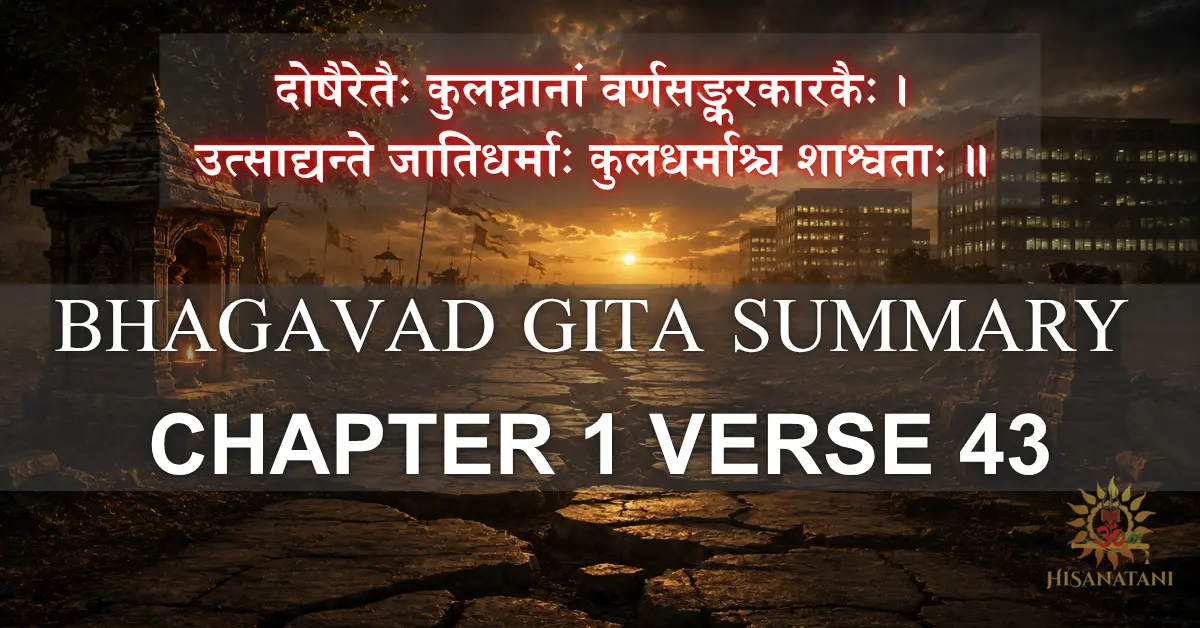
दोषैरेतैः कुलघ्नानां वर्णसङ्करकारकैः ।
उत्साद्यन्ते जातिधर्माः कुलधर्माश्च शाश्वताः ॥ १.४३ ॥
In English :
doṣair etaiḥ kula-ghnānāṁ varṇa-saṅkara-kārakaiḥ |
utsādyante jāti-dharmāḥ kula-dharmāś ca śāśvatāḥ ||
Feel the Vibration: A Guided Chant of Bhagavad Gita Chapter 1 Verse 43:
- doṣair etaiḥ kula-ghnānāṁ varṇa-saṅkara-kārakaiḥ |
Do-shair e-taih ku-la-ghnaa-naam var-na-san-ka-ra kaa-ra-kaih - utsādyante jāti-dharmāḥ kula-dharmāś ca śāśvatāḥ ||
Ut-saa-dyan-te jaa-ti-dhar-maah ku-la-dhar-maash cha shaash-va-taah
English Translation:
“By these evil deeds of the destroyers of the family, which cause the intermixture of social classes, the eternal family duties and traditions are destroyed.”
JOIN THE HISANATANI COMMUNITY
Get daily Verse Summaries & High-Res Posters directly on your WhatsApp.
JOIN CHANNELWhy Your Soul Needed to Hear This Today
Most young professionals aren’t standing on a battlefield surrounded by armies. But plenty are standing inside systems that quietly ask them, again and again, what they’re willing to let slide. Do I stay quiet when my manager takes credit for my work? Do I answer messages at midnight because saying no feels risky? Do I laugh along at something I actually find unfair?
Each of these looks small in the moment. Bhagavad Gita 1.43 says, It isn’t always small. But here’s the thing — you’re not just making a decision. You’re training yourself. And a broken system survives by reproducing itself through the people who learn to adjust to it.
The House That Slowly Forgets How to Feel Like Home

Picture a family living under one roof. They eat together sometimes. They help each other. They speak with respect. Nobody wrote these habits down — everyone just lives by them.
Then, slowly, they start slipping. One person starts shouting. Another stops listening. Somebody starts taking more than their share, and nobody stops them. A few months later, everyone is still physically in the house. But it doesn’t feel like home anymore.
That’s roughly what Arjuna is afraid of in Bhagavad Gita 1.43 — not people vanishing, but the invisible agreements between them vanishing first.
Now put that inside an office. A healthy team also runs on unwritten rules: people give credit where it’s due, admit mistakes without fear, disagree without cruelty. Nobody puts this on a slide deck. Everyone just feels it — until it’s gone.
The desks stay the same. The meetings still happen. But people get guarded. They stop sharing ideas early because ideas get stolen.
They stop asking for help because asking looks weak. The room is full, but something in it has already left.
That’s the simple lesson buried in this verse BG1.43: what holds a group together is usually invisible — until it starts disappearing, and by then, everyone can feel it even if nobody can name it.
When the Outer System Breaks, What Happens to Your Inner One?

There’s a question underneath this Summary of Bhagavad Gita 1.43 that’s hard to escape: what actually keeps a life — or a company, or a family — from dissolving into pure self-interest? Not a handbook. Not a mission statement on the wall. The Gita’s answer circles around dharma — not a rulebook, but an order of responsibility, a sense of what your role actually asks of you.
Arjuna isn’t only worried that war will make him sad. He’s worried it will disturb the structures through which people remember what they owe each other. That’s a much bigger fear, and it shows up in modern life in strange ways. A company can lose its ethical center long before it loses money. A person can lose their inner center long before anyone notices a crisis on the outside.
Think about someone who spends five years chasing recognition. At first, ambition gives them direction. Then it quietly turns into comparison.
Comparison turns into insecurity. Insecurity turns into needing the next achievement just to feel steady. They haven’t stopped succeeding — they’ve just lost the ability to feel like enough is ever enough.
The philosophical weight of Bhagavad Gita Chapter 1 Verse 43 isn’t “protect every old tradition.” It’s this: whatever sits at the center of your life quietly organizes everything around it. If fear sits there, even success feels unsafe. If dharma sits there, the question changes from “will this work?” to “is this right?” — and that question, unpopular as it sometimes is, keeps you whole.
A Toxic Job Can Keep Talking Long After You Leave It

Here’s something a lot of professionals discover only after they’ve already changed jobs: the environment doesn’t leave when you do. They still check email compulsively. They still brace for criticism that isn’t coming. They still apologize before asking for anything.
A new manager writes “can we talk?” and their stomach drops — even though nothing is actually wrong. The office is gone. The alarm system it built inside them stays on.
This is where Arjuna’s fear about consequences spreading beyond the initial act becomes strangely personal. If honesty kept getting punished, you learn to stop being honest. If setting a boundary kept getting you rejected, you learn to stop setting boundaries. The mind isn’t being dramatic — it’s trying to protect you using the last data it had. But protection built on old data can turn into a cage.
The way out starts with one question: “Is this reaction coming from right now, or from what I learned somewhere else?” A colleague disagrees with you and you feel instantly threatened — maybe because disagreement used to mean humiliation, not because this person means you harm. Noticing that gap, even briefly, creates room between what happened to you and how you respond today.
Dharma Is the Thread That Remembers Who You Are

Underneath every job title is a self that the job doesn’t fully reach. You are an employee, sure. Also a friend, a child, maybe a parent — roles that shift and end. The Gita calls the part beneath all of them the Atman, and toxic work culture often attacks it indirectly, whispering that you’re only valuable when you perform, only safe when your manager approves, only enough when you win.
Surrender, in this context, doesn’t mean tolerating mistreatment or explaining away harm as “meant to be.” It means loosening your grip on the outcome while staying sincere in the action — doing the work, speaking honestly, protecting what matters, and accepting that you can’t control how everyone responds to that.
There’s real freedom in being able to say: “I did my best without turning the result into my identity.” The market can measure your output. It was never built to measure your worth.
Arjuna Is Watching a Living Memory Collapse

The setting matters here. Without Kurukshetra, Bhagavad Gita Chapter 1 Verse 43, could get flattened into a vague warning about “tradition.” Arjuna isn’t facing strangers — he’s facing people bound to his own family and social world, and his fear is that the damage won’t stop with the dead. The families left behind will be changed. The practices that carried knowledge and duty forward — kula-dharma — may not survive to reach the next generation.
Words like kula-dharma belong to a specific ancient social order, and a modern office is obviously not the same institution as an ancestral family line. But the underlying question travels well: what happens when the structures that carry values from one generation to the next start to weaken?
Not everything inherited deserves to continue. Some traditions — in a family, a profession, a company — are worth keeping. Some are just habits nobody has questioned yet.
A young professional inherits assumptions the moment they join a team: maybe that burnout proves commitment, maybe that aggression looks like leadership. Inheriting an assumption is not the same as owing it your future. You get to ask which parts of what you’ve absorbed deserve to keep going — and which ones should end with you.
The 24-Hour Gita Challenge for a Toxic Workplace

You don’t need to quit today or confront anyone dramatically. Start smaller.
Step 1 — Name one value you’re quietly compromising. Not “my workplace is toxic” — too vague to act on. Try: “My manager expects instant replies after 9 p.m.” or “My team rewards whoever takes credit fastest.” Specific language turns frustration into information you can actually use.
Step 2 — Set one boundary you can actually keep. Something small and real: “I won’t answer non-emergency messages after 9:30 p.m.” or “I’ll document my contributions before every review.” The point isn’t controlling anyone else. It’s drawing one line you refuse to cross.
Step 3 — Ask the one-year question before bed. “If I keep behaving exactly like this for another year, who do I become?” Not “will I get promoted” — who becomes of me. A raise will tell you what you gained. Only this question tells you what you might be losing.
Getting Out Without Becoming What Hurt You
Arjuna’s real fear in this chapter BG1.43 isn’t only about the war ahead — it’s about what survives it, and what doesn’t. That question is useful long after Kurukshetra. You might be chasing a promotion. Fine.
But what habits are you building on the way there? You might be trying to leave a toxic workplace. Understandable. But are you carrying its patterns into wherever you land next?
That’s the harder question. Leaving the building doesn’t automatically remove the conditioning. If your last manager taught you to answer instantly, you might keep answering instantly long after you’ve changed jobs. The real win was never just getting out — it’s getting out without becoming what hurt you.
Your company can define your job. It cannot define your conscience. Your manager can rate your performance. They cannot set your worth. BG1.43 asks you to notice the cost of destructive patterns before they become permanent — in a culture, or in yourself.
Don’t outsource your dharma to your employer.
Please let me know in the comments.
Embrace the Teachings of the Gita. Dive deeper into the Bhagavad Gita to uncover its timeless wisdom and practical guidance. Let its verses inspire you to cultivate inner clarity, align with higher values, and navigate life’s challenges with courage and grace.
🌼 Join the HiSanatani WhatsApp Channel for your daily dose of light 🪔. Join Now.
Voice of the Soul
Finding clarity in the questions we all carry…
What is the meaning of Bhagavad Gita 1.43?
Arjuna warns that repeated destructive action doesn’t just cause isolated harm — it dissolves the shared duties and traditions (jāti-dharma, kula-dharma) that hold a family or community together over time. Read more in the Philosophical Perspective.
How does Bhagavad Gita 1.43 apply to a toxic workplace?
The verse Bhagavad Gita 1.43 maps onto how small, repeated compromises — staying silent, rewarding dishonesty, tolerating disrespect — can quietly become “how things work here.” Recognizing the pattern is the first step to not absorbing it. See the Simple Perspective.
Does Bhagavad Gita 1.43 mean every tradition must be preserved?
No. Arjuna’s concern is rooted in his specific historical and social context. Modern readers can — and should — separate practices worth keeping from ones that only survive out of habit. See the Historical Perspective.
Why do I still feel anxious after leaving a bad job?
Old environments can leave behind reflexes — bracing for criticism, over-apologizing, distrusting calm managers — that outlast the job itself. Understanding where a reaction is really coming from is the first step to loosening its grip. See the Psychological Perspective.
What’s one small step to protect my values at work?
This Summary of Bhagavad Gita 1.43 says, Name one specific value you’re compromising, set one boundary you can actually maintain, and ask yourself who you’ll become if this continues for another year. See the Practical Perspective.
