
Namaste 🙏
Welcome to Hi Sanatani. It’s a joy to have you here as we explore the deeper layers of human nature. By diving into this Bhagavad Gita 2.9 Summary we create a sacred bridge together, turning ancient verses into helpful tools for your personal growth and peace.
Translation of Bhagavad Gita Shloka Verse 2.9 in English:
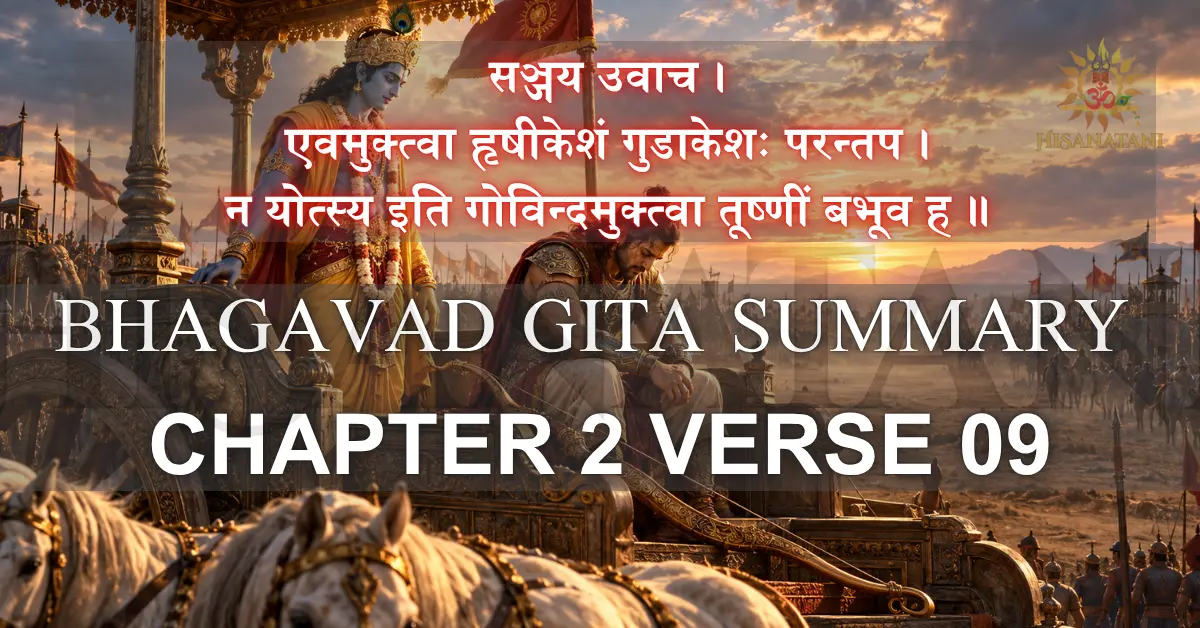
सञ्जय उवाच ।
एवमुक्त्वा हृषीकेशं गुडाकेशः परन्तपः ।
न योत्स्य इति गोविन्दमुक्त्वा तूष्णीं बभूव ह ॥
In English :
sañjaya uvāca
evam uktvā hṛṣīkeśaṁ guḍākeśaḥ parantapaḥ
na yotsya iti govindam uktvā tūṣṇīṁ babhūva ha
Feel the Vibration: A Guided Chant of Bhagavad Gita Chapter 2 Verse 9:
- sañjaya uvāca
san-ja-ya u-vaa-cha - evam uktvā hṛṣīkeśaṁ guḍākeśaḥ parantapaḥ
e-vam uk-tvaa hri-shee-kay-sham gu-daa-kay-shah pa-ran-ta-pah - na yotsya iti govindam uktvā tūṣṇīṁ babhūva ha
na yot-sya i-ti go-vin-dam uk-tvaa toosh-neem ba-bhoo-va ha
English Translation:
“Sanjaya said: After speaking to Hrishikesha (Krishna, master of the senses), Arjuna, the Gudakesha who scorches his foes, told Govinda, “I will not fight.” Then he fell silent.”
JOIN THE HISANATANI COMMUNITY
Get daily Verse Summaries & High-Res Posters directly on your WhatsApp.
JOIN CHANNELWhy Your Silence Deserves Attention
Nobody announces they’re overwhelmed. They get quieter. They stop asking questions. They deliver the minimum and dodge anything that might create another demand.
Sometimes that’s a smart boundary in an unhealthy workplace. Sometimes it’s a warning that months of stress have shrunk your ability to think straight. From outside, the two look identical. From inside, they feel nothing alike.
Maybe you’ve been the dependable one for years. The one who replies fast and says “I’m fine” on autopilot.
Here’s the thing. Your silence isn’t proof you’re weak. It’s information. Before you decide what to do next, figure out what it’s protecting. Your health? A conversation you’re dreading? A choice that might let someone down?
Let’s look at BG2.9 through six lenses.
Find Out Why You Stopped Before You Decide What’s Next

Picture a school sports day. Little Rohan’s in the middle of a race. Halfway down the track, he stops. Sits down. Folds his arms. “I’m not running.“
What would you do? Most adults would say, “Get up! Finish what you started!” A good teacher kneels down and asks questions instead. Did you fall? Is your shoe too tight? Are the other kids pushing you? Are you just tired?
Rohan’s sentence tells you what he’s decided. It tells you nothing about why. Maybe he’s hurt. Maybe he’s scared of losing in front of everyone. A refusal is the headline. The story sits underneath.
That’s Arjuna in Bhagavad Gita Chapter 2 Verse 9. He says “I will not fight” and goes silent. The refusal is a statement, not a solution. Not yet.
Now swap the track for your office. You’re on a Zoom call. Camera off. Mic muted. You type “sounds good” in the chat and nothing else. Technically present, completely absent. Your manager assumes you’re lazy. Your teammates assume you don’t care. Maybe you’ve started believing it too.
But what if the real reason is a workload nobody questions, ideas that keep getting ignored, or six months of running on empty?
The fix depends on the cause. A tired kid needs a break. A kid who’s being pushed around needs a safer team. A lost kid needs someone to explain the rules.
So name your silence before you act on it. One honest sentence: “I stopped because ___.” Once you can finish that sentence, you’ve got something you can actually work with. It’s a small sentence. It might also be the first honest thing you’ve told yourself in weeks.
Why Refusing to Act Does Not End the Conflict

Here’s a question that sounds simple and isn’t: does refusing to act cancel your responsibility?
Not really.
In Bhagavad Gita 2.9, Arjuna announces he’s done. But look at the scene. The armies are still standing there. The people he’s afraid of losing haven’t changed. His moral questions didn’t vanish because he stopped talking.
That’s the philosophical heart of the verse. Ending an action isn’t the same as resolving the reason behind it.
Think about a professional who disagrees with where their company is heading. They stop pitching ideas. They avoid owning anything. They mentally clock out of every project. Their discomfort drops a little. But nothing else moves. Conditions don’t improve. Values don’t get clearer. And they still don’t know what they actually want.
None of this says you must always push through. Sometimes resigning is right. Sometimes refusing an assignment is right. Sometimes leaving is the most honest move available.
The real test is whether the choice is deliberate.
A deliberate “no” comes from clarity. A forced “no” comes from exhaustion. Both deserve respect, but they need different responses.
One honest caution: Bhagavad Gita 2.9 doesn’t hand us the Gita’s full teaching on action. That unfolds later. This verse just shows the moment that makes the teaching necessary.
So ask four questions. What am I refusing? What am I protecting? What am I avoiding? What’s still possible?
Notice what that does. It turns a vague heaviness into specific choices. And specific choices, unlike heaviness, can be acted on.
Silence can be a place to think. It can also be a place to hide. The verse doesn’t tell you which one you’re in. You have to.
Break the Shutdown Cycle Before It Becomes Your Default

Burnout rarely looks dramatic.
It looks like staring at the same email for twenty minutes. Like leaving a message on read because replying might summon another task, another deadline, another conversation. Your body tenses before you even open it. And when you finally don’t reply, you feel relief. Brief, sweet, dangerous relief.
Because that relief teaches your brain something: avoiding works. So tomorrow, you avoid again. Unanswered messages pile up. Shame joins the exhaustion. Soon you’re not just tired of work. You’re tired of everything you’ve been dodging.
That’s where BG2.9 gets psychologically useful. Arjuna moves from describing his pain to declaring he won’t act. We can’t diagnose him from one verse, and we shouldn’t. But the pattern (distress, refusal, silence) will feel familiar to a lot of us. And here’s the sneaky part: the longer you stay silent, the bigger the avoided thing starts to feel.
Here’s how to break the cycle without shaming yourself.
First, separate tired from undecided. If you haven’t slept properly in weeks, you probably need recovery, not another productivity app.
Second, shrink the decision. You may not be ready to decide whether to leave your job. But you can list three conditions that would make staying bearable.
Third, swap silence for a specific message. Not “I’m overwhelmed.” Try: “I can finish A by Friday, but B moves to next week. Which comes first?”
And if your boss is unreasonable or the workload is genuinely unfair, document it and use proper channels. If low mood or exhaustion keeps hanging around, talk to a qualified mental health professional. That’s not weakness. That’s good judgment.
Let Go of the Performance Identity, Not Your Discernment

Who are you when nobody needs anything from you?
Sit with that for a second.
Not your LinkedIn version. Not the person your manager praises. Not the one who answers messages at midnight because “that’s just how I am.” Who are you when the performance stops?
For some people, that question brings relief. For others, it brings a strange, quiet panic. When your identity is built on being useful, a free evening feels like a threat. Even rest turns into a task to optimise. You track your sleep. You plan your mornings. You feel guilty about a lazy Sunday.
Look at what happens just before BG2.9. In Verse 2.7, Arjuna says he’s confused about his duty and asks Krishna to teach him as a disciple. The greatest archer of his age admits he doesn’t have the answer. Two verses later, he goes silent. Not because he’s weak. Because he’s finally stopped pretending.
That’s the spiritual reading. In the Gita’s wider teaching, the Atman, your deeper Self, isn’t your job title, your KPIs, or your output. You’re more than what you produce. Your work matters. Your responsibilities matter. They just can’t be the only measure of you.
Surrender, here, doesn’t mean accepting every demand or switching off your brain. It means dropping the belief that you must control every outcome and carry everything alone.
Try this when you’re running on empty: “If I didn’t have to prove I was strong today, what would I actually need?” Maybe it’s sleep. Maybe a hard conversation. Maybe the courage to leave.
Let go of the performance. Keep your ability to choose.
On Kurukshetra, Silence Becomes a Turning Point

Go back to the scene. Stand there for a moment.
Kurukshetra. Two massive armies facing each other across dust and tension. The conch shells have sounded. At Arjuna’s own request, Krishna, his charioteer, has parked the chariot right in the middle, between both sides.
From there, Arjuna doesn’t see enemies. He sees family. Teachers. Elders. Childhood friends. In Chapter 1, his limbs shake and his mouth goes dry. In 2.8 he admits that no throne on earth could fix this grief. Then comes Bhagavad Gita 2.9 : “I will not fight.” And he sinks into silence.
Feel the weight of that moment. Thousands of warriors waiting. Drums. Horses. And the best fighter on the field has put his bow down.
Here’s a detail most summaries skip. We aren’t watching this directly. Sanjaya is narrating it to the blind king Dhritarashtra, father of the Kauravas. Dhritarashtra must’ve been delighted. Arjuna quits? Easy win for his sons.
But Sanjaya knows what the king doesn’t. This silence isn’t defeat. It’s the pause before the Gita’s teaching begins. In 2.10, Krishna answers, with the hint of a smile, right there between the armies, and the conversation starts.
Be careful with comparisons, though. Arjuna isn’t a tired employee skipping a meeting. He faces war, family, and a moral weight most of us will never carry. Your office isn’t Kurukshetra.
But the pattern still teaches something. Sometimes your old answers stop working. And pushing harder with the same logic rarely helps. You need a better question, a trusted adviser, or a clearer view of what’s actually yours to carry.
A pause isn’t the end of the story. What you do after it is.
The 24-Hour Gita Challenge for Quiet Quitters

Insight feels lovely in a quiet room. Real life shows up when your manager pings you during dinner.
So let’s make it practical. You don’t need to resign today. And please don’t fill your calendar with more tasks to prove you’re fine.
For the next 24 hours, do three small things.
Step 1: The 10-Minute Silence Audit
Tonight, before you open Slack or email
Write down three things you’ve been avoiding. Be specific. “I haven’t asked my manager to clarify the deadline” beats “work is stressful.” Next to each, write your best guess at why: exhaustion, fear of criticism, unclear expectations, resentment, or plain lack of interest. Not sure? Write “unknown.”
Step 2: Replace One Disappearance With One Clear Message
Tomorrow, by lunch
Pick one safe conversation you’ve been postponing. Send one short message that names the problem and asks for a next step. Try: “I’ve got three deadlines competing this week. I can finish the client report by Thursday or the internal analysis by Friday, not both at quality. Can we pick the priority today?” If that person isn’t safe to approach, use HR or a trusted mentor.
Step 3: Choose Your Next Move, Not Your Entire Future
Tomorrow evening, 15 minutes
Pick one avoided problem and the smallest responsible action you can take within 48 hours. Book a workload chat. Document repeated unreasonable demands. Message a mentor. Write down the action, the deadline, and what “done” looks like. Everything else goes in a drawer for now.
The goal isn’t efficiency at any cost. It’s clarity. If your job is hurting your health, a planned exit may beat another year of enduring. If priorities are muddled, one conversation might fix it. If exhaustion won’t lift, recovery and professional support come first.
Action should follow clarity. It shouldn’t replace it.
Your Silence Can Be a Pause, Not Your Permanent Position
Arjuna’s words in Bhagavad Gita 2.9 hit hard because they sound so final. He spoke. He refused. He went quiet.
Maybe you know that feeling. After months of trying to keep up, you stopped asking for opportunities. Stopped pushing back on unfair decisions. Stopped explaining why the workload’s impossible. Your calendar’s full, but your sense of purpose slipped out the back door.
Think back to the kid on the track. Nobody needed to shout at him. He needed someone to ask what happened, and to sit with him until he could answer.
So here’s what I’d take from this verse BG2.9. Don’t use it to beat yourself up. You don’t have to prove your strength by ignoring your exhaustion. And you don’t have to make a permanent decision on the worst day of your working life.
Arjuna’s refusal isn’t where the Gita ends. It’s where it begins. Krishna answers in the very next verse, and the conversation goes on, because the conflict still needs to be understood.
Yours can go on too.
Your next step doesn’t have to be heroic. It needs to be honest, doable, and yours. And when the words finally come back, let them be True.
Please let me know in the comments.
Embrace the Teachings of the Gita. Dive deeper into the Bhagavad Gita to uncover its timeless wisdom and practical guidance. Let its verses inspire you to cultivate inner clarity, align with higher values, and navigate life’s challenges with courage and grace.
🌼 Join the HiSanatani WhatsApp Channel for your daily dose of light 🪔. Join Now.
Voice of the Soul
Finding clarity in the questions we all carry…
What is the meaning of Bhagavad Gita 2.9?
In Bhagavad Gita 2.9, Arjuna tells Krishna, “I will not fight,” and falls silent. It captures a refusal that hasn’t yet become understanding. Read Why Refusing to Act Does Not End the Conflict for the deeper logic.
Why does Arjuna become silent in BG2.9?
He’s voiced his grief and declared his refusal, but the conflict underneath is still unresolved. The silence is a pause, not a verdict. Krishna answers in 2.10. See On Kurukshetra, Silence Becomes a Turning Point for the scene.
What does Bhagavad Gita 2.9 teach about burnout?
It asks whether you’re stepping back on purpose or because exhaustion’s deciding for you. It doesn’t call burnout weakness, and it doesn’t prescribe one fix. Try Break the Shutdown Cycle Before It Becomes Your Default for practical steps.
Is quiet quitting similar to Arjuna refusing to fight?
Only partly. Both involve pulling back from expected action, but Arjuna faces war and family, not a performance review. Quiet quitting can mean a boundary, disengagement, or exhaustion. Find Out Why You Stopped Before You Decide What’s Next helps you tell which.
What should I do when I’m too overwhelmed to decide?
Name what’s weighing on you, shrink the decision to one small next step, and ask for support where it’s safe. You don’t have to solve your whole future today. Start with The 24-Hour Gita Challenge for Quiet Quitters.
