
Namaste 🙏
Welcome to Hi Sanatani. It’s a joy to have you here as we explore the deeper layers of human nature. By diving into this Bhagavad Gita 2.2 Summary we create a sacred bridge together, turning ancient verses into helpful tools for your personal growth and peace.
Translation of Bhagavad Gita Shloka Verse 2.2 in English:
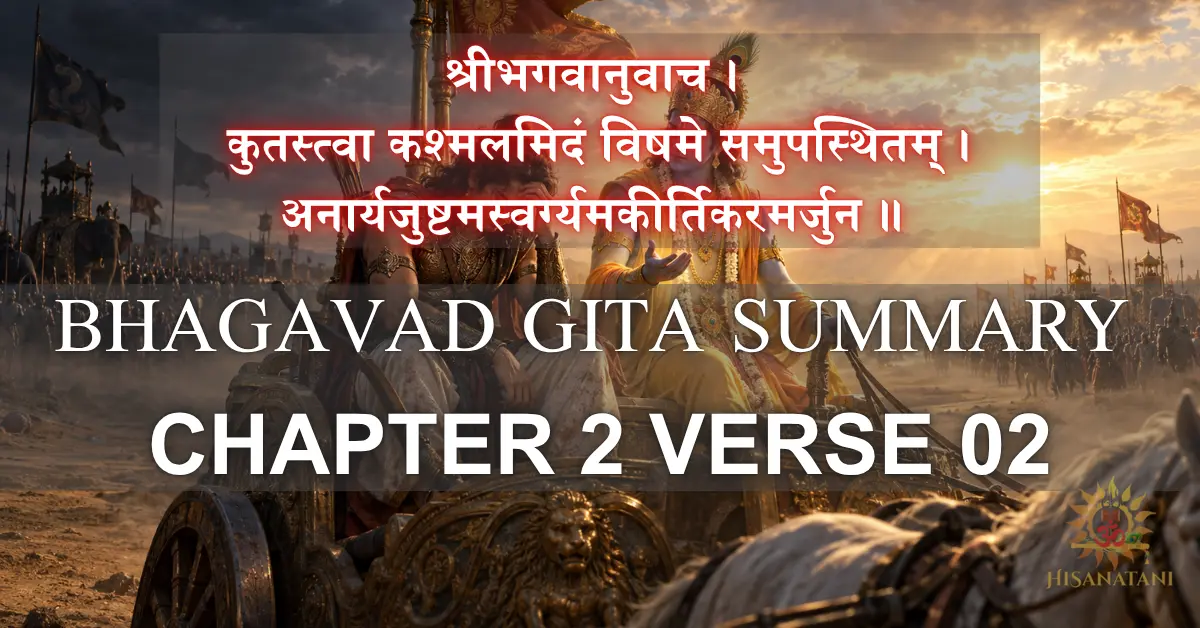
श्रीभगवानुवाच ।
कुतस्त्वा कश्मलमिदं विषमे समुपस्थितम् ।
अनार्यजुष्टमस्वर्ग्यमकीर्तिकरमर्जुन ॥ २.२ ॥
In English :
śrī-bhagavān uvāca |
kutas tvā kaśmalam idaṃ viṣame samupasthitam ||
anārya-juṣṭam asvargyam akīrti-karam arjuna |||
Feel the Vibration: A Guided Chant of Bhagavad Gita Chapter 2 Verse 2:
- śrī-bhagavān uvāca |
Shree Bha-ga-vaan U-vaa-cha - kutas tvā kaśmalam idaṃ viṣame samupasthitam ||
Ku-tas Tvaa Kash-ma-lam I-dam Vi-sha-me Sa-mu-pa-sthi-tam - anārya-juṣṭam asvargyam akīrti-karam arjuna |||
A-naar-ya Ju-shtam A-svar-gyam A-keer-ti-ka-ram Ar-ju-na
English Translation:
“The Blessed Lord said: From where has this dejection come upon you at this critical hour, Arjuna? It is unworthy of a noble person; it leads neither to heaven nor to honor.”
JOIN THE HISANATANI COMMUNITY
Get daily Verse Summaries & High-Res Posters directly on your WhatsApp.
JOIN CHANNELWhy This Question Still Works On You
Krishna’s opening line to Arjuna is a challenge, not comfort — question where the collapse came from before you obey it.
Self-doubt rarely introduces itself as “imposter syndrome.” It sounds more reasonable than that. Maybe I’m not ready. Maybe they hired me by mistake.
Maybe I should wait until I know more. Because these thoughts sound cautious, we mistake them for wisdom. That’s the trap.
A notification arrives. Someone your age got promoted. Someone launched a company. Five minutes later, your brain has quietly built a case against your own competence — without a single new fact to support it.
Krishna doesn’t ask Arjuna to pretend the crisis isn’t real. He asks him to examine the state that showed up inside it. For a professional, that means separating a hard situation from the story your frightened mind tells about it.
Six Ways Bhagavad Gita 2.2 Breaks the Self-Doubt Loop
The Playground Lesson — Don’t Quit the Game Over One Missed Ball

Picture a ten-year-old playing cricket. First ball — miss. Second ball — miss. Third ball, he’s bowled out. He walks off and says, “I’m terrible at cricket. I should never play again.”
What would you tell him? Probably: “You missed three balls. That’s all. Learn what happened and try again.”
Obvious, right? But adults do something stranger. We turn one failed presentation into an identity.
One rejection becomes “I’m not good enough.” One hard task becomes “I’m not technical.” One awkward conversation becomes “I’m not a leader.”
Notice the jump: event → interpretation → identity.
Bhagavad Gita 2.2 interrupts exactly that jump. Arjuna’s event is enormous — his grief is real, his confusion is real. But Krishna refuses to let that collapse become the final definition of who Arjuna is.
Think of a child learning to ride a bike. Falling doesn’t prove the child is “a falling person.” Falling is information. Adjust the balance. Try again.
Your workplace works the same way. If the presentation failed, review the presentation. If you lack a skill, build it. If an AI tool now does part of your job faster, study what that changes — and what distinctly human skill matters more because of it.
Don’t turn a specific problem into a permanent identity. That’s the most useful way to read the Bhagavad Gita 2.2 Summary. Krishna isn’t asking Arjuna to manufacture confidence — he’s asking him to stop treating a temporary collapse as a permanent verdict.
Today’s question isn’t “what does this prove about me?” It’s simply: “what actually happened?”
The Real Fight Is Between the Situation and the Story You Tell About It

The deeper philosophical question in Bhagavad Gita Chapter 2 Verse 2 isn’t whether Arjuna should feel confident. It’s this: who’s actually running the decision right now — clarity, or a passing mental storm?
Human beings often confuse consciousness with whatever thought is loudest. You think, “I’m going to fail.” Fear shows up.
Then another thought arrives: “I’m scared, so there must be real danger.” Now the feeling has become evidence — except it was never verified. That’s how mental loops work: a notification arrives, you interpret it, your body reacts, the reaction seems to confirm the interpretation, and within minutes a mental story has become a behavioral strategy.
Krishna’s opening question — kutaḥ, “from where?” — creates distance between the person experiencing the confusion and the confusion itself. It’s the same distance between watching a cloud cross the sky and believing the sky has become the cloud. The cloud passes. The sky doesn’t.
That distinction has real value. “I am experiencing self-doubt” is not the same sentence as “I am inadequate.” The first describes weather. The second redesigns the house.
Don’t rebuild your whole career because one quarter went badly. Don’t abandon your voice because one person criticized it. First investigate. Then decide. That’s philosophy translated into a Monday morning.
Stop Treating Every Bad Day Like a Performance Review

This is where Bhagavad Gita 2.2 becomes especially relevant to modern mental pressure. Imposter syndrome runs on overgeneralization. One failure becomes “I always fail.” One knowledge gap becomes “I don’t know anything.” One nervous presentation becomes “I can’t communicate.”
Imagine your company’s dashboard working the same way — revenue dips 4% one week, and it announces COMPANY IS DOOMED. No serious business would accept that. You’d check the timeframe, seasonality, market conditions. But when the same person evaluates themselves, one bad day suddenly becomes a final verdict. Feeling incompetent is not the same as being incompetent.
This doesn’t mean ignoring real problems. If you lack a skill, admit it. If feedback repeats a pattern, address it. But don’t add fictional conclusions to factual observations. Try this quick audit next time a doubt spikes:
You make an error, and your mind says “I’m incompetent” — but the evidence only says you made an error. Someone corrects you, and your mind says “they think I’m useless” — but the evidence only says they corrected one specific issue. You don’t know an answer, and your mind says “I’m an imposter” — but the evidence only says you found a knowledge gap. Someone gets promoted, and your mind says “I’m falling behind” — but the evidence only says someone else got promoted.
That’s the use of Krishna’s question here: where did that conclusion come from — evidence, or fear? If self-doubt becomes persistent or starts affecting your sleep or daily functioning, professional mental-health support is worth adding alongside any spiritual practice — the two aren’t in competition.
You Are Not the Number in Your Last Performance Review

The deepest comfort in this BG2.2 isn’t motivational — it’s more basic than that. You are not your résumé. Not your salary. Not your title.
Not the number of rejection emails sitting in your inbox. You’re not even the changing story you tell yourself about all of it.
The Gita’s view of the Self points somewhere deeper. That deeper self isn’t created by a promotion and isn’t destroyed by a professional failure. It doesn’t grow more sacred because someone applauds you, and it doesn’t grow less sacred because someone criticizes you.
That doesn’t make your work meaningless — it gives it its proper place. You can care deeply about a project without asking the project to tell you who you are. You can pursue excellence without turning excellence into your self-worth. You can accept criticism without turning it into a verdict on your worth as a person.
This is where surrender gets misunderstood. It doesn’t mean “I don’t care what happens.” It’s closer to: “I’ll offer my sincere effort without demanding every result prove I’m enough.”
You still prepare for the interview. You still give the presentation. You still make the hard call. But underneath all of it sits a quieter fact: the result was never the measure of who you are.
That’s why Krishna’s question lands as personal, not corrective. He isn’t scolding Arjuna’s behavior — he’s calling him back from a temporary darkness toward something that was there before the fear showed up.
Krishna Doesn’t Wait for a Calm Moment to Say This

It’s easy to read the Gita from a comfortable chair and forget where these words were actually spoken. Kurukshetra wasn’t a retreat center. Arjuna wasn’t sipping tea while journaling about his five-year plan. He was standing between two armies, watching people he loved and respected on both sides, his training colliding head-on with his grief.
That context matters, because it stops us from flattening Krishna’s words into generic positivity. Arjuna’s problem wasn’t “I don’t feel confident today.” It was that his understanding of his own duty had gone cloudy under the weight of attachment and grief — and the emotional pressure was strong enough to change his relationship with action itself.
The word viṣame — this critical, difficult moment — matters here. The biggest inner disruptions rarely arrive when everything is calm. They show up during transitions: a first leadership role, a sudden layoff, a public mistake, a shift in your industry that makes years of expertise suddenly feel uncertain.
That’s the real Kurukshetra for most people reading this — not a physical battlefield, but a collision between what the moment is asking of you and what fear is whispering instead. Krishna’s question doesn’t wait for the storm to pass before it arrives. It shows up in the middle of it. Sometimes wisdom doesn’t come after the crisis. It speaks from inside it.
The 24-Hour Gita Challenge — Catch Self-Doubt Before It Becomes a Decision
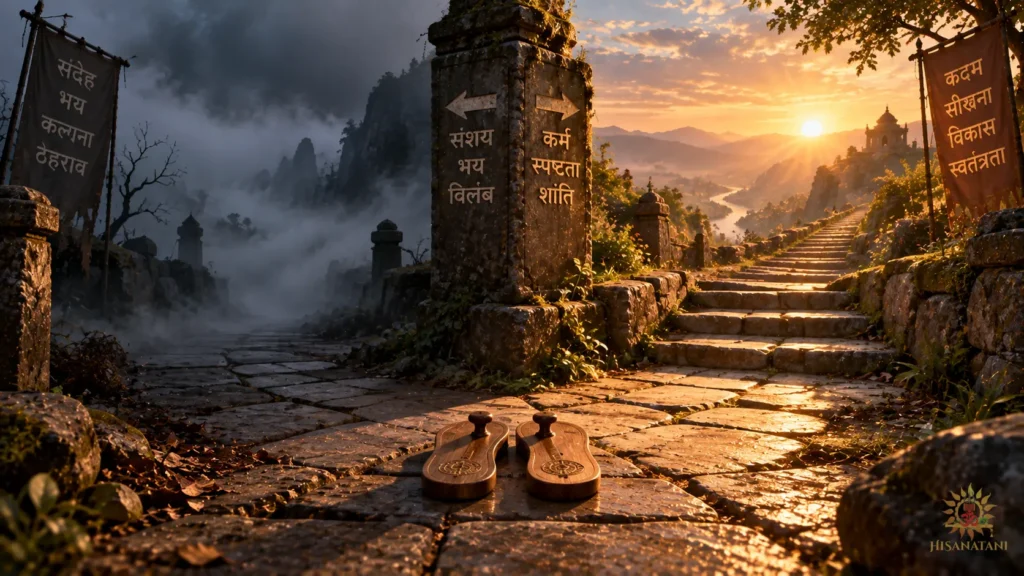
Time to turn Bhagavad Gita 2.2 into something you actually do — not tomorrow, today.
Step 1 — Write the “Kutaḥ” Question. Next time you catch yourself thinking “I’m not good enough,” stop. Open your notes app and write: Kutaḥ — from where did this thought come? Then find its source.
A specific piece of feedback? A real skill gap? A scroll through someone else’s highlight reel? Don’t solve it yet — just locate it. You’re separating data from noise.
Step 2 — Trade Identity Statements for Skill Statements. For the next 24 hours, ban yourself from saying “I’m bad at this.” Replace it with “I haven’t learned this yet.” Don’t say “I’m not leadership material” — say “I need more practice with hard conversations.”
That’s not a small edit. You’ve moved from identity to execution. Identity feels permanent. A skill statement gives you a plan — and plans can be worked on.
Step 3 — Take One Uncomfortable Action Before Midnight. Pick the thing you’ve been postponing because you don’t feel ready. Do the smallest real version of it. Send the application. Ask the question.
Book the meeting. Set a 20-minute timer and act — then note what you feared would happen, and what actually did. You’re collecting evidence against your own worst predictions.
By tonight, you’ll have three things: the source of one recurring doubt, a rewritten skill-based version of it, and one real action taken despite the uncertainty. That’s the challenge. Not a motivational exercise — execution.
Your Worst Moment Doesn’t Get to Run Your Next Decision
Arjuna’s collapse is understandable. That’s exactly why this Summary of Bhagavad Gita 2.2 matters. Krishna doesn’t pretend the crisis is small — he challenges the mental state that’s taken control of it. That’s the lesson to carry into Monday morning.
You may feel unqualified — investigate the feeling. You may have failed — study the failure. You may lack a skill — go build it. And when the mind says “maybe I don’t belong here,” ask Krishna’s question in your own words: where did this thought come from?
That question creates space. Space creates observation. Observation creates clarity. And clarity — slowly — produces evidence that the fear was never the whole story.
The goal was never to become fearless. It’s to stop letting fear run the show. Your mind can panic.
You can still prepare. Your confidence can shake. You can still speak.
Please let me know in the comments.
Embrace the Teachings of the Gita. Dive deeper into the Bhagavad Gita to uncover its timeless wisdom and practical guidance. Let its verses inspire you to cultivate inner clarity, align with higher values, and navigate life’s challenges with courage and grace.
🌼 Join the HiSanatani WhatsApp Channel for your daily dose of light 🪔. Join Now.
Voice of the Soul
Finding clarity in the questions we all carry…
What is the main message of BG2.2?
Krishna questions the source of Arjuna’s sudden collapse instead of comforting him, and asks him not to let that mental state make his decisions for him. For a professional, that means investigating self-doubt before it becomes a decision. See The Playground Lesson — Don’t Quit the Game Over One Missed Ball.
What does “Kutaḥ” mean in Bhagavad Gita 2.2?
Kutaḥ means “from where?” — Krishna’s opening question, used to trace a troubled thought back to its actual source instead of accepting it as fact. See The Real Fight Is Between the Situation and the Story You Tell About It.
How does Bhagavad Gita 2.2 apply to imposter syndrome?
It teaches you to separate a genuine skill gap from an exaggerated identity judgment, auditing what actually happened versus what you concluded from it. See Stop Treating Every Bad Day Like a Performance Review.
Does Krishna tell Arjuna to ignore his emotions?
No — Arjuna’s grief is treated as real throughout. Krishna challenges the way that grief has taken over his judgment at a critical moment, not the emotion itself. See Krishna Doesn’t Wait for a Calm Moment to Say This.
What can I actually do today from Bhagavad Gita 2.2?
Trace one self-doubt thought to its source, rewrite it as a skill gap instead of an identity, and take one real action despite the discomfort. See The 24-Hour Gita Challenge — Catch Self-Doubt Before It Becomes a Decision.
