
Namaste 🙏
Welcome to Hi Sanatani. It’s a joy to have you here as we explore the deeper layers of human nature. By diving into this Bhagavad Gita 1.27 Summary we create a sacred bridge together, turning ancient verses into helpful tools for your personal growth and peace.
Translation of Bhagavad Gita Shloka Verse 1.27 in English:
तान् समीक्ष्य स कौन्तेयः सर्वान् बन्धूनवस्थितान् ।
कृपया परयाविष्टो विषीदन्निदमब्रवीत् ॥ २७ ॥
In English :
tān samīkṣya sa kaunteyaḥ sarvān bandhūn avasthitān |
kṛpayā parayāviṣṭo viṣīdann idam abravīt ||
Feel the Vibration: A Guided Chant of Bhagavad Gita Chapter 1 Verse 27:
- tān samīkṣya sa kaunteyaḥ sarvān bandhūn avasthitān |
Tān Sa-mīk-shya Sa Kaun-te-yaḥ / Sar-vān Ban-dhūn A-va-sthi-tān - kṛpayā parayāviṣṭo viṣīdann idam abravīt ||
Kṛ-pa-yā Pa-ra-yā-viṣ-ṭo / Vi-shī-dan Ni-dam A-bra-vīt
English Translation:
“Seeing all these kinsmen arrayed before him, Arjuna, the son of Kunti, was overcome with deep compassion, and in sorrow he spoke these words.”
JOIN THE HISANATANI COMMUNITY
Get daily Verse Summaries & High-Res Posters directly on your WhatsApp.
JOIN CHANNELWhy Your Soul Needed to Hear This Today
Let’s be honest. We live in an era of constant performance pressure, digital noise, and corporate reorganization. You are told to keep your feelings out of your work, to automate, and to scale up. But when your industry shifts overnight, or when team members you respect get managed out by a cold algorithm, your natural empathy kicks in.
You feel a heavy weight in your chest. That isn’t weakness; it is your humanity trying to process a changing landscape. Arjuna’s sudden crash from fierce warrior to paralyzed observer shows that even the strongest minds break down when empathy turns into a choking trap.
The Playground Changed Into Family: A Child-Friendly View of Bhagavad Gita 1.27 Summary

Imagine playing a game at school. Your team lines up on one side, and the other team stands opposite. Everything feels normal until you suddenly notice your best friend, your cousin, your favorite teacher, and your older sibling standing on the other side. Now winning doesn’t feel simple anymore.
This lens comes mostly from Summary of Bhagavad Gita 1.27, where Arjuna sees the people gathered for battle. The important detail is not the weapons. It is the relationships.
Children understand this naturally. Suppose two friends are arguing — you care about both. If one asks you to choose sides, you may feel uncomfortable, not because you are weak, but because you care.
Arjuna experiences something similar in BG1.27. Before this moment, he was focused on battle plans. Then he notices the faces, and once he sees who is standing there, his emotions change immediately.
The simple lesson is powerful: strong people still have feelings, and good people often struggle when people they care about are involved.
Bhagavad Gita Chapter 1 Verse 27 teaches children and adults alike that compassion is natural. The challenge is learning what to do after compassion appears. That question becomes the foundation of the rest of the Gita.
When Human Attachment Challenges Duty: The Philosophical Core of Bhagavad Gita 1.27 Summary

The philosophical weight lies in the verse’s second line — the moment compassion floods Arjuna and grief takes hold. Arjuna’s problem is not physical danger. It is a clash between two valid realities.
One reality says: “Perform your duty.” The other says: “Protect those you love.” When these collide, the mind becomes confused.
Most people assume suffering comes from choosing between good and bad. Actually, some of life’s hardest decisions involve choosing between two goods.
A judge may care deeply about a defendant yet still uphold the law. A doctor may need to perform a painful procedure to save a patient. A leader may need to make decisions that hurt people in the short term to preserve a larger mission.
Arjuna stands inside this tension. The philosophical question is profound: should personal attachment determine action, or should action be guided by a higher principle?
The Gita does not dismiss compassion. It examines whether compassion alone can serve as a complete guide.
If every difficult duty is abandoned when emotions become intense, society cannot function. Yet if emotions are ignored completely, humanity disappears. The wisdom of the Krishna in Bhagavad Gita 1.27 emerges from navigating this middle ground.
Arjuna’s breakdown is not a mistake. It is the necessary starting point for discovering a deeper framework for action.
The Emotional Crash Before the Conversation: A Psychological Reading

This verse describes something psychologists observe regularly: the mind often reacts to anticipated pain before the event itself occurs.
Notice what has happened. The battle has not started. No arrows have been released. No injuries have occurred. Yet Arjuna is already overwhelmed. This is anticipatory distress.
Young professionals today experience it constantly. You hear rumors of AI-driven restructuring. You receive a meeting invitation with no explanation. A company announces organizational changes. Nothing has happened yet.
But your body reacts as though the outcome is already real. Sleep becomes difficult. Focus declines. Worst-case scenarios multiply.
In this verse of BG1.27, Arjuna experiences exactly this pattern. Seeing the possibility of loss creates an emotional flood. The mind moves faster than reality.
That is why emotional regulation matters. The lesson is not to suppress feelings — the lesson is to avoid letting future fears completely dominate present perception.
Arjuna sees one possible future and immediately experiences its emotional consequences. Many professionals do the same. The Gita begins by acknowledging this human tendency before offering tools to move beyond it. The diagnosis comes before the solution.
Compassion Is Not Weakness: The Spiritual Message Hidden in Arjuna’s Tears

Many people assume spirituality requires emotional detachment. This verse suggests otherwise.
Arjuna’s compassion is genuine. His sorrow is genuine. His concern for others is genuine. The problem is not that he cares — the problem is that his emotional state prevents him from seeing clearly.
Spiritually speaking, compassion and wisdom must work together. Compassion without wisdom can become paralysis. Wisdom without compassion can become coldness. The ideal combines both.
In BG 1.27, Arjuna’s heart opens before his understanding expands. That sequence matters.
The Gita does not ask him to stop caring about his relatives. It asks him to understand reality more deeply before deciding how to act.
This is a lesson many seekers overlook. Feeling emotional does not make you less spiritual. Feeling compassion does not make you less capable. The challenge is remaining connected to truth while emotions are active.
Arjuna’s tears become the doorway through which spiritual instruction enters. Without this vulnerability, the conversation with Krishna would never begin.
The Battlefield That Was Also a Family Reunion: Historical Context of Bhagavad Gita 1.27
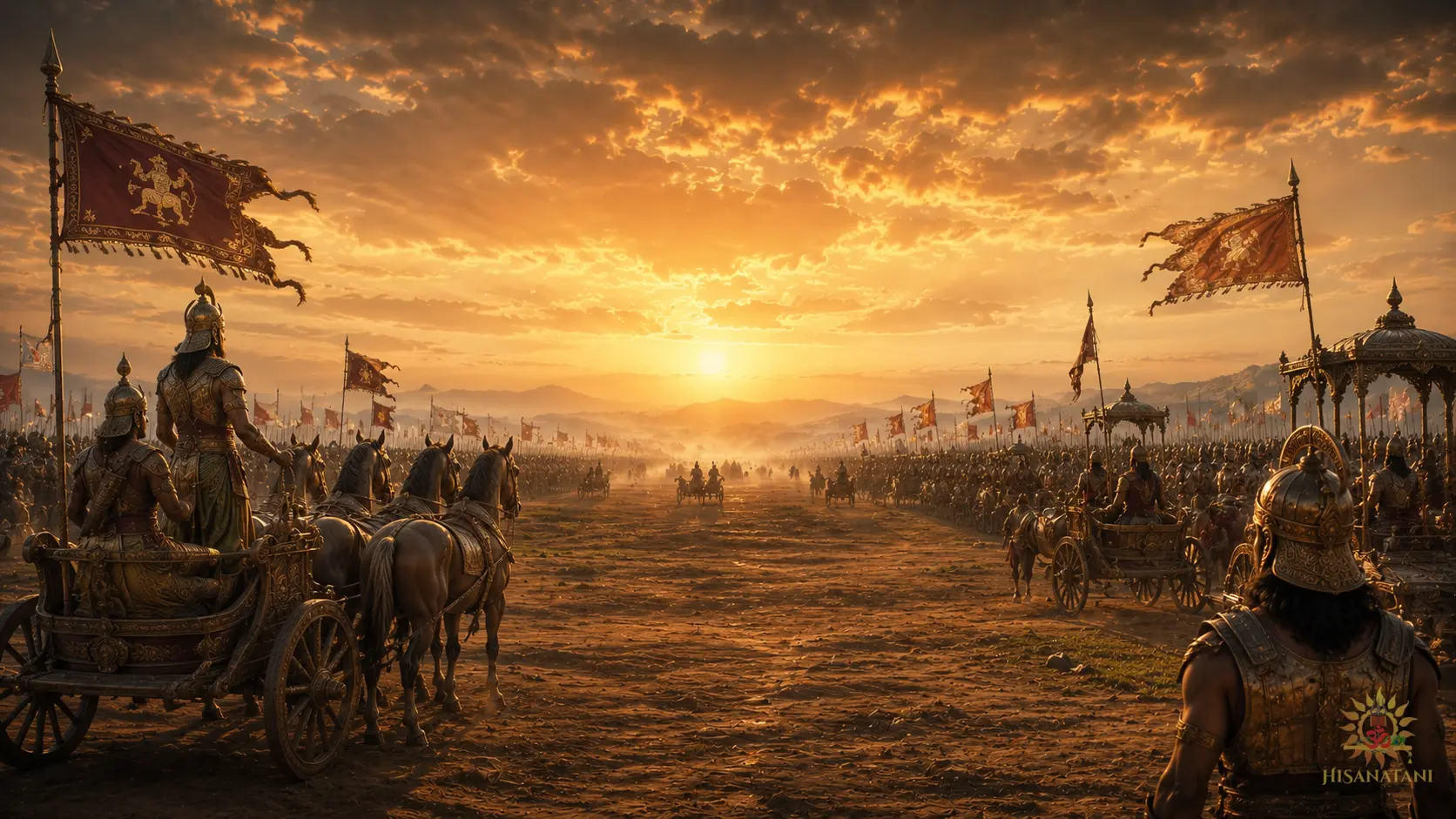
Strip away the myth for a second and look at the roster. Kurukshetra was fought by two branches of one royal house — the Kauravas and the Pandavas were first cousins. The men lined up across from Arjuna weren’t a foreign army. Many had eaten at his table.
This is what separates Kurukshetra from most wars people picture when they hear the word “battlefield.” There was no anonymous “other side.” Every formation Arjuna scanned was staffed with people who had a name, a relationship, and a claim on his memory before they ever picked up a weapon.
Historians studying the Mahabharata period point to something else worth noting: in that era, teachers, in-laws, and extended family often served the ruling house that employed them, regardless of personal loyalty to any one prince. Drona and Bhishma stood with the Kauravas not because they had turned against Arjuna, but because duty to the throne pulled them there — a duty that looked a lot like the duty now pulling Arjuna into battle against them.
That detail changes how you read this verse. Arjuna isn’t just seeing people he loves on the wrong side. He’s seeing the same principle — duty overriding personal preference — already at work in the men standing opposite him. Their presence on that field is proof that the dilemma about to spill out of him isn’t unique to him. It is the condition of everyone standing on that plain.
That is the weight behind the scene: not just grief at recognizing faces, but the uncomfortable recognition that everyone here, on both sides, is trapped by the same forces.
24-Hour Gita Challenge: Turning Compassion Into Clear Action

To turn this ancient wisdom into tactical steps for your career today, execute these three actions within the next 24 hours.
Audit Your Emotional Scope: Write down three professional situations that are causing you anxiety right now. Separate what you can control (your execution) from what you cannot control (market shifts, other people’s jobs).
Establish an “Off-Grid” Sabbatical: Take a literal 15-minute break from your smartphone and laptop today. Sit without notifications to deliberately lower your internal noise and reset your nervous system from empathy overload.
Reframe Your Corporate Duty: The next time you face a tough decision at work that affects others, focus entirely on the objective benefit of the project rather than personal dynamics. Execute clearly while honoring everyone involved.
Beyond the Battlefield
Arjuna’s crisis begins the moment he truly sees. The battlefield does not change. The people do not change. What changes is his perception.
In Bhagavad Gita 1.27 Summary, we witness a timeless human experience: a capable person suddenly confronted by the emotional consequences of a difficult responsibility. Compassion floods the heart. Clarity disappears. Speech begins.
For professionals navigating AI disruption, workplace uncertainty, and emotionally difficult choices, these verses offer a powerful reminder: seeing the human side of a situation is not weakness. The real challenge is learning how to act wisely after the emotions arrive.
Arjuna’s struggle is our struggle. And Krishna’s guidance is about to begin.
Please let me know in the comments.
Embrace the Teachings of the Gita. Dive deeper into the Bhagavad Gita to uncover its timeless wisdom and practical guidance. Let its verses inspire you to cultivate inner clarity, align with higher values, and navigate life’s challenges with courage and grace.
🌼 Join the HiSanatani WhatsApp Channel for your daily dose of light 🪔. Join Now.
Continue the journey: Previous — Bhagavad Gita 1.26 Summary | Next — Bhagavad Gita 1.28 Summary | Bhagavad Gita Chapter 1 Summary
Voice of the Soul
Finding clarity in the questions we all carry…
What is the main message of Bhagavad Gita 1.27?
The main message is that deep compassion can overwhelm even strong individuals when personal relationships collide with difficult responsibilities. This becomes the foundation for the wisdom discussed in When Human Attachment Challenges Duty.
Is Bhagavad Gita 1.27 a complete verse on its own?
Yes. 1.27 is a full sentence — Arjuna sees his kinsmen, is overcome with compassion, and speaks, all within its own two lines and its own finite verb, abravīt. See the note in the English Translation section above.
How is Bhagavad Gita 1.27 relevant to today’s AI-disrupted workplaces?
Many professionals now face decisions that affect people they know and care about, often with little warning. The anticipatory dread Arjuna feels before a single arrow is fired mirrors this anxiety, explored further in The Emotional Crash Before the Conversation.
Does the Gita consider compassion a weakness?
No. The Gita treats compassion as valuable and deeply human. The challenge is combining compassion with clear judgment and wise action, as explained in Compassion Is Not Weakness.
What’s a practical first step from Bhagavad Gita 1.27?
Start by separating what you can control from what you can’t — your own execution versus market shifts or other people’s outcomes. The full three-step method is in the 24-Hour Gita Challenge.
