
Namaste 🙏
Welcome to Hi Sanatani. It’s a joy to have you here as we explore the deeper layers of human nature. By diving into this Bhagavad Gita 1.30 Summary we create a sacred bridge together, turning ancient verses into helpful tools for your personal growth and peace.
Translation of Bhagavad Gita Shloka Verse 1.30 in English:
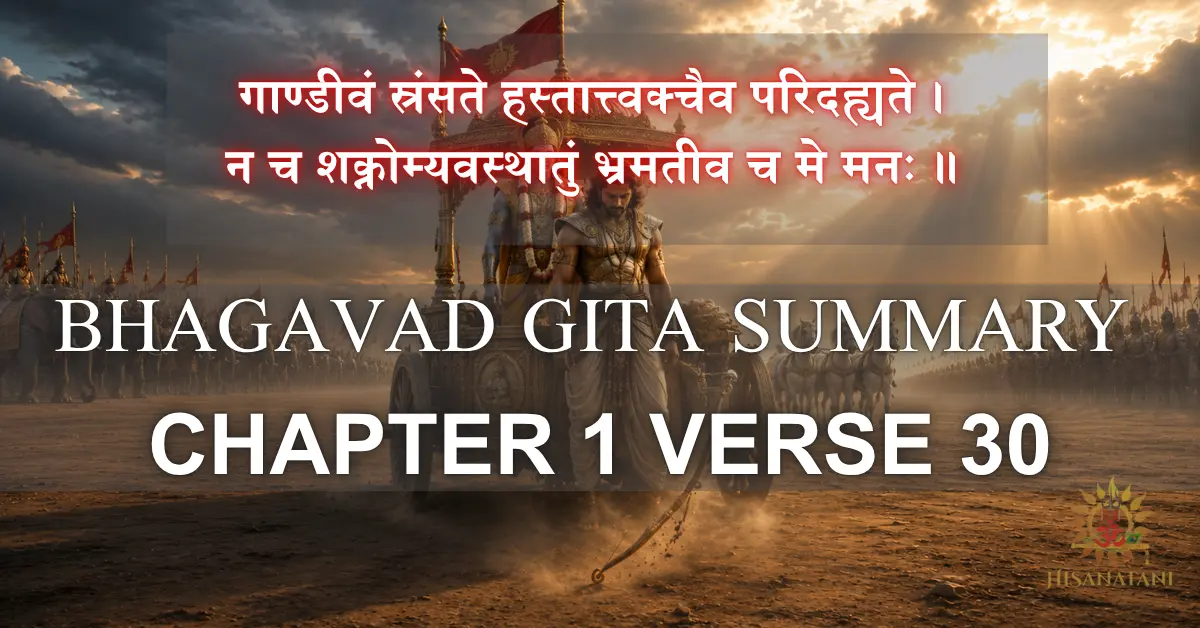
गाण्डीवं स्रंसते हस्तात्त्वक्चैव परिदह्यते।
न च शक्नोम्यवस्थातुं भ्रमतीव च मे मनः॥ १.३० ॥
In English :
gāṇḍīvaṃ sraṃsate hastāt tvak caiva paridahyate |
na ca śaknomy avasthātuṃ bhramatīva ca me manaḥ || 1.30 ||
Feel the Vibration: A Guided Chant of Bhagavad Gita Chapter 1 Verse 30:
- gāṇḍīvaṃ sraṃsate hastāt tvak caiva paridahyate |
gāṇ-ḍī-vaṃ sraṃ-sa-te has-tāt tvak cai-va pa-ri-dah-ya-te - na ca śaknomy avasthātuṃ bhramatīva ca me manaḥ || 1.30 ||
na ca śak-no-my a-vas-thā-tuṃ bhra-ma-tī-va ca me ma-naḥ
English Translation:
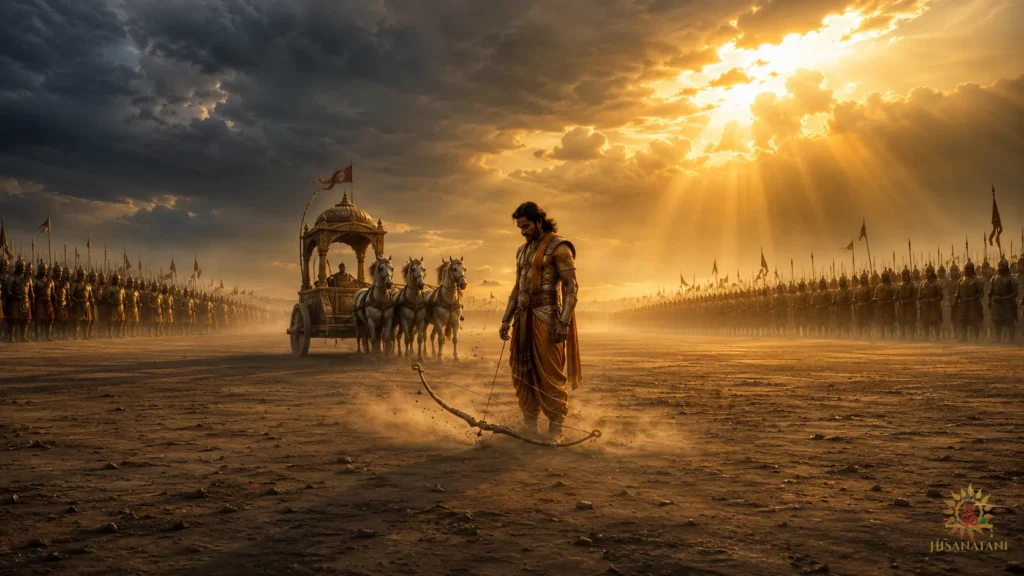
“The Gāṇḍīva slips from my hand, and my skin burns all over. I am unable to stand steady, and my mind seems to be reeling.”
JOIN THE HISANATANI COMMUNITY
Get daily Verse Summaries & High-Res Posters directly on your WhatsApp.
JOIN CHANNELWhy Your Mind Feels Like a Browser With 100 Tabs Open
If you’ve ever sat before an appraisal review and felt your heart race for no clear reason, this verse will feel familiar.
Modern life rewards performance. Targets. Ratings. Deadlines. Promotions. But here’s the thing — your nervous system doesn’t care about your corporate hierarchy.
When pressure outweighs your sense of being able to cope, your body enters survival mode. Thoughts scatter. Focus disappears. Every email starts to feel like a threat. Every silence starts to feel dangerous.
Arjuna’s collapse isn’t weakness. It’s a human response to overwhelming internal conflict. And this verse offers a quiet reminder: before you can fix what’s outside, you have to steady the battlefield within.
The Playground Lesson: Why Arjuna Couldn’t Think Clearly
Imagine a child participating in a school race. The child has practiced for weeks. They know exactly how to run. But just before the whistle blows, they notice hundreds of people watching.
Suddenly they feel nervous. Their stomach hurts. Their legs feel strange. They forget everything they practiced.
Did the child lose their ability to run? No. Fear temporarily interrupted their confidence.
This is exactly what happens to Arjuna. He has spent his entire life training as a warrior. Nobody on the battlefield is more qualified than him. Yet fear causes him to doubt his abilities.
Many young professionals experience this during appraisals. They have completed projects successfully. They have achieved results. Yet one difficult meeting makes them question everything. BG 1.30 teaches children and adults alike that fear can distort perception. When fear becomes the loudest voice in the room, facts become hard to see.
The Hidden Rule of Human Experience Nobody Talks About

Human beings do not experience reality directly. They experience reality through interpretation. The battlefield itself has not changed. The warriors remain the same. The weapons remain the same. What changed? Arjuna’s perception.
This principle operates everywhere. A confident entrepreneur sees opportunity; a fearful one sees risk. A confident employee sees feedback; an anxious one sees criticism. The external event may be identical — the interpretation differs.
The verse is exposing a timeless law of the mind ,its just like a clean water mirror : when it becomes unstable, reality appears unstable. When it becomes fearful, danger appears everywhere. This explains why two people can live through the same event and walk away with completely different conclusions. The battlefield outside reflects the battlefield inside.
The Science Behind Pre-Appraisal Panic

Young professionals often describe anxiety in physical language: “My head is spinning.” “I can’t focus.” “I feel frozen.” Arjuna uses almost the same words. His mind is reeling. He can’t stand steady.
Here’s what’s actually happening. When your brain detects a threat — real or imagined — it diverts energy away from calm, clear thinking and straight toward your body’s alarm system. Blood moves toward your muscles. Your focus narrows to danger-scanning instead of problem-solving. This is why your hands shake and your thoughts scatter at the exact moment you need them most.
This creates a loop. Anxiety produces negative predictions. Negative predictions produce more anxiety. More anxiety produces stronger physical symptoms. Soon, a normal meeting feels like a survival situation.
BG1.30 offers a practical mental-health insight buried inside an ancient text: your thoughts are not always facts. The mind predicting disaster doesn’t mean disaster is coming. Learning to notice the gap between what your body is telling you and what is actually true is one of the most useful skills any professional can build.
The Spiritual Cost of Forgetting Who You Are

At a spiritual level, Arjuna’s suffering comes from identifying with fear. The eternal self remains unchanged, but Arjuna temporarily forgets that deeper identity and becomes absorbed in the storm of his own thoughts.
This is where many people struggle today. Job title becomes identity. Salary becomes identity. Performance rating becomes identity. Then any threat to those things feels like a threat to existence itself.
But spiritual wisdom from Summary of Bhagavad Gita 1.30offers another view: you are more than your latest performance review, more than your quarterly results, more than your successes and failures. Arjuna’s panic emerges because his awareness gets trapped in the immediate moment. Krishna’s teachings that follow will slowly redirect him toward a deeper truth — stability comes when identity is rooted in something larger than temporary outcomes.
What Was Actually Happening on Kurukshetra

Historically, this verse falls in one of the most emotionally loaded moments of the Mahabharata. Arjuna stands between two armies made up of his own teachers, cousins, and childhood companions.
Notice what actually slips from his hand here — the Gandiva. This wasn’t an ordinary bow. Tradition holds it was gifted to Arjuna by Agni, the fire god, and it had stayed with him through years of exile and battle. In a very real sense, it was part of his identity as a warrior.
So when the Gandiva slips from his grip, it isn’t a small detail — it’s a symbol. The very thing that made Arjuna feel most like himself is the first thing to fail when the pressure becomes unbearable.
This progression matters. The BG1.30 carefully tracks how unresolved inner conflict moves through the entire human system — body first, then focus, then identity. Thousands of years before modern psychology had language for it, this text was already mapping the anatomy of a breakdown.
24-Hour Gita Challenge: Regain Control Before Anxiety Takes Over

Bhagavad Gita 1.30 doesn’t just describe the problem. It points toward action. Try these three steps in the next 24 hours.
Step 1: Separate Facts From Predictions — Take a sheet of paper. Two columns: Facts and Fears. List every worry about your upcoming meeting or decision. You’ll usually find most of the weight sits in the Fears column.
Step 2: Use Your Breath to Interrupt the Spiral — Before anything high-stakes, try this: inhale through your nose for 4 counts, hold for 7, exhale slowly through your mouth for 8. Repeat it four times. This isn’t just a calming trick — it’s a direct signal to your nervous system that you are safe, which is exactly what Arjuna’s body needed before he could think clearly again.
Step 3: Replace Catastrophe Questions — Instead of asking “What if everything goes wrong?” ask “What evidence actually supports this fear?” This one question pulls your mind back toward reality.
Practice this for the next 24 hours and notice how much mental noise starts to fade.
The Battle Before the Battle
Bhagavad Gita 1.30 reveals a truth every young professional eventually discovers: the hardest battles aren’t always the ones in front of you. Sometimes they’re the ones happening inside your own mind.
Arjuna’s body weakens. His thoughts scatter. His confidence collapses. And yet this exact breakdown becomes the doorway to everything Krishna is about to teach him.
The moment you notice fear shaping what you see, you get some of your power back. You move from reacting to responding. And that changes everything.
Continue the journey: Read Bhagavad Gita 1.28–29 (Previous) | Bhagavad Gita 1.31 (Next) | Chapter 1 Summary
Please let me know in the comments.
Embrace the Teachings of the Gita. Dive deeper into the Bhagavad Gita to uncover its timeless wisdom and practical guidance. Let its verses inspire you to cultivate inner clarity, align with higher values, and navigate life’s challenges with courage and grace.
🌼 Join the HiSanatani WhatsApp Channel for your daily dose of light 🪔. Join Now.
Voice of the Soul
Finding clarity in the questions we all carry…
What is the main message of Bhagavad Gita 1.30?
The verse shows how overwhelming pressure can destabilize the body and mind at the same time. Arjuna’s bow slips and his skin burns because internal conflict has taken over his entire system. See The Science Behind Pre-Appraisal Panic.
Why does the Gandiva slip from Arjuna’s hand?
The Gandiva represented Arjuna’s identity as a warrior. When pressure overwhelms him, even the thing most central to who he is starts to fail him. See What Was Actually Happening on Kurukshetra.
How is Bhagavad Gita 1.30 relevant to modern professionals?
Many professionals experience the same freeze before interviews, appraisals, or big presentations. The verse explains how anxiety can hijack focus and performance. See the 24-Hour Gita Challenge.
Does Bhagavad Gita 1.30 talk about mental health?
While it isn’t a clinical text, it accurately describes anxiety symptoms like scattered focus and physical overwhelm, explored further in The Science Behind Pre-Appraisal Panic.
What’s one practical lesson from BG 1.30 I can use today?
Learn to separate facts from fear-based predictions. When your perception feels clouded, return to actual evidence before you act. Revisit The Hidden Rule of Human Experience Nobody Talks About.
