
Namaste 🙏
Welcome to Hi Sanatani. It’s a joy to have you here as we explore the deeper layers of human nature. By diving into this Bhagavad Gita 1.32 Summary we create a sacred bridge together, turning ancient verses into helpful tools for your personal growth and peace.
Translation of Bhagavad Gita Shloka Verse 1.32 in English:
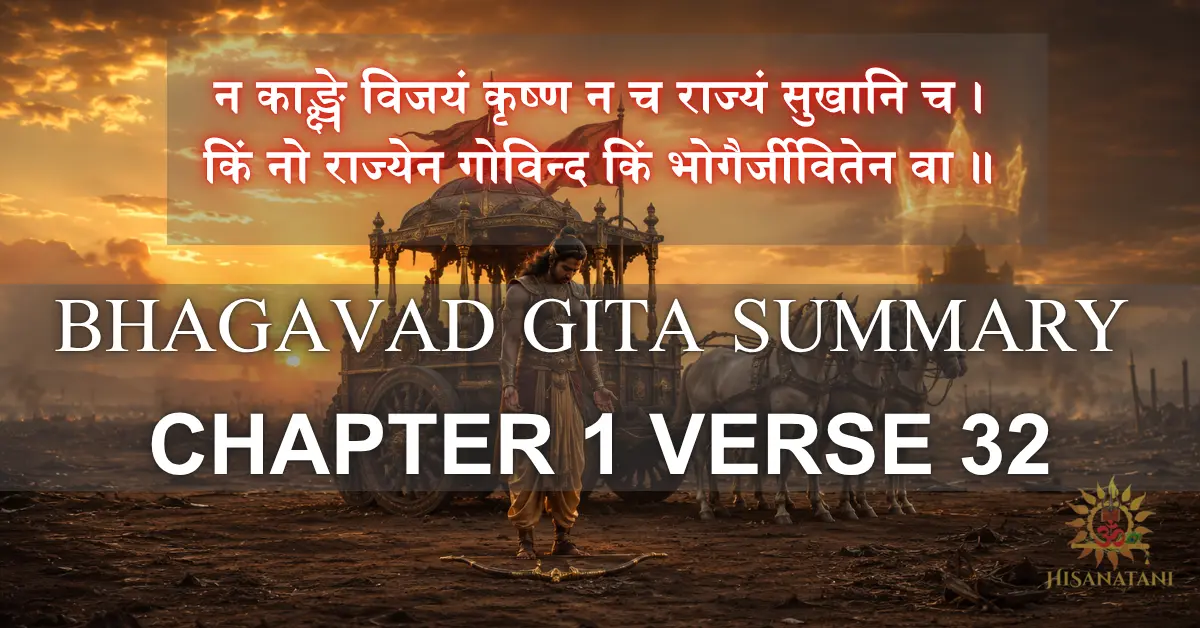
न काङ्क्षे विजयं कृष्ण न च राज्यं सुखानि च ।
किं नो राज्येन गोविन्द किं भोगैर्जीवितेन वा ॥ १.३२ ॥
In English :
na kāṅkṣe vijayaṁ kṛṣṇa na ca rājyaṁ sukhāni ca |
kiṁ no rājyena govinda kiṁ bhogair jīvitena vā ||
Feel the Vibration: A Guided Chant of Bhagavad Gita Chapter 1 Verse 32:
- na kāṅkṣe vijayaṁ kṛṣṇa na ca rājyaṁ sukhāni ca |
Na — kāṅk-ṣe — vi-ja-yaṁ — kṛṣ-ṇa — na — ca — rāj-yaṁ — su-khā-ni — ca - kiṁ no rājyena govinda kiṁ bhogair jīvitena vā ||
kiṁ — no — rāj-ye-na — go-vin-da — kiṁ — bho-gair — jī-vi-te-na — vā
English Translation:
“O Krishna, I do not desire victory, nor kingdom, nor pleasures. O Govinda, what use is a kingdom, enjoyment, or even life itself to us?”
JOIN THE HISANATANI COMMUNITY
Get daily Verse Summaries & High-Res Posters directly on your WhatsApp.
JOIN CHANNELWhy Your Soul Needed to Hear This Today
Let’s be honest. You’re tired. You’ve spent years collecting credentials, beating deadlines, optimizing your calendar — and the return on all that effort is sitting at zero. Digital exhaustion has quietly turned into something heavier. You look at your screen and wonder why you’re working sixty hours a week for a system that doesn’t care about your well-being.
Arjuna is right there with you. He’s living the ancient version of a professional collapse. This isn’t weakness — it’s your soul rejecting a bad deal. Let’s break this down through six different mirrors.
The Playground Trophy That Lost Its Shine

Picture a kid playing tag on a playground. He runs so hard his lungs burn, scraping his knees just to win a plastic gold medal. But right before he crosses the finish line, he notices his best friends already walked off to get ice cream. Suddenly that medal feels stupid and heavy. He doesn’t even want it anymore.
Arjuna is looking at the kingdom the exact same way. He realizes that if he destroys his family to get the crown, he won’t have anyone left to share the win with. It’s like pulling brutal overtime to afford a massive TV, only to realize you have no one left to invite over to watch it with you.
Winning only matters when the people around you are thriving too. If your success isolates you, it isn’t success — it’s just an expensive cage.
The Illusion of External Validation

From a metaphysical standpoint, this BG1.32 verse exposes the core flaw of object-dependent happiness. Modern culture wires your internal state to external acquisitions. You’re happy if you get the bonus; you’re successful if your profile looks prestigious.
But Krishna’s presence in this scene tells a different story. Arjuna calls him Govinda — a name that means “bringer of true satisfaction to the senses.” Even unconsciously, Arjuna is admitting that an earthly kingdom can’t heal a fractured spirit.
When you attach your self-worth to a job title, you’re trying to fill a spiritual gap with a material metric. It never works. Moments of real disillusionment force us to stop looking outward and start anchoring ourselves in something that doesn’t move when the market does.
Dismantling the Hedonic Treadmill

Psychologists call it the “hedonic treadmill” — the mental trap where your brain normalizes every achievement almost instantly, forcing you to chase the next high just to feel normal. The Summary of Bhagavad Gita 1.32 acts like a radical intervention against that loop.
Arjuna’s anxiety here isn’t about fear of losing. It’s the terrifying realization that he might win a game that has no real meaning left in it. When you hit a wall of burnout, your nervous system isn’t malfunctioning — it’s doing exactly its job. It’s sending a distress signal that your output has disconnected from your internal value system.
Stop treating low motivation as a personal failure. It’s a protective mechanism. Your mind is refusing to spend energy on things that don’t feed your deeper purpose — and to heal, you have to step off the treadmill completely.
When Selfish Desire Gives Way to Higher Duty

Spiritually, Arjuna’s collapse is a necessary step toward surrender. Right now his grief is still tangled up in his own ego. He believes he is the doer, the fighter, the one who will consume the kingdom. “I do not desire victory,” he says. Notice the word: I.
That exhaustion of personal desire is fertile ground for real spiritual awakening. When you finally admit your own strategies can’t fix the emptiness inside, you make room for something bigger to step in. Burnout is often the exact doorway through which people find their true calling.
It strips away the false layers of professional identity and leaves you raw, open, and ready to serve something beyond your own ambition. That shift — from personal ego to devotion — is the seed of everything that follows in the Gita.
The Real Stakes on the Field of Kurukshetra
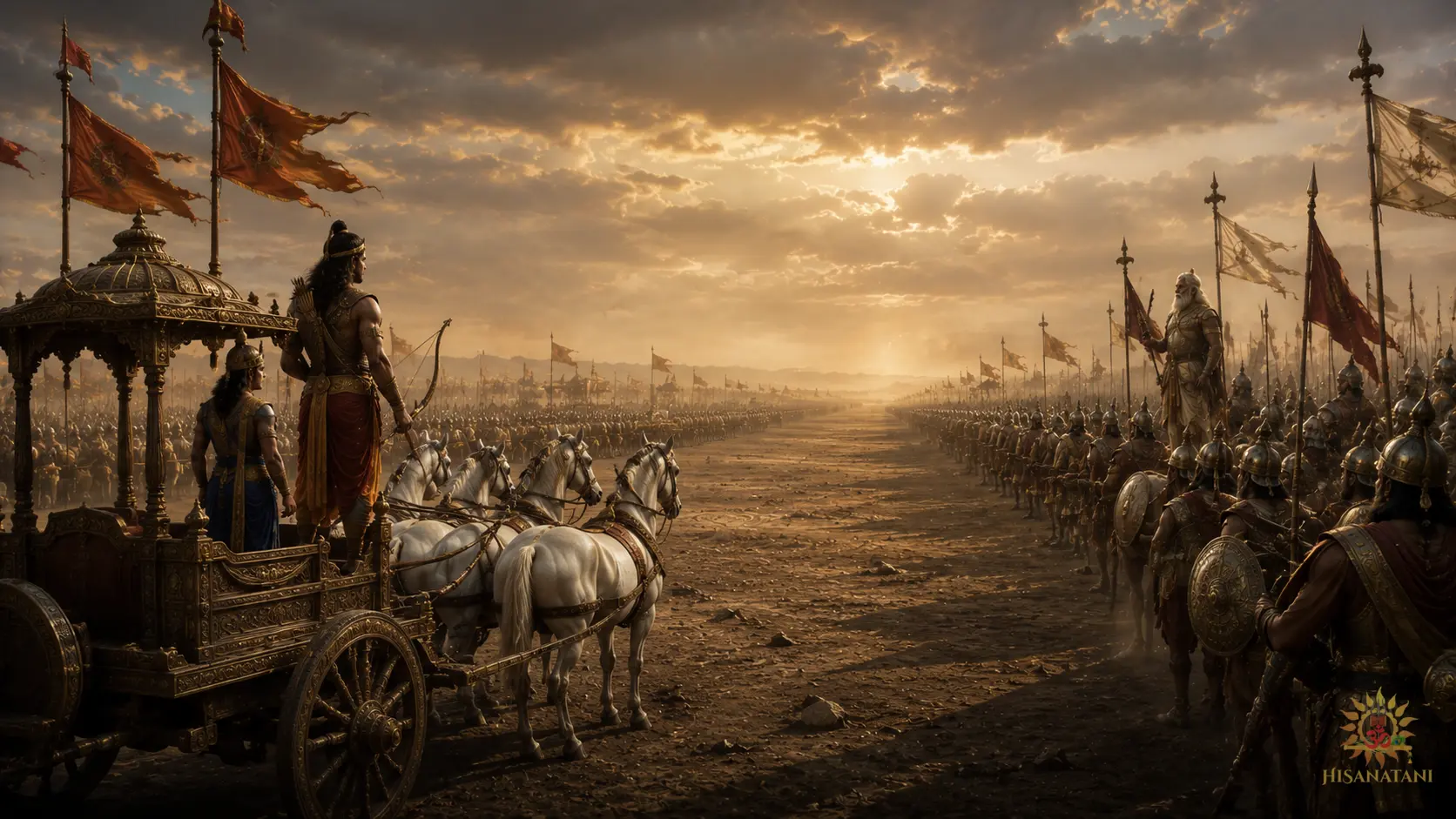
We need to re-anchor ourselves in the literal reality of Kurukshetra. This wasn’t a metaphor — it was a devastating geopolitical crisis. The leaders standing across from Arjuna were his own mentors. Bhishma, the grand patriarch on the opposing side, carried Arjuna on his shoulders when he was a baby.
In the context of this verse, Arjuna’s resistance is deeply radical. He’s rejecting a war that society told him was mandatory. His political duty demanded he fight; his personal conscience revolted at the human cost of doing so.
This tension isn’t ancient history repeating a moral lesson from a distance — it’s the same tension people feel today when a promotion demands abandoning health, or a raise costs them their family time. The battlefield changes shape. The dilemma doesn’t.
Your 24-Hour Gita Challenge from Bhagavad Gita 1.32 Summary

Three concrete steps to run in the next 24 hours, straight out of Bhagavad Gita 1.32.
Audit your calendar: find two meetings or tasks you’re only doing to please people. Delete them, delegate them, or decline them.
Build a digital firewall: shut the laptop and phone off by 8 PM tonight. No emails before bed. Let the world run without you for twelve hours.
Reconnect with your circle: spend one screen-free hour with someone you love. No talk of work, targets, or anxieties. Just presence.
Small moves like these are how you actually put Bhagavad Gita 1.32 into practice — not by quoting it, but by living it for one day.
The Question That Changes Everything
Bhagavad Gita 1.32 captures one of the most human moments in the entire Gita. Arjuna isn’t asking how to win. He’s asking why winning matters. That distinction changes everything.
Most people spend years learning how to succeed. Very few pause long enough to ask whether the success they’re chasing is actually worth having. This verse invites that pause — not to kill your ambition, but to make sure it’s serving something deeper than your ego.
Because when purpose disappears, even victory can feel empty. And when purpose is clear, even the struggle starts to mean something. You don’t have to burn out to build a life that matters.
Please let me know in the comments.
Embrace the Teachings of the Gita. Dive deeper into the Bhagavad Gita to uncover its timeless wisdom and practical guidance. Let its verses inspire you to cultivate inner clarity, align with higher values, and navigate life’s challenges with courage and grace.
🌼 Join the HiSanatani WhatsApp Channel for your daily dose of light 🪔. Join Now.
Voice of the Soul
Finding clarity in the questions we all carry…
What is the central message of Bhagavad Gita 1.32?
The verse shows Arjuna losing his desire for victory, kingdom, and pleasure once he realizes none of it means anything without the people it’s meant for. Explore this in The Illusion of External Validation.
Why does Arjuna reject victory in BG1.32?
Arjuna questions whether the rewards of war can ever justify their personal cost. See this unfold in The Real Stakes on the Field of Kurukshetra.
How is Bhagavad Gita 1.32 relevant to burnout and corporate life?
Many professionals hit external milestones yet still feel internally empty — this verse names that exact experience. It’s explored in Dismantling the Hedonic Treadmill.
Does Bhagavad Gita 1.32 mean you should give up on ambition?
No. It’s an invitation to check whether your ambition still aligns with what truly matters. Start with Your 24-Hour Gita Challenge.
What spiritual lesson does BG 1.32 offer?
It shows that lasting peace comes from inner alignment, not external reward — a shift from ego to something higher. This is unpacked in When Selfish Desire Gives Way to Higher Duty.
