
Namaste 🙏
Welcome to Hi Sanatani. It’s a joy to have you here as we explore the deeper layers of human nature. By diving into this Bhagavad Gita 1.33 Summary we create a sacred bridge together, turning ancient verses into helpful tools for your personal growth and peace.
Translation of Bhagavad Gita Shloka Verse 1.33 in English:
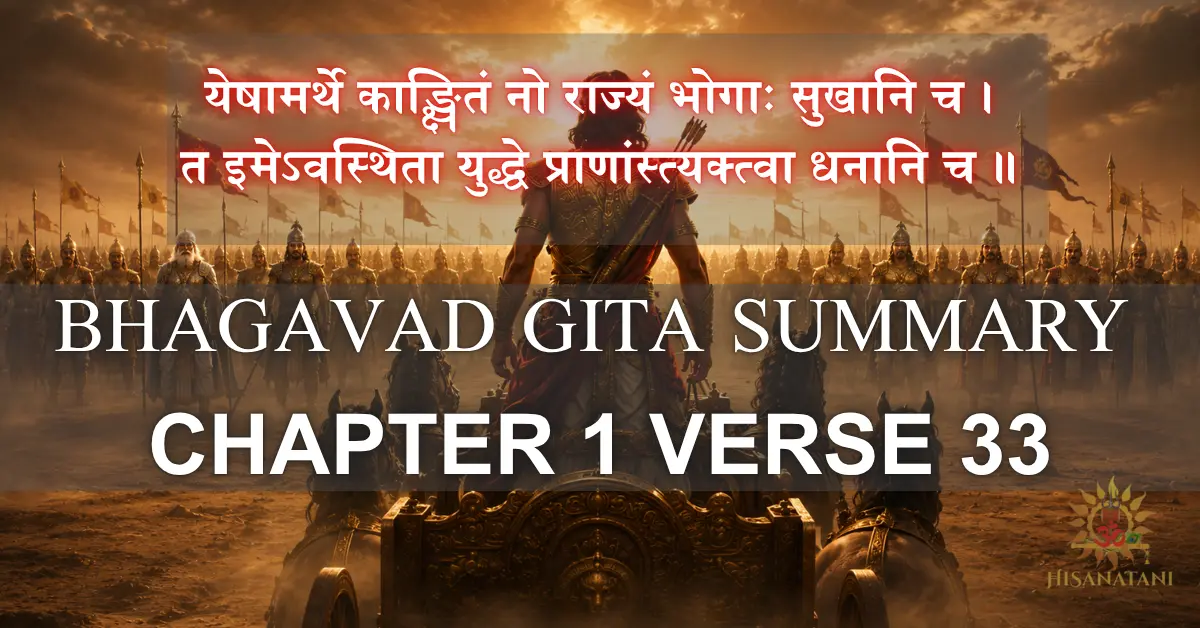
येषामर्थे काङ्क्षितं नो राज्यं भोगाः सुखानि च ।
त इमेऽवस्थिता युद्धे प्राणांस्त्यक्त्वा धनानि च ॥ ३३ ॥
In English :
yeṣām arthe kāṅkṣitaṁ no rājyaṁ bhogāḥ sukhāni ca |
ta ime ‘vasthitā yuddhe prāṇāṁs tyaktvā dhanāni ca ||
Feel the Vibration: A Guided Chant of Bhagavad Gita Chapter 1 Verse 33:
- yeṣām arthe kāṅkṣitaṁ no rājyaṁ bhogāḥ sukhāni ca |
Ye-shaam ar-the kaank-shi-tam no
raaj-yam bho-gaah su-khaa-ni cha - ta ime ‘vasthitā yuddhe prāṇāṁs tyaktvā dhanāni ca ||
ta i-me a-va-sthi-taa yud-dhe
praa-naans tyakt-vaa dha-naa-ni cha
English Translation:
“Those for whose sake we desire kingdom, comforts, and happiness — they themselves stand here in battle, ready to give up their wealth and their lives.”
JOIN THE HISANATANI COMMUNITY
Get daily Verse Summaries & High-Res Posters directly on your WhatsApp.
JOIN CHANNELWhy Your Soul Needed to Hear This Today
Let’s be honest. A lot of us are tired — not the kind of tired sleep fixes. The world keeps telling us to achieve more, scale faster, earn more, become somebody. Nobody stops to ask why.
The endless scroll trains your mind to compare. Hustle culture trains it to chase. What’s left is noise — a nagging feeling that real life is happening somewhere else, to someone else.
Arjuna’s pain starts the moment he remembers why he wanted the kingdom at all. It wasn’t the throne. It was the people he pictured standing beside him on it. Now that picture is falling apart, and the whole dream is losing its shine along with it. This verse asks you the same thing: not what you’re chasing, but what you’re actually hoping to feel once you catch it.
The Ice Cream Nobody Wanted — A Child-Friendly Take

Imagine saving your pocket money for weeks. You finally buy the biggest ice cream in the shop — chocolate, sprinkles, everything. You rush home, excited to share it with your friends.
But when you get there, nobody’s around.
The ice cream is still huge. It still tastes sweet. But somehow it doesn’t feel exciting anymore.
Why? Because what made it special was never the ice cream. It was the people you wanted to share it with.
That’s exactly what Arjuna is realizing. He wanted a kingdom. He wanted comfort and victory. But not so he could sit with it alone — he wanted to share it with the people he loved. Now those same people are standing on the battlefield in front of him.
So he wonders: if they’re gone, what’s even the point?
Kids get this instantly. Playing alone isn’t as fun. Celebrating alone isn’t as fun. The lesson here is simple: people matter more than the prize. Without someone to share it with, even the biggest win can feel strangely small.
The Layer Beneath Every Desire — The Philosophical Truth

Look closer at what’s actually happening here. This BG1.33 verse quietly exposes something true about how desire works.
Most people think they want success. But success is rarely the finish line — it’s usually a stand-in for something else. Someone wants money, but what they’re really after is freedom. Someone wants fame, but what they’re really chasing is being seen. Someone wants status, but underneath it, they just want to belong.
Arjuna sees straight through the surface layer. The kingdom was never the real desire. Sharing life with the people he loved was. The moment that becomes clear, the surface goal stops holding so much power over him.
A lot of us spend years chasing symbols — the perfect job title, the dream city, the lifestyle in the reels. Then we get there and feel oddly unmoved. That’s because we mistook the container for what was supposed to be inside it. Summary of Bhagavad Gita 1.33 points at exactly this gap between what we chase and what we actually need.
Burnout Nobody Warns You About — The Psychological Read

Most conversations about burnout blame workload. Too many hours, too many deadlines. But there’s a second kind of exhaustion that gets far less attention: running out of meaning.
Psychologists sometimes describe a pattern where people assume one milestone — a certain salary, a promotion, a title — will finally switch off their anxiety for good. It rarely does. You hit the number and the relief lasts about a week before the next target appears. The finish line just keeps moving, and the body keeps paying the toll in the meantime.
Arjuna is living a version of this on the battlefield. His mind hasn’t collapsed because he lacks skill or courage. It’s collapsed because it can no longer justify the cost of the win. That gap between what you’re doing and what you actually value is exhausting in a very specific way — it drains focus, flattens motivation, and makes decisions feel heavier than they should.
The takeaway isn’t anti-ambition. It’s pro-alignment. Chase the goal, but keep checking that it still points toward something you actually care about — because a goal that’s drifted from your values will burn you out faster than any workload ever could.
When the Soul Quietly Says “This Isn’t It” — The Spiritual Layer

Sometimes the soul doesn’t shout. It withdraws. Excitement fades. Wins stop landing the way they used to. Something inside just goes quiet and says, this isn’t it.
Most people read that as failure. It’s usually the opposite — it’s awareness showing up late but on time. Arjuna isn’t growing weak here. He’s finally seeing past the shine of power and victory to what’s underneath.
The ego keeps asking, what can I get out of this? The soul asks a different question: does this actually create harmony in my life? When those two questions point in the same direction, things feel light. When they don’t, you get friction — and that friction is exactly what Arjuna is sitting with.
This isn’t a verse against success. It’s an invitation to chase the kind of success that feeds you instead of hollowing you out.
Standing Between Love and Duty — The Historical Context

When Arjuna looks across the battlefield, he isn’t looking at strangers. He’s looking at his history — his grandfather Bhishma, his teacher Drona, cousins, friends, people who shaped every part of his life.
That detail is what gives this verse its weight. The Kurukshetra war was never simply a fight over land. It carried generations of family loyalty, broken trust, and political pressure. Arjuna knew the kingdom being fought over existed to support these very relationships — and now those same relationships stood directly in the path of the war meant to secure it.
Historically, this is the moment the real conflict shifts location. It stops being a fight on the field and becomes a fight inside Arjuna. That inner battlefield is what makes room for everything Krishna teaches from here on. Without this collapse of certainty, the rest of the Gita simply doesn’t happen.
Your 24-Hour Gita Challenge: Find the Feeling Behind the Goal

Today’s challenge isn’t about productivity. It’s about noticing what you’re actually chasing.
Step 1 — Name One Goal You’re Currently Chasing. Just one. A promotion, more followers, a certain paycheck, a lifestyle milestone. Write it down plainly.
Step 2 — Ask “Why?” Five Times. Why do you want it? Then ask why again about that answer. Keep going until you hit something emotional — freedom, security, being accepted, being loved, feeling at peace.
Step 3 — Run a One-Line Alignment Check. Before bed tonight, ask yourself: if I got this tomorrow, what feeling am I hoping it gives me? Then ask: can I create a small version of that feeling today, without waiting for the goal at all?
This exercise is the heart of Bhagavad Gita 1.33 Summary. Because often the soul isn’t asking for more achievement. It’s asking for more alignment.
The Success That Feels Like Home
Arjuna’s question echoes across centuries because it touches something universal. We don’t merely seek achievement — we seek meaning. We don’t merely seek wealth — we seek security. We don’t merely seek recognition — we seek belonging.
And sometimes life hands us a difficult but freeing realization: the thing we’re chasing isn’t actually the thing we need.
This Bhagavad Gita 1.33 Summary invites you to listen beneath the noise, beneath the pressure, beneath the comparison. In that quieter space, a different definition of success shows up — one rooted in connection and alignment instead of endless striving. A kind of success that still feels worth having after the applause fades.
Please let me know in the comments.
Embrace the Teachings of the Gita. Dive deeper into the Bhagavad Gita to uncover its timeless wisdom and practical guidance. Let its verses inspire you to cultivate inner clarity, align with higher values, and navigate life’s challenges with courage and grace.
🌼 Join the HiSanatani WhatsApp Channel for your daily dose of light 🪔. Join Now.
Voice of the Soul
Finding clarity in the questions we all carry…
What is the main lesson of Bhagavad Gita 1.33?
The verse teaches that achievements only carry meaning through the people and values connected to them. Without that deeper purpose, even a real win can feel strangely empty. See The Layer Beneath Every Desire above for the full breakdown.
Why does Arjuna question victory in this verse?
He realizes the very people he wanted the kingdom for are the ones standing across from him, ready to die. That single realization is enough to make the entire war feel pointless. This plays out fully in Burnout Nobody Warns You About.
How does Bhagavad Gita 1.33 relate to hustle culture and the soft life movement?
The verse challenges chasing goals on autopilot and asks you to check whether your achievements are actually supporting your peace or quietly draining it. Explore this further in When the Soul Quietly Says “This Isn’t It”.
Is Bhagavad Gita 1.33 against ambition?
No. It questions ambition that’s lost its connection to what you value, not ambition itself. The Gita never asks you to want less — just to want with your eyes open. See The Ice Cream Nobody Wanted for the simplest version of this idea.
What can young professionals learn from Bhagavad Gita Chapter 1 Verse 33?
External success alone can’t satisfy the deeper need for meaning, connection, and peace of mind. Put it into practice with Your 24-Hour Gita Challenge: Find the Feeling Behind the Goal.
