
Namaste 🙏
Welcome to Hi Sanatani. It’s a joy to have you here as we explore the deeper layers of human nature. By diving into this Bhagavad Gita 1.34-35 Summary we create a sacred bridge together, turning ancient verses into helpful tools for your personal growth and peace.
Translation of Bhagavad Gita Shloka Verse 1.34-35 in English:
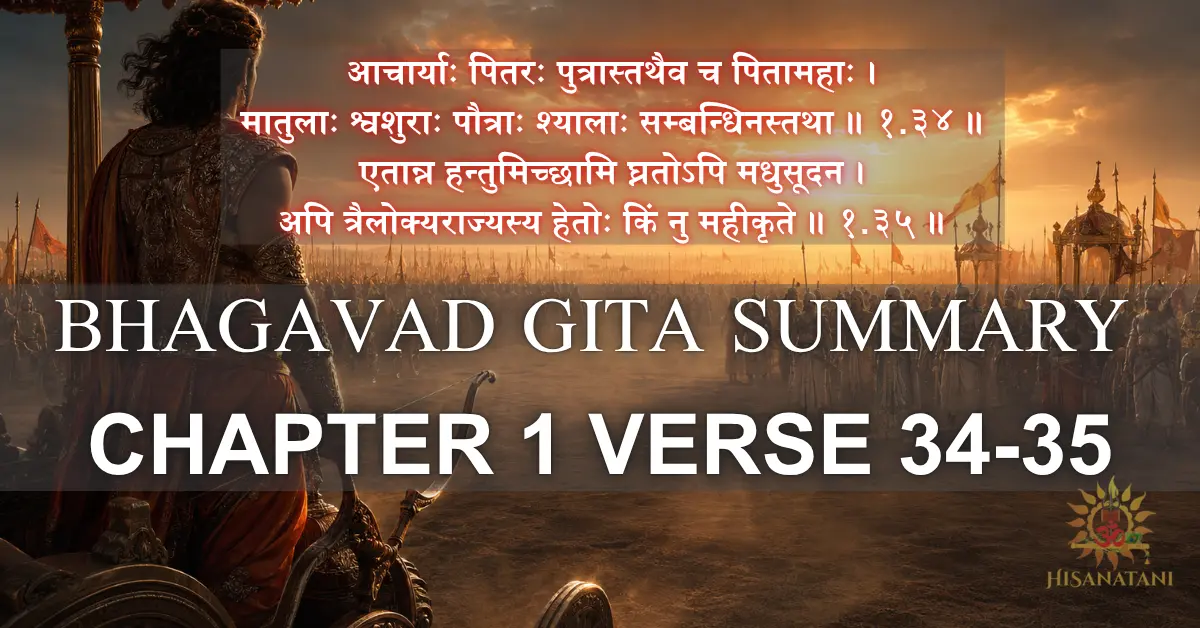
आचार्याः पितरः पुत्रास्तथैव च पितामहाः ।
मातुलाः श्वशुराः पौत्राः श्यालाः सम्बन्धिनस्तथा ॥ १.३४ ॥
एतान्न हन्तुमिच्छामि घ्नतोऽपि मधुसूदन ।
अपि त्रैलोक्यराज्यस्य हेतोः किं नु महीकृते ॥ १.३५ ॥
In English :
ācāryāḥ pitaraḥ putrās tathaiva ca pitāmahāḥ |
mātulāḥ śvaśurāḥ pautrāḥ śyālāḥ sambandhinas tathā || 1.34 ||
etān na hantum icchāmi ghnato ‘pi madhusūdana |
api trailokya-rājyasya hetoḥ kiṁ nu mahī-kṛte || 1.35 ||
Feel the Vibration: A Guided Chant of Bhagavad Gita Chapter 1 Verse 34-35:
- ācāryāḥ pitaraḥ putrās tathaiva ca pitāmahāḥ |
Aa-chaar-yaah pi-ta-rah pu-traas ta-thai-va cha pi-taa-ma-haah - mātulāḥ śvaśurāḥ pautrāḥ śyālāḥ sambandhinas tathā || 1.34 ||
Maa-tu-laah shva-shu-raah pau-traah shyaa-laah sam-ban-dhi-nas ta-thaa - etān na hantum icchāmi ghnato ‘pi madhusūdana |
Ee-taan na han-tum ich-chhaa-mi ghna-to-pi ma-dhu-soo-da-na - api trailokya-rājyasya hetoḥ kiṁ nu mahī-kṛte || 1.35 ||
A-pi trai-lo-kya raa-jya-sya he-toh kim nu ma-hee-kri-te
English Translation:
“Teachers, fathers, sons, and likewise grandfathers, maternal uncles, fathers-in-law, grandsons, brothers-in-law, and other kinsmen stand here before me. O Madhusudana, I do not wish to kill them, even if they kill me — not for sovereignty over the three worlds, let alone this earth.”
JOIN THE HISANATANI COMMUNITY
Get daily Verse Summaries & High-Res Posters directly on your WhatsApp.
JOIN CHANNELWhy Your Mind Feels Exhausted Before the Work Even Starts
Maybe you’re not tired because of the workload. Maybe you’re tired because every decision carries emotional baggage. One responsibility pulls you toward career growth. Another pulls you toward family expectations. Someone expects you to earn more. Someone expects you to stay available. Someone expects loyalty. Someone expects sacrifice. Eventually the mind gets crowded.
This is where Arjuna finds himself. His body is capable. His skills are intact. His training is complete. But his emotional system is overloaded — and when emotions get heavier than clarity, even the strongest person starts questioning actions they once thought were obvious.
That’s why Bhagavad Gita Chapter 1 Verse 34-35 speaks straight to modern burnout. Not all exhaustion comes from effort. Some of it comes from carrying too many emotional weights at once.
The Family Tug-of-War Every Child Understands

Imagine your school organizes a sports competition. You’re excited to play. You’ve practiced for weeks. Then on match day, you discover your cousins and closest friends are on the opposing team.
Suddenly winning doesn’t feel simple anymore. If you win, someone you love loses. If you lose, your team suffers. You feel stuck.
That’s similar to Arjuna’s situation. In Bhagavad Gita Chapter 1 Verse 34-35, he looks across the battlefield and sees the people who’ve loved him his whole life. His teachers taught him. His elders guided him. His relatives supported him. Now he’s expected to fight them.
For a child, the lesson is simple: sometimes life hands you situations where every option hurts. The real challenge isn’t strength. It’s knowing what’s right when emotions run this strong. Arjuna is showing us that even heroes get confused — and that confusion is a normal, human thing to feel.
When Attachment Disguises Itself as Morality

Look closely at Arjuna’s reasoning in BG1.34-35. At first, it sounds entirely noble. He doesn’t want power. He doesn’t want kingdoms. He doesn’t want victory.
But here’s the thing — the Gita asks us to examine not just what we feel, but why we feel it. Attachment often wears noble clothing. Sometimes we call it compassion. Sometimes loyalty. Sometimes morality. Underneath these labels, a deeper force is often at work: fear of separation, fear of change, fear of losing familiar anchors.
Human beings build identity around relationships. A mentor’s approval becomes part of self-worth. A family’s expectations become part of self-definition. An organization’s recognition becomes part of personal significance. When these attachments feel threatened, the ego destabilizes.
Arjuna believes he’s rejecting violence. Krishna will gradually reveal something deeper is happening — his inner clarity has become clouded by emotional identification. This isn’t criticism. It’s observation. Bhagavad Gita Chapter 1 Verse 34-35 reveals a timeless truth: attachment doesn’t always announce itself as attachment. Sometimes it arrives disguised as virtue, and unless we examine it carefully, we mistake emotional comfort for wisdom.
Financial Anxiety Is Often Emotional Anxiety Wearing a Different Mask

Many professionals believe they’re stressed about money. Sometimes they are. But not always. Look beneath the surface and the fear often sounds like: “What if I disappoint my family?” “What if my mentor thinks I failed?” “What if I lose status?” “What if people stop respecting me?”
The nervous system translates these emotional fears into financial urgency. The bank account becomes the visible target. The deeper wound stays hidden.
Arjuna’s crisis works the same way. The battlefield appears to be about war. Psychologically, it’s about relationships — belonging, identity, connection, approval. His emotional system is overloaded because every decision threatens an attachment.
This creates internal fragmentation. One part of him wants duty. Another wants emotional safety. Another wants harmony. Another wants escape. Sound familiar? Many burnout cases come from exactly this pattern — not excessive work, but excessive internal contradiction. When different parts of you pull in opposite directions, energy leaks away, focus weakens, and even simple tasks start feeling heavy. The problem isn’t effort. It’s internal misalignment which we can clearly understand from Summary of Bhagavad Gita 1.34-35.
The Soul’s Challenge Beyond Personal Preference

The spiritual depth of BG1.34-35 shows up when we examine what Arjuna actually values. He says he doesn’t want power. He doesn’t want wealth. He doesn’t want kingdoms. At first glance, this sounds noble.
But Krishna will soon reveal something important: rejecting action can be just as ego-driven as chasing reward. Spiritual growth isn’t merely avoiding uncomfortable situations — it’s aligning with dharma. The soul’s purpose extends beyond personal preference.
Many people assume spirituality means choosing peace over conflict. Authentic spirituality means choosing truth even when conflict shows up. A surgeon may dislike causing temporary pain, yet surgery remains necessary. A parent may dislike discipline, yet guidance remains necessary.
Arjuna’s compassion is genuine. But compassion alone isn’t enough — it has to be aligned with wisdom, or it can block necessary action. The soul grows strongest when love and responsibility operate together.
The Real Kurukshetra Was a Family System in Collapse
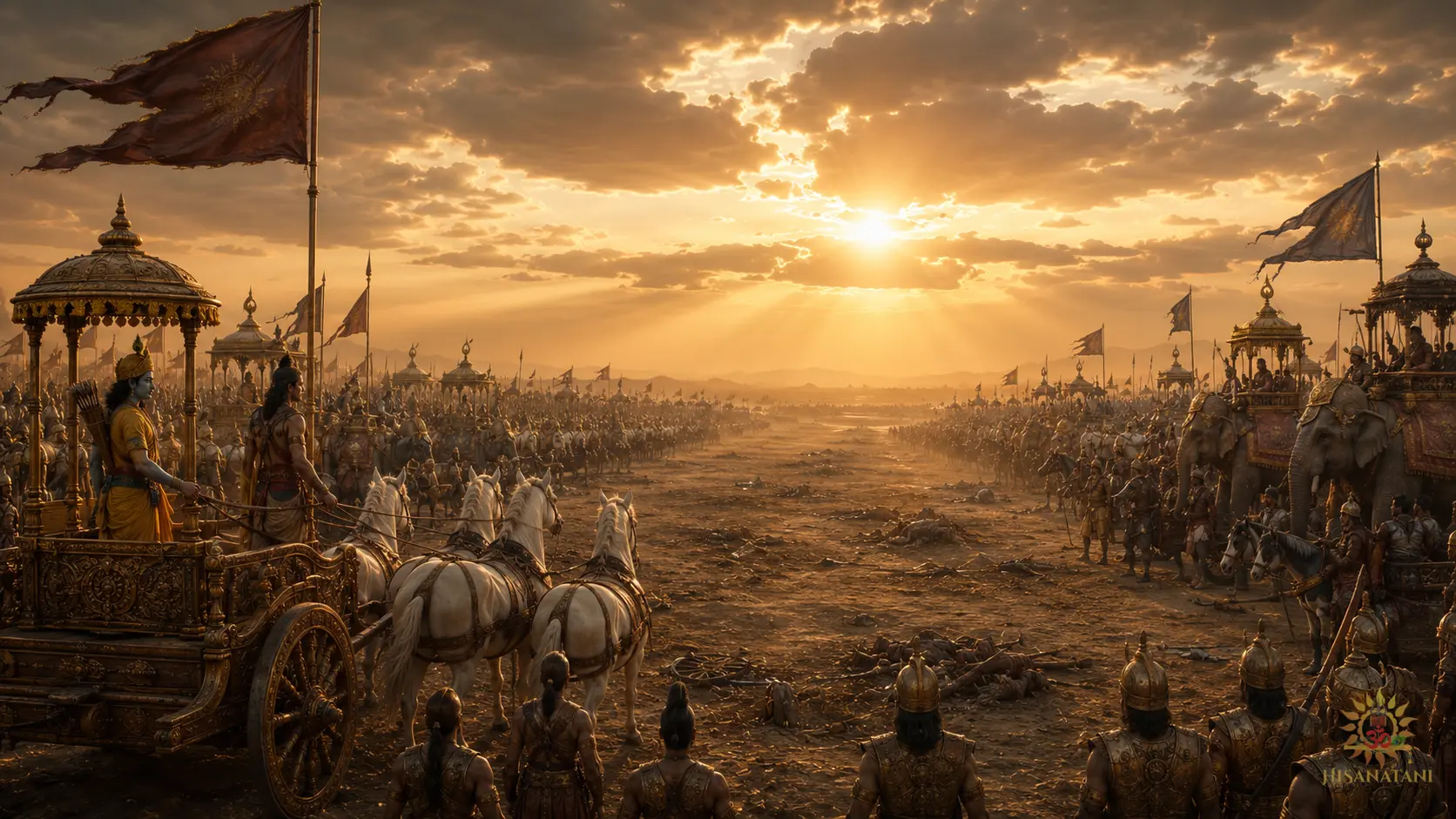
Historically, these verses occur at an extraordinary moment. The Kuru dynasty had fractured from within. This battle wasn’t primarily against outsiders or invaders — it was a conflict inside one extended family. Teachers stood on one side, students on another. Grandfathers stood against grandsons. Relatives faced relatives.
This historical reality explains the intensity of Arjuna’s reaction. He wasn’t confronting strangers. He was confronting his own social world. In ancient India, family structures formed the foundation of identity, duty, inheritance, and belonging — standing against one’s own kin carried immense emotional and cultural weight.
That’s why Arjuna’s resistance is understandable. His crisis isn’t cowardice. It’s relational overload. And this historical scene still resonates because human beings continue to draw identity from family systems, professional tribes, and social groups. The names change. The emotional mechanics stay remarkably similar.
24-Hour Gita Challenge — Reduce Internal Noise

Arjuna’s problem begins with emotional overload. Your solution begins with emotional clarity. Try these three practices in the next 24 hours.
Step 1: Name the Real Fear. Take one decision you’re postponing. Ask: “What am I truly afraid of losing?” Not money. Not the promotion. Go deeper — approval? Belonging? Validation? Write the answer down.
Step 2: Separate Love from Obligation. List three people influencing your decision. Then write: “I can love this person without obeying every expectation.” Read it slowly. Notice what comes up.
Step 3: Spend Ten Minutes in Signal Recovery. Sit without music, notifications, or podcasts. Ask: “What would I choose if nobody judged me?” Don’t force an answer. Just listen. Clarity often shows up only after the noise settles.
The Pain of Outgrowing an Identity
Bhagavad Gita 1.34-35 Summary reveals something deeply human. Arjuna isn’t overwhelmed by enemies. He’s overwhelmed by emotional connections. The faces before him represent history, memory, belonging, identity — and identity rarely dissolves without resistance.
Many professionals feel the same tension. The path that once felt right no longer resonates. The approval that once motivated now feels insufficient. The ambitions that once energized now feel strangely empty. Yet moving forward feels like betraying something familiar.
This is the hidden pain of growth — not gaining a new life, but releasing an old version of yourself. Arjuna’s crisis teaches that clarity often arrives only after confusion reaches its peak, because before the soul can hear its deepest truth, the noise of attachment has to reveal itself first. And that revelation has already begun.
Please let me know in the comments.
Embrace the Teachings of the Gita. Dive deeper into the Bhagavad Gita to uncover its timeless wisdom and practical guidance. Let its verses inspire you to cultivate inner clarity, align with higher values, and navigate life’s challenges with courage and grace.
🌼 Join the HiSanatani WhatsApp Channel for your daily dose of light 🪔. Join Now.
Voice of the Soul
Finding clarity in the questions we all carry…
What is the main lesson of Bhagavad Gita 1.34-35?
Arjuna’s noble-sounding refusal to fight is, underneath, powered by attachment — fear of loss disguised as compassion. The verse teaches that attachment rarely announces itself; it hides inside virtue. Explore this in When Attachment Disguises Itself as Morality.
Why does Arjuna refuse to fight in Verse 35?
Because the people on the opposing side aren’t strangers — they’re his teachers, grandfather, uncles, and in-laws. The Kuru family had split itself in two. See the full context in The Real Kurukshetra Was a Family System in Collapse.
How does Bhagavad Gita 1.34-35 relate to modern professional burnout?
A lot of what feels like financial or workload stress is actually competing loyalty — fear of disappointing people who matter to you. Read the full breakdown in Financial Anxiety Is Often Emotional Anxiety Wearing a Different Mask.
What spiritual insight does BG 1.34-35 offer?
That rejecting action out of emotional discomfort can be just as ego-driven as chasing a reward — real spiritual growth means aligning with dharma, not just avoiding conflict. Dive deeper in The Soul’s Challenge Beyond Personal Preference.
How can I apply Bhagavad Gita 1.34-35 in daily life?
Name what you’re really afraid of losing, separate love from obligation, and give yourself ten minutes of silence before deciding anything big. The full three-step routine is in 24-Hour Gita Challenge — Reduce Internal Noise.
