
Namaste 🙏
Welcome to Hi Sanatani. It’s a joy to have you here as we explore the deeper layers of human nature. By diving into this Bhagavad Gita 1.23 Summary we create a sacred bridge together, turning ancient verses into helpful tools for your personal growth and peace.
Translation of Bhagavad Gita Shloka Verse 1.23 in English:
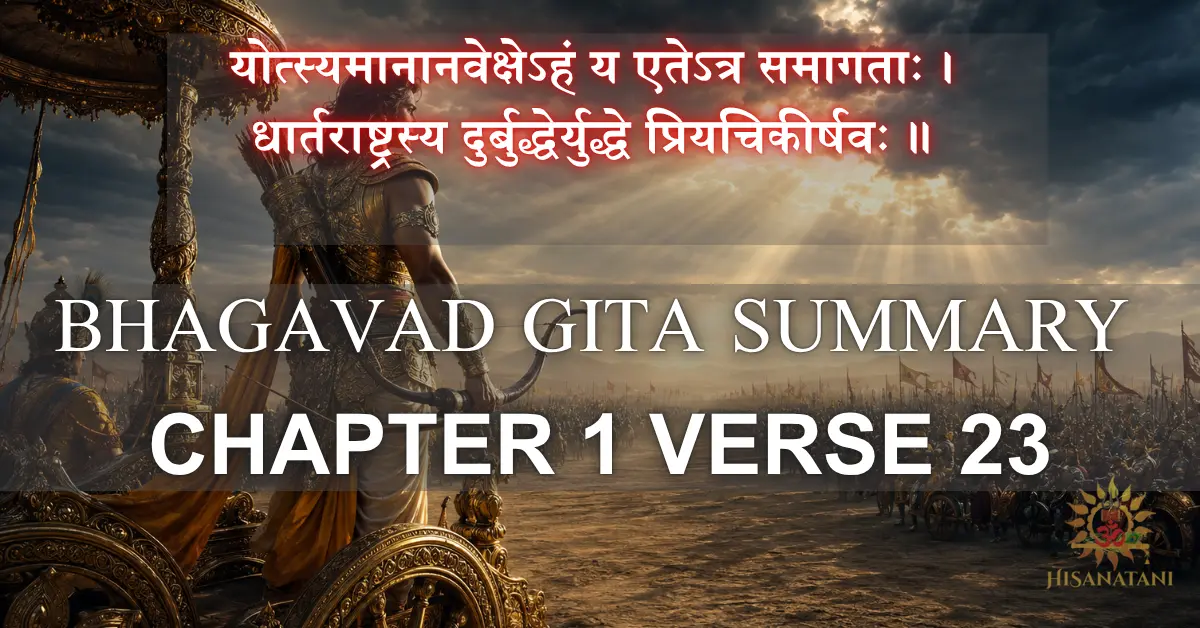
योत्स्यमानानवेक्षेढहं य एतेत्र समागताः ।
धार्तराष्ट्रस्य दुर्बुद्धेर्युद्धे प्रियचिकीर्षवः ॥। १.२३ ।।
In English :
yotsyamānān avekṣe ‘haṃ ya ete ‘tra samāgatāḥ |
dhārtarāṣṭrasya durbuddher yuddhe priya-cikīrṣavaḥ || 1.23 ||
Feel the Vibration: A Guided Chant of Bhagavad Gita Chapter 1 Verse 23:
- yotsyamānān avekṣe ‘haṃ ya ete ‘tra samāgatāḥ |
Yot-syā-mā-nān a-vek-ṣe-‘haṃ ya e-te-‘tra sa-mā-ga-tāḥ - dhārtarāṣṭrasya durbuddher yuddhe priya-cikīrṣavaḥ || 1.23 ||
Dhār-ta-rāṣ-ṭra-sya dur-bud-dher yud-dhe pri-ya-ci-kīr-ṣa-vaḥ
English Translation:
“I wish to look upon those who have gathered here, ready to fight, desiring to please the evil-minded son of Dhritarashtra in this war.”
JOIN THE HISANATANI COMMUNITY
Get daily Verse Summaries & High-Res Posters directly on your WhatsApp.
JOIN CHANNELWhy Your Soul Needed This Today
Most of the exhaustion you’re carrying right now isn’t physical. It’s relational.
It’s the weight of trying to belong everywhere at once — to your team, your manager, your friend circle, your family — and quietly hoping none of those loyalties ever collide.
But here’s the thing: sometimes they do. And when they do, the question gets loud fast.
Who am I betraying if I stay silent? Who am I betraying if I speak?
This is where BG 1.23 stops being ancient history and starts being personal. Arjuna isn’t just preparing for combat. He’s preparing for clarity. Before his arrows move, his awareness moves first. Before his hands act, his heart looks.
Confusion doesn’t usually clear up because you acted fast. It clears up because you finally looked honestly at what was in front of you.
The Child Who Realized Every Group Isn’t Right

Picture a school playground. One popular group starts mocking another kid. Most kids in earshot join in — not because they hate the target, but because they want to stay on the popular group’s good side.
One child pauses and asks, “Wait — why are we doing this?”
That one question changes everything for him.
This is the simplest way into Bhagavad Gita 1.23 Summary. Arjuna is doing exactly what that child does. He doesn’t blindly accept who’s “his side” and who isn’t. He looks first.
Grown-up playgrounds just wear different clothes — office teams, friend circles, college groups, online communities. The pressure to go along is identical. Belonging feels good. Belonging blindly is where the trouble starts.
A lot of people spend years defending opinions they never personally examined, simply because their group already had. Arjuna’s pause says something even a ten-year-old gets instantly: just because a crowd stands together doesn’t mean they’re standing for something right.
Sometimes integrity starts the moment you stop asking “who’s with me?” and start asking “what are we actually standing for?”BG1.23 is simply trying to explain this to us.
When Loyalty and Truth Stop Walking Together

Look closely at what Arjuna is actually inspecting. Not faces. Not titles. Allegiances.
That distinction carries real weight. Most of us assume loyalty is automatically a good thing. Here Bhagavad Gita Chapter 1 Verse 23 asks a harder question: loyal to what? Loyal for what purpose? Loyalty itself is morally neutral — its worth depends entirely on what it’s serving.
This is why Arjuna wants to see who has aligned with Duryodhana’s side. Not because he hates them — because understanding what someone is aligned with reveals what they actually value, regardless of what they say out loud.
Every professional eventually meets this fork. A manager asks for support — support for what, exactly? A company asks for silence — silence about what? A friend asks for loyalty — loyalty toward which action?
Summary of Bhagavad Gita 1.23 suggests conscience exists precisely for these moments. It’s quiet when social pressure gets loud, but it doesn’t disappear. The real tragedy isn’t that people lose their values — it’s that they slowly stop listening to them. Before you choose where to stand, understand what each side actually serves. Only then can loyalty and truth move in the same direction.
The Psychology of Inner Conflict and Invisible Stress

A lot of stress doesn’t come from your workload. It comes from divided loyalty.
Your manager wants one thing. Your own sense of right and wrong is pointing somewhere else. Your friends want you to fall in line. Something in you is resisting. These competing signals don’t cancel out — they create noise, and noise quietly drains you.
This is where BG 1.23 gets psychologically sharp. Arjuna doesn’t suppress his confusion. He investigates it. That’s the whole difference. Discomfort you ignore tends to grow — discomfort you actually look at starts to make sense.
Psychologists describe anxiety as competing internal forces pulling in opposite directions — the pull toward acceptance against the pull toward authenticity, the pull toward security against the pull toward truth. Arjuna does the healthy version of dealing with that: he looks straight at the source of the conflict instead of around it. He names it. He studies the people actually involved.
Naming a conflict doesn’t resolve it instantly. But it does something almost as valuable — it creates distance between you and the panic, and that distance is where clearer decisions actually happen.
Confusion isn’t always weakness. Sometimes it’s your own early-warning system, and Arjuna’s pause in Bhagavad Gita 1.23 is a reminder to respect that signal instead of silencing it.
Choosing Who You’re Really Trying to Please

The warriors gathered around Duryodhana are described in the verse as priya-cikīrṣavaha — those wishing to please him. They are not warriors fighting for a cause they believe in.. They are warriors fighting to become the favorite of someone in power.
That’s worth sitting with, because most of us have done some version of it. Said yes to something we didn’t believe in, just to stay in someone’s good graces. The Bhagavad Gita 1.23 gives us a glimpse of the truth-that we stretched our own conscience a little, to avoid disappointing a manager, a parent, a partner, a friend group.
Arjuna’s question — who exactly is standing here, and why — becomes a mirror. Spiritually, it’s an invitation to ask the same of yourself: when you say yes, who are you actually trying to please? Your own conscience, or someone else’s approval?
There’s a quiet cost to constantly trying to please the wrong audience. A feeling of being slightly off from yourself. A heaviness that doesn’t have an obvious cause. That feeling isn’t random — it shows up exactly when your actions and your conscience stop agreeing with each other.
Arjuna is standing at the edge of that realization. The external battlefield is about to expose the one inside him — and that’s where every real spiritual reckoning actually starts.
The Human Drama Unfolding at Kurukshetra

This moment in the Mahabharata is delicate for a reason most retellings skip past: Arjuna isn’t looking at strangers.
Teachers. Relatives. Friends. Elders he’s respected his entire life — many of them are standing on Duryodhana’s side. This isn’t a fight between good people and bad people. It’s a fight between relationships and what’s right, and those two things were never supposed to be on opposite teams.
Historically, many of the warriors backing Duryodhana weren’t villains. Some were bound by old promises. Others by debts of gratitude, family obligation, or political alliances made a generation earlier. That’s what makes the Mahabharata feel less like myth and more like real life — good people often end up supporting harmful outcomes, not out of malice, but because they’re caught between competing duties.
This still plays out today. A respected boss makes a call you know is wrong. A colleague you genuinely like backs a policy that hurts someone else. A friend nudges you toward a decision that doesn’t sit right. The pain isn’t abstract — it hurts more because you know these people.
Arjuna’s request to look carefully, before acting, is the first thread of the bigger crisis that’s about to unfold across the rest of Chapter 1. But it starts exactly here — with a willingness to see clearly before choosing a side.
The 24-Hour Gita Challenge: Listening to Conscience Without Losing Compassion

Wisdom only means something once you’ve actually used it. Try these three steps in the next 24 hours.
Step 1 — Map your current loyalty conflict. Open a notes app or a notebook. Write down one situation right now where you feel torn — manager versus values, friendship versus honesty, comfort versus conscience.
Don’t try to solve it yet. Just name it clearly. Awareness always comes before resolution.
Step 2 — Ask the question underneath the decision. For whatever’s pulling at you, ask: “If I support this, what kind of outcome am I actually helping to bring about?” Not what people expect of you.
Not what’s easiest. What grows from your support. Sit with that answer for a minute before you move.
Step 3 — Give yourself ten minutes of real silence. No music, no notifications, no scrolling. Just sit. Ask yourself: “If nobody was watching or judging me, what would my conscience actually choose?”
Write down the first honest answer. Don’t edit it.
Repeated often enough, these three habits build something valuable — a tighter alignment between what you do and what you actually believe. And that alignment, more than any external win, is where real peace comes from.
Where Loyalty and Conscience Finally Meet
On the surface, this verse is just Arjuna asking to see an army.
Underneath, it’s about something every one of us eventually runs into — the moment loyalty and conscience stop pointing in the same direction.
Arjuna pauses here because no one can act wisely while staying unconscious of what they’re actually aligned with. He wants to see. To understand. To recognize the deeper forces already in motion before he commits to anything.
Maybe that’s the real invitation hidden in Bhagavad Gita 1.23 Summary: before choosing a side in any conflict, understand what each side is actually asking of you. Before handing over your loyalty, understand who’s receiving it. Before silencing your conscience to keep the peace, listen carefully to what it’s trying to protect you from.
Because real peace rarely comes from keeping everyone around you happy. It comes from standing exactly where truth, compassion, and your own conscience finally agree.
Please let me know in the comments.
Embrace the Teachings of the Gita. Dive deeper into the Bhagavad Gita to uncover its timeless wisdom and practical guidance. Let its verses inspire you to cultivate inner clarity, align with higher values, and navigate life’s challenges with courage and grace.
🌼 Join the HiSanatani WhatsApp Channel for your daily dose of light 🪔. Join Now.
Voice of the Soul
Finding clarity in the questions we all carry…
What is the core teaching of Bhagavad Gita Chapter 1 Verse 23?
The verse shows Arjuna pausing to understand the intentions and alignments behind people’s actions before he takes a stand. This idea is explored more deeply in When Loyalty and Truth Stop Walking Together.
Why does Arjuna want to see the warriors gathered against him?
He wants to know who has chosen to support Duryodhana, and why — because understanding what someone is aligned with reveals more than their reputation does. This historical complexity is explored in The Human Drama Unfolding at Kurukshetra.
How does BG1.23 apply to workplace loyalty conflicts?
It teaches professionals to check whether the loyalty being asked of them lines up with their own conscience before they offer support. See The Psychology of Inner Conflict and Invisible Stress.
What does the word “durbuddhi” mean in this verse?
Durbuddhi refers to a corrupted or short-sighted intellect — one that chases immediate gain over what’s actually right. This sits at the center of When Loyalty and Truth Stop Walking Together.
Can Bhagavad Gita Chapter 1 Verse 23 actually help with a difficult decision I’m facing?
Yes — it models observation and honest reflection before action, rather than reacting under pressure. Try the steps in The 24-Hour Gita Challenge: Listening to Conscience Without Losing Compassion.
