
Namaste 🙏
Welcome to Hi Sanatani. It’s a joy to have you here as we explore the deeper layers of human nature. By diving into this Bhagavad Gita 1.24-25 Summary we create a sacred bridge together, turning ancient verses into helpful tools for your personal growth and peace.
Translation of Bhagavad Gita Shloka Verse 1.24-25 in English:
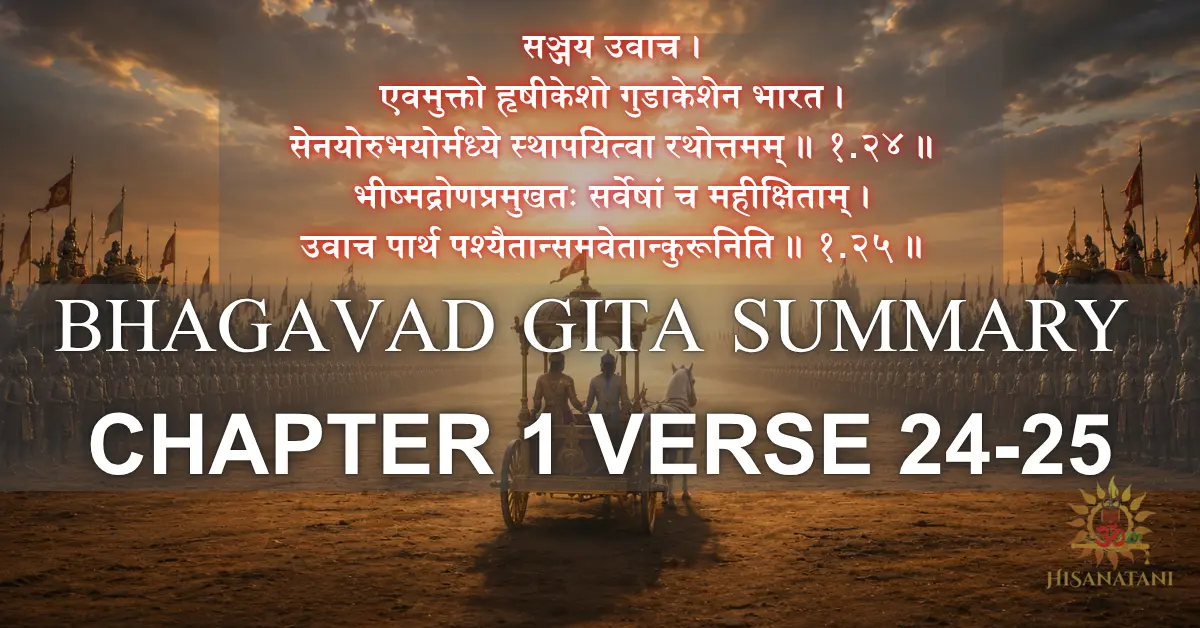
सञ्जय उवाच ।
एवमुक्तो हृषीकेशो गुडाकेशेन भारत ।
सेनयोरुभयोर्मध्ये स्थापयित्वा रथोत्तमम् ॥ १.२४ ॥
भीष्मद्रोणप्रमुखतः सर्वेषां च महीक्षिताम् ।
उवाच पार्थ पश्यैतान्समवेतान्कुरूनिति ॥ १.२५ ॥
In English :
Sañjaya uvāca |
evam ukto hṛṣīkeśo guḍākeśena bhārata |
senayor ubhayor madhye sthāpayitvā rathottamam || 24 ||
bhīṣma-droṇa-pramukhataḥ sarveṣāṁ ca mahī-kṣitām |
uvāca pārtha paśyaitān samavetān kurūn iti || 25 ||
Feel the Vibration: A Guided Chant of Bhagavad Gita Chapter 1 Verse 24-25:
- Sañjaya uvāca |
San-ja-ya u-vā-cha - evam ukto hṛṣīkeśo guḍākeśena bhārata |
e-vam uk-to hṛ-ṣī-ke-śo gu-ḍā-ke-śe-na bhā-ra-ta - senayor ubhayor madhye sthāpayitvā rathottamam || 24 ||
se-na-yor u-bha-yor madh-ye sthā-pa-yit-vā ra-thot-ta-mam - bhīṣma-droṇa-pramukhataḥ sarveṣāṁ ca mahī-kṣitām |
Bhī-ṣma-dro-ṇa-pra-mu-kha-taḥ sar-ve-ṣāṁ cha ma-hī-kṣi-tām - uvāca pārtha paśyaitān samavetān kurūn iti || 25 ||
u-vā-cha pār-tha pa-śyai-tān sa-ma-ve-tān ku-rūn i-ti
English Translation:
“Sanjaya said: O Bharata, thus addressed by Arjuna, Lord Krishna placed the magnificent chariot between the two armies. In front of Bhishma, Drona, and all the rulers of the earth, Krishna said, ‘O Partha, behold these Kurus assembled here.'”
JOIN THE HISANATANI COMMUNITY
Get daily Verse Summaries & High-Res Posters directly on your WhatsApp.
JOIN CHANNELWhy Your Mind Needed This Verse Today
Maybe you’re sitting on a promotion decision. Maybe you’re deciding whether to stay or leave. Maybe you’re stuck between loyalty and growth.
Modern work runs at notification speed. Messages pile up faster than thoughts can form. Everyone wants an answer right now.
But wisdom doesn’t work at notification speed.
Krishna doesn’t push Arjuna toward action here. He positions him toward awareness. That’s the exact thing most professionals skip.
The six lenses below turn this battlefield moment into something you can actually use this week.
The Playground Rule Every Child Understands

Two teams. Before a football match. Everyone’s shouting. Everyone thinks they’re right.
A good coach says one thing first: “Look at the field.” That’s the Bhagavad Gita 1.24 Summary in one line.
Krishna hears Arjuna’s request and places the chariot right in the middle. Why? Because understanding comes before acting.
Kids get this naturally. If two friends fight, a good teacher doesn’t punish first. She hears both sides first.
Someone says something rude. You get angry. Later you find out they were having a rough day. Pause first, and the outcome changes.
Don’t rush a decision when emotions are louder than the facts.
Observation isn’t weakness. It’s preparation. And preparation prevents regret.
The Physics of Confrontation

Look closer. This isn’t about moving a chariot. It’s about consciousness.
The mind builds layers of illusion to protect itself from friction. We downplay weaknesses. We exaggerate strengths.
Arjuna expected a statistical overview — a detached look at the opposing force. Instead, he gets something hyper-personal.
Truth doesn’t live in abstractions. Reality isn’t a pie chart.
Ignorance thrives in distance. Clarity demands proximity.
Krishna — higher awareness — forces Arjuna — the ego — to close the gap. The Bhagavad Gita 1.24 Summary hides this exact law: the more distance you put between yourself and a hard problem, the bigger your illusions grow.
Startup failing? Industry averages won’t help. You need to look at your own bank balance. At the actual number on the dashboard.
Growth — spiritual or material — only happens when you collapse the distance between yourself and the harsh truth.
The Hidden Cure for Decision Paralysis

Ten tabs open. Three career options. Four stakeholders. No clarity. Sound familiar?
That’s decision paralysis. The mind overloads with possibilities and loses the ability to prioritize.
Notice Krishna’s move here. In BG1.24 he doesn’t overwhelm Arjuna with philosophy. He gives him visibility.
Clarity reduces anxiety. Uncertainty grows it. When leaders avoid a hard reality, stress builds. When they face it directly, the brain starts organizing information.
That’s why good executives ask questions before giving instructions. Why good consultants diagnose before they prescribe. Why athletes study opponents before they compete.
The sequence is always: Observe. Understand. Evaluate. Act.
Critical feedback lands in your inbox. An anxious mind reacts instantly. A steady mind studies the information first. One sees danger. The other sees data. That difference changes outcomes.
Standing Where the Soul Can See Clearly

Arjuna doesn’t drive the chariot. Krishna does. That detail matters.
Every person carries desire, fear, ambition, attachment, expectation. These cloud judgment fast.
The soul wants truth. The ego wants comfort. The soul seeks growth. The ego seeks certainty.
When Krishna centers the chariot, he’s also positioning Arjuna where deeper understanding can actually land.
Growth often starts with uncomfortable visibility. Many people pray for success. Few pray for clarity — yet clarity is the bigger gift. Success without it turns into self-destruction. A promotion without values creates misery.
Let a higher intelligence position you where the truth becomes visible.
Sometimes life puts you somewhere you didn’t choose — a hard boss, an unexpected failure, a conversation you dread. Those spots often teach what nothing else can.That’s what Bhagavad Gita Chapter 1 verse 24-25 is.
Ground Zero at Kurukshetra

The Bhagavad Gita 1.25 Summary gets heavier once you see the actual targets Krishna picks.
Not Duryodhana. Not the nameless foot soldiers. The text is specific: Bhishma, Drona, and all the rulers of the earth.
Why them? Bhishma raised Arjuna. Drona taught him to hold a bow. These aren’t strangers — they’re the people who shaped his life.
This was psychological warfare, executed by the Divine. Arjuna could put arrows through a thousand nameless soldiers without blinking. The real war was never the Kaurava army. It was Arjuna’s own sentimentality.
“Behold these Kurus.” Translation: here’s your actual target. Can you act when the target is someone you love?
In most conflicts — historical or personal — the real turning point isn’t the clash itself. It’s the quiet, tense moment right before it, when someone decides what they’re willing to face.
The 24-Hour Gita Challenge for Professionals

This isn’t theory. It’s a blueprint. Here’s your 24-hour version of what Krishna did on that chariot and we can understand from Bhagavad Gita 1.24-25 summary.
Step 1: Name the target. Write down the single most intimidating task you’re avoiding. The angry client call. The bank balance you haven’t checked. The hard conversation with a partner.
Name it clearly. Stop fighting the small stuff and lock onto the real one.
Step 2: Position the chariot. You can’t fix what you won’t schedule. Send the calendar invite. Open the spreadsheet. Dial the number.
Don’t plan the perfect words yet — just place yourself in front of the problem so you can’t dodge it anymore.
Step 3: Behold — don’t strike yet. Krishna said “behold,” not “shoot.” Give it five honest minutes. Look at the data.
Sit with the discomfort. Let the first wave of fear pass before you act. That’s where real clarity shows up.
The Battlefield Isn’t Going Anywhere — So Face It
Krishna teaches something modern leadership still struggles with:
Pause before judgment. Observe before action. Understand before commitment.
Kurukshetra has become conference rooms, career crossroads, and 2 a.m. decisions. The battlefield changed. The human mind didn’t.
When confusion rises, don’t rush. Position yourself where reality becomes visible — because the quality of your decisions depends on the quality of what you’re willing to see.This Bhagavad Gita 1.24-25 summary can help you on your journey.
Please let me know in the comments.
Embrace the Teachings of the Gita. Dive deeper into the Bhagavad Gita to uncover its timeless wisdom and practical guidance. Let its verses inspire you to cultivate inner clarity, align with higher values, and navigate life’s challenges with courage and grace.
🌼 Join the HiSanatani WhatsApp Channel for your daily dose of light 🪔. Join Now.
Voice of the Soul
Finding clarity in the questions we all carry…
What is the main lesson of Bhagavad Gita 1.24-25?
Wise action starts with clear observation. Krishna makes Arjuna see reality before any decision gets made. More on this in The Hidden Cure for Decision Paralysis.
Why does Krishna place the chariot between the armies?
So Arjuna can’t look away from what’s actually in front of him. Awareness comes before judgment. See The Physics of Confrontation.
How is Bhagavad Gita 1.25 Summary relevant today?
It shows what happens when a hard reality turns personal instead of abstract. Read Ground Zero at Kurukshetra.
Can Bhagavad Gita 1.24 help with career decisions?
Yes — it teaches observation before commitment, which cuts down impulsive, emotion-driven choices. See The Playground Rule Every Child Understands.
What practical habit can I build from Bhagavad Gita 1.24-25?
Name the task you’re avoiding, schedule the confrontation, then observe before you react. Full steps in The 24-Hour Gita Challenge for Professionals.

1 thought on “Bhagavad Gita 1.24-25 Summary| Real Clarity Before Deciding”