
Namaste 🙏
Welcome to Hi Sanatani. It’s a joy to have you here as we explore the deeper layers of human nature. By diving into this Bhagavad Gita 1.36 Summary we create a sacred bridge together, turning ancient verses into helpful tools for your personal growth and peace.
Translation of Bhagavad Gita Shloka Verse 1.36 in English:
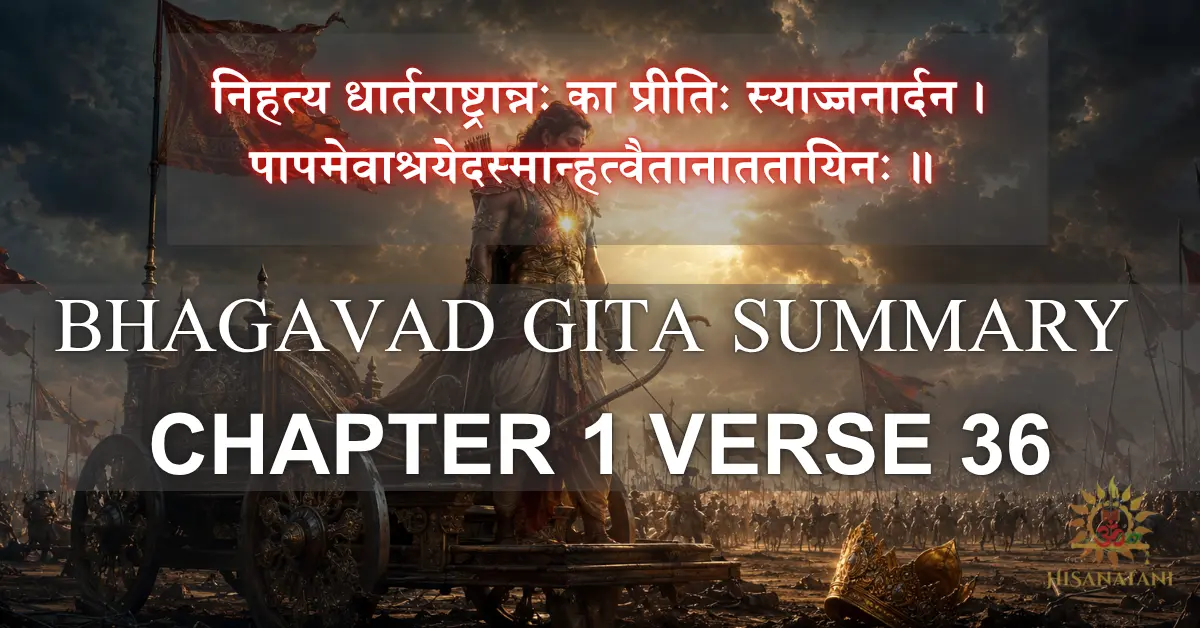
निहत्य धार्तराष्ट्रान्नः का प्रीतिः स्याज्जनार्दन ।
पापमेवाश्रयेदस्मान् हत्वैतानाततायिनः ॥ १.३६ ॥
In English :
nihatya dhārtarāṣṭrān naḥ kā prītiḥ syāj janārdana |
pāpam evāśrayed asmān hatvaitān ātatāyinaḥ ||
Feel the Vibration: A Guided Chant of Bhagavad Gita Chapter 1 Verse 36:
- nihatya dhārtarāṣṭrān naḥ kā prītiḥ syāj janārdana |
Ni-ha-tya Dhaar-ta-raa-shtraan Nah Kaa Pree-tih Syaaj Ja-naar-da-na - pāpam evāśrayed asmān hatvaitān ātatāyinaḥ ||
Paa-pam E-va Aash-ra-yed As-maan Hat-vai-taan A-ta-taa-yi-nah
English Translation:
“O Janardana, what joy can be ours in killing the sons of Dhritarashtra? Even though they are aggressors, sin alone will be our gain by killing these felons.”
JOIN THE HISANATANI COMMUNITY
Get daily Verse Summaries & High-Res Posters directly on your WhatsApp.
JOIN CHANNELWhy Your Conscience Keeps Score Even When Your Dashboard Doesn’t
Have you ever kept going with something at work that felt off, just because everyone else seemed fine with it?
A sales pitch that stretched the truth. Pressure to round a number up. Staying quiet while something unfair happened to someone else.
Most people know this feeling. Modern work trains us to track outputs: targets hit, promotions landed, funding closed. But here’s the thing. Your conscience isn’t reading the same spreadsheet as your manager.
Bhagavad Gita Chapter 1 Verse 36 pulls this into the open. It asks whether an achievement is worth what it costs internally, and it refuses the lazy defense of “everyone else is doing it.” Arjuna’s battlefield is louder than yours. The question underneath it is exactly the same.
The Two-Kid Trophy Problem

Picture two kids racing for the last seat on the school bus. One kid gets there first, fair and square. The other kid trips him. Who sits down? The one who tripped him.
Who feels good about it? Not really anyone, including the kid who won.
This is the whole idea behind Bhagavad Gita 1.36 Summary in miniature. Arjuna isn’t asking whether he can beat the other side. He already knows he can. He’s asking whether beating them this way is worth it.
Kids get this instinctively. A cheat on a test raises the grade but not the student. A shove on the playground wins the swing but not a friend. Somewhere between childhood and adulthood, a lot of people unlearn this and start calling it “strategy” instead.
The lesson from Bhagavad Gita 1.36 holds for a ten-year-old and a CEO equally: don’t just measure what a win gets you, measure what it turns you into.
Clean Wins vs. Convenient Wins

Most people judge success by outcome. The Bhagavad Gita 1.36 keeps pushing toward a harder question: does a good outcome justify any method used to reach it?
Say a company grows by quietly exploiting customers who won’t notice for years. Say a leader gets promoted by taking credit that isn’t theirs. Both are wins on paper.
Look closer, though. Arjuna’s fear in this verse isn’t losing the war. It’s becoming the kind of person who’ll do anything to win it.
This matters because these compromises rarely arrive all at once. They show up small. Just this one deal. Just this quarter. Just this once. Small exceptions turn into habits, and habits turn into character, and character is what actually follows you around.
The principle Arjuna is circling: a win that costs your integrity isn’t banked, it’s borrowed, and it comes due later.
The Real Reason You’re Exhausted

A lot of professionals assume burnout comes from doing too much. Sometimes it does. But a specific kind of exhaustion comes from something else entirely: doing things that fight against what you actually believe.
Psychologists have a name for the gap between your actions and your values: cognitive dissonance, or in its more serious workplace form, moral injury. It isn’t ordinary job stress. It’s a quieter wound, and it doesn’t show up on a performance review.
Think of someone asked to defend a decision they know is unfair. Or someone told to sell something they don’t believe in. The paycheck still clears. The discomfort doesn’t.
This is where Bhagavad Gita 1.36 gets sharp. Arjuna senses the damage before it happens, instead of after. Most people do the opposite. They push the discomfort down, stay busy, and then wonder why they’re running on empty despite “only” working a normal week.
The takeaway: when your actions keep contradicting your values, the strain isn’t optional, it’s coming. Protecting your integrity isn’t just an ethics decision. It’s basic mental maintenance.
What Your Conscience Is Actually Protecting

You can call it conscience, call it instinct, or call it the quiet voice that flags something before your brain finishes the sentence. Whatever name you use, you already know the feeling of something being wrong before you can explain why.
Arjuna’s concern in this verse goes past the battlefield. He’s not only worried about the act of fighting. He’s worried about what repeating certain choices does to him over time. Choose profit over honesty enough times, and it stops feeling unusual. It starts feeling normal.
That’s the real danger. Not one bad decision, but the version of yourself that a hundred small bad decisions slowly builds.
This is why the Bhagavad Gita Chapter 1 Verse 36 keeps circling back to right action, not because anything external demands it, but because you’re the one who has to live inside the person those actions create.
Arjuna’s worry, stripped of the battlefield: what am I turning into, and can I live with that person?
What Was Actually Happening at Kurukshetra

To take Bhagavad Gita 1.36 seriously, it helps to remember what was standing in front of Arjuna.
The Kauravas, led by Duryodhana, had genuinely wronged the Pandavas. Traditional texts describe six specific acts that mark someone as an atatayi, a lethal aggressor deserving no mercy under the era’s own laws: poisoning an enemy, setting fire to their home, attacking with a deadly weapon, robbing their wealth, seizing their land, and abducting their spouse. The Kauravas were on record for several of these.
By the strict rulebook of the time, Arjuna had every justification to strike without hesitation.
He still paused.
That pause is the historically strange part. Most warriors in his position would be thinking formations, weapons, odds. Arjuna is thinking about what happens to him after the swords go quiet. He’s not weighing military strategy. He’s weighing consequence.
Without this exact hesitation, there’s no reason for Krishna’s teaching to unfold at all. The war is the backdrop. This inner conflict is the actual subject of the Gita.
The 24-Hour Gita Challenge: Choose One Clean Win

Reading about integrity is easy. Practicing it for a day is where it gets real.
Challenge 1: Run a 10-minute integrity audit. Write down one thing at work that quietly bothers you. Name which value it’s bumping against. Don’t fix it yet, just name it.
Challenge 2: Use the tomorrow test. Before you send that message or approve that proposal, ask: if everyone knew about this tomorrow, would I still feel fine about it? Let the answer decide.
Challenge 3: Take one clean win. Find one place today where you could gain something through exaggeration, silence, or manipulation, and choose the honest route instead, even if it costs you something. Especially if it costs you something.
The goal isn’t perfection. It’s alignment. Small clean wins build the kind of trust that actually compounds.
Who Are You Becoming While You Chase Your Goals?
The core message of Bhagavad Gita 1.36 Summary is simple to say and hard to practice: not every victory is worth taking.
Arjuna is showing us that a win has to be measured by what it costs internally, not just what it earns externally. In a world obsessed with targets and titles, this verse asks a different question.
Who are you becoming while you chase your goals?
Careers rise and fall. Titles come and go. What stays with you is the person all those choices quietly built.
Please let me know in the comments.
Embrace the Teachings of the Gita. Dive deeper into the Bhagavad Gita to uncover its timeless wisdom and practical guidance. Let its verses inspire you to cultivate inner clarity, align with higher values, and navigate life’s challenges with courage and grace.
🌼 Join the HiSanatani WhatsApp Channel for your daily dose of light 🪔. Join Now.
Voice of the Soul
Finding clarity in the questions we all carry…
What is the main message of Bhagavad Gita 1.36?
A victory won through morally troubling means can create suffering even when it succeeds externally. Arjuna questions whether that kind of success is worth pursuing at all, as explored in Clean Wins vs. Convenient Wins.
Why does Arjuna worry about sin in this verse?
Arjuna fears that killing relatives, even ones who’ve committed real wrongs, will leave a lasting mark on him regardless of the justification. See What Was Actually Happening at Kurukshetra for the full context.
How is Bhagavad Gita 1.36 relevant to modern professionals?
It offers a check for anyone facing a choice between career advancement and personal values, a tension broken down in The Real Reason You’re Exhausted.
What psychological lesson does BG 1.36 teach?
It points to the strain that builds when actions repeatedly contradict beliefs, a pattern covered in The Real Reason You’re Exhausted.
What practical action can I take after reading this verse?
Start by naming one place where success is tempting you to cut a corner, then choose the honest option instead. The exact steps are in The 24-Hour Gita Challenge: Choose One Clean Win.
