
Namaste 🙏
Welcome to Hi Sanatani. It’s a joy to have you here as we explore the deeper layers of human nature. By diving into this Bhagavad Gita 1.37 Summary we create a sacred bridge together, turning ancient verses into helpful tools for your personal growth and peace.
Translation of Bhagavad Gita Shloka Verse 1.37 in English:
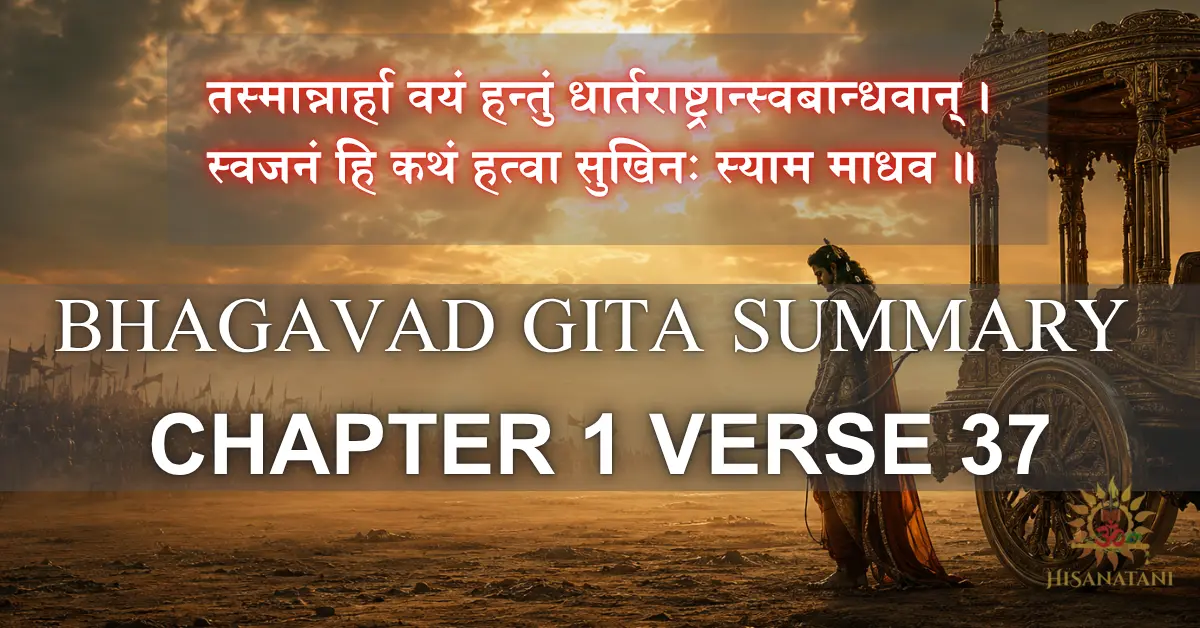
तस्मान्नार्हा वयं हन्तुं धार्तराष्ट्रान्स्वबान्धवान् ।
स्वजनं हि कथं हत्वा सुखिनः स्याम माधव ।। १.३७ ।।
In English :
tasmān nārhā vayaṁ hantuṁ dhārtarāṣṭrān sa-bāndhavān |
svajanaṁ hi kathaṁ hatvā sukhinaḥ syāma mādhava ||
Feel the Vibration: A Guided Chant of Bhagavad Gita Chapter 1 Verse 37:
- tasmān nārhā vayaṁ hantuṁ dhārtarāṣṭrān sa-bāndhavān |
Tas-mān nār-hā va-yaṁ han-tuṁ dhār-ta-rāṣ-ṭrān sa-bān-dha-vān - svajanaṁ hi kathaṁ hatvā sukhinaḥ syāma mādhava ||
Sva-ja-naṁ hi ka-thaṁ hat-vā su-khi-naḥ syā-ma mā-dha-va
English Translation:
“Therefore, it is not right for us to kill the sons of Dhritarashtra and our own kinsmen. How can we be happy, O Madhava, by killing our own people?”
JOIN THE HISANATANI COMMUNITY
Get daily Verse Summaries & High-Res Posters directly on your WhatsApp.
JOIN CHANNELWhy Your Soul Needed to Hear This Today
Let’s be honest.
Many people are not exhausted because of workload. They are exhausted because of inner contradiction. Part of them knows something is off.
A manager demands loyalty but offers little respect in return. A team speaks about values while rewarding politics. An organization celebrates culture while quietly normalizing burnout.
The mind keeps making excuses. The heart keeps noticing the truth. That tension creates a strange fatigue.
You can sleep eight hours and still wake up tired. Not because your body is depleted. Because your conscience is carrying a weight your voice has not yet expressed.
Bhagavad Gita 1.37 Summary speaks directly to this hidden struggle. It reminds us that awareness is not punishment. It is an invitation to return to alignment with your own values.
Now let’s explore this verse through six deeper lenses.
The Playground Lesson About Following the Wrong Crowd

Imagine a group of children breaking a neighbor’s window while playing cricket.
Most of them laugh. Nobody feels guilty. But one child knows the act is wrong.
Now that child faces a choice. Should he join because everyone else is doing it? Or should he stop because he understands the consequences?
This is the simplest meaning of BG1.37.
The Kauravas are like children who are too excited about winning to think about the damage they are causing. Greed has clouded their judgment.
Arjuna notices something important. Being surrounded by people making bad decisions does not remove personal responsibility.
Kids understand this naturally. If your friends cheat during a game, you still know cheating is wrong. If classmates bully someone, joining them doesn’t make the action right.
Knowing better means acting better.
Wisdom is not measured by what you know. It is measured by what you do when everyone else is doing the opposite.
The Dangerous Philosophy of “Everyone Does It”

One of humanity’s oldest excuses is surprisingly simple: “Everyone else is doing it.”
Look closer.
Entire societies have justified harmful actions through group thinking. Organizations have hidden corruption because it became normal. Communities have accepted unethical behavior because enough people participated.
Arjuna challenges this logic. He does not judge the Kauravas merely because they are greedy. He points out that greed damages perception itself.
When desire becomes intense enough, people stop evaluating right and wrong objectively. They only evaluate outcomes. Will I win? Will I profit? Will I gain power?
That is the philosophical danger Bhagavad Gita Chapter 1 Verse 37 warns about. When success becomes the only metric, morality becomes negotiable.
The verse reminds us that truth does not change based on popularity. A thousand people repeating a mistake cannot transform it into wisdom.
Right action matters independently of the outcome.
The crowd can be wrong. The majority can be blinded. Conscience exists precisely because numbers alone cannot determine truth.
Why Toxic Teams Feel Spiritually Draining

Many corporate employees describe the same feeling.
“I don’t know what’s wrong.” “I just feel heavy.” “I feel disconnected.”
That heaviness often emerges when external behavior and internal truth stop matching.
Psychologically, humans require coherence. Your thoughts, emotions, values, and actions naturally seek alignment. When they conflict for long periods, mental strain appears.
A toxic team creates exactly this condition. You know certain decisions are unhealthy. You know certain conversations are manipulative. You know certain expectations are unreasonable. Yet every day you participate anyway.
The result is cognitive friction. The mind burns energy trying to justify what the heart already understands. Over time, this creates anxiety, emotional fatigue, and even physical exhaustion.
Arjuna recognizes the beginning of this process. The Kauravas have repeated unhealthy patterns so long that they no longer recognize them. This is the danger. Repeated misalignment slowly becomes normal.
But healing does not begin when discomfort disappears. Healing begins when awareness returns. And awareness is exactly what Arjuna is experiencing in Bhagavad Gita 1.37.
The Spiritual Cost of Betraying Your Inner Compass

Spiritually, this verse is not primarily about war. It is about separation from truth.
The soul naturally moves toward harmony, honesty, and alignment with Dharma. Greed pulls in the opposite direction. It creates noise. The louder the noise becomes, the harder it is to hear the guidance already present within.
Many people imagine spiritual growth as learning something new. Actually, it often means removing distortion.
Think about muddy water. The reflection is unclear not because the reflection disappeared. The disturbance simply prevents it from being seen.
The Kauravas represent disturbed consciousness. Arjuna represents awakening consciousness.
The deeper lesson of the Summary of Bhagavad Gita 1.37 is that spiritual blindness is self-created. Whenever attachment becomes stronger than wisdom, perception suffers. Whenever ego becomes stronger than conscience, suffering follows.
The soul does not lose its connection to truth. It simply becomes harder to hear.
This verse invites us back toward inner clarity. Toward listening. Toward alignment. Toward Dharma.
What Was Actually Happening on the Battlefield?

Historically, Arjuna is standing between two massive armies at Kurukshetra. Across from him stand cousins, teachers, relatives, and former allies.
The Kauravas have repeatedly acted through greed. They cheated the Pandavas. Humiliated Draupadi. Ignored peace negotiations. Rejected opportunities for reconciliation.
From Arjuna’s perspective, they are no longer making rational decisions. Their judgment has been overtaken by attachment to power.
This context matters. Arjuna is not describing a minor disagreement. He is describing a leadership failure of enormous scale.
The verse captures a timeless political reality. Power often creates blindness. Those pursuing dominance frequently underestimate the damage their actions create.
Ancient kingdoms experienced it. Modern corporations experience it. Governments experience it. Even families experience it.
This is why Bhagavad Gita Chapter 1 Verse 37 remains relevant. The battlefield changes. Human psychology does not.
The 24-Hour Gita Challenge: Breaking Toxic Loyalty

Young professionals often hear phrases like:
“We are family here.” “Real team players sacrifice.” “If you leave now, you’ll let everyone down.”
Sometimes these statements are genuine. Sometimes they are tools of control.
Here is your 24-Hour Gita Challenge inspired by BG 1.37:
Action 1: List the Hidden Costs
Write down three ways a current relationship, workplace, or commitment is harming your peace, values, or growth. Be brutally honest.
Action 2: Separate Guilt From Responsibility
Ask yourself: “Am I staying because it is right, or because I fear disappointing people?” Write the answer without editing it.
Action 3: Make One Boundary Visible
Send one message. Decline one unreasonable request. Protect one personal limit. Take one small action that respects your conscience.
Remember: Loyalty is a virtue. Blind loyalty is a liability.
The Gita never teaches submission to wrongdoing. It teaches alignment with Dharma.
A Difficult but Liberating Truth
Bhagavad Gita 1.37 Summary reveals a difficult but liberating truth.
Not everyone who acts wrongly realizes they are doing so. Greed, fear, ambition, and attachment can cloud judgment until harmful actions appear justified.
But awareness changes responsibility. Once you see clearly, you can no longer hide behind the crowd.
Arjuna’s struggle is the same struggle many young professionals face today. When a company, group, or relationship demands loyalty at the cost of integrity, the real battle begins within.
The verse asks a timeless question: If others cannot see the consequences of their actions, will you still follow them?
The answer determines the direction of your life.
Please let me know in the comments.
Embrace the Teachings of the Gita. Dive deeper into the Bhagavad Gita to uncover its timeless wisdom and practical guidance. Let its verses inspire you to cultivate inner clarity, align with higher values, and navigate life’s challenges with courage and grace.
🌼 Join the HiSanatani WhatsApp Channel for your daily dose of light 🪔. Join Now.
Voice of the Soul
Finding clarity in the questions we all carry…
What is the main message of Bhagavad Gita 1.37?
The verse teaches that greed can cloud judgment, preventing people from seeing the consequences of harmful actions. Those who see clearly carry greater responsibility, as explored in The Dangerous Philosophy of “Everyone Does It”.
Why does Arjuna mention greed in this verse?
Arjuna believes the Kauravas can’t recognize their mistakes because greed has distorted their thinking, creating the same coherence-breaking strain many people feel in a toxic team, as explained in Why Toxic Teams Feel Spiritually Draining.
How is Bhagavad Gita 1.37 relevant to workplace culture?
The verse helps you recognize when loyalty demands conflict with ethics, encouraging independent judgment over blind group pressure, an idea put into action in The 24-Hour Gita Challenge: Breaking Toxic Loyalty.
Does the Gita teach obedience to authority?
No. The Gita consistently emphasizes Dharma and right action above blind obedience; authority only holds value when aligned with righteousness, as detailed in The Spiritual Cost of Betraying Your Inner Compass.
What can young professionals learn from BG 1.37?
Staying loyal to unhealthy environments out of guilt isn’t always virtuous. Awareness should lead to courageous, conscience-guided action, a lesson mirrored in The Playground Lesson About Following the Wrong Crowd.
