
Namaste 🙏
Welcome to Hi Sanatani. It’s a joy to have you here as we explore the deeper layers of human nature. By diving into this Bhagavad Gita 1.41 Summary we create a sacred bridge together, turning ancient verses into helpful tools for your personal growth and peace.
Translation of Bhagavad Gita Shloka Verse 1.41 in English:
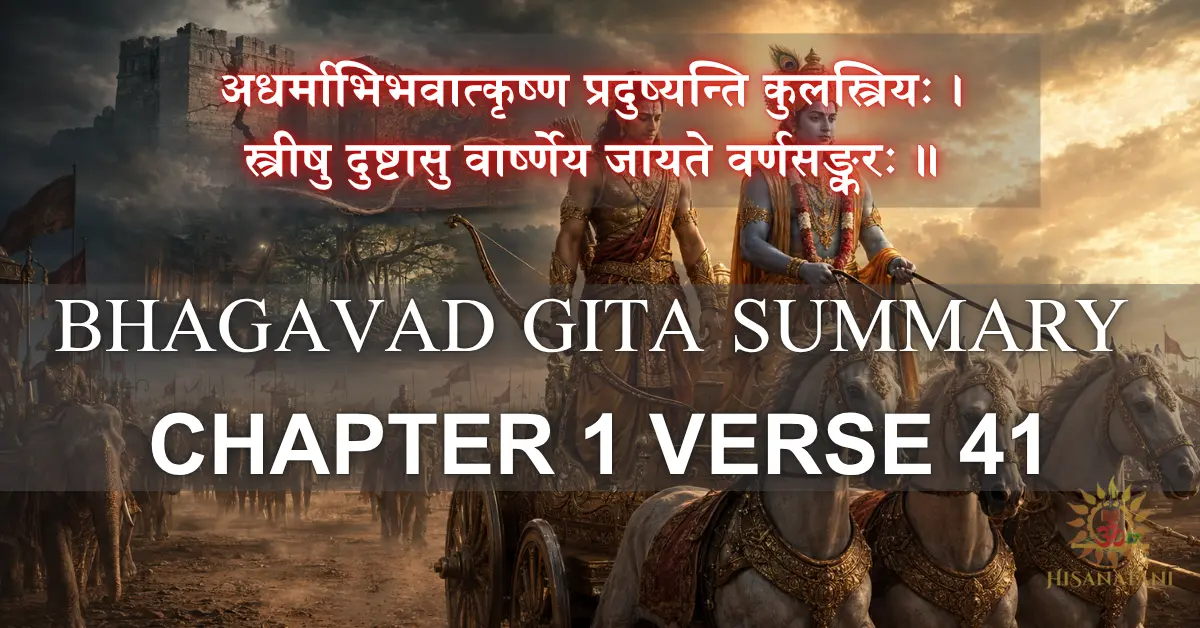
अधर्माभिभवात्कृष्ण प्रदुष्यन्ति कुलस्त्रियः ।
स्त्रीषु दुष्टासु वार्ष्णेय जायते वर्णसङ्करः ॥ १.४१ ॥
In English :
adharmābhibhavāt kṛṣṇa praduṣyanti kula-striyaḥ |
strīṣu duṣṭāsu vārṣṇeya jāyate varṇa-saṅkaraḥ ||
Feel the Vibration: A Guided Chant of Bhagavad Gita Chapter 1 Verse 41:
- adharmābhibhavāt kṛṣṇa praduṣyanti kula-striyaḥ |
a-dhar-mā-bhi-bha-vāt kṛṣ-ṇa | pra-duṣ-yan-ti ku-la-stri-yaḥ - strīṣu duṣṭāsu vārṣṇeya jāyate varṇa-saṅkaraḥ ||
strī-ṣu duṣ-ṭā-su vārṣ-ṇe-ya | jā-ya-te var-ṇa-saṅ-ka-raḥ
English Translation:
“O Krishna, when unrighteousness overtakes a family, its women are drawn into corruption; and when the women of a family are corrupted, unwanted mixing of social order follows, O descendant of Vrishni.”
JOIN THE HISANATANI COMMUNITY
Get daily Verse Summaries & High-Res Posters directly on your WhatsApp.
JOIN CHANNELWhy This Verse Finds You Right Where You Are
Let’s name it plainly: you’re tired of overthinking. You lie there running the tape forward — if I quit, if I speak up, if I say no — until one decision has somehow ruined your whole future. That’s not weakness. That’s a mind trying to protect you the only way it knows how, by imagining every disaster in advance so none of them can surprise you.
Arjuna is doing the same thing on a battlefield, thousands of years before you had a phone to doomscroll on. Bhagavad Gita 1.41 Summary catches him mid-spiral — and catches you too, if you’re honest.
The Sweater With One Loose Thread

Picture a sweater someone knit for you by hand. One morning you notice a thread poking out near the sleeve. You could leave it. You could snip it. Instead, you pull.
One tug and a few inches unravel. You panic and pull harder, trying to “fix” it, and now half the sleeve is gone. That’s the fear inside this Bhagavad Gita Chapter 1 Verse 41 — not that trouble exists, but that the smallest opening might undo the whole thing.
Here’s what a lot of us forget, though: a loose thread doesn’t have to become a ruined sweater. Most of the time, it just needs a steady hand and a needle, not a full unraveling. Arjuna sees the thread and assumes the sweater is already gone. He hasn’t noticed he’s still holding the needle.
Think about your group chat. One person goes quiet after a disagreement. Nobody names it. Weeks later, the whole friend group feels “off,” and everyone blames everything except the one thread nobody pulled back into place. Small neglect, left alone, does grow. But it grows because it’s ignored — not because it’s unstoppable.
Character Is Built in Directions, Not Decisions

Arjuna isn’t afraid of one battle. He’s afraid of a direction — the idea that this one choice sets the whole future rolling downhill. And honestly, he’s onto something real: life rarely turns on a single dramatic event. It turns on which way you’re already facing.
A habit repeated becomes a personality. A shortcut taken twice becomes a standard. A promise broken once quietly resets what “normal” means for everyone watching. None of this happens because of one moment — it happens because of what that moment points toward.
But Arjuna’s mistake is thinking he’s the only force steering that direction. He’s treating himself like the sole engine of everything that will ever happen to his family, his people, the next hundred years. That’s a heavy — and honestly arrogant — amount of weight to put on one decision made on one afternoon. There’s a difference between taking your choices seriously and believing the entire world balances on them.
One builds character. The other builds paralysis. The Bhagavad Gita 1.41 sits right at that line, and most of us live closer to it than we’d like to admit.
Your Brain Is Writing a Disaster Movie Before the First Scene Happens

Psychologists have a name for what Arjuna’s doing: catastrophizing. It’s the mental habit of taking one uncertain event and running it forward to the worst possible ending — and then treating that ending like it’s already decided.
You know the pattern. I say no to this project, and I get labeled difficult, and I get passed over, and I never recover. None of that has happened. Your brain skipped straight from step one to the finale, and now your body is stressed about a movie that only exists in your head.
This is exactly Arjuna’s state BG1.41. He’s not reacting to what’s true. He’s reacting to what his mind has already decided will be true — social collapse, ruined families, generations paying for a war that hasn’t started. Fear doesn’t wait for evidence. It runs ahead and builds the evidence itself.
The way out isn’t forcing positivity. It’s asking sharper questions: What do I actually know right now? What am I assuming? Would I hand this same worst-case story to a friend, or would I tell them to slow down?
Arjuna hasn’t asked himself that yet. Krishna’s about to make him.
When You’re Anchored to the Outcome, Every Wobble Feels Like a Threat

Underneath Arjuna’s fear is a quiet demand: he wants a guarantee. He wants to know, before he acts, that everything downstream will turn out clean and unblemished. When he can’t get that guarantee, his faith buckles.
That’s a trap a lot of us fall into without noticing. We tell ourselves we’ll feel steady once the outcome is certain — once the job offer comes through, once the relationship is confirmed, once the numbers line up. But peace that depends on a guaranteed outcome was never peace. It was just borrowed calm, waiting to be repossessed the moment things get uncertain again.
The steadier path this Sloka Bhagavad Gita 1.41, points toward isn’t pretending outcomes don’t matter. It’s putting your weight down somewhere sturdier than the outcome — in your own intentions, in the part of you that stays constant whether the result is a win or a mess. Arjuna hasn’t found that footing yet. He’s still standing entirely on “what if this goes wrong,” which means every gust of wind knocks him over.
Kurukshetra Was a Civilization Holding Its Breath
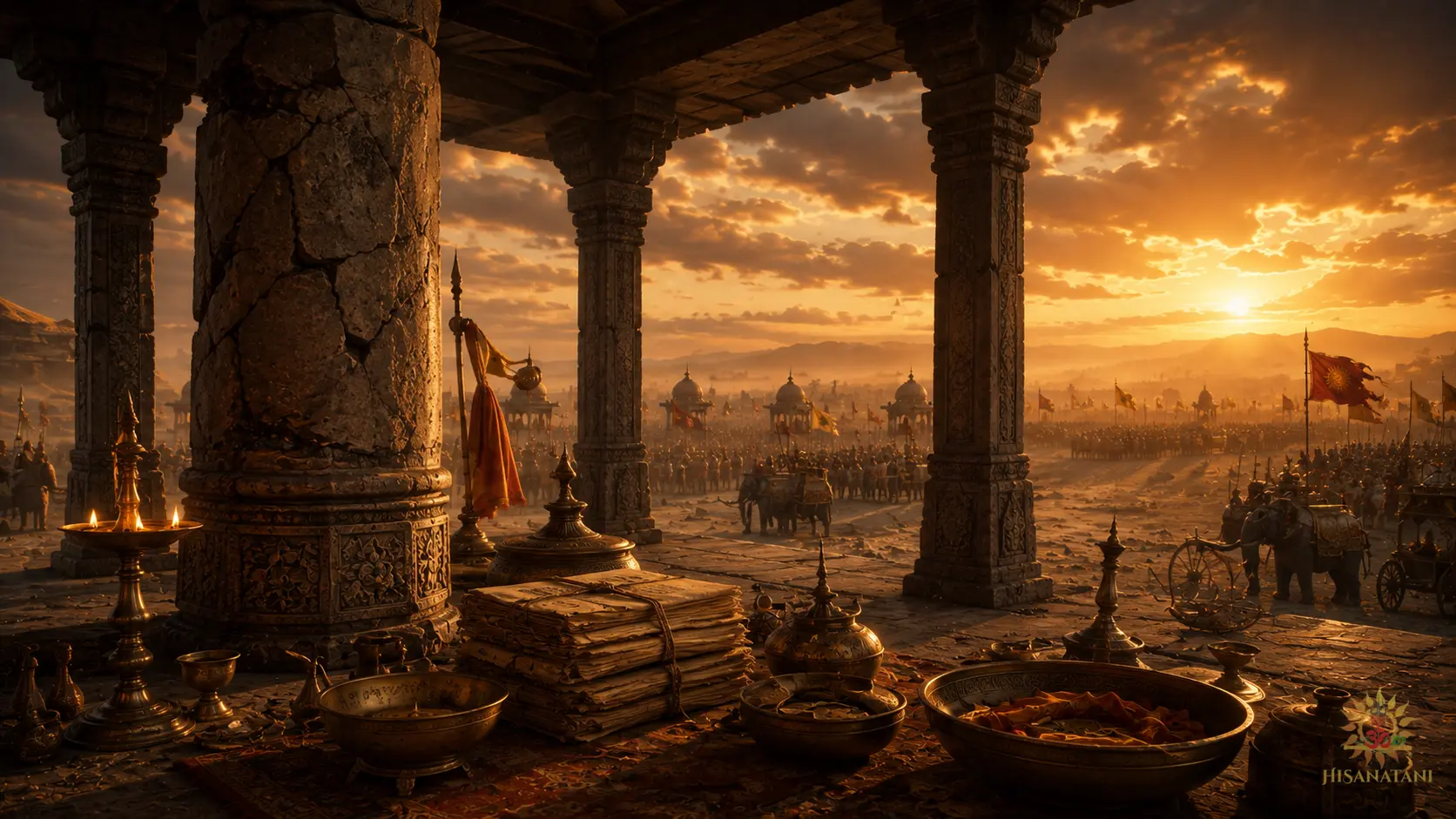
To take the Bhagavad Gita Chapter 1 Verse 41 seriously, you have to picture what “family” meant in Arjuna’s world. It wasn’t just people under one roof. It was the entire delivery system for education, protection, ritual, and moral training. If the elders and protectors on this battlefield died, whole households would lose the people responsible for holding all of that together.
That’s the real weight behind “kula-striyaḥ” — the women of the family. It’s not a verdict on women causing decline. It’s a description of who becomes most exposed when the structures meant to protect a household fall apart during war. And “varṇa-saṅkara” — often flattened into a line about caste mixing — is better understood in Bhagavad Gita 1.41 as Arjuna’s fear of total role confusion: a generation growing up with no one left to teach them what their responsibilities even are.
Whether or not his prediction was accurate isn’t really the point. The Gita is letting us watch a capable, caring man talk himself into standing completely still, because he’s convinced that action itself is what causes ruin. That’s a very old fear wearing very old language — and it’s still working on people today, just with different battlefields.
The 24-Hour Gita Challenge: Interrupt the Spiral Before It Finishes the Sentence
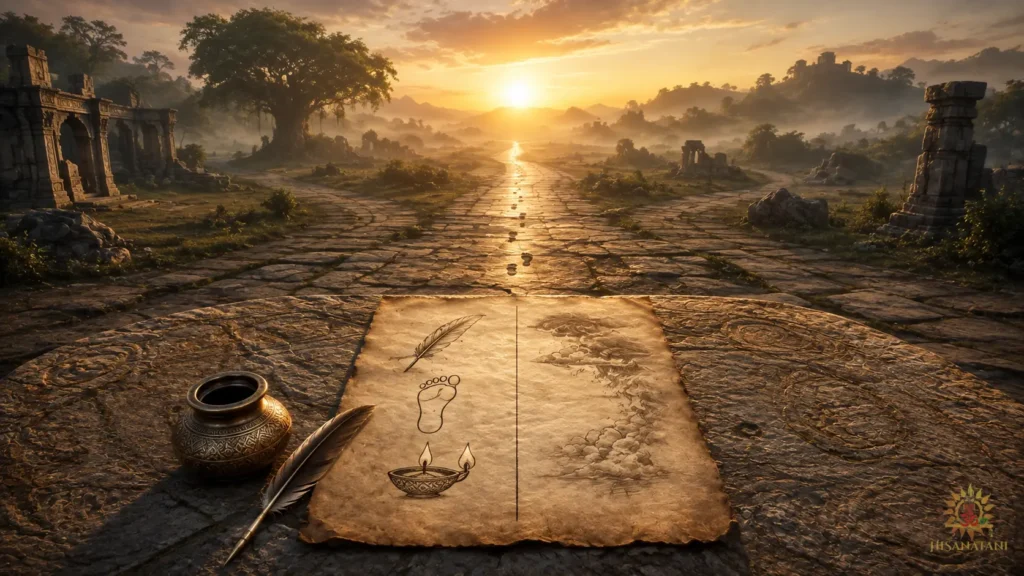
You don’t need to solve your whole future in the next day. The Summary of Bhagavad Gita 1.41 says,You need to interrupt one spiral before it convinces you it’s already true. Three steps.
Name the worst-case out loud. Write down the exact disaster your mind is rehearsing — not the vague dread, the actual sentence. Seeing it on paper usually shrinks it.
Find the next honest step, not the final one. Ask what one small, doable action moves things forward in the next five minutes — sending the message, drafting the email, making the call — without requiring you to solve everything else first.
Sort your worry into two columns: “Things I can actually act on right now” and “Things I’m only imagining.” Move the imagined ones out of your head and onto the page, where they belong, and give your attention back to the first column.
The Fear Was Never the Problem — Believing It Was Truth Is
Arjuna isn’t wrong to care this much. His fear comes from love — for his people, for what they’re building, for the generations who’ll inherit whatever happens next. That’s not a flaw. It’s the part of him worth keeping.
What’s tripping him up is treating his fear like a finished prediction instead of an unfinished thought. You don’t have to silence the worry to move past it. You just have to stop handing it the final word.
Please let me know in the comments.
Embrace the Teachings of the Gita. Dive deeper into the Bhagavad Gita to uncover its timeless wisdom and practical guidance. Let its verses inspire you to cultivate inner clarity, align with higher values, and navigate life’s challenges with courage and grace.
🌼 Join the HiSanatani WhatsApp Channel for your daily dose of light 🪔. Join Now.
Voice of the Soul
Finding clarity in the questions we all carry…
What is the main message of Bhagavad Gita 1.41?
Arjuna warns that when a family’s moral foundation weakens, the damage spreads outward — but the verse also shows how fear turns a possible outcome into a certainty in the mind before anything has happened. See Your Brain Is Writing a Disaster Movie Before the First Scene Happens.
Why does Arjuna mention the women of the family in Verse 41?
He’s describing who becomes most vulnerable when the structures meant to protect a household — leadership, income, safety — collapse during war, not placing blame on women for social decline. Full context in Kurukshetra Was a Civilization Holding Its Breath.
How does Bhagavad Gita 1.41 relate to overthinking and decision-paralysis?
The verse captures a mind that’s stopped responding to what’s real and started responding to an imagined worst case. That pattern — and how to interrupt it — is explored in The 24-Hour Gita Challenge.
Is Bhagavad Gita 1.41 saying that one bad choice destroys everything?
Not exactly — it shows how a mind under stress convinces itself of that, which is different from it being true. The steadier alternative is explained in When You’re Anchored to the Outcome, Every Wobble Feels Like a Threat.
What can young professionals learn from Bhagavad Gita Chapter 1 Verse 41?
That taking your choices seriously is healthy, but believing every choice determines your entire future is a distortion worth catching. Character Is Built in Directions, Not Decisions breaks down that distinction.
