
Namaste 🙏
Welcome to Hi Sanatani. It’s a joy to have you here as we explore the deeper layers of human nature. By diving into this Bhagavad Gita 1.42 Summary we create a sacred bridge together, turning ancient verses into helpful tools for your personal growth and peace.
Translation of Bhagavad Gita Shloka Verse 1.42 in English:
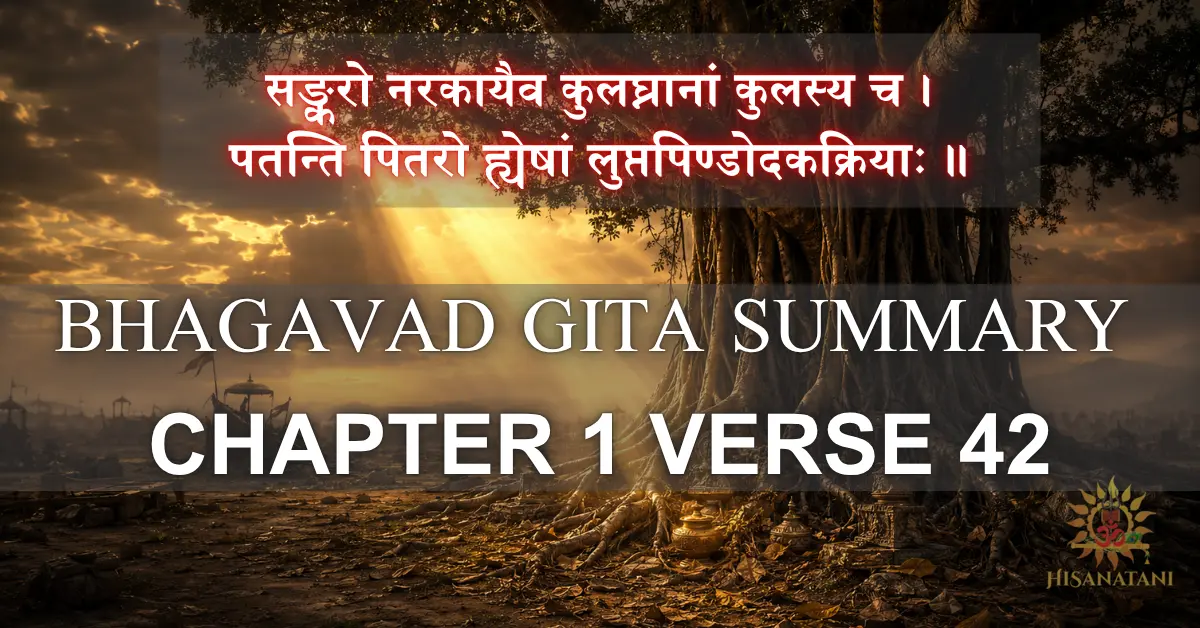
सङ्करो नरकायैव कुलघ्नानां कुलस्य च ।
पतन्ति पितरो ह्येषां लुप्तपिण्डोदकक्रियाः ॥ १.४२॥
In English :
saṅkaro narakāyaiva kula-ghnānāṁ kulasya ca |
patanti pitaro hy eṣāṁ lupta-piṇḍodaka-kriyāḥ ||
Feel the Vibration: A Guided Chant of Bhagavad Gita Chapter 1 Verse 42:
- saṅkaro narakāyaiva kula-ghnānāṁ kulasya ca |
San-ka-ro Na-ra-kā-ya-e-va Ku-la-ghnā-nām Ku-la-sya Cha - patanti pitaro hy eṣāṁ lupta-piṇḍodaka-kriyāḥ ||
Pa-tan-ti Pi-ta-ro Hy-e-shām Lup-ta Pin-do-da-ka Kri-yāh
English Translation:
“An increase of unwanted population brings hellish conditions to the family and to those who destroy family tradition. Deprived of the sacrificial offerings of food and water, the spirits of the ancestors fall from their place of peace.”
JOIN THE HISANATANI COMMUNITY
Get daily Verse Summaries & High-Res Posters directly on your WhatsApp.
JOIN CHANNELWhy Your Restless Heart Keeps Searching for Home
Here’s the honest part. You can change your city, your career, your circle, even your online persona — and some quiet ache still doesn’t move. That ache isn’t asking for something new. It’s asking for something true.
Arjuna senses this exact thing. When the chain connecting generations snaps, people don’t just lose customs. They lose the inner signal that tells them where they belong. A culture can survive in a museum. Identity only survives in a living heart.
The Kite That Forgot Its String
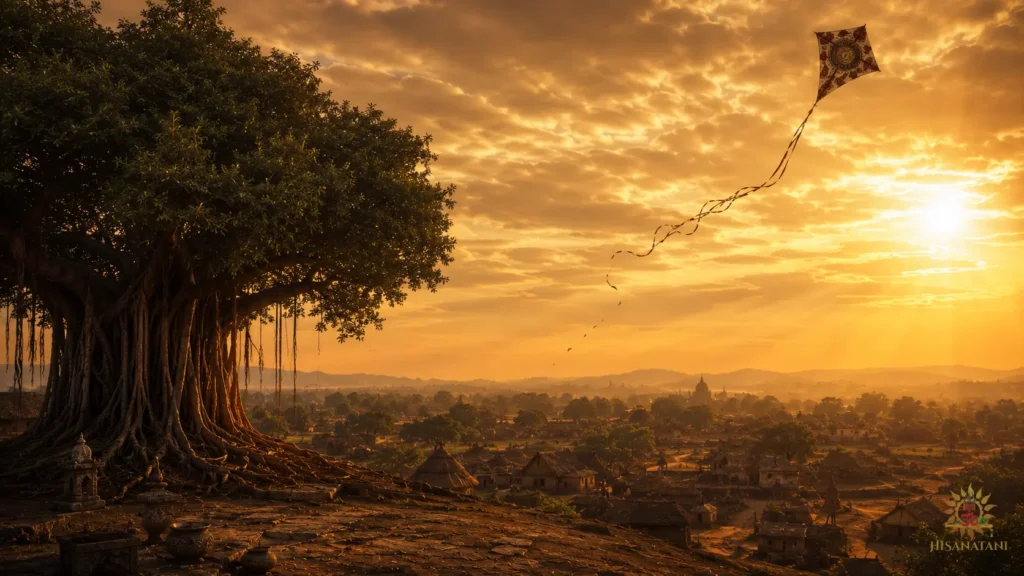
Picture a kid flying a kite. It climbs higher, riding the wind, until the string snaps.
For a second it looks free. It drifts wherever the breeze pushes it. Someone watching might think, “Now it’s finally free.” Look closer, though. It’s not flying anymore. It’s falling — just slowly.
That’s what Arjuna means in Bhagavad Gita Chapter 1 Verse 42.
Family values aren’t chains. They’re the string. They don’t stop you from reaching the sky. They tell you where home is.
Think about how you learned your first language. Nobody forced every word into your head. You absorbed it because you lived inside it. Values work the same way. A kid learns honesty because honesty is just around. Kindness feels normal because someone modeled it at breakfast, not because a lecture demanded it.
Now picture growing up where every app teaches something different. One says success is money. One says it’s beauty. One says power. The heart gets confused — not because it’s weak, but because ten voices are pulling ten directions at once.
That’s most young adults right now. Busy. Connected. Still quietly wondering, “Why do I feel lost anyway?”
Bhagavad Gita 1.42 answers that plainly: belonging isn’t built by collecting more identities. It grows when the heart remembers its original rhythm. The string doesn’t cage the kite. It’s the only reason the kite can actually soar.
When the Inner Compass Stops Whispering

One truth buried inside the Summary of Bhagavad Gita 1.42: humans aren’t built to run purely on outside reference points.
We assume identity comes from what we pick — career, looks, opinions, achievements. Those shape experience. They don’t define the core of a person.
But everything external moves. Interests shift. Friendships change shape. Bodies age. A career can vanish in a single bad year. Even convictions bend with time. If identity depends only on things that keep moving, the self never gets to rest.
That’s precisely why so many people burn out trying to “find themselves.” The one doing the searching keeps changing shape too.
Arjuna senses something subtler still. When tradition disappears, people don’t just lose customs — they lose a shared language that once pointed toward something steady.
Think of a guitar string. Tighten it too much and it snaps. Loosen it too much and it makes no sound at all. Music only happens at the right tension. Human consciousness runs on a similar law. Culture, at its best, was never meant to cage anyone.
Modern culture keeps pushing endless self-invention. The Gita offers a quieter option: maybe the deepest self isn’t something you build from scratch. Maybe it’s something you slowly uncover once the noise settles.
You’re not being asked to become someone new. You’re being invited to remember who was quietly there all along.
The Quiet Loneliness Hidden Behind Constant Connection
People have never had more ways to talk to each other. And loneliness is still one of the defining feelings of this decade. Why?
Because connection and belonging aren’t the same thing.
Arjuna understands that when the invisible scaffolding of family and shared meaning starts dissolving, something unexpected happens. People don’t just lose traditions. They lose an inner place to actually rest.
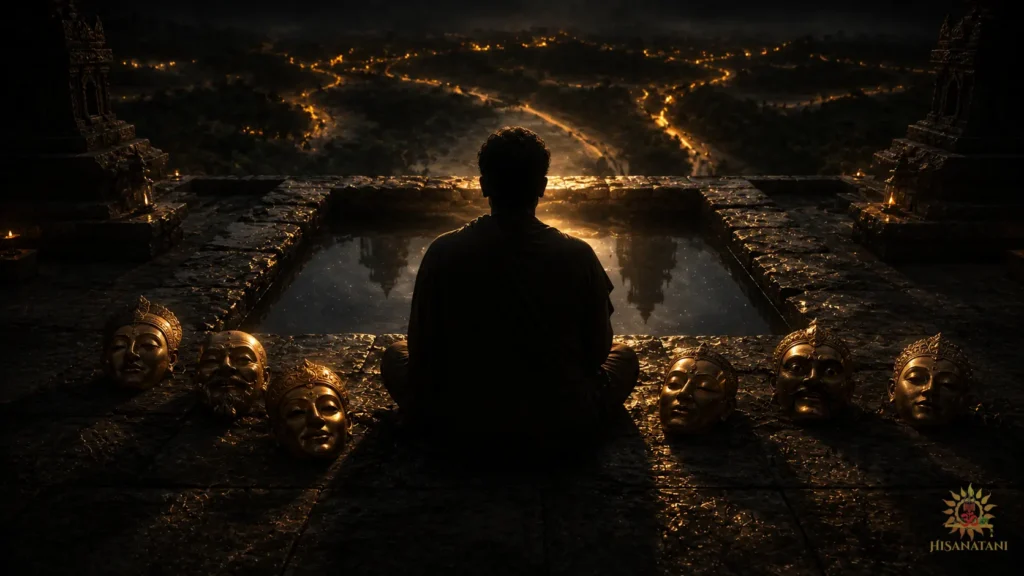
The nervous system keeps asking one quiet question: “Am I safe to just be myself here?” When the answer feels shaky, the mind starts building masks. One face for work. One for friends. One for the group chat. One for family dinners. One for when nobody’s looking. At first the masks feel useful. Eventually, they’re just exhausting.
Most tired young adults aren’t tired from working too much. They’re tired from performing too many versions of themselves in a single day.
Think about your phone battery. Ten apps open, music playing, a dozen browser tabs running — it drains fast, not because one app is dangerous, but because too many are competing for the same energy. Minds work the same way. Every borrowed identity quietly taxes your attention.
Algorithms ask, “What keeps you scrolling?” The soul asks something else entirely: “What brings you home?” Family rituals, honest conversations, shared meals, stories from grandparents — psychologists might call this emotional stability. The Gita calls it something deeper: an inner anchor. Once the heart knows where it belongs, it stops chasing approval everywhere else.
The Soul Never Forgets the Song It Came With
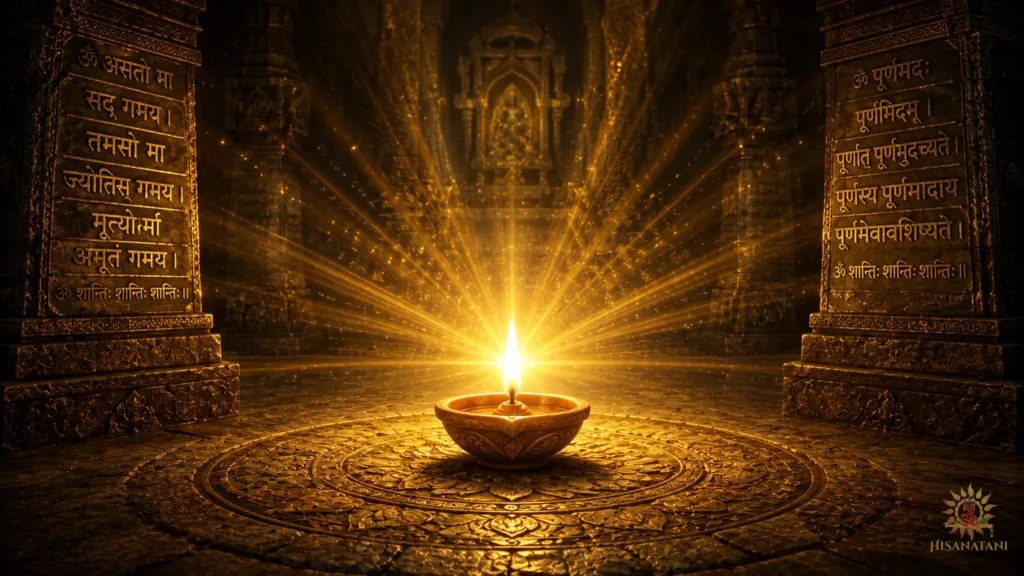
The spiritual weight of Bhagavad Gita Chapter 1 Verse 42 gets missed because most readers stop at “ancestor rituals.” But the ritual is only the visible part. The real teaching is about remembrance.
The soul, per the Gita, existed before this body and continues after it. Its deepest nature was never dependent on trends, careers, or how many people approve of you.
Still, something happens after birth. Layers pile on fast — identity, conditioning, success, failure, fear, expectation — loud enough that the soul’s original voice gets buried under static, the way a weak phone signal gets swallowed by interference in a crowded building.
Stand beside the ocean and at first you only hear traffic, people talking, waves crashing. Stay still long enough, though, and a steadier rhythm rises underneath it all. The soul speaks like that — not loud. Steady.
The traditions Arjuna is grieving were never meant to trap anyone in empty ceremony. Their real purpose was cutting through internal noise. Every festival was a nudge toward gratitude. Every offering, a reminder that life is received before it’s ever achieved.
Without those reminders, the ego starts narrating: “I am what I own. I am what people think of me.” The soul just quietly disagrees. It knows none of that was ever fully true.
Bhagavad Gita 1.42 Summary doesn’t threaten punishment for forgetting this. It gently points out that the path home never actually vanished. Only your attention wandered.
Kurukshetra Was Also a Battle for Memory

History remembers Kurukshetra as one of the largest wars ever recorded. But the scale of the war doesn’t explain Arjuna’s tears.
He wasn’t afraid of death. Warriors understood death. He feared something that outlasts it: forgetting.
If the elders on that field fell, something irreplaceable could vanish with them — not because knowledge only lived in books, but because living wisdom lived in people. Ancient India ran heavily on oral transmission. Kids didn’t just study values. They watched them happen, around evening fires, at festivals, in daily practice.
Every elder was a bridge between the past and whatever came next. Lose enough bridges, and future generations inherit information but lose direction.
Fast-forward. Libraries are full now. The internet holds almost everything ever recorded. Information has multiplied past comprehension — and wisdom somehow feels harder to reach than ever. Why? Because information fills the mind. Wisdom transforms the heart. History can tell you what your ancestors did. Only lived practice tells you why it mattered.
That’s the historical pulse still running through Bhagavad Gita 1.42 — the biggest loss was never buildings or bloodlines. It was the quiet disappearance of meaning.
The 24-Hour Gita Resonance Challenge: Remember Before You Reinvent
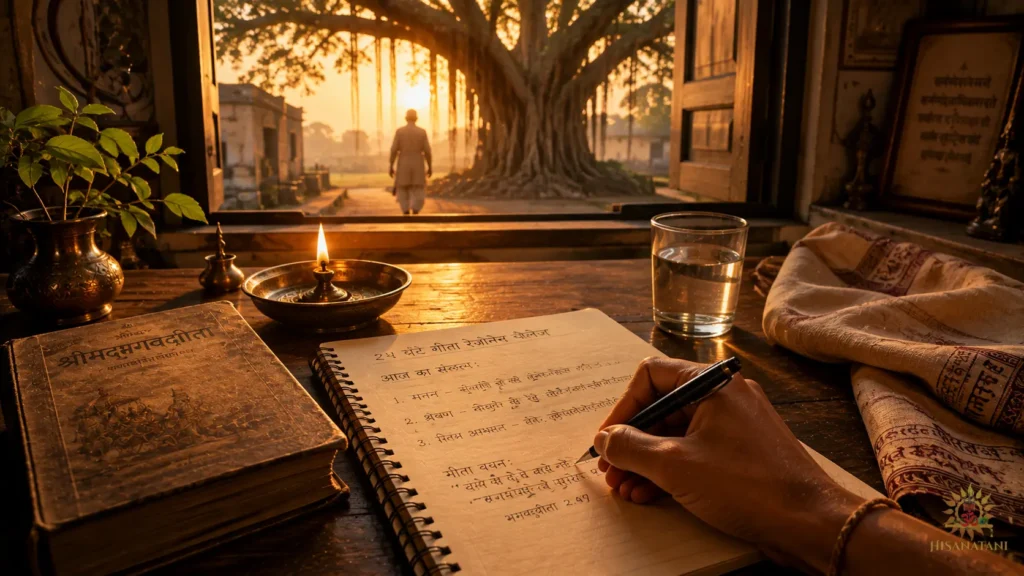
Bhagavad Gita 1.42 Summary isn’t asking you to reject modern life. It’s asking one honest question: are you becoming more yourself, or just easier for the world to define?
You don’t need to abandon your phone or memorize every ritual perfectly. You just need to start listening for the signal underneath the noise. Here’s your 24-hour challenge from the Summary of Bhagavad Gita 1.42.
Challenge 1: Sit with your story for fifteen minutes. Phone on airplane mode. Notebook out. Write without editing yourself. Which values did your family pass on without ever saying so out loud? Which patterns should end with you?
Challenge 2: Ask an elder for one story, not one opinion. Call a parent, a grandparent, an older relative. Ask: “What moment changed your life?” or “What do you hope my generation never forgets?” Then just listen. No rebuttal prepared.
Challenge 3: Build one ritual that reminds you who you are. One verse read each morning. A silent breath before meals. Five minutes of stillness before the first scroll of the day. A single sentence each night starting with, “Today I felt most like myself when…”
By tonight, ask yourself one thing: did I spend today becoming visible to the world, or becoming real to myself? That question is the practical heartbeat of Bhagavad Gita Chapter 1 Verse 42.
Your Soul Is Older Than Your Identity
The world keeps moving. New technology, new careers, new cultural waves rising and fading like tide. None of that is the real problem.
The real question is whether your center moves with every wave too.
Arjuna’s worry was never really about ceremonies. It was about protecting the current that carries wisdom from one generation into the next. When that current thins out, people start hunting for identity through consumption, comparison, and constant reinvention.
But identity was never something the soul manufactures. It’s something you remember, slowly. Your roots aren’t prison walls. They’re the channel gratitude and purpose keep flowing through.
Some traditions deserve honest reform. Others deserve careful protection. The Gita asks for discernment — not blind rejection, not blind obedience.
So instead of asking “Where do I belong?” — try the quieter question: “What in me has never actually stopped belonging?”
Please let me know in the comments.
Embrace the Teachings of the Gita. Dive deeper into the Bhagavad Gita to uncover its timeless wisdom and practical guidance. Let its verses inspire you to cultivate inner clarity, align with higher values, and navigate life’s challenges with courage and grace.
🌼 Join the HiSanatani WhatsApp Channel for your daily dose of light 🪔. Join Now.
Voice of the Soul
Finding clarity in the questions we all carry…
What is the main message of Bhagavad Gita 1.42?
It warns that when a family’s shared values break down, identity, gratitude, and inner stability break down too. See The Kite That Forgot Its String.
Why does Arjuna talk about ancestors in Bhagavad Gita Chapter 1 Verse 42?
Ancestors represent continuity — the sense that your life didn’t begin with your birth, and losing that connection means losing a sense of where you came from. Explored further in Kurukshetra Was Also a Battle for Memory.
How does Bhagavad Gita 1.42 relate to identity confusion today?
Modern identity leans heavily on trends and online approval, while the Gita points to something steadier underneath all that noise. Dig into this in When the Inner Compass Stops Whispering.
Does BG1.42 say we should follow every tradition blindly?
No — it asks for conscious remembrance rather than mechanical repetition, a distinction unpacked in The Soul Never Forgets the Song It Came With.
What’s one practical step a young adult can take from BG1.42?
Start with something small and repeatable — a daily ritual or one honest conversation with an elder — rather than overhauling your whole identity at once. Full steps in The 24-Hour Gita Resonance Challenge.
