
Namaste 🙏
Welcome to Hi Sanatani. It’s a joy to have you here as we explore the deeper layers of human nature. By diving into this Bhagavad Gita 2.4 Summary we create a sacred bridge together, turning ancient verses into helpful tools for your personal growth and peace.
Translation of Bhagavad Gita Shloka Verse 2.4 in English:
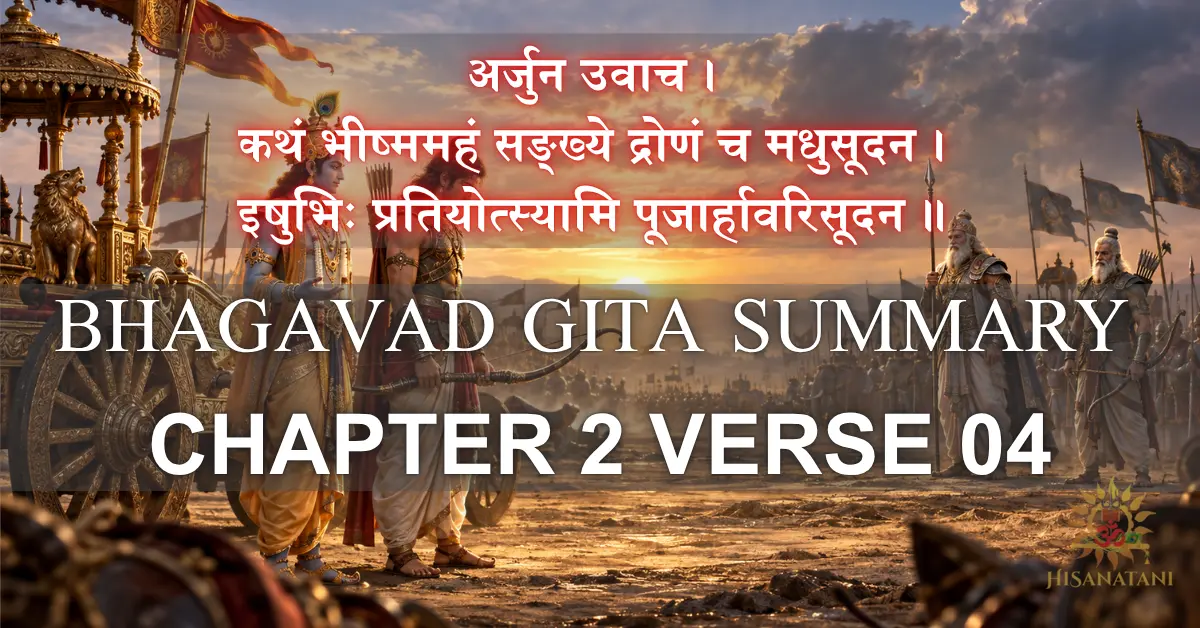
कथं भीष्ममहं सङ्ख्ये द्रोणं च मधुसूदन ।
इषुभिः प्रतियोत्स्यामि पूजार्हावरिसूदन ॥ २.४ ॥
In English :
kathaṁ bhīṣmam ahaṁ saṅkhye droṇaṁ ca madhusūdana
iṣubhiḥ pratiyotsyāmi pūjārhāv ari-sūdana
Feel the Vibration: A Guided Chant of Bhagavad Gita Chapter 2 Verse 4:
- kathaṁ bhīṣmam ahaṁ saṅkhye droṇaṁ ca madhusūdana
Ka-tham Bhīsh-mam a-ham sankh-ye
Dro-nam cha ma-dhu-sū-da-na - iṣubhiḥ pratiyotsyāmi pūjārhāv ari-sūdana
I-shu-bhih pra-ti-yot-syā-mi
Pū-jār-hāv a-ri-sū-da-na
English Translation:
“Arjuna said: O Madhusudana, how can I counter-attack with arrows in battle against men like Bhishma and Drona, who are worthy of my worship, O destroyer of enemies?”
JOIN THE HISANATANI COMMUNITY
Get daily Verse Summaries & High-Res Posters directly on your WhatsApp.
JOIN CHANNELWhy Bhagavad Gita Chapter 2 Verse 4 Still Wrecks People at Work
Here’s the thing nobody tells you about growing up: at some point, someone who shaped you will ask something of you that your gut refuses. Maybe it’s a senior leader hiding bad news. Maybe it’s the person who gave you your first real job, now asking you to look away from something wrong.
Your chest tightens. You start rehearsing sentences you’ll never say out loud, then deleting them before you even send them. Arjuna felt that exact freeze, standing in front of the two men who made him who he is.
Bhagavad Gita 2.4 isn’t really about a battlefield. It’s about the specific, suffocating guilt of disagreeing with someone you owe — and the quiet fear that speaking up erases everything they once gave you.
The Coach Who Taught You to Play Fair — Then Broke the Rules
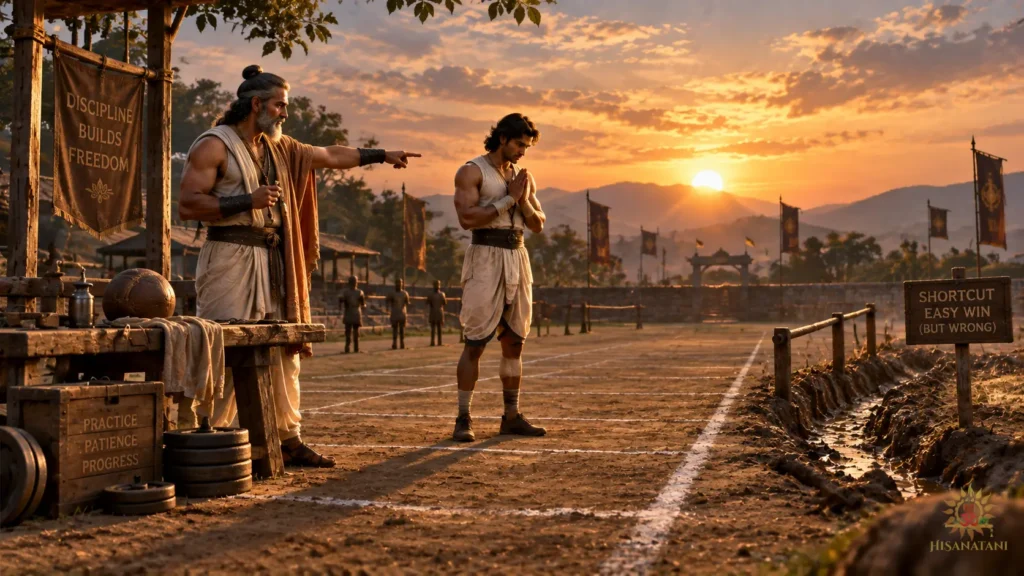
Picture the coach who taught you to play the game right. He showed up early, stayed late, believed in you before you believed in yourself. Then one day, during the biggest match of the season, he tells you to fake an injury to slow the other team down.
You freeze. Not because you don’t know the answer — cheating is cheating — but because saying no to him feels like betraying everything he gave you.
Here’s what a kid eventually figures out, and what a lot of adults forget: you can love your coach and still refuse the play. Those aren’t opposites. Respecting someone’s past doesn’t mean rubber-stamping their present.
Arjuna is standing in that exact spot, just with far higher stakes. Bhishma and Drona taught him everything he knows about fighting. But knowing someone, even owing them everything, doesn’t make their instruction automatically right. A good coach, deep down, doesn’t actually want a player who agrees with everything. He wants one who plays the game straight — even when that means telling him he’s wrong.
Kids get this faster than adults do, mostly because they haven’t yet learned to confuse gratitude with obedience. That confusion tends to arrive later — usually the first year of a real job.
Gratitude Isn’t a License

Arjuna’s real question isn’t “can I fight.” It’s “does this relationship decide what’s right.” That’s a much bigger question than it sounds.
We like to think respect and rightness travel together — that the more someone has done for us, the more automatically correct their decisions become. But that’s backwards. Bhishma and Drona are pūjārhau, worthy of worship, and Arjuna still has to ask the question. Their worthiness doesn’t answer it for him.
Dharma — your actual duty — doesn’t check your gratitude before deciding what’s right. That sounds harsh until you notice the alternative: a world where the people who’ve done the most for you get to be wrong the most freely, simply because of what they’ve already given.
Real loyalty says, “I respect you enough to tell you the truth.” Blind allegiance says, “I’ll defend you no matter what, because you’re you.” The first protects the relationship. The second usually ends up protecting nobody — not the mentor, not the truth, and eventually not you either.
Arjuna hasn’t worked this out yet in bg2.4. He’s still tangled. But asking the question honestly is already a harder, more mature move than either fighting blindly or refusing outright.
The Approval Trap No One Names

Sit with this question: if this person could never affect your job, your reputation, or your next promotion, would you still feel unable to disagree with them?
For a lot of people, the honest answer is no. What gets called “respect” is sometimes closer to dependency — you’ve quietly wired your sense of safety to someone else’s opinion of you. Their approval lifts you. Their silence makes you replay a five-minute conversation for six hours afterward.
Arjuna calls his freeze reverence. It might partly be. But look closer and there’s fear tangled in there too — fear of becoming the person who disappointed Bhishma, who let down his own teacher. That fear dresses itself up as loyalty in Bhagavad Gita 2.4 because loyalty sounds nobler than admitting you’re scared of losing someone’s approval.
The way out isn’t rebellion. It’s separating the person from the problem. Not “my mentor is wrong,” but “this specific decision creates this specific risk.”
The person disappears from the sentence. The issue becomes visible. That shift alone makes disagreement feel less like betrayal and more like what it actually is — professional honesty.
Your Worth Isn’t Their Job Title

There’s a subtler trap hiding in this verse Bhagavad Gita 2.4, and it isn’t really about violence. It’s about attachment to roles.
Bhishma is grandfather. Drona is teacher. Those identities are real, and they matter. But the Gita keeps nudging us toward something underneath every title: the Atman, the part of you that isn’t your job description, your years of service, or anyone’s opinion of you.
When you quietly believe your mentor is the source of your worth, disagreeing with them starts to feel like disappearing. When you believe your boss’s approval defines your value, you’ll tolerate things that should bother you a lot more than they do.
But you can bow to someone without shrinking in front of them. You can honor what someone taught you without handing over your conscience along with your thanks. That isn’t coldness — it’s actually a cleaner form of respect, because it isn’t propped up by fear.
Arjuna hasn’t reached that steadiness yet. He’s still seeing Bhishma and Drona through every role they’ve ever held for him — grandfather, teacher, protector, elder. Untangling the person from the role is slow work, and it doesn’t happen in a single conversation or a single verse. But it’s the only way to stay both respectful and honest at the same time, instead of quietly picking one and calling it a virtue.
Kurukshetra Wasn’t a Stranger’s War

Zoom out from the metaphor in Bhagavad Gita Chapter 2 Verse 4 for a second and look at what’s literally happening. Bhishma isn’t a stranger — he held Arjuna as a child. Drona isn’t a random general — he spent years shaping Arjuna into the finest archer of his era.
In the customs of the time, a warrior would send an arrow near an elder’s feet before battle, a small gesture of respect before the real fighting started. Arjuna is talking about something else entirely — pratiyotsyāmi, striking back for real, to win.
This wasn’t a border dispute. Kurukshetra existed partly because people with power, Bhishma and Drona among them, had stayed silent while injustice happened in plain sight — most infamously during Draupadi’s humiliation in open court. Their silence back then is part of why this battle exists now.
That detail should change how you read modern versions of this same standoff. When someone resists confronting a senior leader they admire, they’re rarely just being difficult or scared. They’re usually caught between two things they consider sacred: the relationship, and the truth. Understanding that difference, before judging the hesitation, is where real leadership actually starts — on a battlefield or in a boardroom.
The 24-Hour Gita Challenge — Speak Without Betraying Yourself

Don’t leave Summary of Bhagavad Gita 2.4 in theory. Take one real situation — a decision from a senior leader or mentor that’s been sitting wrong in your stomach — and run it through this today.
Step 1: Separate the person from the decision. Open a blank page and draw two columns. On one side, write what you genuinely respect about them — what they taught you, what they’ve done for you. On the other, write exactly what you disagree with, and why.
Don’t let the columns mix. You’ll often discover you don’t actually resent the person. You disagree with one decision.
Step 2: Replace emotion with evidence. Swap “I think this is a mistake” for something like: “These renewal numbers have dropped for two quarters straight. I’d like us to test a different approach before we scale the current one.”
One sentence attacks a person. The other one just describes reality.
Step 3: Have the conversation inside 24 hours. Not after three weeks of rehearsing it with everyone except them. Start with genuine respect, state the concern plainly, share your evidence, then actually listen to their answer.
You’re not trying to win an argument. You’re trying to stay someone who tells the truth to the people they respect most, because that’s rarer, and more valuable, than someone who simply agrees.
The Real Courage BG2.4 Is Pointing At
Arjuna’s question doesn’t get resolved in Bhagavad Gita 2.4 — that’s still chapters away. But it does something important: it puts language on a conflict most of us carry quietly for years. Respect and responsibility aren’t supposed to be enemies. The moment you stop confusing gratitude with obedience, and start honoring people while still telling them the truth, you get to keep both — the relationship and your own integrity.
That’s the real courage this Summary of Bhagavad Gita 2.4 is pointing toward. Not the courage to fight. The courage to stay honest with the people who made you.
Arjuna will keep talking. Krishna will keep answering. Chapter 2 has a long way to go before either of them reaches clarity — and so might you, on whatever version of this conflict you’re carrying right now.
That’s fine. The point was never to resolve it in one sitting. The point was to stop pretending it isn’t there.
Please let me know in the comments.
Embrace the Teachings of the Gita. Dive deeper into the Bhagavad Gita to uncover its timeless wisdom and practical guidance. Let its verses inspire you to cultivate inner clarity, align with higher values, and navigate life’s challenges with courage and grace.
🌼 Join the HiSanatani WhatsApp Channel for your daily dose of light 🪔. Join Now.
Voice of the Soul
Finding clarity in the questions we all carry…
What is the main message of Bhagavad Gita 2.4?
Arjuna asks Krishna how he can fight Bhishma and Drona, men he deeply reveres, even though duty demands it. The verse captures the exact moment respect for a person collides with responsibility to act, and it refuses to offer an easy answer for either side. That collision is explored further in Philosophical Perspective: Gratitude Isn’t a License.
Why does Arjuna hesitate to fight Bhishma and Drona?
Because they aren’t strangers — Bhishma raised him, Drona trained him. His hesitation comes from genuine reverence, not fear of battle. That relational weight is unpacked in Historical Perspective: Kurukshetra Wasn’t a Stranger’s War.
What does Bhagavad Gita 2.4 teach about disagreeing with a mentor or senior leader?
It teaches that gratitude and obedience aren’t the same thing. You can honor someone’s role in your life while still questioning a specific decision. For a grounded example, see Simple Perspective: The Coach Who Taught You to Play Fair — Then Broke the Rules.
How can I confront authority without feeling disloyal?
Separate the person from the decision, replace emotional language with evidence, and have the conversation soon rather than rehearsing it for weeks with everyone except the person involved. Disloyalty and disagreement only feel identical when the issue and the relationship stay tangled together. The full three-step method is in Practical Perspective: The 24-Hour Gita Challenge.
Is disagreeing with someone always a sign of disrespect?
No — sometimes it’s the opposite. Silent agreement can come from fear of losing someone’s approval, not genuine respect. That pattern is broken down in Psychological Perspective: The Approval Trap No One Names.
