
Namaste 🙏
Welcome to Hi Sanatani. It’s a joy to have you here as we explore the deeper layers of human nature. By diving into this Bhagavad Gita 2.5 Summary we create a sacred bridge together, turning ancient verses into helpful tools for your personal growth and peace.
Translation of Bhagavad Gita Shloka Verse 2.5 in English:
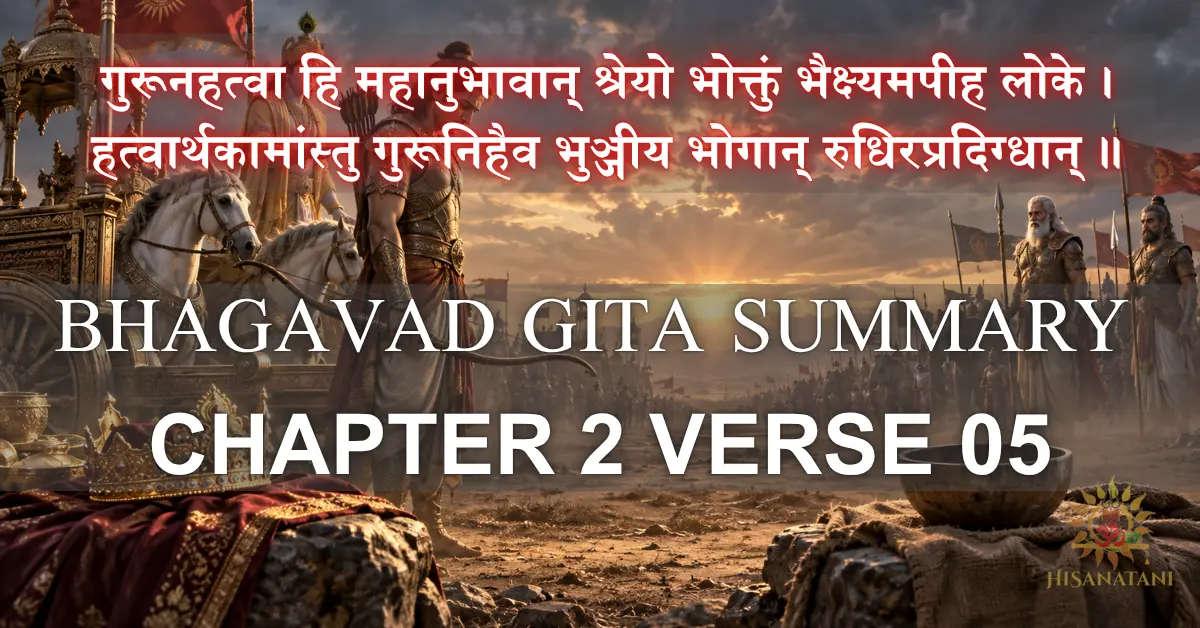
गुरूनहत्वा हि महानुभावान्
श्रेयो भोक्तुं भैक्ष्यमपीह लोके ।
हत्वार्थकामांस्तु गुरूनिहैव
भुञ्जीय भोगान् रुधिरप्रदिग्धान् ॥ २.५ ॥
In English :
gurūn ahatvā hi mahānubhāvān
śreyo bhoktuṁ bhaikṣyam apīha loke
hatvārtha-kāmāṁs tu gurūn ihaiva
bhuñjīya bhogān rudhira-pradigdhān
Feel the Vibration: A Guided Chant of Bhagavad Gita Chapter 2 Verse 5:
- gurūn ahatvā hi mahānubhāvān
Gu-rūn a-hat-vā hi ma-hā-nu-bhā-vān - śreyo bhoktuṁ bhaikṣyam apīha loke
Śre-yo bhok-tuṁ bhaik-ṣyam a-pī-ha lo-ke - hatvārtha-kāmāṁs tu gurūn ihaiva
Hat-vār-tha-kā-māṁs tu gu-rūn i-hai-va - bhuñjīya bhogān rudhira-pradigdhān
Bhuñ-jī-ya bho-gān ru-dhi-ra-pra-dig-dhān
English Translation:
“It’s better to live on alms in this world than to kill these noble-souled teachers. Even if they’re chasing wealth and comfort, they’re still my gurus. And every pleasure I’d enjoy after killing them would be stained with their blood.”
JOIN THE HISANATANI COMMUNITY
Get daily Verse Summaries & High-Res Posters directly on your WhatsApp.
JOIN CHANNELWhy Leaving Feels Like Betrayal (Even When It Isn’t)
Be honest. Some nights it isn’t the workload that flattens you. It’s the arguing.
One voice says, “I can’t do another year of this.” The other says, “After everything she did for me?” So you answer a 10:40 p.m. message with “On it,” close the laptop, and the argument picks up again in the dark. No calendar invite ever blocks time for this part.
That’s not weakness. It’s what happens when gratitude and self-preservation live in the same head and neither one will back down.
Arjuna’s stuck in that exact argument in this Bhagavad Gita 2.5. He’s the finest archer alive, not a man hunting for an excuse. Actually, that’s what makes it hurt.
You’re not the first person to sit there at midnight doing the math on loyalty. You won’t be the last. Feeling torn doesn’t make you a bad person. It means those people mattered.
Thank the Old Shoes, Then Run the Race in New Ones

Picture a nine-year-old and his first proper pair of school shoes. Papa saved for two months to buy them. They carried him through monsoon puddles, cricket in the lane, the sports-day race. He loved those shoes.
Then one morning his toes hit the front. Pinch. Blister. By afternoon he’s limping.
Now he’s got a choice. He can say, “These shoes did so much for me, I’ll never take them off,” and limp through the whole year. Or he can say thank you, wipe them clean, park them on the shelf, and put on a pair that fits.
That’s Arjuna in this BG2.5, more or less. “These people gave me everything. I’d rather walk barefoot, even beg, than go against them.” Big heart. Not much of a plan.
And he’s not wrong to feel it. He’s just about to learn that feeling something and deciding something are two separate jobs.
Here’s what the nine-year-old figures out sooner or later: being grateful to the shoes and outgrowing the shoes can happen on the same day. Gratitude looks backward. Growth looks forward. Neither one cancels the other.
Bring that to your desk. The first manager who trusted you, the team that felt like family, they earn a permanent spot on the shelf. But “I’m grateful” and “I’m staying” are two different sentences. You’re allowed to say just one of them.
Try saying it out loud once: “Thank you for everything you taught me. I’m also ready for something different.” Notice it’s one breath. Two true things. Nobody has to lose for both to stand.
The Win That Costs More Than the Loss

Look at Arjuna’s math in Bhagavad Gita 2.5 summary. Option one: fight, win the kingdom, enjoy it. Option two: refuse, live on alms, keep his hands clean. He picks option two, because he can smell what option one really costs.
Think of a “zero-cost EMI.” Looks free. Then the processing fee shows up in the fine print, and the interest was baked into the price all along.
Arjuna’s saying the same about victory in BG2.5. The prize looks free, but the bill arrives later, in the form of who you’d have to become to collect it. That’s what “stained with blood” means here.
And notice the detail people skip. He says this even though these teachers are chasing wealth and position on Duryodhana’s side. They’re not saints, and he knows it. The cost doesn’t shrink just because the other person isn’t perfect.
That’s real philosophy, and the Gita doesn’t laugh at it. Dharma isn’t whatever feels comfortable. It’s what’s right, and right doesn’t get cheaper because it hurts.
You’ve seen the small version. Someone gets the promotion because they stayed quiet while a teammate took the blame.
The title’s real. The salary’s real. So is the little knot in their stomach every time that teammate walks past. Same fee, smaller print.
But here’s the catch. Refusing everything has a bill too. Doing nothing is also a choice, and it lands on people who are counting on you. Krishna won’t call Arjuna’s values wrong. He’ll call his conclusion unfinished.
So the honest question isn’t “which option hurts less?” It’s “which option can I live with when nobody’s watching?” Ask it once this week. Out loud, if you can.
Guilt Is Information, Not an Order

Guilt works like a background app. You’re not looking at it, but it’s draining the battery all day.
Here’s how it plays out. You’ve got another option on the table. Better role, saner hours.
But your manager stood by you once, so the resignation sits in your drafts for three weeks. You open job portals, close them, open them again. Freeze.
That’s not indecision. It’s a mind trying to answer “what should I do?” with the question “what kind of person does that make me?” Two different questions, and mixing them is where the paralysis comes from.
You’re not alone in this. Glassdoor’s 2026 look at employee reviews found that burned-out workers who still liked their employers applied for about 45% fewer jobs in 2025 than their happier peers. Some of that is a frozen market. Some of it is guilt holding the door shut.
Arjuna’s doing the same thing. His attachment is deciding what the facts mean before he’s even looked at them.
Watch for the verdict words: ungrateful, selfish, disloyal. They sound like facts. They aren’t. They’re sentences your guilt wrote in advance, and you never got to appeal.
Try pulling three questions apart. What do I feel? (Guilt, fear, maybe love.)
What’s actually true today? (The role’s changed, my health’s slipping.) What’s mine to do about it?
Feel first. Check facts second. Choose third. Guilt gets a vote. It doesn’t get the final say.
It won’t feel brave. It’ll feel boring. That’s how you know it’s working.
One more thing. If the anxiety is constant and it’s hitting your sleep or appetite, talk to a professional. That isn’t a failure of faith. It’s smart.
Who Are You When the Job Title Disappears?

Here’s a question worth sitting with: if your title vanished tomorrow, who’s left?
Think about your mobile number. You’ve switched networks, cities, plans. The number stayed yours. Nobody who loves you calls the network. They call you.
The Gita’s word for that part of you is the Atman, the self that isn’t the job, the team, or the LinkedIn headline. Those are the network. You’re the number. Networks get bought, merged, shut down. The number ports.
This matters because loyalty can quietly turn into identity. “I’m the dependable one.” “They need me.” “Without this place, who am I?”
Some loyalty is love. Some is just the fear of being the person who caused the awkward conversation.
Now notice something. Arjuna’s reverence isn’t the problem. It’s beautiful, and the Gita never asks him to drop it.
Watch what he does two verses from now, in 2.7: he stops arguing and tells Krishna, “I’m your student. Teach me.”
Same reverence. New direction. Devotion at its best is warmth without a leash.
That’s the spiritual move. Surrender isn’t giving in to your boss’s expectations. It’s letting go of the ego’s need to control how everyone reacts, and acting from what’s true anyway.
Try this tonight. Finish the sentence “I am…” without using a job title, a company, or a relationship. Harder than it sounds, right? That pause is exactly where the work is. Whatever you land on is closer to the number than the network.
You can thank someone for building you and still not need their permission to become who you’re becoming.
Why Bhishma and Drona Were Never Neutral

Don’t pull this Bhagavad Gita Chapter 2 Verse 5 out of Kurukshetra. It loses its edge.
Drona taught Arjuna the bow. Bhishma looked after the Pandava boys from childhood. Those two are a big part of why Arjuna is who he is.
But here’s what the epic never hides. Both men had picked a side. Both sat in the Kuru court while Draupadi was humiliated, and neither stopped it.
And when Yudhishthira crossed the battlefield before the war to ask for their blessings, each told him plainly that the wealth and protection of the Kauravas had them bound. Bhishma said it in nearly those words. Drona said much the same.
Read Bhagavad Gita 2.5 with that in mind and the phrase about chasing wealth (artha-kāma) hits differently. Arjuna knows their reasons. He isn’t blind. He just can’t switch respect off.
Real life runs the same way. Think of a company you love that’s quietly making bad calls. The people you trust most inside it are often the last to say so out loud, because their paycheck lives there too.
The mentor who trained you can be a good person and still work inside a system that isn’t good for you, or for anyone under them. Your gratitude for the person doesn’t have to mean you sign off on the setup. Keep the respect. Question the setup. Both can be true on the same Monday.
Does that make Drona and Bhishma villains? No. Does it make Arjuna wrong to grieve? Also no.
It just means the situation was never as clean as “loyal student versus bad teachers.” It’s messier than that. And Krishna’s about to pull on exactly that thread.
The 24-Hour Gita Challenge for When You Feel Trapped

Don’t ask “should I quit?” Not yet. That’s a 3 a.m. question. Ask “what’s true right now?” and run this today.
Step 1: Two lists, ten minutes (morning). Open your notes app. Head one list “What they gave me.” Head the other “What this role costs me right now.”
Be specific. Names, dates, late nights, rupees, hours of sleep. Don’t blend the lists. You’re allowed to be grateful and exhausted at the same time.
Example: “She stayed back three evenings to teach me client decks” sitting next to “11 p.m. calls, three weekends this month.”
Step 2: The forwarded message (afternoon). Write your situation in three lines, as if your best friend just sent it to you. Then write back what you’d tell them. Read it out loud. Funny how we hand friends better advice than we hand ourselves.
Step 3: One bridge move, thirty minutes (evening). Pick exactly one. Work out your runway (savings divided by monthly expenses gives you the months you can breathe).
Or update your résumé. Or message one person in your field just to say hi. Or draft one boundary sentence, like “I can’t take weekend work anymore,” and don’t send it yet.
That’s it. No resignation letter. No confrontation. No big speech to the mirror.
Why this order? Because the lists keep you honest, the friend test clears the fog, and the bridge move gives you options. Options are what shrink guilt down to size.
The goal isn’t “quit.” It’s “stop feeling trapped.”
You might stay, with a boundary. You might ask for a new project. You might leave in six months, with a handshake and a plan. Prepare first. Decide second.
The Victory You Can Live With
Arjuna picks the beggar’s bowl because it feels like the only way to stay clean. Krishna’s answer is coming after this Summary of Bhagavad Gita 2.5, and it isn’t “stop caring.” It’s bigger than that.
Until then, hold onto this. Gratitude is real. Guilt is real. So is rent. None of them gets to run your life alone.
Maybe you stay, with better boundaries. Maybe you ask for a different role. Maybe you build quietly and leave when the market breathes. Whatever you choose, choose it awake, not because guilt happened to be louder than fear today.
If nobody’s told you this yet: you’re not a traitor for wanting more room. And you’re not a fool for staying loyal, either. Arjuna’s whole story starts right here, with someone who cares too much to move. It goes somewhere good.
Tomorrow morning you’ll still have the same inbox. What changes is who’s holding the pen. Start with one small step from the challenge above. The rest can wait.
Thank the people who built you. Just don’t hand them the pen for what you write next.
Please let me know in the comments.
Embrace the Teachings of the Gita. Dive deeper into the Bhagavad Gita to uncover its timeless wisdom and practical guidance. Let its verses inspire you to cultivate inner clarity, align with higher values, and navigate life’s challenges with courage and grace.
🌼 Join the HiSanatani WhatsApp Channel for your daily dose of light 🪔. Join Now.
Voice of the Soul
Finding clarity in the questions we all carry…
What is the main message of Bhagavad Gita 2.5?
Arjuna would rather live by begging than win a kingdom by killing his teachers. The Bhagavad Gita 2.5 shows gratitude, duty, and survival colliding in one heart. For the logic behind his refusal, read The Win That Costs More Than the Loss.
What does Bhagavad Gita Chapter 2 Verse 5 teach about loyalty?
Loyalty and gratitude are real, but they aren’t ownership. You can honor someone who helped you and still ask what’s right today. Start with Thank the Old Shoes, Then Run the Race in New Ones.
How does BG2.5 apply to workplace burnout?
Burnout gets heavier when guilt blocks every decision. The Bhagavad Gita Chapter 2 Verse 5 shows how attachment clouds judgment, and the fix starts with separating feelings from facts. See Guilt Is Information, Not an Order.
Does Bhagavad Gita 2.5 mean you should quit a toxic job?
No. It records Arjuna’s dilemma; it doesn’t order anyone to resign. Krishna’s answer comes in the verses that follow. For a grounded next step, try The 24-Hour Gita Challenge.
Why does Arjuna mention begging in Bhagavad Gita 2.5?
Begging is his extreme comparison: even poverty seems cleaner than wealth won by killing his teachers. He isn’t praising poverty, he’s refusing the price. The backstory is in Why Bhishma and Drona Were Never Neutral.
