
Namaste 🙏
Welcome to Hi Sanatani. It’s a joy to have you here as we explore the deeper layers of human nature. By diving into this Bhagavad Gita 2.8 Summary we create a sacred bridge together, turning ancient verses into helpful tools for your personal growth and peace.
Translation of Bhagavad Gita Shloka Verse 2.8 in English:
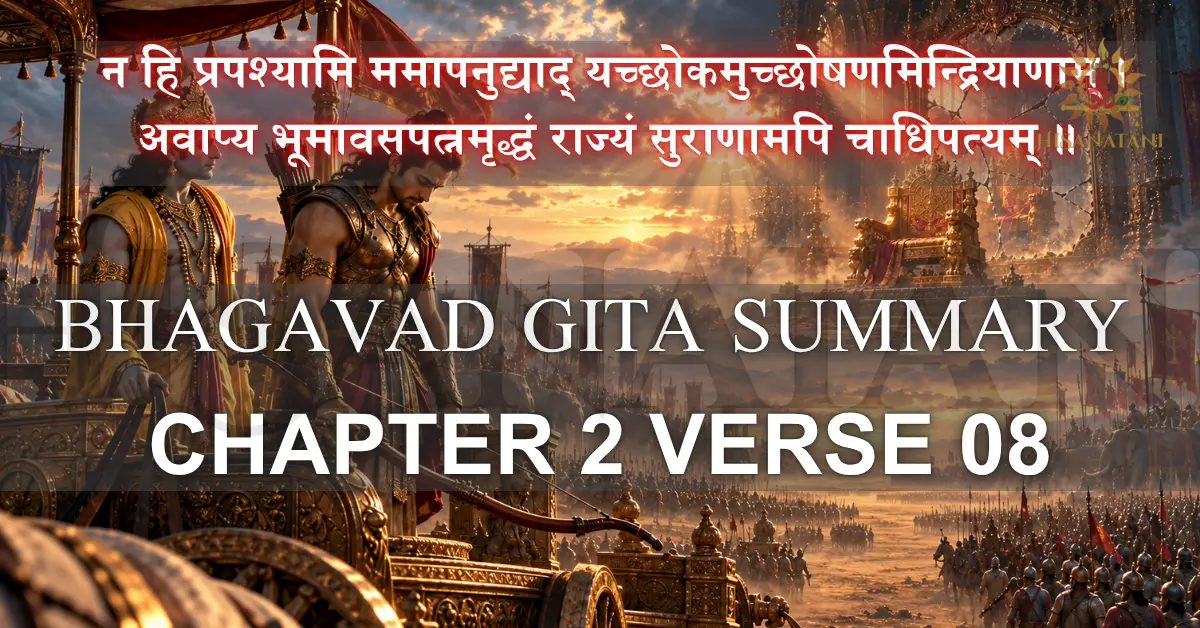
न हि प्रपश्यामि ममापनुद्याद् यच्छोकमुच्छोषणमिन्द्रियाणाम्।
अवाप्य भूमावसपत्नमृद्धं राज्यं सुराणामपि चाधिपत्यम्॥ २.८॥
In English :
na hi prapaśyāmi mamāpanudyād yac chokam ucchoṣaṇam indriyāṇām |
avāpya bhūmāv asapatnam ṛddhaṃ rājyaṃ surāṇām api cādhipatyam ||
Feel the Vibration: A Guided Chant of Bhagavad Gita Chapter 2 Verse 8:
- na hi prapaśyāmi mamāpanudyād yac chokam ucchoṣaṇam indriyāṇām |
Na hi pra-pash-yaa-mi ma-maa-pa-nud-yaad
yach cho-kam uch-cho-sha-nam in-dri-yaa-naam - avāpya bhūmāv asapatnam ṛddhaṃ rājyaṃ surāṇām api cādhipatyam ||
a-vaa-pya bhoo-maa-v a-sa-pat-nam rid-dham
raaj-yam su-raa-naam a-pi chaa-dhi-pat-yam
English Translation:
“I don’t see anything that could drive out this grief that’s drying up my senses, even if I won a thriving, rival-free kingdom on earth and lordship over the gods.”
JOIN THE HISANATANI COMMUNITY
Get daily Verse Summaries & High-Res Posters directly on your WhatsApp.
JOIN CHANNELYou’re Not Ungrateful. You’re Running on Empty.
Let’s be honest. You can be the top performer on your team and still feel numb. You close the laptop after a big win and feel nothing but tomorrow’s to-do list.
Then guilt walks in: I should be grateful. Now you’re tired and ashamed of being tired.
Stop. That’s not ingratitude. It’s a mismatch. You asked a promotion to answer a question it was never built to answer.
Arjuna had the pedigree, the skills and a shot at an empire. He still said it out loud: this won’t fix it. If a prince can admit that, so can you.
Here’s the plan. Six angles on one verse, then one 24-hour experiment you can start tonight.
Why a Shiny Phone Case Can’t Fix a 2% Battery

Picture a ten-year-old whose tablet is at 2%. It’s dying. He’s panicking.
His uncle walks in and says, “Look, I bought you a gorgeous new case. Metallic blue. It lights up.”
The kid loves it. For about ten minutes. Then the screen goes black anyway.
Was the case bad? No. Was the kid silly for liking it? Of course not. It just can’t do the charger’s job.
That’s Arjuna in Bhagavad Gita 2.8. He’s looking at the shiniest cases in the universe, a kingdom, even rule over heaven, and saying: none of these is a charger.
Now swap in your own life. The promotion is a nice case. The raise is a better case. Both are real. Both feel great on day one.
But if you secretly expect them to fix the 2% inside (loneliness, the fear of not being enough, the constant tired), they’ll fail. Every time. And you’ll blame yourself instead of the case.
Try this before your next big goal: What exactly do I expect this to fix? If the answer is “my income,” wonderful. Make a plan.
If it’s “finally feeling worthy,” hold on. You’re about to buy a case for a dead battery.
Kids get this fast. They know a charger from a cover. Adults? We keep buying covers. Enjoy the case. Just go find the charger.
Why You Can’t Pay Inner Bills with Outer Currency

Think about Credit card with lounge facility. They’re worth something. Real flights, real upgrades.
But try getting discount for groceries with them. Declined. These credit cards aren’t fake. They’re just the wrong currency.
That’s the philosophical heart of Bhagavad Gita Chapter 2 Verse 8. Titles, salary and influence are real currency in the outer economy. Grief and meaning run on a different one.
Look at what Arjuna imagines: a kingdom with no rivals (asapatnam, literally “without enemies”) and lordship over the gods. That’s the top of every ladder he knows. And he says: still no.
Here’s where we go wrong. We treat every question like a work problem. A spreadsheet for money? Perfect. A spreadsheet for “who am I when I’m not producing?” It just sits there blinking.
A salary answers “Can I afford this?” It stays silent on “Is this life worth living?” A promotion tells you what you’re responsible for. It never tells you who to be while you carry it.
Don’t misread this as “quit and give everything away.” Nothing in BG2.8 says that. Arjuna isn’t rejecting the world. He’s noticing it can’t do every job we hand it.
The later chapters build on this. Krishna will move to the Self, and to action without clinging to results. But the first move belongs to Arjuna: admit the currency doesn’t match.
So sort your problems. Which are outer ones, solvable with effort? Which are inner ones, where more effort in the same direction just burns you out faster? That sorting alone cuts through a lot of noise.
Why Your Finish Line Keeps Moving (and How to Stop Chasing It)

Ever hit a goal you chased for two years and felt relief for about a lunch break? Then the next worry slid in. That’s not weakness. That’s wiring.
Psychologists have names for this. Hedonic adaptation: good things become normal fast. Social comparison: you stop measuring yourself against last year’s you and start measuring against someone’s LinkedIn post. Contingent self-worth: your value depends on staying above some bar.
Arjuna wasn’t diagnosing any of these. But the pattern rhymes.
Think of a GPS that reroutes the second you arrive. “You have reached your destination.” Then: “Continue to the next destination.” That’s your mind after every promotion.
Manager? Now director. Director? Now VP. The security you were promised stays one exit ahead.
BG2.8 hits pause right there. Arjuna can’t name a prize that would end his grief. Which means the prize was never the fix.
So separate two things. The problem you can solve: salary, skills, role. And the feeling you hope solving it will delete: I’m enough. Make a plan for the first. Question the second.
Three quick questions:
What real need does this goal meet?
What exactly do I expect to feel when I get it?
If that feeling fades in a week, will I just pick a new goal?
One honest note. If numbness, anxiety or loss of interest sticks around, talk to a qualified mental-health professional. Spiritual reflection can sit beside that help. It doesn’t replace it.
Ambition isn’t the enemy. A nonstop referendum on your worth is.
You Are Not Your Email Signature

Quick question. Who are you when nobody’s evaluating you?
Not at the review. Not at the family dinner where your designation gets announced. Just you, lights off.
Think about your email signature. Name, title, company. It changes every time you switch jobs. You don’t.
Your face didn’t get replaced when your title did. Yet somewhere along the way, many of us start treating the signature as the person.
The Gita’s spiritual answer is the Ātman, the Self that isn’t the same as your body, your role or your résumé. Krishna builds that teaching properly from 2.11 onward. BG2.8 isn’t the full lesson. It’s the crack in the wall. If worldly power can’t settle what’s hurting inside, what am I missing?
Take someone who’s spent ten years becoming indispensable. Praise is their oxygen. Then a restructuring wipes out the role. The loss is real. But the collapse feels total because role and self were glued together.
Spiritual practice loosens the glue. Not by quitting. You still show up prepared. You still own your mistakes. But you stop asking applause to carry your whole identity.
If you’re devoted to Krishna, this can mean prayer, remembering Him before a big meeting, offering the work itself. Grace isn’t a deal where ritual guarantees promotions. It’s trust. Humility. Staying open.
Your work can express your values. It can’t be your whole foundation. The world will know you by your title. You don’t have to forget yourself inside it.
What Was Really Happening on That Chariot at Kurukshetra

Forget the calm painting version. Picture the real scene. Dust. War horns. Thousands of men waiting for a signal.
Arjuna asks Krishna to park the chariot between the two armies (1.21–22). Then he looks closely. Teachers. Cousins. Elders he grew up with.
In chapter 1 (verses 28–30), his limbs give way, his mouth goes dry, the bow slips from his hand. Earlier still, he’d said he didn’t even want the kingdom (1.32).
Krishna pushes back in 2.2 and 2.3. Arjuna argues. Then comes 2.7, the surrender: I’m confused. Teach me.
And then bg2.8. Look at the escalation. In chapter 1 his mouth was dry. Now the dryness has reached his senses.
Ucchoṣaṇam indriyāṇām. The grief isn’t a mood anymore. It’s draining how he experiences everything.
This is why Bhagavad Gita 2.8 Summary can’t be turned into a cute slogan. Arjuna’s crisis is about duty, family and loss, a far heavier thing than a bad quarter. Calling your job a Kurukshetra is a metaphor, not a measurement.
Still, one thing carries over. He didn’t find clarity on a retreat in the hills. He found it in the middle of the noise, with the armies waiting. Your inbox and back-to-back meetings aren’t a war, but they’re where your clarity has to happen too.
And notice what Bhagavad Gita 2.8 isn’t. It isn’t the answer. It’s the point where Arjuna runs out of his own answers. In 2.9 he’ll say he won’t fight and go silent. That silence is where the teaching begins.
The 24-Hour Gita Challenge for Professionals Who Feel Empty After Winning

You don’t need to quit your job. You don’t need to renounce ambition. You need one honest day. Three steps.
Step 1: Name what it’s supposed to fix (10 minutes, before your first work block).
Pick the one goal living rent-free in your head. Write it at the top of a page, then finish three sentences: “I want this because…” “I believe I’ll finally feel…” “If I don’t get it, I’m afraid…”
Don’t edit yourself. “I want to lead bigger projects” is one answer. “I want nobody to think I’m a failure” is a different one. Both are okay. You’re just sorting need from promise.
Step 2: Take fifteen minutes off the comparison feed (lunch).
Close LinkedIn, the dashboard, every feed that ranks you. Phone out of reach. Walk or sit by a window.
When a comparison pops up, name the feeling under it. Envy? Fear? Wanting to be seen? Then ask: Is this pointing at a problem I can fix, or turning someone else’s win into a verdict on me?
Step 3: Shut down with one measure that isn’t status (before you close the laptop tonight).
Pick one thing that makes today a good day without a title, raise or applause.
Finish one task with care. Help a colleague without keeping score. Leave on time and actually be home.
Then ask two questions: What did I chase today? What did I care for today?
You’ll wake up with the same inbox. That’s fine. You’re not chasing transformation by morning. You’re testing a more honest way to work.
You’re More Than Your Last Quarter
There’s a quiet tiredness that only shows up after you win. Nobody sees it. Your wins are real. Your effort deserves respect. Maybe that raise helped your family breathe easier, and that matters.
Still, something keeps asking a question the next promotion can’t answer. Arjuna gave that feeling a voice.
Standing between two armies, he said it plain: I can’t see how any kingdom fixes this. No spin. No motivational poster. Just honesty.
And honesty is where the Gita starts. Not with answers. With an admission.
So start there. What do you actually expect your next win to give you? Which needs can it never meet? Then go back to work with clearer eyes, and leave room for your people, your health, your faith, and the questions a performance review can’t touch.
You can be ambitious without bowing to the scoreboard. You can be successful without making your title your foundation. You don’t have to postpone peace until the next milestone.
Your worth isn’t a number that climbs every time someone approves your work. It was never on the scoreboard to begin with.
What happens next? In 2.9, Arjuna says he won’t fight and goes completely silent. That silence is where Krishna begins to teach. Let’s walk into it together.
Please let me know in the comments.
Embrace the Teachings of the Gita. Dive deeper into the Bhagavad Gita to uncover its timeless wisdom and practical guidance. Let its verses inspire you to cultivate inner clarity, align with higher values, and navigate life’s challenges with courage and grace.
🌼 Join the HiSanatani WhatsApp Channel for your daily dose of light 🪔. Join Now.
Voice of the Soul
Finding clarity in the questions we all carry…
What is the main message of Bhagavad Gita 2.8?
Arjuna admits that even an unrivalled kingdom or rule over the gods couldn’t remove his grief. Outer success can’t answer every inner question. See Why You Can’t Pay Inner Bills with Outer Currency.
Why does Arjuna say a kingdom can’t remove his sorrow?
His grief comes from duty, family and loss, not from lacking rewards. More power doesn’t touch that. Read What Was Really Happening on That Chariot at Kurukshetra.
How does Bhagavad Gita 2.8 help with career burnout?
It shows why promotions often fail to bring lasting peace. The goal moves, so the relief does too. Learn Why Your Finish Line Keeps Moving (and How to Stop Chasing It).
Does Bhagavad Gita 2.8 say ambition is wrong?
No. Arjuna only says worldly rewards can’t end his particular grief. Enjoy the win, just don’t expect it to do everything. Try Why a Shiny Phone Case Can’t Fix a 2% Battery.
How can I apply Bhagavad Gita Chapter 2 Verse 8 today?
Name what a goal is supposed to fix, take a short break from comparison, and end the day with one non-status measure. Start The 24-Hour Gita Challenge for Professionals Who Feel Empty After Winning.
