

Namaste 🙏
Welcome to Hi Sanatani. It’s a joy to have you here as we explore the deeper layers of human nature. By diving into this Bhagavad Gita 1.44 Summary we create a sacred bridge together, turning ancient verses into helpful tools for your personal growth and peace.
Translation of Bhagavad Gita Shloka Verse 1.44 in English:
उत्सन्नकुलधर्माणां मनुष्याणां जनार्दन ।
नरके नियतं वासो भवतीत्यनुशुश्रुम ॥ १.४४ ॥
In English :
utsanna-kula-dharmāṇāṁ manuṣyāṇāṁ janārdana |
narake niyataṁ vāso bhavatīty anuśuśruma ||
Feel the Vibration: A Guided Chant of Bhagavad Gita Chapter 1 Verse 44:
- utsanna-kula-dharmāṇāṁ manuṣyāṇāṁ janārdana |
Ut-san-na-ku-la-dhar-mā-ṇāṁ Ma-nu-shyā-ṇāṁ Ja-nār-da-na - narake niyataṁ vāso bhavatīty anuśuśruma ||
Na-ra-ke Ni-ya-taṁ Vā-so Bha-va-tī-ty A-nu-shu-shru-ma
English Translation:
“O Janardana, we have heard that those whose family traditions and duties are destroyed are made to dwell in hell for an unknown length of time.”
JOIN THE HISANATANI COMMUNITY
Get daily Verse Summaries & High-Res Posters directly on your WhatsApp.
JOIN CHANNELThe Debt You Don’t See Until It’s Due
Arjuna’s fear sounds ancient — hell, tradition, dharma — but underneath it is something painfully current: the fear of becoming successful and unrecognizable to the people who knew you first. Burnout gets talked about like it’s only about hours. It isn’t. It’s about identity quietly rearranging itself around a job title until there’s less and less of you left for anyone else.
You don’t notice the shift in a single day. You notice it the day someone you love says, “You’ve changed,” and you can’t honestly argue back. Bhagavad Gita 1.44 puts words to that fear before it becomes a headline in your own life.
The Boy Who Built the Tallest Tower

Picture a kid at recess building the tallest block tower anyone’s ever seen. He won’t let anyone else place a piece — he wants it to be entirely his. By the final bell, the tower touches the ceiling. And he’s the only one standing next to it. Everyone else went back outside to play something that actually needed more than one person.
That’s the warning tucked inside Bhagavad Gita 1.44. Arjuna isn’t scared of losing the war. He’s scared of winning it and discovering the throne is surrounded by people he doesn’t recognize anymore.
Grown-up towers just look different. A corner office. A bigger title. A trophy shelf nobody’s home enough to dust. None of that is the problem — building things is good, actually. Building alone, and calling it success, is where it goes wrong.
Here’s the part kids get faster than adults do: a tower is only impressive if someone’s around to see it.
Otherwise it’s just a very tall pile of blocks in an empty room. The fix isn’t “stop building.” It’s simpler than that — leave room in the tower for someone else’s hands.
Winning the Argument, Losing the Person
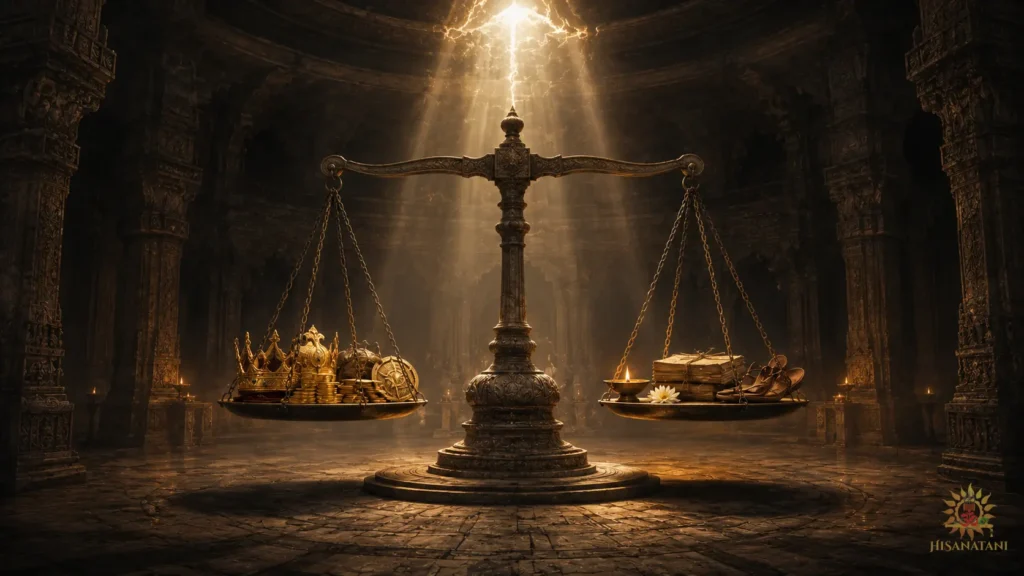
Arjuna’s real question in this verse isn’t moral in the simple sense — it’s structural. What actually counts as a win?
Most of us inherited a default answer without ever choosing it: winning means more. More income, more followers, more square footage, more control over your own calendar. It’s a scoreboard that only goes up.
Bhagavad Gita 1.44 quietly interrupts that scoreboard. Arjuna says that when the practices and duties that hold a family together get destroyed, something worse than a loss occurs. A kind of debt gets created that outlives the war itself.
Translate that into ordinary terms: you can win the negotiation and lose the relationship. You can hit the number and lose the person who used to celebrate numbers with you. The scoreboard says you’re ahead. Everything that actually matters says otherwise.
The philosophical move here is subtle but important — Arjuna isn’t rejecting achievement. He’s rejecting the idea that achievement justifies itself no matter what it costs somebody else. Traditions, relationships, trust: none of that shows up on a quarterly report, and none of it rebuilds itself automatically once it’s gone.
So the real question this verse leaves standing isn’t “how do I win more.” It’s “what am I willing to let a win cost — and who’s paying that cost besides me?”
Your Mind Will Normalize Almost Anything

There’s a specific psychological trick ambition plays, and it’s not dramatic — that’s exactly what makes it dangerous.
It starts small. One late email during dinner. One skipped call with your mother because a deadline moved. One missed school pickup that gets absorbed into “this month is just busy.” None of these register as damage in the moment. Each one, on its own, is forgivable.
The mind is extremely good at recalibrating what “normal” means. Miss enough dinners and eventually a dinner together starts to feel like the exception, not the baseline. That’s not a character flaw — it’s just how habituation works. The alarm bells that used to go off get quieter every time you override them.
Arjuna’s fear in BG1.44 can be read exactly this way: it’s rarely one catastrophic decision that destroys a family’s traditions. It’s a thousand small, defensible ones, stacked without anyone noticing the pile.
The way out isn’t guilt. Guilt doesn’t build anything. What works is smaller and more boring: pick one block of time that nothing is allowed to touch. Dinner. A Sunday call home. Thirty minutes with your phone in another room.
Protect it the same way you’d protect a client meeting — because to the people waiting on the other side of it, that’s exactly what it is.
You Are Not Your Job Title

Underneath the family-and-career framing, Bhagavad Gita 1.44 is asking something more personal: what are you actually protecting when you chase status this hard?
The easy answer is “my family” or “my future.” But look closer and it’s often the ego doing the talking — the part of you that needs the title, the raise, the recognition, in order to feel like you exist. That’s a fragile place to build a life from, because titles change. Companies restructure. Someone younger gets the promotion you wanted.
The Gita keeps returning to one idea across its eighteen chapters: you are not the roles you play. Not the job. Not the salary. Not the version of you that shows up on a resume. There’s something underneath all of that — call it the atman, call it your actual self — that none of your achievements can add to or subtract from.
This doesn’t mean stop working hard. It means stop asking your work to prove you’re worth something.
Serve well. Build well. But hold the results a little more loosely, the way you’d hold something you never actually owned. When ambition stops being about proving your worth, it gets quieter. And a quieter kind of ambition tends to leave more room for the people standing next to you.
Arjuna Wasn’t Worried About Losing. He Was Worried About What Winning Would Cost.

Step back onto the field at Kurukshetra for a second. This isn’t an abstract ethics seminar — Arjuna is standing across from actual people. Teachers who taught him to shoot a bow. Uncles. Cousins he grew up next to. The entire war council on both sides is, in some way, family.
By the time he speaks this Bhagavad Gita Chapter 1 Verse 44, Arjuna has already worked through several layers of dread — grief for the dead, fear for the families left behind, and now, specifically, fear about what happens when the practices that hold a family’s identity together get destroyed along with the people who carried them.
This is bigger than one battle. Arjuna is doing something most of us rarely do in the middle of a big decision — he’s running the story forward. Not “what happens tomorrow,” but “what happens generations from now if this goes through.”
Modern ambition rarely thinks that far ahead. A parent takes the promotion requiring constant travel; a decade later, the kids describe their childhood as “Dad was gone a lot.” A founder puts everything into the company for five years; the marriage doesn’t survive the sixth.
Arjuna’s insight, thousands of years old, still holds: what you win or lose today doesn’t stay contained to today. It becomes what the next generation inherits — for better, or for considerably worse.
The 24-Hour Gita Challenge

Enough reflection from the summary of Bhagavad Gita 1.44. Here’s what to actually do with the next 24 hours.
Step 1 — Count your actual week. Grab five minutes and write down where the last seven days actually went: work hours, commute, scrolling, one distracted dinner after another. Don’t judge the numbers, just get them down on paper. You can’t fix what you’ve never measured.
Step 2 — Block one hour nobody gets. Pick a specific window in the next 24 hours — not “more family time” in general, that’s too vague to keep. 7:30 to 8:30 tonight, phone in another room, dinner with your family or a call with your parents. Put it in the calendar like it’s a client call, because in a sense, it is.
Step 3 — Ask the uncomfortable question out loud. Tonight, before you sleep, ask yourself: “If my career keeps going exactly like this for five more years, whose relationship am I most likely to regret losing?” Write down the first name that comes to mind. Then do one small thing tomorrow for that person — call them, show up, put the phone away for an hour.
Bhagavad Gita 1.44 isn’t telling you to quit your job. It’s telling you not to wait for a funeral, a breakup, or a distant kid to find out what you already suspect.
When the Promotion Isn’t Worth What It Costs
There’s nothing wrong with wanting more. A better salary, a bigger title, a business that actually works — none of that is spiritual failure, whatever certain corners of the internet want you to believe.
The trouble starts when winning becomes the only thing that’s allowed to matter — when “just one more year” turns into five, and everyone waiting for you at home quietly stops waiting.
Arjuna’s fear in Bhagavad Gita 1.44 isn’t really about a battlefield. It’s about the version of yourself that survives whatever you’re currently chasing. Not “will I win,” but “who’s still standing beside me when I do.”
Build. Compete. Climb, if that’s genuinely what you want. Just don’t get so busy constructing the life you think you’re supposed to have that you lose the one you already had.
Please let me know in the comments.
Embrace the Teachings of the Gita. Dive deeper into the Bhagavad Gita to uncover its timeless wisdom and practical guidance. Let its verses inspire you to cultivate inner clarity, align with higher values, and navigate life’s challenges with courage and grace.
🌼 Join the HiSanatani WhatsApp Channel for your daily dose of light 🪔. Join Now.
Voice of the Soul
Finding clarity in the questions we all carry…
What is Bhagavad Gita 1.44 about?
Arjuna tells Krishna he’s heard that people who destroy their family’s traditions are condemned to suffer for a long time — and he’s terrified going to war will make him one of them. See The Boy Who Built the Tallest Tower.
Does Bhagavad Gita 1.44 say ambition is bad?
No — it questions what ambition is allowed to cost, not ambition itself. See Winning the Argument, Losing the Person.
How does Bhagavad Gita 1.44 apply to career and work-life balance?
It’s a warning about how small, forgivable compromises quietly become a pattern. See Your Mind Will Normalize Almost Anything.
What is the historical context of Bhagavad Gita 1.44?
Arjuna stands at Kurukshetra facing relatives and teachers on the opposing side, worried that destroying his family’s traditions will cost future generations more than the war itself. See Arjuna Wasn’t Worried About Losing.
What is the practical lesson of Bhagavad Gita 1.44?
Measure where your time actually goes, protect one block of time from work, and ask who you’d regret losing five years from now. See The 24-Hour Gita Challenge.
