
Namaste 🙏
Welcome to Hi Sanatani. It’s a joy to have you here as we explore the deeper layers of human nature. By diving into this Bhagavad Gita 1.45 Summary we create a sacred bridge together, turning ancient verses into helpful tools for your personal growth and peace.
Translation of Bhagavad Gita Shloka Verse 1.45 in English:
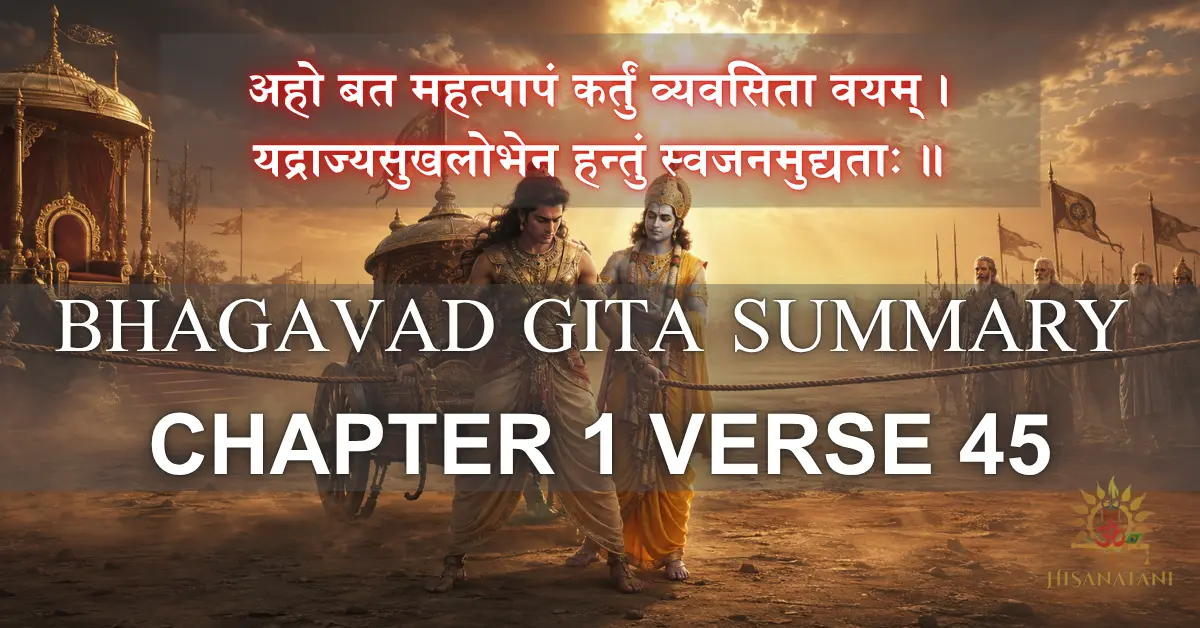
अहो बत महत्पापं कर्तुं व्यवसिता वयम् ।
यद्राज्यसुखलोभेन हन्तुं स्वजनमुद्यताः ॥ ४५ ॥
In English :
aho bata mahat pāpaṁ kartuṁ vyavasitā vayam |
yad rājya-sukha-lobhena hantuṁ sva-janam udyatāḥ ||
Feel the Vibration: A Guided Chant of Bhagavad Gita Chapter 1 Verse 45:
- aho bata mahat pāpaṁ kartuṁ vyavasitā vayam |
A-ho ba-ta ma-hat paa-pam kar-tum vya-va-si-taa va-yam - yad rājya-sukha-lobhena hantuṁ sva-janam udyatāḥ ||
Yad raa-jya-su-kha-lo-bhe-na han-tum sva-ja-nam ud-ya-taah
English Translation:
“Alas, how strange it is that we’ve resolved to commit this great sin — ready to kill our own people, driven by greed for the comforts of a kingdom.”
JOIN THE HISANATANI COMMUNITY
Get daily Verse Summaries & High-Res Posters directly on your WhatsApp.
JOIN CHANNELSoulful Insight
Here’s the part nobody tells you: guilt and ambition can wear the same mask. You tell yourself you’re staying quiet at work because you’re being a team player. You tell yourself you’re taking the safe path because you love your family. Both stories sound noble. Both can be true, and both can be a way of not looking at the fear underneath.
Arjuna doesn’t get to skip that moment. Neither do you. The Bhagavad Gita Chapter 1 Verse 45 simply asks the question first: what am I actually protecting — the people I love, or my own comfort dressed up as loyalty?
The Two Ropes Pulling You in Different Directions

Picture a kid standing between two grown-ups, each holding one of his hands, each pulling toward a different door. He isn’t confused about which door he wants. He’s frozen because moving toward one hand means letting go of the other.
That’s Arjuna at the edge of Kurukshetra in Bhagavad Gita 1.45. One hand is rajya-sukha — the comfort, the win, the version of success he was raised to chase. The other is sva-janam — his own people, the ones who’d pay the price for that win. He’s not weak for freezing. Anyone would. But standing still forever isn’t a third option — it’s just letting the stronger hand decide for him.
A kid learns eventually that you can love both hands and still have to pick a direction. That’s not betrayal. That’s growing up.
One Root, Two Branches

Classical commentary reads the Bhagavad Gita 1.45 as a study in attachment, or moha — the mental fog that shows up whenever the mind is gripped too tightly by something it’s afraid to lose. The Gita doesn’t treat attachment to people and attachment to reward as two separate diseases. It treats them as the same root wearing two branches.
That’s a genuinely useful distinction for a modern reader. The employee who won’t report fraud because the bonus is due next month, and the son who won’t move cities because his mother will cry — both are, philosophically speaking, doing the exact same thing. Each has let something outside his own judgment become the deciding vote.
The eternal truth underneath Bhagavad Gita 1.45 isn’t “choose family” or “choose ambition.” It’s this: whatever you’re too attached to let go of is the thing currently making your decisions for you. Name it, and you get a vote back.
When “I’m Just Being Loyal” Is Actually Fear Talking

Psychologists call it moral injury when a person is forced into a position where every option violates something they value. Arjuna’s collapse — “aho bata,” alas, how strange — is that exact break. He isn’t calm. He isn’t reasoning cleanly. He’s flooded.
You’ll recognize the same flooding in two very ordinary modern scenes. The first: an employee who stays silent about something wrong because speaking up threatens the identity he’s built around being “a team player.” The second: an adult child who calls a painful compromise “respect” because naming it as fear would mean admitting he’s been avoiding a hard conversation for years. In enmeshed families, this shows up as guilt that masquerades as love. In workplaces, it shows up as compliance that masquerades as loyalty. Different rooms, same nervous system.
The fix isn’t to stop caring about your family or your career. It’s to get honest about which feeling in your chest is conscience, and which one is just fear wearing conscience’s clothes. This is what Summary of Bhagavad Gita 1.45 tries to express.
You Are Not the Role You Play

Spiritually, BG1.45 is an invitation to notice the gap between who you are and the roles you’re standing inside — the dutiful son, the reliable employee, the good daughter, the loyal manager. Those roles matter. They are not, however, the whole of you. The Gita calls the part of you underneath all roles the Atman — the quiet witness that doesn’t change shape depending on who’s watching.
Arjuna’s mistake in this moment isn’t that he loves his people or wants a good outcome. It’s that he’s let the roles speak for the self. When your inner compass gets buried under “what will they think” or “what will I lose,” you stop making choices from that quiet witness and start making them from panic.
Returning to stillness before a hard decision — even five honest minutes of it — isn’t escapism. It’s how you hear your own voice again underneath everyone else’s.
A Battlefield With Two Motives

Step onto the field at Kurukshetra and look at who’s actually standing there. On one side, Arjuna sees Bheeshma, who held him as a child, and Drona, who taught him to hold a bow. These aren’t strangers. They’re svajanam — his own people, in the most literal sense the word has ever carried.
But historically, the war itself wasn’t caused by love. It was caused by Duryodhana’s refusal to share a kingdom he had no rightful claim to — rajya-sukha-lobhena, greed for a throne’s comforts, dressed up for years as pride and entitlement. Arjuna, standing between the people he loves and a fight caused by someone else’s greed, says the quiet part out loud: this bloodshed is happening because of appetite, not necessity.
That’s why Bhagavad Gita Chapter 1 Verse 45 still reads as strikingly modern. Most real conflicts — in families, in companies, in nations — aren’t started by people who hate each other. They’re started by unchecked appetite, and the people who love each other are the ones left holding the damage.
The 24-Hour Gita Challenge

Take one decision currently sitting heavy in your chest — a job, a relationship, a conversation you’ve been postponing. Then run it through these three steps.
Step 1 — The Two-Column Truth Audit (15 minutes). Draw a line down a page. On the left, write every fear-driven reason you’ve been telling yourself to stay put — money, guilt, what people will say. On the right, write what you’d choose if no one was watching and nothing was at risk. Don’t edit either column.
Step 2 — The One Honest Sentence (15 minutes). Write a single sentence you could say out loud to the person involved — your manager, your parent, your partner — without over-explaining or apologizing for existing. Something like: “I need to do this, and I still care about you.” Practice it until it sounds calm, not defensive.
Step 3 — The Five-Breath Reset (5 minutes). Before the real conversation happens, sit still and take five slow breaths. Remind yourself: their reaction is theirs to carry. Your job is only to be honest and kind. Then go say the sentence.
Two Ropes, One Grip You Can Loosen
Arjuna’s confession in Bhagavad Gita 1.45 isn’t a failure of courage. It’s the moment before courage — the point where a person finally admits both hands are pulling, and stops pretending only one of them exists.
You don’t have to solve your entire career or your entire family in one afternoon. You just have to stop calling fear by the wrong name. Loyalty that costs you your own voice isn’t loyalty. It’s just fear that learned to sound respectable.
If this verse found you at the right moment, don’t carry it alone.
Continue the journey.
Please let me know in the comments.
Embrace the Teachings of the Gita. Dive deeper into the Bhagavad Gita to uncover its timeless wisdom and practical guidance. Let its verses inspire you to cultivate inner clarity, align with higher values, and navigate life’s challenges with courage and grace.
🌼 Join the HiSanatani WhatsApp Channel for your daily dose of light 🪔. Join Now.
Voice of the Soul
Finding clarity in the questions we all carry…
What is the main message of Bhagavad Gita 1.45?
Arjuna admits he’s ready to harm the people he loves for the comfort of winning — and names greed and attachment as the real cause of his crisis, not fate. See the One Root, Two Branches section above.
Does Bhagavad Gita 1.45 mean I should never disappoint people I love?
No. It means checking whether you’re avoiding a decision out of genuine care, or out of fear disguised as loyalty. That distinction is worked through in When “I’m Just Being Loyal” Is Actually Fear Talking.
How does this BG1.45 apply to quitting a toxic job?
Arjuna’s fear of losing rajya-sukha — comfort and status — mirrors the fear that keeps people in jobs that cost them their self-respect. The Two Ropes Pulling You in Different Directions breaks this down with a plain analogy.
What does “rajya-sukha-lobhena” actually mean?
It translates to “greed for the comforts of a kingdom” — Arjuna’s honest admission that ambition, not just duty, was part of what got him here. A Battlefield With Two Motives unpacks where that greed actually came from.
How can I stop feeling guilty about choosing myself?
Start by separating your actual conscience from inherited guilt using a short daily practice. The 24-Hour Gita Challenge above walks through a same-day exercise for exactly this.
