
Namaste 🙏
Welcome to Hi Sanatani. It’s a joy to have you here as we explore the deeper layers of human nature. By diving into this Bhagavad Gita 1.47 Summary we create a sacred bridge together, turning ancient verses into helpful tools for your personal growth and peace.
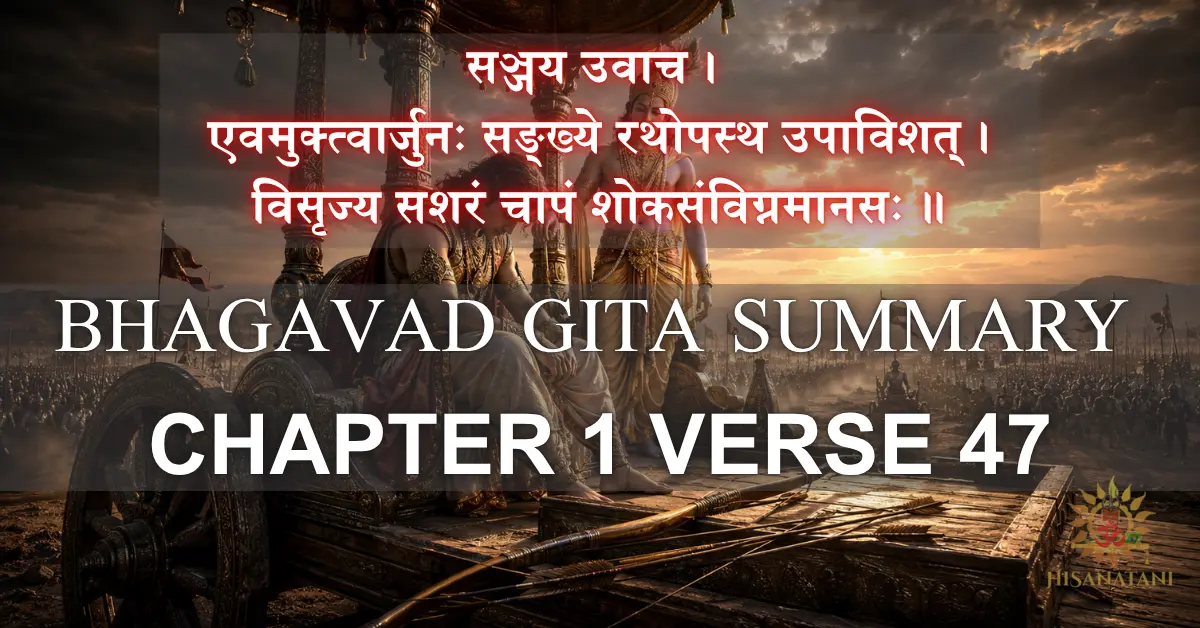
Translation of Bhagavad Gita Shloka Verse 1.47 in English:
सञ्जय उवाच ।
एवमुक्त्वार्जुनः सङ्ख्ये रथोपस्थ उपाविशत् ।
विसृज्य सशरं चापं शोकसंविग्नमानसः ॥ ४७ ॥
In English :
sañjaya uvāca |
evam uktvārjunaḥ saṅkhye rathopastha upāviśat ||
visṛjya saśaraṁ cāpaṁ śoka-saṁvigna-mānasaḥ |||
Feel the Vibration: A Guided Chant of Bhagavad Gita Chapter 1 Verse 47:
- sañjaya uvāca |
San-ja-ya | U-vā-cha - evam uktvārjunaḥ saṅkhye rathopastha upāviśat ||
E-vam | Ukt-vā | Ar-ju-naḥ | Saṅ-khye | Ra-tho-pas-tha | U-pā-vi-shat - visṛjya saśaraṁ cāpaṁ śoka-saṁvigna-mānasaḥ |||
Vi-sṛj-ya | Sa-sha-raṁ | Chā-paṁ | Sho-ka | Saṁ-vig-na | Mā-na-saḥ
English Translation:
“Sanjaya said: Having spoken thus, Arjuna cast aside his bow and arrows in the midst of the battlefield and sat down upon the seat of his chariot, his mind overwhelmed with sorrow.”
JOIN THE HISANATANI COMMUNITY
Get daily Verse Summaries & High-Res Posters directly on your WhatsApp.
JOIN CHANNELWhy Your Mind Needed to Hear This Today
There’s a difference between being tired and being inwardly exhausted. Tiredness says, “I need sleep.” Real exhaustion says, “I don’t even know what I need anymore.”
Arjuna’s breaking point happens in public — his weapon falls in front of two armies. Ours is usually quieter. We stare at the screen. We postpone everything.
We cry without warning. We fantasize about disappearing from our own life.
The Gita doesn’t mock Arjuna for reaching that point. It lets us watch him get there — because sometimes the first true thing we need isn’t another command to push harder. Sometimes we need permission to get still enough to hear what the exhaustion has been trying to say.
What a Ten-Year-Old Would Ask About Arjuna’s Bow
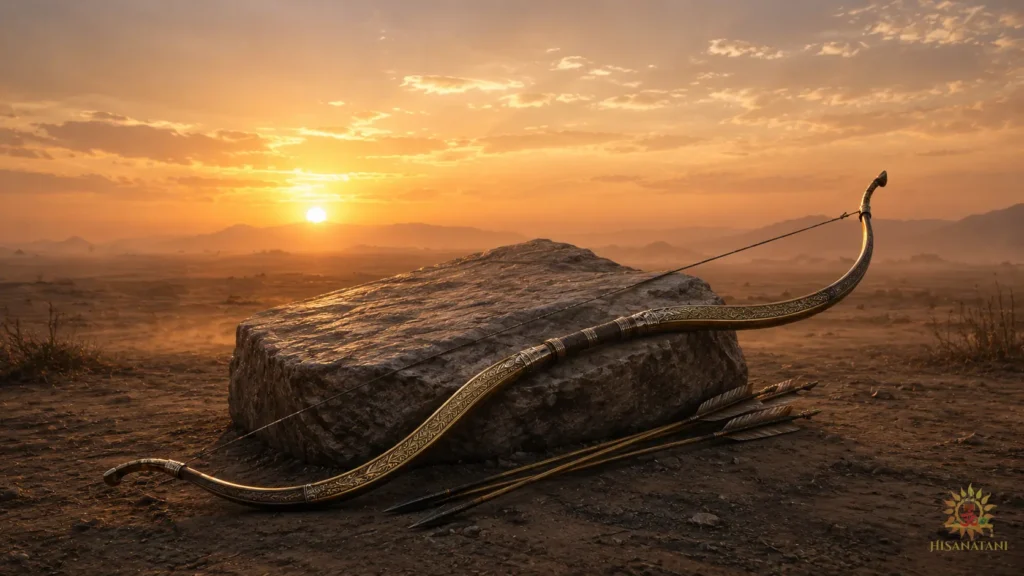
Imagine you’re playing in the park. You’ve been running for hours. Your friends want you to keep going, but your legs hurt, you’re angry, and you can barely remember the rules anymore.
What happens if someone forces you to keep playing? You might make bad calls. You might yell. You might cry. Or you might just sit down.
That’s a simple way to understand Arjuna. He wasn’t sitting on a park bench — he was sitting in the middle of a battlefield, with a duty to perform and emotions too heavy to let him perform it. Bhagavad Gita Chapter 1 Verse 47 shows the difference between having a responsibility and being mentally ready to carry it. A tired child doesn’t need another hour of pressure. Sometimes neither do you.
Your Actions Distort When the Mind Is Overloaded
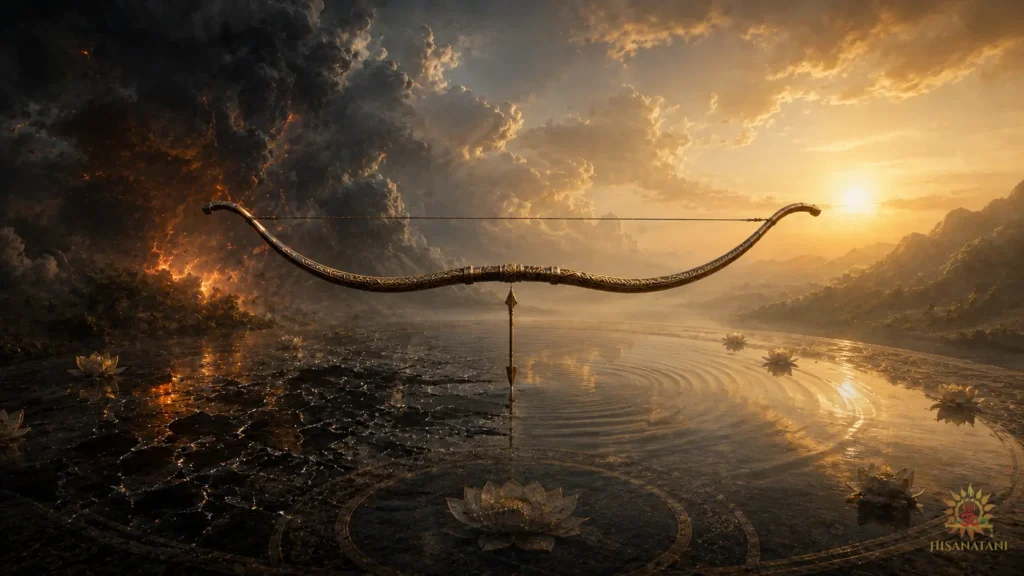
Arjuna has knowledge, training, weapons, and allies. Yet knowledge alone can’t produce wise action when the mind is overwhelmed — because action never happens in isolation from the state of the person taking it.
Picture two people getting the same email: “Can we discuss this tomorrow?” Person A, well-rested, thinks, “Sure.” Person B — three hours of sleep, fourteen-hour workday, a fight with a partner — reads the same sentence and thinks, “They hate my work.”
Same email. Different internal state. Different reaction.
That’s the deeper lesson of Bhagavad Gita Chapter 1 Verse 47. It isn’t “never fight.” It’s: don’t confuse frantic reaction with purposeful action. When the inner system is overloaded, pause before converting emotional intensity into something irreversible.
The pause creates distance. Distance creates discernment. And discernment is what makes real action possible.
When Everything Starts to Feel Meaningless
Burnout doesn’t always look like dramatic sadness.Bhagavad Gita Chapter 1 Verse 47 says, Sometimes it looks like nothing at all. Your favorite music doesn’t move you. Your weekend doesn’t restore you.
Even your wins feel strangely flat. You look at your career and think, “What’s the point?”
This numbness is especially disorienting for ambitious people trained to measure themselves through output — numbers, promotions, followers, performance reviews. When the usual metrics stop delivering any feeling, it’s easy to conclude, “Maybe I don’t care about anything anymore.” But often it isn’t apathy.
It’s an overloaded system — like a phone running twenty apps at once. The screen still works. Everything just gets slower.
Arjuna is still physically present. The war hasn’t gone anywhere. But his inner capacity to engage has collapsed.
To be clear: BG1.47 isn’t a call to spiritualize away every hard day — real burnout often needs sleep, boundaries, and sometimes professional support. But the Gita adds one honest question: what happens when your sense of worth has fused completely with what you produce?
If “I am valuable” has quietly become identical to “I am productive,” rest starts to feel like failure. For one moment, Arjuna isn’t performing, winning, or proving anything. He is simply there. And that’s exactly where the real conversation begins.
Surrender Isn’t Giving Up — It’s Giving Up the Illusion of Total Control
Arjuna in Bhagavad Gita 1.47,has run out of his own answers. He has arguments, memories, predictions — none of it brings him peace. This is where surrender begins. Not surrender to laziness, defeat, or fear. Surrender of the illusion that “I alone must control everything.”
That illusion is painfully familiar today. A professional believes, “If I don’t answer immediately, everything collapses.” A founder believes, “If I take one day off, the company falls apart.”
A student believes, “If I don’t get this result, my future is finished.” The ego quietly insists: everything depends on me.
Arjuna’s bow goes down. His personal certainty has failed. And only then does he become receptive to guidance from Bhagavad Gita 1.47 Summary .
Grief, fear, and exhaustion can move through you without being the whole of who you are. When the mind stops pretending it has every answer, it finally becomes capable of receiving one.
Arjuna sits. Krishna speaks. That sequence matters.
The Silence Before Krishna Speaks
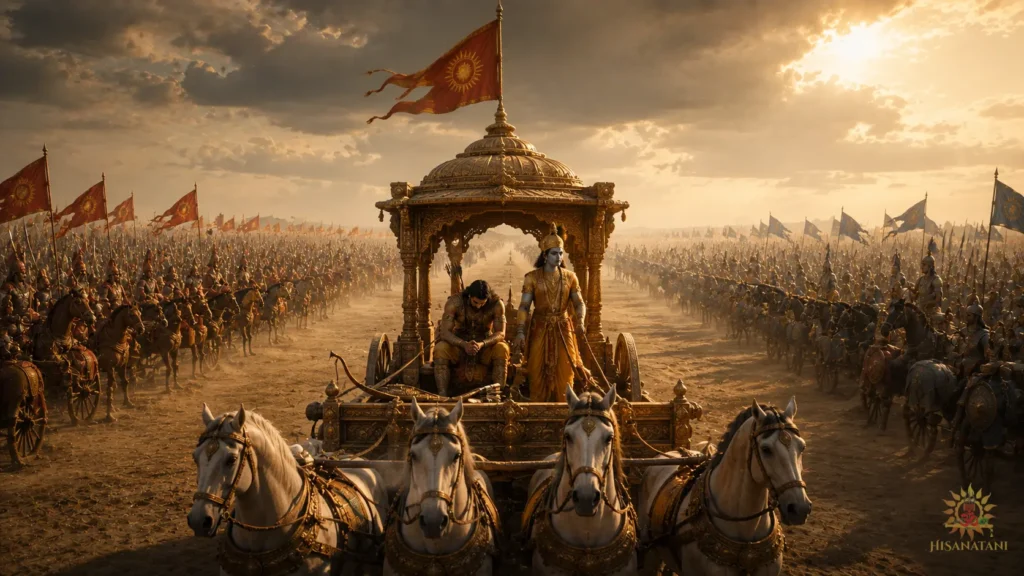
To feel the full weight of BG1.47, stay with Kurukshetra a moment longer. Two massive armies stand assembled. The conch shells have already sounded.
Arjuna asked Krishna to place the chariot between the ranks so he could see who he was about to face — and what he saw broke his composure. Teachers. Relatives. Friends. People he loves, on both sides.
Sanjaya narrates all of this to the blind king Dhritarashtra, who hears it as a flicker of political hope: if the Pandavas’ greatest archer has dropped his weapon, maybe the war ends here. But this context matters, because it stops us from flattening the Bhagavad Gita 1.47 into a slogan like “just quit when it’s hard.”
Arjuna isn’t facing ordinary discomfort. He’s facing a genuine moral crisis, in full view of both armies, with every rule of warrior conduct telling him to stay silent about it.
The battlefield doesn’t disappear because Arjuna sits down. It’s still there. What changes is him — and that shift is exactly what makes room for Krishna’s teaching to begin.
The 24-Hour Gita Challenge
The daily application of Bhagavad Gita Chapter 1 Verse 47 is simple: when your mind is overwhelmed, stop forcing execution. Pushing through severe fatigue tends to produce shallow results and quiet resentment. Here’s the practical version to try in the next 24 hours:
Drop Your Digital Bow. Pick a firm time today to disconnect from work apps, email, and social media. Shut the laptop. Put your phone in another room. Physically step away from the tools of your strain.
Sit in Sacred Silence. Spend 20 minutes in a quiet room with zero screens, music, or podcasts. Let your thoughts settle the way sediment settles in water.
Release One Unnecessary Burden. Name one task, project, or obligation that’s draining you purely out of people-pleasing. Postpone or cancel it to protect your peace.
The Bow on the Ground Isn’t the End of the Story
Bhagavad Gita 1.47 closes Chapter 1 on an image of real vulnerability. Arjuna sits. His bow is down. His mind is overwhelmed.
There’s no heroic speech, no victory music — just silence.
That’s exactly why Summary of Bhagavad Gita 1.47 speaks so directly to anyone who’s been running for too long. The world usually rewards visible strength: keep going, keep producing, keep answering, keep smiling. But the soul doesn’t always need another command. Sometimes it needs space.
There’s a real difference between the pattern that leads somewhere and the one that doesn’t: Pause → observe → receive guidance → regain clarity → act deliberately — versus — Overwork → collapse → impulsively quit → regret → repeat.
Arjuna’s silence is not the destination. It’s the threshold. He does not remain seated forever, and Krishna doesn’t tell him to abandon his life — the dialogue continues, wisdom enters, and action eventually returns, on steadier ground.
If you’ve been working past your limits for months, the task in front of you may not be “become more productive.” It may be getting honest about what your exhaustion has been trying to tell your decisions. Your breaking point can become a warning instead of a destination — but only if you actually stop long enough to hear it.
Please let me know in the comments.
Embrace the Teachings of the Gita. Dive deeper into the Bhagavad Gita to uncover its timeless wisdom and practical guidance. Let its verses inspire you to cultivate inner clarity, align with higher values, and navigate life’s challenges with courage and grace.
🌼 Join the HiSanatani WhatsApp Channel for your daily dose of light 🪔. Join Now.
Voice of the Soul
Finding clarity in the questions we all carry…
What happens in Bhagavad Gita 1.47?
Arjuna puts down his bow and arrows and sits in his chariot, overwhelmed by sorrow. It closes Chapter 1 and sets up Krishna’s teaching in Chapter 2. See What a Ten-Year-Old Would Ask About Arjuna’s Bow for how a child’s exhaustion explains it best.
What does Arjuna’s bow symbolize in Bhagavad Gita Chapter 1 Verse 47?
The bow represents his readiness and ability to act. Letting it go signals that his inner conflict has grown stronger than his capacity to perform his duty. See Your Actions Distort When the Mind Is Overloaded for how an overloaded mind distorts action.
Does Arjuna dropping his bow mean he was weak?
No — it happens during a genuine moral and emotional crisis, in full public view. His pause becomes the setting for Krishna’s guidance rather than a final retreat. See Surrender Isn’t Giving Up — It’s Giving Up the Illusion of Total Control for why surrender isn’t defeat.
How does Bhagavad Gita 1.47 apply to burnout?
It shows what happens when accumulated pressure finally outweighs your capacity to act, and argues for a conscious pause over impulsive decisions made from exhaustion. Try the three steps in The 24-Hour Gita Challenge.
Why does Krishna only begin teaching after Arjuna collapses?
Because Arjuna’s existing understanding can’t resolve the conflict on its own, and that vulnerability is what opens him to real guidance. See The Silence Before Krishna Speaks for what Sanjaya was describing to Dhritarashtra.
