
Namaste 🙏
Welcome to Hi Sanatani. It’s a joy to have you here as we explore the deeper layers of human nature. By diving into this Bhagavad Gita 2.6 Summary we create a sacred bridge together, turning ancient verses into helpful tools for your personal growth and peace.
Translation of Bhagavad Gita Shloka Verse 2.6 in English:
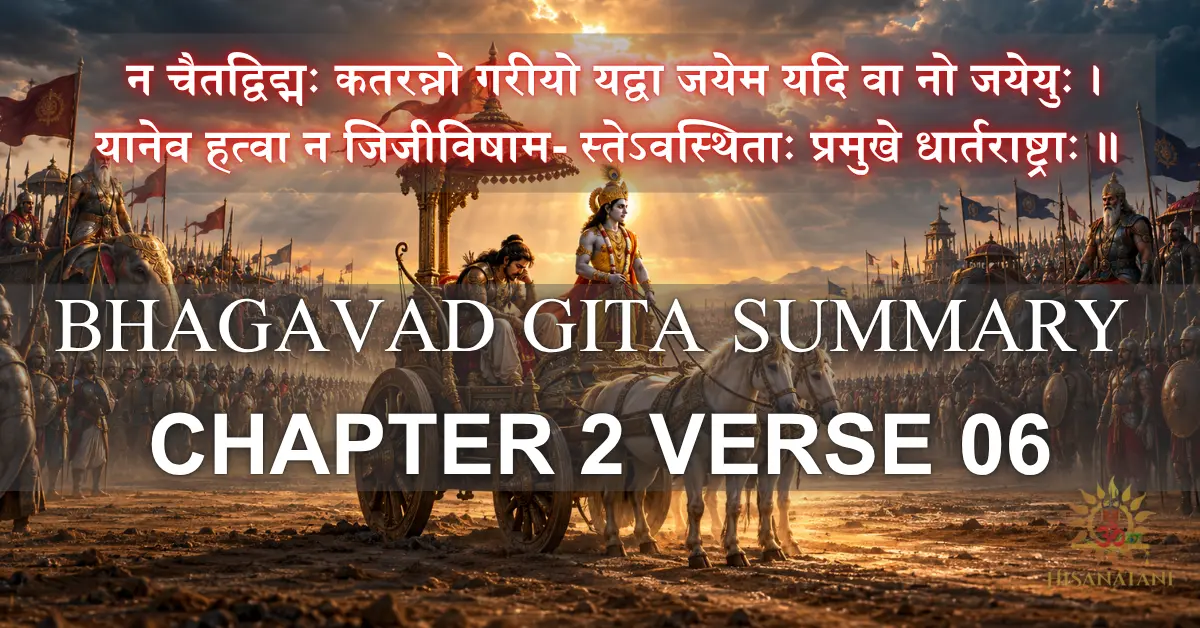
न चैतद्विद्मः कतरन्नो गरीयो यद्वा जयेम यदि वा नो जयेयुः ।
यानेव हत्वा न जिजीविषामस्तेऽवस्थिताः प्रमुखे धार्तराष्ट्राः ॥ ६ ॥
In English :
na caitad vidmaḥ kataran no garīyo yad vā jayema yadi vā no jayeyuḥ |
yān eva hatvā na jijīviṣāmas te ‘vasthitāḥ pramukhe dhārtarāṣṭrāḥ ||
Feel the Vibration: A Guided Chant of Bhagavad Gita Chapter 2 Verse 6:
- na caitad vidmaḥ kataran no garīyo yad vā jayema yadi vā no jayeyuḥ |
Na chai-tad vid-mah ka-ta-ran no ga-ree-yo
Yad vaa ja-ye-ma ya-di vaa no ja-ye-yuh - yān eva hatvā na jijīviṣāmas te ‘vasthitāḥ pramukhe dhārtarāṣṭrāḥ ||
Yaan e-va hat-vaa na ji-jee-vi-shaa-mas
Te ‘vas-thi-taah pra-mu-khe dhaar-ta-raash-traah
English Translation:
“We don’t know which is better for us: that we conquer them, or that they conquer us. And the very sons of Dhritarashtra, after killing whom we wouldn’t even want to go on living, are standing right there in front of us.”
JOIN THE HISANATANI COMMUNITY
Get daily Verse Summaries & High-Res Posters directly on your WhatsApp.
JOIN CHANNELYou’re Not Lazy. You’re Carrying Two Heavy Things.
Let’s be honest. Most of us don’t freeze because we’re lazy. We freeze because every option costs something we care about.
Take the job with the better salary and you lose your evenings. Take the one with the better hours and you watch everyone else’s promotions roll past on LinkedIn. Stay near your parents and you wonder what you missed. Leave, and you wonder who you left behind.
So you open one more tab. Read one more Reddit thread. Ask one more friend.
Here’s the thing. That isn’t indecision. That’s a person taking two things seriously at the same time.
Arjuna knew this feeling long before Wi-Fi existed. Let’s see what he does with it.
The Ice-Cream Counter Problem: When “Which Is Better?” Has No Answer

Picture a seven-year-old at an ice-cream counter. Thirty-one flavours. A queue building behind her.
She points at chocolate. Changes to mango. Back to chocolate. Then, quietly: “I don’t know which one is better.”
And she’s right. Nobody can know that in advance.
Chocolate might be perfect today. Mango might have been the one. “Better” isn’t sitting in the freezer waiting to be found. It depends on what she feels like, and even she isn’t sure.
Now make it heavier. Say one flavour means her best friend goes without, and the other means she does. That’s closer to Arjuna in BG 2.6. He isn’t choosing between good and bad. He’s choosing between two kinds of loss.
What would a kind parent do here? They just not say “Just pick already!” They’d crouch down and say, “It’s okay. This is hard. Let’s work out what you actually want.”
That’s the first lesson of Bhagavad Gita 2.6. Feeling stuck doesn’t mean something is wrong with you. Sometimes it means the choice is genuinely hard.
And look at what Arjuna doesn’t do. He doesn’t fake confidence to make the discomfort stop. He says it straight: “We don’t know.”
Think about it. How many big decisions have you made just to escape the feeling of not knowing? A confident wrong move can feel better than an honest pause. It isn’t.
Nobody Gave Your Life an ETA (And Arjuna Didn’t Get One Either)

Open Google Maps. It says 42 minutes. You leave. A truck breaks down on the flyover, and now it’s 58.
Did the app lie? No. It made its best estimate, and the road did what roads do.
Nobody feels betrayed by that. Yet we expect our careers to arrive with a guaranteed ETA. Tell me this job leads somewhere good. Tell me this city will feel like home. Tell me I won’t regret it.
Look at what Arjuna is really asking. He isn’t asking, “What’s my duty?” He’s asking which outcome is garīyaḥ, a word that literally means heavier, or weightier.
Which result carries more weight? He wants the verdict before the trial. The ending before he picks the chapter.
But here’s the catch. That’s a question about what matters, and no forecast can answer it. Predicting the future is one skill. Knowing what you’d be willing to pay for is another. Arjuna is drowning because he’s trying to solve the second with the first.
Does that mean we should act blind? No. Krishna’s answer starts building from 2.11 and lands hardest in 2.47: give the work your full effort, and let go of the demand for a guaranteed result. Bhagavad Gita 2.6 shows that demand at its rawest.
Acting inside incomplete knowledge isn’t a flaw of your generation. Arjuna had no LinkedIn, no Reddit, no career coach.
He still couldn’t see how it ended. Nobody can. That’s not a problem to solve. That’s the ground you’re standing on.
Your Pros-and-Cons Sheet Isn’t Broken. It’s Missing Its Weights.

You’ve built the spreadsheet. Salary, growth, commute, manager, brand name. Colour-coded. It’s honestly beautiful. And it still won’t tell you what to do.
That’s because a spreadsheet needs weights, and weights are the one thing you haven’t decided. Is an extra ₹8 lakh a year worth double the stress? Half? Is a better manager worth a worse title?
No dataset answers that. It’s not an information gap. It’s a values gap.
Arjuna has the same problem. He knows both armies. He knows the risks. What he can’t rank is what matters more: winning, or the people he’d lose by winning.
So the brain does what brains do. It reopens the tab. Checks one more review. Asks one more friend.
Each search gives a tiny hit of relief, then the loop starts again. It feels like progress. It isn’t.
Now watch what Arjuna does. He says it out loud: “We don’t know.” That small act matters more than it looks.
Saying it turns a fog into a sentence. “I’m a mess” is a weight nobody can lift. “I don’t know whether growth or stability matters more to me this year” is a problem you can actually work on.
Try it right now. Write your decision as one plain sentence. Then sort what’s in your head into three piles: what you know for sure, what you’re guessing, and what you’re afraid of. Fear loves dressing up as fact.
Nobody Asks for Directions Until They Admit They’re Lost

Think about the last time you were properly lost. Phone dead, unfamiliar lane, everyone in the shop watching you. How long did you wander before asking someone?
Exactly. Nobody asks while they still believe they’ll figure it out.
That’s the spiritual layer of this verse. In BG2.6, Arjuna has run out of his own answers. He’s the finest archer of his time, and he’s still standing there, unable to say what’s right.
Watch what comes next. In 2.7 he tells Krishna he’s confused about his duty and asks to be taught. He calls himself a student. The admission in 2.6 is what opens that door.
The ego’s job description is simple: control the outcome. It wants guarantees.
Which road has no regret? How does this end? What will people say? It wants the future’s report card before it agrees to act.
Surrender, in the Gita’s sense, isn’t giving up. It isn’t lying on the sofa saying “whatever happens, happens.” It’s doing your honest best while dropping the belief that you manage every result.
There’s real relief in that. Your job title, salary and city can all change. So can your plan.
The deeper Self the Gita points toward, the Atman, isn’t reduced by any of it. A failed startup is a painful chapter. It isn’t your whole story.
The Man Who Asked to See the Enemy Up Close
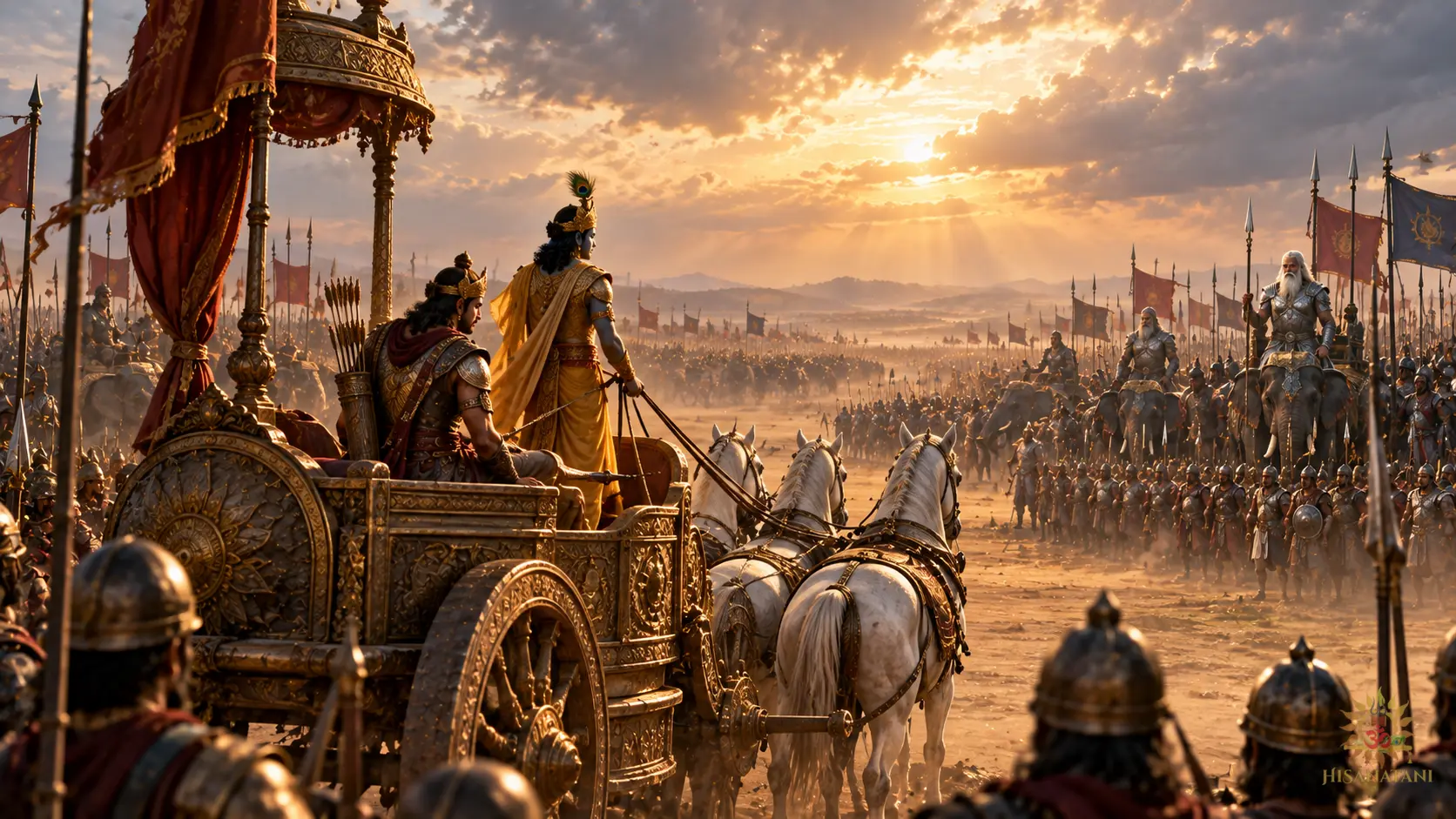
Here’s a detail most summaries skip. Arjuna chose this spot himself. In 1.21 and 1.22, he asks Krishna to park the chariot between the two armies so he can look over the people he’s about to fight.
Then he got his look. Bhishma, who helped raise him. Drona, who trained him. Cousins, uncles, friends, all standing in formation. A few verses later, in 1.47, he drops his bow and sinks onto the chariot seat.
By 2.6, that drop has turned into a full question: what would victory even mean here?
Now the sharp part. The sons of Dhritarashtra, the very people he says he wouldn’t want to outlive, had cheated the Pandavas at dice and pushed them into years of exile. Arjuna isn’t naive about them. He has every reason to fight.
That’s exactly why Bhagavad Gita Chapter 2 Verse 6 hurts. He isn’t confused because the other side is innocent. He’s confused because being right doesn’t feel like enough to justify the cost.
Kurukshetra wasn’t a classroom. Conches had sounded. Both armies were waiting. And the person everyone was counting on couldn’t move.
Sound familiar? The strongest person on the team is often the one who goes quiet before the biggest call. Skill doesn’t protect you from this. Knowing how to win is one thing. Knowing whether the win is worth having is something else entirely.
The 24-Hour Gita Challenge: Stop Solving Your Life, Solve One Decision

Enough thinking. For the next 24 hours, don’t try to fix your whole future. Run three small steps instead.
Step 1: Finish this sentence. Write your decision in one line. “I’m deciding whether to stay in my current role for six more months or start applying elsewhere.” One decision, not five.
Then complete this: “Better, for me, means ______.” Salary? Growth? Peace? Time with family?
Arjuna’s whole problem is that he never defined “better.” You get to.
Step 2: Sort your head into three piles. Take a page and write three headings: Fact, Guess, Fear.
Fact: “My notice period is 60 days.”
Guess: “The new team might be healthier.”
Fear: “I’ll fail and everyone will know.”
Anxiety loves passing off guesses as facts. Once they sit in separate piles, most of the noise loses its authority.
Step 3: Make one reversible move. Not a final decision. Something small that gives you real information: message one person already in the role you’re eyeing, update one section of your résumé, ask your manager one honest question about growth. Then write down a date, maybe two weeks away, when you’ll decide with whatever you know by then. And if you can only see two doors, spend two minutes hunting for a third.
Swap imagined information for real information. That’s the whole game of the Summary of Bhagavad Gita 2.6.
You Don’t Need the Whole Map. You Need One Honest Step.
Here’s what Arjuna shows us. He doesn’t have the answer, and Krishna doesn’t shame him for it. Not knowing isn’t the end of the conversation. It’s where the real teaching starts.
You may be standing between two futures right now. One feels safe but flat. The other feels alive but risky. You keep waiting for the option with zero fear. Actually, that option may never show up.
So change the question. Skip “How do I guarantee I’ll choose perfectly?” Ask, “Can I decide honestly, with what I know today, without demanding a promise from the future?”
You can. Start with the sentence Arjuna started with. “I don’t know.” Then take the next small, honest step.
Please let me know in the comments.
Embrace the Teachings of the Gita. Dive deeper into the Bhagavad Gita to uncover its timeless wisdom and practical guidance. Let its verses inspire you to cultivate inner clarity, align with higher values, and navigate life’s challenges with courage and grace.
🌼 Join the HiSanatani WhatsApp Channel for your daily dose of light 🪔. Join Now.
Voice of the Soul
Finding clarity in the questions we all carry…
What is the main message of Bhagavad Gita 2.6?
Arjuna admits he can’t tell whether winning or losing is better, because both cost him people he loves. Honest confusion, BG2.6 suggests, is where wisdom starts, not where it fails. See The Ice-Cream Counter Problem.
Why is Arjuna confused in Bhagavad Gita Chapter 2 Verse 6?
Victory means killing teachers and cousins he loves. Defeat means abandoning his role. Neither feels clean, so his mind stalls. The battlefield backdrop makes it clearer in The Man Who Asked to See the Enemy Up Close.
How does BG2.6 help with career decisions and choice overload?
Often the stuckness comes from unclear values, not missing information. Defining what “better” means to you breaks the loop faster than another round of research. Try it in The 24-Hour Gita Challenge.
What does Bhagavad Gita 2.6 teach about uncertainty?
Uncertainty comes with every real choice. The Gita doesn’t ask you to remove it, only to stop demanding a guarantee before you act. More in Nobody Gave Your Life an ETA.
Does Bhagavad Gita 2.6 mean we should avoid making decisions?
No. Arjuna’s confession is a pause, not a policy. In the very next verse he asks Krishna to teach him, and the real guidance begins from there. See Nobody Asks for Directions Until They Admit They’re Lost.
