
Namaste 🙏
Welcome to Hi Sanatani. It’s a joy to have you here as we explore the deeper layers of human nature. By diving into this Bhagavad Gita 2.10 Summary we create a sacred bridge together, turning ancient verses into helpful tools for your personal growth and peace.
Translation of Bhagavad Gita Shloka Verse 2.10 in English:
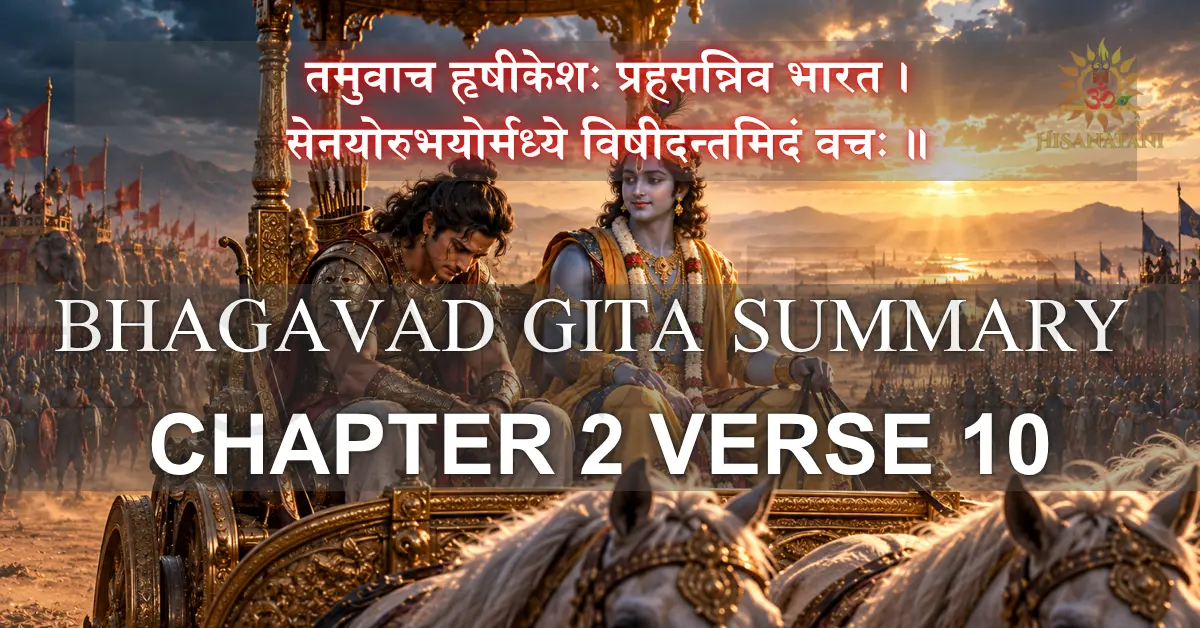
तमुवाच हृषीकेशः प्रहसन्निव भारत।
सेनयोरुभयोर्मध्ये विषीदन्तमिदं वचः॥ २.१० ॥
In English :
tam uvāca hṛṣīkeśaḥ prahasann iva bhārata |
senayor ubhayor madhye viṣīdantam idaṁ vacaḥ ||
Feel the Vibration: A Guided Chant of Bhagavad Gita Chapter 2 Verse 10:
- tam uvāca hṛṣīkeśaḥ prahasann iva bhārata |
tam u-vaa-cha hri-shee-ke-shah pra-ha-san-ni-va bhaa-ra-ta - senayor ubhayor madhye viṣīdantam idaṁ vacaḥ ||
se-na-yor u-bha-yor mad-hye vi-shee-dan-tam i-dam va-chah
English Translation:
“O Dhritarashtra, descendant of Bharata: in the middle of the two armies, Krishna, master of the senses, smiled slightly and spoke these words to the grieving Arjuna.”
JOIN THE HISANATANI COMMUNITY
Get daily Verse Summaries & High-Res Posters directly on your WhatsApp.
JOIN CHANNELYou’ve Been the Strong One for Too Long
Burnout rarely looks like a breakdown. It looks like “Sure, I’ll take that.” It looks like three unanswered messages you keep re-reading. It looks like saying “I’m good, just busy” for the fourth month running.
You might be 24 and unable to pick between two offers. You might be 41 and unable to tell your manager the deadlines don’t fit. Different age. Same freeze. Think about it: when did anyone last ask how you’re doing and get the real answer?
Krishna’s move here is quiet. He doesn’t wait for Arjuna to cheer up. He doesn’t ask him to pretend he’s fine. He starts talking right where Arjuna is standing.
So maybe you don’t need to be stronger today. Maybe you just need one place where you can stop acting strong.
Lost in the Crowd? A Calm Voice Beats a Map

Picture a small kid lost in a festival crowd. Everything’s loud. Hundreds of legs, no familiar face. Panic climbs fast.
Then a grown-up crouches down to eye level. No shouting. No “why did you wander off?” Just: “Okay. I’m here. Tell me what you can see.”
The crowd hasn’t thinned. The kid is still lost. But the breathing changes.
Why? Because steadiness is catchy. Nobody handed the kid a map. The calm was the map.
That’s Krishna in BG2.10. Same noise, same armies. He just crouches down, so to speak, and speaks at Arjuna’s level.
Now flip it. Next time your boss says “let’s talk” and your stomach drops, you’re both people in that scene. The lost kid and the one who can crouch down. Ask yourself two things:
What do I know for sure?
What am I guessing because I’m scared?
Tiny questions. They work anyway. They stop a manageable problem from growing into an imaginary disaster. Try it on the next “urgent” message. Most of the urgency lives in your head, not in the text.
For a young professional, that might mean rereading critical feedback before replying. For someone further into their career, it might mean saying, “This deadline doesn’t work,” out loud, to one person.
You Can Feel the Fear Without Letting It Run the Show
Your phone buzzes at 11 PM. The message says, “Can we talk tomorrow?” That’s it. Four words and a question mark.
By midnight your mind has written the whole scene. The meeting. The bad news. The long drive home. None of it has happened.
Notice the three layers. There’s the event (a message). There’s the story (I’m in trouble). And there’s the identity jump (I’m bad at this). Fear can run through all three in about ninety seconds.
Arjuna does the same on a much bigger stage. Family, duty, loyalty and loss crash into each other, and his mind announces: no way forward. His pain is real. The Gita never pretends it isn’t.
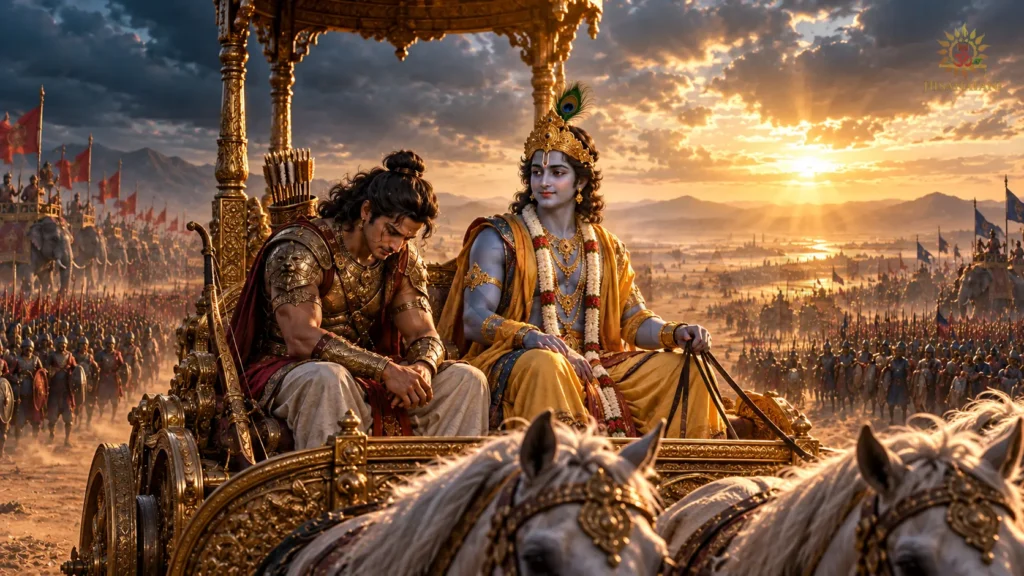
But look at the picture Bhagavad Gita 2.10 paints. One man is flooded. One man isn’t.
Both stand in the same noise, the same morning, the same armies. The difference isn’t the situation. It’s where each one is standing inside it.
Krishna’s long answer comes later, from 2.11 onward, and it goes deep into what lasts in us and what doesn’t. This BG2.10 verse only sets the table. It asks a smaller question first: can you feel the fear and still keep a seat for your own judgment?
You’re allowed to care a lot. You’re also allowed to think straight. The people you admire at work aren’t fearless. They just don’t let fear write their replies.
The message said “tomorrow.” Let it mean only that.
Break the 2 AM Spiral Before It Becomes Your Personality

Ever sat on a bridge call during a production outage? Twelve people talking at once. Alerts firing. Someone says “everything’s down” and the panic doubles. Then one engineer unmutes and says, slowly, “Okay. What do we actually know?”
The system hasn’t improved. The room has.
That’s the psychology hiding in Bhagavad Gita Chapter 2 Verse 10. Arjuna’s mind is stuck in a loop: imagine the worst, try to calculate everything, freeze, avoid the decision, feel worse. Krishna doesn’t join the loop. He doesn’t match Arjuna’s pitch. That makes a different conversation possible.
Calming down and solving the problem are two separate jobs. Do them in that order. Skip the first and you’re solving with a scrambled brain. Skip the second and you’re just sitting calmly beside an unsolved problem.
When your head is flooded, split it three ways:
The event: My manager added a new project to my plate.
The story: If I say no, they’ll think I can’t cope.
The choice: I can accept, negotiate the scope, ask for support, or decline with reasons.
At 2 AM the story feels like fact. It’s a guess. Pick one reversible next step. Book the conversation instead of quitting. Ask for the deadline in writing.
And if you’re the one everybody leans on, there’s a nastier version of this loop. You hide the overload, people assume you’re fine, you get handed more.
Start small. “I’ve got more on my plate than I can handle well. Can we look at priorities together?” That counts as asking.
One honest note. If the exhaustion lasts weeks, talk to a qualified professional. Bhagavad Gita 2.10 isn’t a treatment plan.
Stop Cleaning the House Before the Cleaner Arrives
We’ve all done it. The cleaner’s coming tomorrow, so you scrub the kitchen tonight. Which sort of defeats the point.
Plenty of us treat the Divine the same way. I’ll pray properly once the project ships. I’ll rest after the promotion. I’ll come back to myself when everyone stops needing things. First get composed, then show up.
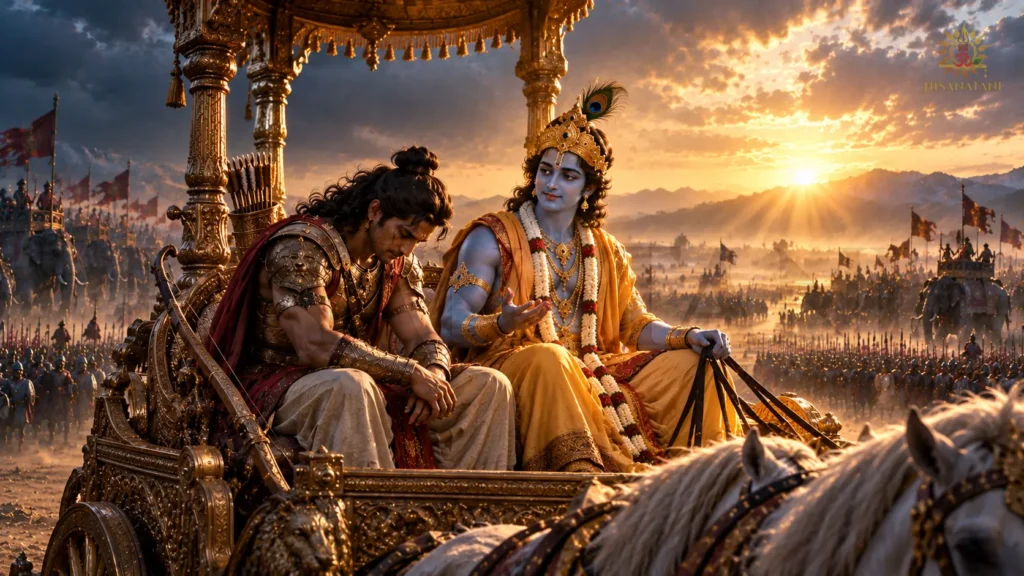
BG2.10 refuses that order. Krishna speaks while the armies are still lined up. Arjuna hasn’t pulled himself together. His bow is down. The conversation begins anyway.
Notice what Krishna doesn’t say. He doesn’t say, “Come back when you’ve calmed down.”
Devotees call this grace: help that doesn’t wait until you’ve earned it. You can arrive with your confusion intact.
Surrender gets misread here. It doesn’t mean going limp. It means dropping the demand that you control every variable before you’re allowed to breathe.
You still prepare. You still do the work. You just stop acting like the result is yours to guarantee.
Try this tonight. Sit for two minutes. Write one line on what’s yours to do tomorrow. Then name what isn’t yours to carry.
If prayer is part of your life, hand that second list to Krishna. If it isn’t, handing it to the night works too.
The Gita reaches the deeper teaching on the Atman, the enduring self, a few verses later. For now the lesson is smaller and kinder. You don’t need a spotless version of yourself to begin.
Kurukshetra Didn’t Wait for Arjuna’s Bad Day to End
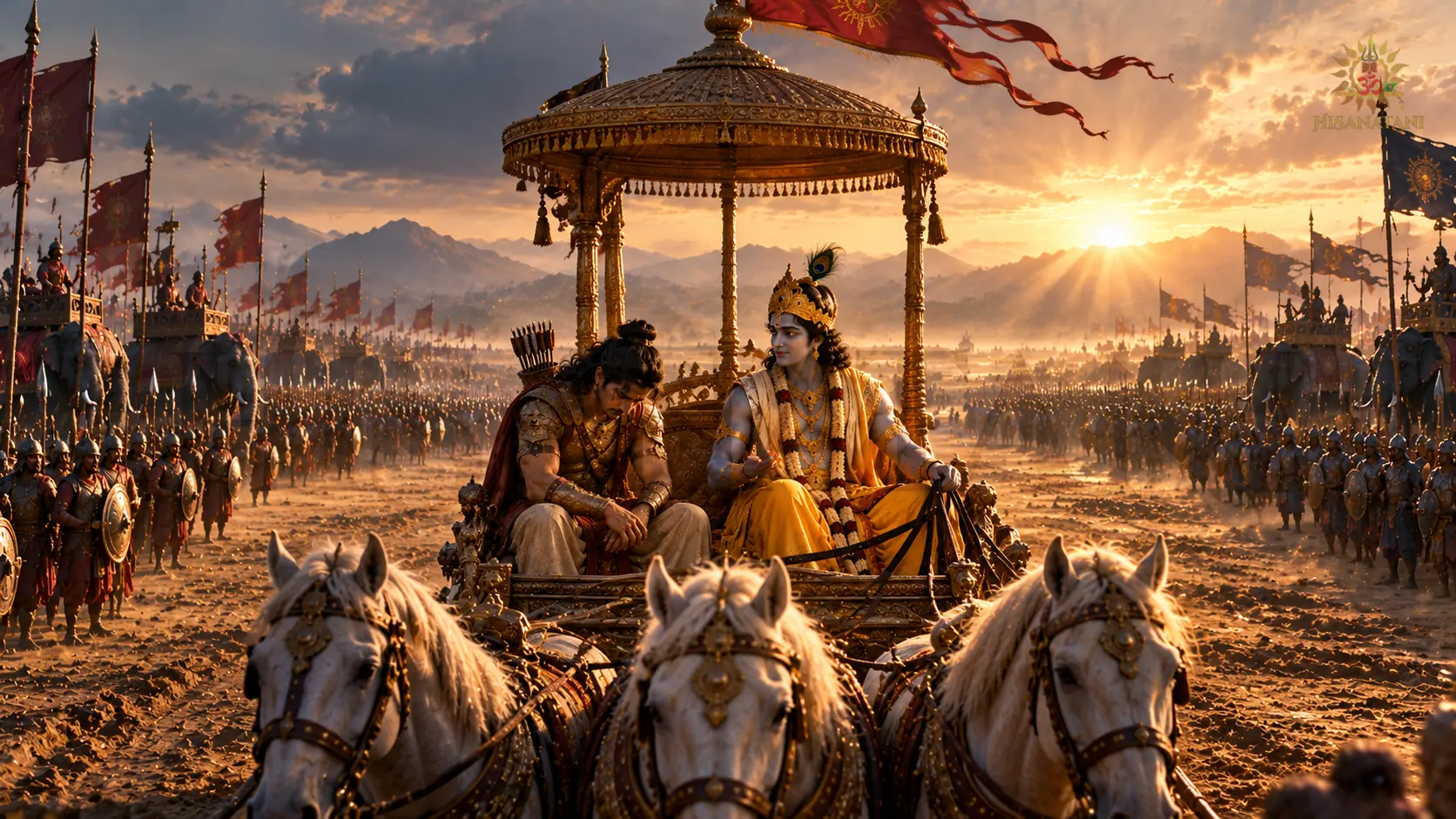
Zoom out to the full scene. The Gita sits inside the Mahabharata, at the edge of a war between the Pandavas and the Kauravas. Arjuna, a seasoned warrior, asked his charioteer Krishna to position the chariot between the two armies so he could see who he’d be fighting.
What he saw broke him. Teachers. Elders. Cousins. Family on both sides of the line.
By the end of Chapter 1 he has dropped his bow. In Chapter 2 it gets heavier. In 2.7 he admits he’s confused about duty and asks Krishna to teach him. In 2.8 he says even a kingdom couldn’t ease this grief. In 2.9 he says he won’t fight, and goes quiet.
And remember who’s in the chariot. This isn’t a stranger walking into the scene. Krishna is Arjuna’s friend and his driver, the one steering the horses while Arjuna falls apart.
Then comes BG2.10. Sanjaya, the narrator, is describing all this to Dhritarashtra, the blind king. That’s why the verse says “Bhārata.” The word points at him, not at Arjuna.
The armies haven’t moved. The war hasn’t been postponed. Krishna simply begins.
Why the smile? Traditional readers have taken it as composure, affection, or a clear view of Arjuna’s confusion. The verse says prahasann iva, “as if smiling.” It doesn’t hand us Krishna’s motive, so let’s not invent one.
What the scene does show is plain. The first thing a good teacher does is show up. The actual teaching starts in 2.11.
For a modern reader, that matters. Big decisions rarely wait for a quiet week. Sometimes the bravest move is asking for a guide when your own reasoning has hit its ceiling.
The 24-Hour Gita Challenge: Get From Frozen to Moving

You don’t need to fix your whole life by tomorrow. Trying that is just another way to freeze. Use 24 hours to practise one skill: meeting difficulty without handing it your judgment.
Action 1: Say the freeze in one sentence.
Next time a message or deadline spikes your pulse, put the phone down for ten minutes (unless it’s truly urgent). Breathe slowly. Then write one plain sentence about what actually happened.
“My manager wants the report revised by tomorrow” beats “My manager thinks I’m useless.” Facts first. Fear second. You’re not lying to yourself that it’s fine. You’re just refusing to add fiction.
Action 2: Make one small ask.
Pick one person and make one specific request. To a manager: “I want to do this well, but these two deadlines clash. Which one comes first?” To a partner: “I’m stretched thin. Can you take this week’s appointments?” To a friend: “I don’t need advice. Can you just listen for ten minutes?”
Small enough to say out loud. Big enough to count.
Action 3: Close the day with two columns.
Before bed, split a page in two. Left side: what was in my hands today. Right side: what wasn’t.
Spend a minute honouring the left column and write tomorrow’s next action. Then leave the right column alone for the night. Not solved. Just unattended.
Tomorrow evening, ask one question: did I take one useful step before the feeling went away? If yes, that’s progress. You’re not trying to become fearless. You’re trying to stop needing fearlessness as a permission slip.
And if the exhaustion is constant, or your mood stays low, see a qualified healthcare professional. Practice and professional support work well together.
You Can Be Overwhelmed Without Being Alone
The Summary of Bhagavad Gita 2.10 isn’t a big moment on paper. One line. A half-smile. A man who’s stopped speaking.
But it’s the doorway. The armies are still there. Arjuna’s grief is still there. The choice hasn’t gotten easier. Yet a conversation has started, and the teaching proper begins in the very next verse.
That’s the hope here. Not that the noise disappears. That you don’t have to face it alone, and you don’t have to be fixed before you’re met.
If you’re 25, that might mean admitting you’re lost at your first real job. If you’re 40, it might mean admitting you’re tired of being the dependable one. Either way, the verse meets you there.
So pause. Say what’s true. Ask one person. Take the next honest step, not the whole staircase.
And when your mind gets loud again, picture two figures between two armies. One shaking. One steady. Both standing in the same hard place.
You can learn to be the steady one. For yourself first.
Please let me know in the comments.
Embrace the Teachings of the Gita. Dive deeper into the Bhagavad Gita to uncover its timeless wisdom and practical guidance. Let its verses inspire you to cultivate inner clarity, align with higher values, and navigate life’s challenges with courage and grace.
🌼 Join the HiSanatani WhatsApp Channel for your daily dose of light 🪔. Join Now.
Voice of the Soul
Finding clarity in the questions we all carry…
What is the main message of Bhagavad Gita 2.10?
Krishna answers Arjuna’s silence with calm, speaking before any solution exists. Steadiness comes first; the teaching follows from 2.11. For the full picture, read “You Can Feel the Fear Without Letting It Run the Show.”
Why is Krishna smiling in Bhagavad Gita 2.10?
The Sanskrit says prahasann iva, “as if smiling.” Traditional readers see composure or affection, not mockery. The verse BG2.10 doesn’t state his motive. See the scene in “Kurukshetra Didn’t Wait for Arjuna’s Bad Day to End.”
Who is speaking in BG 2.10, and who is “Bhārata”?
Sanjaya is narrating to the blind king Dhritarashtra, so “Bhārata” addresses Dhritarashtra, not Arjuna. Krishna is the one who speaks, to Arjuna. Get the setting in “Kurukshetra Didn’t Wait for Arjuna’s Bad Day to End.”
How does Bhagavad Gita 2.10 help with decision paralysis?
It models steadiness before solutions. Separate the event from your story about it, then pick one reversible step. Try that with “Break the 2 AM Spiral Before It Becomes Your Personality.”
What does Bhagavad Gita 2.10 teach about asking for help?
It never says so directly. It shows Arjuna, silent and stuck, and Krishna meeting him there. That’s an invitation to seek guidance at your limit. Start with “The 24-Hour Gita Challenge: Get From Frozen to Moving.”
